The Hidden Cost of Convenience: Cloud Dependency in Smart Doorbells
When you purchase a smart video doorbell, you are not just buying a camera and a microphone; you are installing a sophisticated data collection node at the most vulnerable entry point of your home. The modern smart home ecosystem is heavily reliant on cloud infrastructure to deliver push notifications, AI-powered person detection, and remote video playback. However, this convenience introduces significant privacy vulnerabilities, ranging from mandatory data harvesting to potential exposure via cloud breaches.
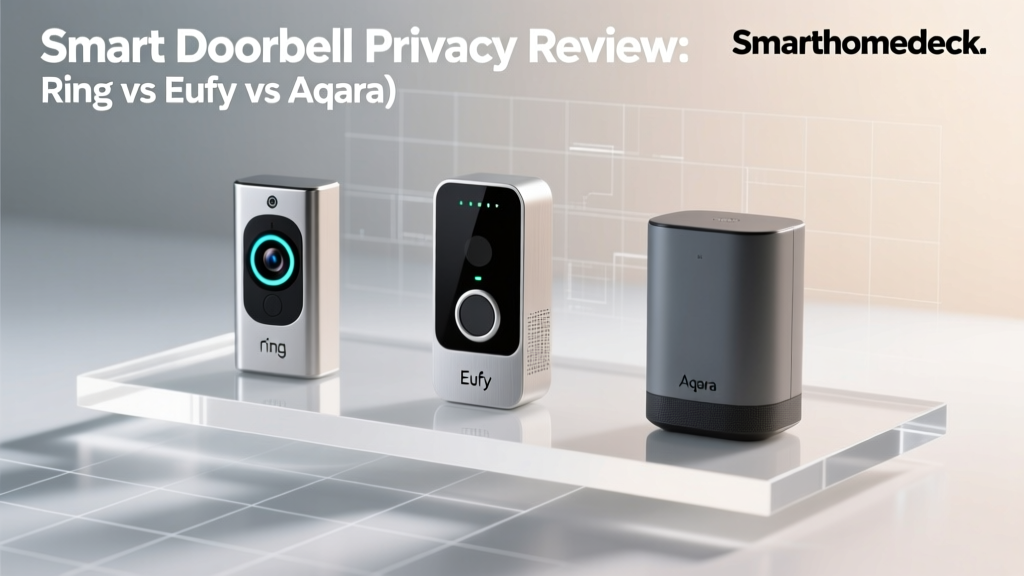
In this comprehensive SmartHomeDeck privacy evaluation, we are shifting our focus away from simple video resolution and battery life. Instead, we are conducting a deep-dive audit into the privacy policies, cloud dependency, network telemetry, and local storage capabilities of three flagship smart doorbells: the Ring Video Doorbell Pro 2, the Eufy Video Doorbell Dual (Wired), and the Aqara Video Doorbell G4. Our goal is to determine which device respects your digital boundaries and which treats your front porch as a data mine.
Ring Video Doorbell Pro 2: The Cloud-First Ecosystem
Ring, an Amazon-owned company, dominates the market share for smart doorbells, but its business model is intrinsically tied to cloud subscription revenue and data aggregation. The Ring Video Doorbell Pro 2 is an engineering marvel featuring 1536p HD video, 3D motion detection, and Bird's Eye View. Yet, from a privacy perspective, it represents the ultimate cloud-tethered device.
Data Harvesting and the Neighbors App
Ring's ecosystem is designed to keep you engaged within its proprietary app. The "Neighbors" feature aggregates user-generated crime and safety reports, creating a localized surveillance network. While Ring claims this is community-driven, privacy advocates have long pointed out that this fosters a culture of surveillance and biases. Furthermore, Ring's historical partnerships with law enforcement agencies—allowing police to request footage directly through a specialized portal—have drawn intense scrutiny. Although Ring recently updated its policies to require user consent before sharing footage with law enforcement (unless compelled by a subpoena), the underlying infrastructure remains heavily geared toward data centralization.
As noted by Mozilla's Privacy Not Included project, Ring's privacy policy grants the company broad latitude to use your data for targeted advertising, product improvement, and third-party analytics. While Ring does offer an End-to-End Encryption (E2EE) toggle, enabling it severely cripples the device, disabling features like Bird's Eye View, Alexa integration, and the Neighbors app.
Cloud Dependency and Subscription Lock-In
The Ring Pro 2 does not support local video storage. Without a Ring Home subscription (starting at $4.99/month), the device is reduced to a simple real-time notification system; you cannot record, save, or review past events. This forced cloud dependency means every video packet captured by your doorbell is uploaded to Amazon Web Services (AWS) servers, increasing your network's upload bandwidth usage and expanding your digital attack surface.
Eufy Video Doorbell Dual: The Local Storage Illusion and Reality
Anker's Eufy brand built its reputation on a bold promise: "No Monthly Fees" and "Local Storage Only." The Eufy Video Doorbell Dual, paired with the HomeBase 2 or HomeBase 3, processes AI facial recognition and human detection locally on the hub's eMMC storage. On paper, this is the privacy enthusiast's dream. In practice, the reality is more nuanced.
The 2022 Cloud Controversy
In late 2022, security researchers discovered that despite Eufy's claims of strict local-only storage, the Eufy web portal was quietly uploading thumbnail images and facial recognition metadata to Eufy's cloud servers to enable remote web access. This revelation shattered the trust of many privacy-focused consumers. Eufy responded by issuing firmware updates, removing the web portal, and introducing a more transparent Privacy Dashboard that allows users to explicitly opt out of any cloud telemetry.
Current Privacy Standing
Today, if you strictly use the Eufy Security app on your local network and disable remote access features, the Eufy Dual operates as a genuinely local device. Video streams utilize peer-to-peer (P2P) WebRTC connections when you are on the same Wi-Fi network, meaning the video data never touches an external server. However, the moment you leave your home network and request a live view, the connection is relayed through Eufy's cloud servers, though the stream itself is encrypted. Eufy does not have a law enforcement portal, making it significantly more resistant to casual subpoena dragnets than Ring.
Aqara Video Doorbell G4: The HomeKit Secure Video Sanctuary
The Aqara Video Doorbell G4 is a unique contender. While it possesses its own proprietary app and cloud infrastructure, its true value proposition lies in its native support for Apple's HomeKit Secure Video (HKSV). For users entrenched in the Apple ecosystem, the G4 offers a masterclass in modern IoT privacy architecture.
How HomeKit Secure Video Works
When you connect the Aqara G4 to HomeKit Secure Video, the doorbell ceases to communicate directly with Aqara's cloud for video processing. Instead, the video stream is routed to a local Apple Home Hub (an Apple TV 4K or HomePod). The Home Hub acts as a secure bridge, analyzing the video locally for person, pet, or package detection using its onboard neural engine. The footage is then encrypted using AES-256-GCM end-to-end encryption before being uploaded to your private iCloud storage. According to Apple's official HomeKit Secure Video documentation, not even Apple can decrypt or view your video footage; the encryption keys are stored exclusively on your trusted Apple devices.
The Cost of Privacy
This level of privacy requires a paid iCloud+ subscription (starting at $0.99/month for 50GB, which supports one HKSV camera). While this is a cloud dependency, it is a dependency on an ecosystem built around user privacy and zero-knowledge architecture rather than advertising-driven data mining. The Aqara G4 also supports local RTSP streams, allowing advanced users to pull the video feed into local Network Video Recorders (NVR) like Synology Surveillance Station or Frigate, completely bypassing the cloud if desired.
Feature & Privacy Comparison Matrix
| Privacy Feature | Ring Video Doorbell Pro 2 | Eufy Video Doorbell Dual | Aqara Video Doorbell G4 |
|---|---|---|---|
| Local Storage Support | No (Ring Edge requires hub & sub) | Yes (HomeBase eMMC) | Yes (via HKSV or Local RTSP) |
| End-to-End Encryption | Optional (Disables key features) | Yes (Local P2P only) | Yes (Native via Apple HKSV) |
| Law Enforcement Portal | Yes (Neighbors Portal) | No | No |
| Mandatory Cloud Sub | Yes (Ring Home required for recording) | No | Yes (iCloud+ required for HKSV) |
| Network Telemetry | High (AWS, Amazon Ads, Analytics) | Moderate (Push notification servers) | Low (Apple Home Hub routing) |
Cost vs. Privacy: The 5-Year Outlook
To understand the true value of these devices, we must calculate the 5-year total cost of ownership (hardware + mandatory subscriptions) and weigh it against our SmartHomeDeck Privacy & Local Control Score (out of 100). Ring's mandatory subscription inflates its long-term cost while yielding the lowest privacy score. Eufy offers the best financial value but requires careful configuration to maintain privacy. Aqara strikes a balance, leveraging Apple's paid but highly secure iCloud+ infrastructure.
5-Year Cost vs Privacy Score
Actionable Network Security: Securing Your Smart Vestibule
Regardless of which doorbell you choose, relying solely on the manufacturer's privacy policy is insufficient. The National Institute of Standards and Technology (NIST) emphasizes the need for network segmentation and strict access controls for IoT devices. Here is how you can harden your smart doorbell deployment:
- Implement VLAN Segmentation: Never place your smart doorbell on the same local network as your personal computers or NAS drives. Create a dedicated IoT VLAN using a router like the UniFi Dream Machine or pfSense. Restrict this VLAN from accessing your main LAN, allowing only outbound internet access and specific inbound ports for local casting.
- DNS Sinkholing (Pi-hole / AdGuard Home): For devices like Ring, you can use a network-wide DNS sinkhole to block known telemetry and tracking domains. However, be warned: blocking Ring's core AWS domains will break the device's functionality. With Eufy, you can block external cloud domains and force the device into local-only mode, though you will sacrifice remote push notifications.
- Disable UPnP and Port Forwarding: Smart doorbells should never be exposed directly to the public internet via port forwarding. Rely on the manufacturer's secure outbound relay connections or use a secure tunnel like Tailscale or Cloudflare Tunnels if you need remote access to a local NVR.
- Enforce Hardware-Level Privacy Masks: If your doorbell faces a neighbor's window or the public sidewalk, use the app's privacy zone features to digitally black out those areas. This ensures that even if the cloud is compromised, the sensitive data was never captured in the video buffer.
Final Deck Scores & Verdict
Ring Video Doorbell Pro 2
Privacy Score: 3.5/10
The Ring Pro 2 offers unparalleled hardware features and seamless Alexa integration, but its mandatory cloud reliance, aggressive telemetry, and historical law enforcement ties make it a poor choice for privacy-conscious users. You are paying a premium to feed Amazon's data ecosystem.
Eufy Video Doorbell Dual
Privacy Score: 7.5/10
Eufy remains the champion of local storage and zero-subscription costs. While the 2022 cloud controversy dented its reputation, the hardware's ability to operate entirely offline on a local network is unmatched. It requires a technically literate user to properly lock down the network, but the privacy payoff is substantial.
Aqara Video Doorbell G4
Privacy Score: 9.2/10
For Apple users, the Aqara G4 is the undisputed winner. By leveraging HomeKit Secure Video, it shifts the burden of privacy to Apple's zero-knowledge encryption architecture. It offers the best balance of modern AI features, remote accessibility, and ironclad data protection, provided you are willing to pay for iCloud+.
SmartHomeDeck Recommendation: If your priority is absolute data sovereignty and you have the networking knowledge to manage a local NVR, choose the Eufy Dual or utilize the Aqara G4's local RTSP stream. If you want a "set it and forget it" experience that doesn't compromise your privacy for corporate data mining, the Aqara G4 via HomeKit Secure Video is the gold standard for the modern smart home.