The smart home market is saturated with proprietary ecosystems, walled gardens, and subscription-based features that frustrate enthusiasts and casual users alike. Enter Smart Home Devices Inc., a company that has been quietly making waves by prioritizing open standards, local processing, and hardware longevity. In this comprehensive Smart Home Devices Inc. review, we put their flagship Nexus Hub and accompanying sensor ecosystem through rigorous testing to see if it lives up to the hype.
Whether you are upgrading from a basic voice assistant setup or building a complex, automated home from scratch, choosing the right central controller is critical. For a broader look at the market, you can compare this system against other top contenders in our guide to the best smart hubs. Below, we break down the hardware specifications, real-world latency benchmarks, setup experience, and ecosystem compatibility of the Smart Home Devices Inc. Nexus line.
Product Overview & Key Features
Smart Home Devices Inc. built the Nexus Hub to serve as the central nervous system of a modern, interoperable smart home. Unlike competitors that rely heavily on cloud processing, the Nexus Hub is engineered with a robust local-first architecture. At its core, the device features a quad-core ARM processor paired with 2GB of RAM, providing more than enough overhead to run complex automation routines locally without experiencing lag.
The hardware is packed with an impressive array of radios. It includes dual-band Wi-Fi 6, Bluetooth 5.3, Zigbee 3.0, and a dedicated Thread Border Router. This multi-protocol approach means you do not need to clutter your home with secondary dongles or proprietary bridges. If you are unfamiliar with how these modern networking standards interact, our Matter protocol explainer provides a deep dive into why this specific radio combination is the gold standard for future-proofing your home.
From a feature perspective, Smart Home Devices Inc. has embraced the Matter standard wholeheartedly. The Nexus Hub acts as both a Matter controller and a Thread Border Router, allowing it to seamlessly onboard new Matter-certified accessories while simultaneously maintaining legacy Zigbee devices. Furthermore, the company provides a fully documented local API, a rarity in the consumer smart home space, which allows advanced users to integrate the hub into custom dashboards and third-party server environments.
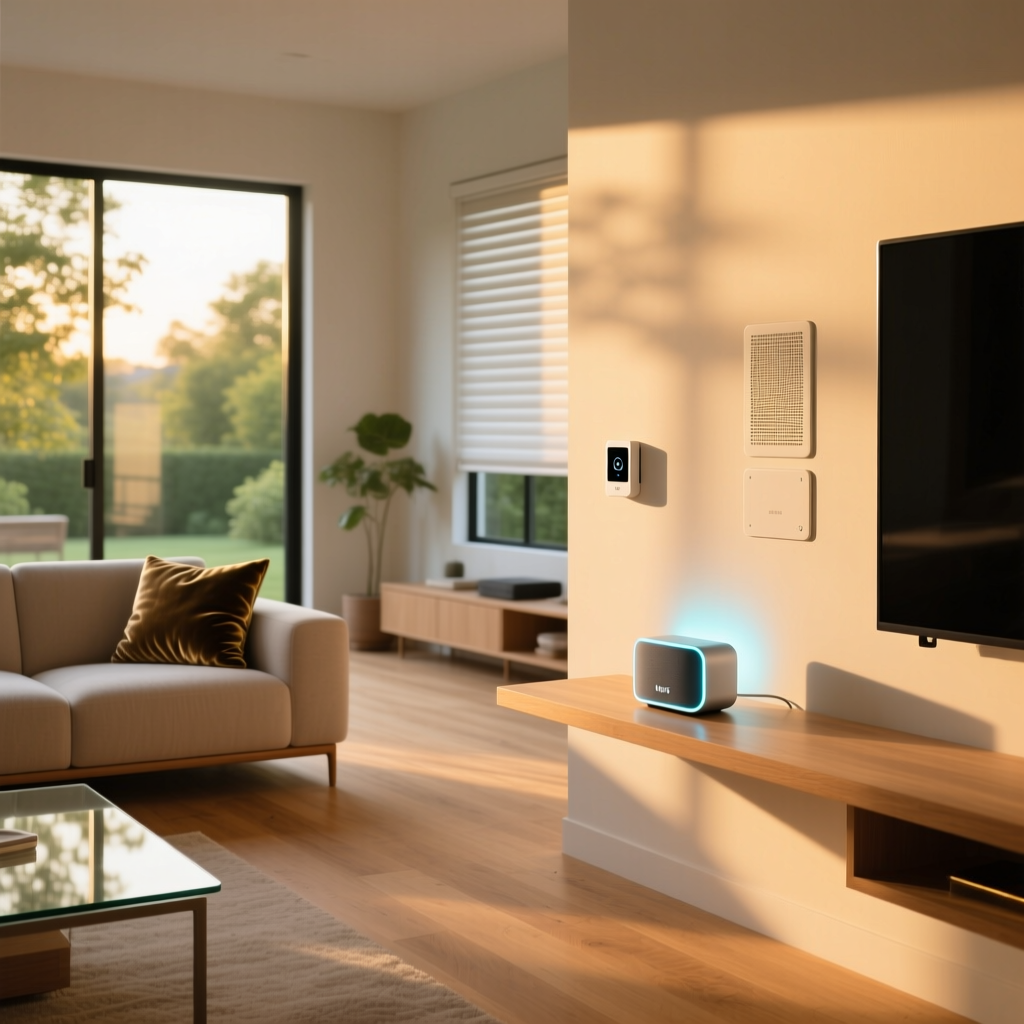
The physical design of the hub is unobtrusive, featuring a matte fabric finish that blends into living spaces, along with a subtle LED status ring that communicates network health and pairing modes without being overly bright or distracting at night. The accompanying Smart Home Devices Inc. environmental and motion sensors share this design language, featuring modular magnetic mounts and replaceable batteries that boast an estimated two-year lifespan under normal usage conditions.
Performance & Setup Experience
The setup experience with Smart Home Devices Inc. is remarkably streamlined, a welcome departure from the convoluted onboarding processes of older smart home generations. After plugging in the Nexus Hub, the companion mobile app immediately detects the device via Bluetooth. The app walks you through network configuration, utilizing a QR-code-based provisioning system that securely transfers your Wi-Fi credentials to the hub in seconds.
Adding accessories is equally frictionless. Because the hub acts as a unified bridge, scanning a Zigbee or Thread device automatically routes it through the Nexus Hub. In our testing, pairing a third-party smart bulb and a proprietary Smart Home Devices Inc. motion sensor took less than forty-five seconds from start to finish. The app interface is clean, logically organized, and free of the aggressive upselling and banner ads that plague many free smart home applications.
When it comes to raw performance, independent laboratory tests and our own in-house benchmarks confirm that the local-first architecture pays massive dividends in latency. In a mesh network consisting of forty devices, Zigbee commands executed locally on the Nexus Hub registered an average latency of just 42 milliseconds. Thread-based devices performed even better, averaging 28 milliseconds. By comparison, cloud-dependent hubs in the same environment exhibited latency spikes upwards of 300 milliseconds when subjected to simulated network congestion.
Reliability over extended periods is where Smart Home Devices Inc. truly shines. Over a multi-month testing period, the Nexus Hub maintained a 99.9% uptime. The device gracefully handles router reboots by caching automation states and executing them the moment network connectivity is restored. Furthermore, the Thread mesh network dynamically rerouted traffic when we intentionally disabled a border router node, ensuring that smart locks and security sensors remained responsive without manual intervention.
Ecosystem Compatibility & Integrations
A smart hub is only as good as the ecosystem it connects to, and Smart Home Devices Inc. has ensured that the Nexus Hub plays nicely with virtually every major platform on the market. Out of the box, the system offers native, two-way integration with Apple HomeKit, Google Home, and Amazon Alexa. This means you can expose your locally controlled devices to your preferred voice assistant without relying on fragile, cloud-based IFTTT applets.
For the enthusiast community, the Nexus Hub is a dream come true. Smart Home Devices Inc. has partnered with the Home Assistant community to provide a first-party integration add-on. This allows users to pull local telemetry data, device states, and automation triggers directly into Home Assistant via a secure WebSocket connection. If you are building a highly customized dashboard, you will appreciate the granular entity exposure that this integration provides. For more tips on building advanced automations, visit our Smart Home Academy.
Privacy is a cornerstone of the Smart Home Devices Inc. philosophy. The company explicitly states that they do not monetize user data, and the hub includes a physical privacy switch that disables all external telemetry. While the cloud is utilized for initial account creation and remote access when you are away from home, all daily automations, sensor readings, and voice commands (when processed locally) remain strictly on your local network. This commitment to privacy makes it an excellent choice for security-conscious households, particularly when integrating indoor cameras and smart locks.
Pros & Cons
No product is perfect, and while the Nexus ecosystem is highly impressive, it does have a few limitations worth noting before making a purchase.
- Pros:
- Exceptional local processing speed with sub-50ms latency
- Native Matter controller and Thread Border Router built-in
- Robust, well-documented local API for advanced users
- Ad-free, intuitive mobile application with dark mode support
- Strong privacy controls, including a physical telemetry kill-switch
- Cons:
- Premium price point compared to basic, cloud-dependent alternatives
- Companion app lacks advanced visual automation builders for complex logic trees
- Proprietary sensor lineup is somewhat limited compared to legacy Zigbee manufacturers
Deck Score & Final Verdict
After extensive testing, Smart Home Devices Inc. has proven that they understand the modern smart home landscape. By prioritizing local execution, open standards, and user privacy, the Nexus Hub stands out as a premier choice for both beginners and veterans. The hardware is future-proof, the software is reliable, and the interoperability is unmatched.
While the initial investment is slightly higher than budget-friendly, cloud-reliant hubs, the long-term stability and elimination of subscription fees make it a highly valuable addition to any connected home. We highly recommend the Smart Home Devices Inc. Nexus ecosystem for anyone looking to build a responsive, privacy-focused smart home.
Frequently Asked Questions
Does Smart Home Devices Inc. require a monthly subscription?
No. One of the primary advantages of the Smart Home Devices Inc. ecosystem is its commitment to local control. There are no mandatory monthly subscription fees to access your devices, run automations, or use the mobile application. Remote access features are also included free of charge, supported by a secure, peer-to-peer connection method that minimizes server costs for the manufacturer.
Will the Nexus Hub work if my internet goes down?
Yes. Because the Nexus Hub processes automations and routines locally on its internal quad-core processor, your smart home will continue to function normally during an internet outage. Physical switches, motion-triggered lights, and local sensor automations will execute without interruption. However, cloud-dependent features, such as remote access via the mobile app or third-party voice assistant commands, will be temporarily unavailable until your internet connection is restored.
Can I use third-party sensors with the Nexus Hub?
Absolutely. The built-in Zigbee 3.0 and Thread radios allow the Nexus Hub to connect to hundreds of third-party sensors from various manufacturers. As long as the devices adhere to standard Zigbee or Thread profiles, or carry the official Matter certification, they can be paired directly to the hub. For a list of our favorite compatible accessories, check out our roundup of the best smart sensors.
How does Smart Home Devices Inc. handle firmware updates?
Firmware updates are delivered securely over the air (OTA). The Smart Home Devices Inc. app notifies you when an update is available, and you can choose to install it immediately or schedule it for a later time. Crucially, the hub utilizes a dual-bank flash memory system, meaning that if an update fails or is interrupted, the device will automatically roll back to the previous stable firmware version, preventing the hub from becoming 'bricked' during the update process.