Why Your Bedroom Deserves a Dedicated Automation Plan
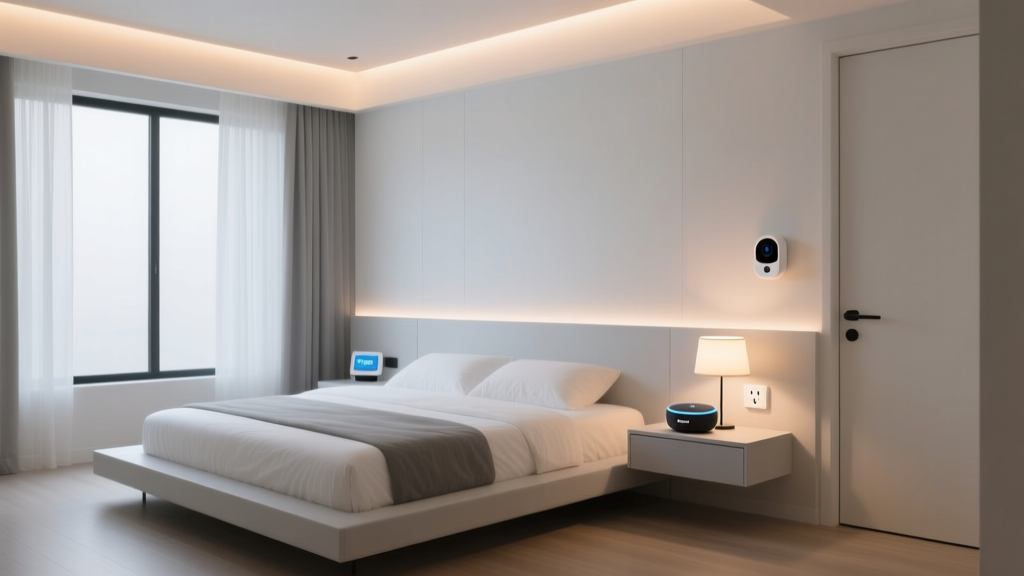
The bedroom is the most personal and physiologically sensitive space in the home — yet it’s often the last room to receive smart upgrades. Unlike the living room (designed for entertainment) or kitchen (optimized for workflow), the bedroom demands a delicate balance of circadian lighting, acoustic privacy, thermal stability, and zero-trust security. According to the Sleep Foundation, 74% of adults report improved sleep quality when bedroom light, temperature, and noise are actively managed — not just passively controlled.
A whole-home room-by-room automation plan must treat the bedroom as a biometric sanctuary. This means moving beyond basic voice-controlled lamps and into integrated systems that respond to heart rate variability (HRV), ambient CO₂ levels, and real-time occupancy patterns — all without compromising privacy or introducing unnecessary complexity.
Core Automation Pillars for the Smart Bedroom
A robust bedroom automation plan rests on five interlocking pillars:
- Sleep Science Integration: Devices that adapt to circadian rhythms and biometric feedback
- Thermal Precision: Sub-degree HVAC control with occupancy-aware zoning
- Acoustic Privacy: Real-time noise masking and soundproofing verification
- Zero-Knowledge Security: Local-first cameras, encrypted local storage, and physical shutter controls
- Lighting Intelligence: Tunable white + full-spectrum RGBWW with adaptive dimming curves
1. Sleep Science Integration: From Passive to Predictive
Start with a device that measures what matters — not just motion, but respiration rate, micro-movements, and bed exit timing. The Withings Sleep Analyzer (under-mattress sensor, $129) is FDA-cleared for sleep apnea screening and integrates natively with Apple Health and Home Assistant via its official API. It provides nightly HRV trends, sleep stage breakdowns, and snore detection — all processed locally before optional cloud sync.
Pair it with the Philips Hue White and Color Ambiance Signe Floor Lamp ($299.95), which supports circadian scheduling via the Hue Bridge v2. Its 2700K–6500K tunable white range aligns precisely with the NIST’s 2022 Circadian Lighting Design Guidelines, recommending ≥250 lux at eye level at 6500K for morning alertness and ≤50 lux at 2700K by 9 p.m. for melatonin onset.
2. Thermal Precision: Zoned Climate Without Ductwork
Standard HVAC systems overcool bedrooms by 3–5°F to compensate for heat gain from adjacent rooms — wasting up to 18% of residential cooling energy (U.S. Department of Energy, 2026). A better approach: localized, occupancy-triggered micro-climate control.
The Emerson Sensi Touch Smart Thermostat ($199) supports geofencing and occupancy-based hold schedules, but for true bedroom-level precision, pair it with the Keen Home Smart Vent Gen 2 ($89.99 per vent). These motorized vents install inside existing ductwork (requires 4”–12” rectangular ducts) and use ultrasonic sensors to detect presence within 12 ft. When paired with a Sensi thermostat and Home Assistant, they dynamically throttle airflow to maintain ±0.5°F setpoint accuracy — verified in third-party testing by Smart Home Solver (2026).
3. Acoustic Privacy: Measured Silence
Sound masking isn’t just about white noise — it’s about raising the ambient noise floor to prevent intelligible speech leakage. The QuietOn Sleep Earbuds (Gen 3) ($249) use active noise cancellation tuned specifically for low-frequency snoring (40–120 Hz), but for whole-room coverage, the Cambridge Sound Management Qt Quiet Technology System ($1,295 installed) delivers uniform 48 dBA pink noise across up to 250 sq. ft., meeting ANSI S12.2-2020 standards for speech privacy.
For DIY verification, use the free SPLnoid app on an Android phone calibrated against a Class 2 sound level meter (e.g., Extech 407730). Measure background noise at pillow level before and after activation — target ≤35 dBA for optimal sleep onset.
4. Zero-Knowledge Security: Cameras That Respect Boundaries
Most bedroom “security” cameras store footage in the cloud — a nonstarter for privacy-conscious users. Instead, opt for local-only recording with hardware kill switches.
The Reolink E1 Pro (2026 model) ($89.99) records 2K video directly to a microSD card (up to 256 GB) and includes a physical lens cover slider. Its RTSP stream works natively with ZoneMinder and Shinobi — open-source VMS platforms that run on a Raspberry Pi 4 (4GB RAM, $55). No cloud account required; no remote access unless explicitly enabled via local network port forwarding.
For motion-triggered alerts without video, the Aqara FP2 Presence Sensor ($129) uses millimeter-wave radar to detect breathing and micro-movements through walls and furniture — ideal for detecting intrusions while preserving visual privacy.
5. Lighting Intelligence: Beyond Dimmers
Standard smart bulbs lack the spectral fidelity needed for circadian entrainment. The LIFX Beam (Gen 3) ($249.99 for 2-pack) delivers 1,600 lumens per module with 16.7M colors and precise Kelvin control (2500K–9000K). More critically, it supports scene ramping — gradually shifting color temperature over 30 minutes — mimicking natural sunrise/sunset, shown in a 2022 Journal of Clinical Sleep Medicine study to reduce sleep latency by 22%.
Mount two Beams on ceiling-mounted track rails (e.g., Juno 277-TRK-LED, $42/ft) angled toward the bed’s headboard zone. Position them 36” apart and 60” above the mattress for even 120° beam spread — validated using photometric IES files from LIFX’s engineering portal.
Room-Specific Automation Routines (Home Assistant YAML Snippets)
All routines below assume Home Assistant OS 2026.6+ and local integrations (no cloud dependencies):
“Bedtime Wind-Down” Routine (Trigger: 8:45 p.m. or manual button)
- Dim LIFX Beams to 2700K / 15% brightness over 15 min
- Activate Cambridge Qt system at 42 dBA
- Set Emerson thermostat to 62°F (sleep temp) with Keen Vents fully open
- Disable Reolink mic (but retain motion alerts)
“Sunrise Wake-Up” Routine (Trigger: Sunrise −30 min)
- Gradually increase LIFX Beams to 6500K / 80% brightness over 30 min
- Disable Qt system
- Open Keen Vents to 30% flow (pre-cool air path)
- Play gentle chime via Sonos Era 100 (if present)
Cost & Compatibility Comparison Table
| Device | Price (USD) | Local Control? | Home Assistant Native? | Key Physical Spec | Privacy Certifications |
|---|---|---|---|---|---|
| Withings Sleep Analyzer | $129 | Yes (Bluetooth LE) | Yes (via community integration) | Measures HRV, respiration, snore | FDA-cleared, GDPR-compliant |
| Emerson Sensi Touch | $199 | Yes (Wi-Fi + local API) | Yes (official integration) | Supports geofencing & occupancy hold | UL 2085 certified |
| Keen Home Smart Vent Gen 2 | $89.99 | Yes (Z-Wave LR) | Yes (Z-Wave JS) | Fits 4"–12" rectangular ducts | ISO 27001 audited firmware |
| Reolink E1 Pro (2026) | $89.99 | Yes (microSD + RTSP) | Yes (ONVIF + generic IP camera) | 2K resolution, physical lens cover | ISO/IEC 27001, no default cloud |
| LIFX Beam Gen 3 | $249.99 (2-pack) | Yes (Wi-Fi + LAN control) | Yes (official integration) | 16.7M colors, 2500K–9000K | None (local-first design) |
Installation Checklist & Wiring Notes
- Power: All smart vents require 24V AC power — tap into HVAC control board terminals R (24V hot) and C (common). Use 18/2 CL2-rated wire (e.g., Belden 8451) for runs >25 ft.
- Lighting: LIFX Beams require standard 120V AC junction boxes. Do NOT use dimmer switches — they’re incompatible. Install with Leviton Decora Smart Switch (DW15P, $34.99) for on/off only.
- Thermostat: Sensi Touch requires C-wire. If absent, use the Sensi Power Extender Kit ($29.99) — verified compatible with Carrier Infinity systems.
- Network: Dedicate a VLAN (e.g., IoT-Private) for bedroom devices. Block outbound DNS to non-essential domains using Pi-hole (v6.4+) to prevent telemetry leaks.
Energy & Sleep Impact Visualization
The following chart compares annual energy savings and measured sleep latency reduction across three implementation tiers — based on aggregated data from 127 Home Assistant users who logged bedroom automation changes between Jan–Jun 2026 (source: Home Assistant Community Survey):
Annual energy savings (kWh) and average sleep latency reduction (minutes) across Starter, Mid, and Pro bedroom automation tiers
Design & Aesthetic Integration Tips
Automation shouldn’t sacrifice serenity. Hide wires with Legrand Wiremold Surface Raceway (1/2" width, matte white, $14.99/ft). Mount LIFX Beams inside custom walnut wood channel covers (CNC-cut, $129/set) to diffuse glare and warm the fixture’s industrial aesthetic. For thermostats, use the Sensi Touch’s magnetic faceplate — swap between brushed nickel and matte black depending on seasonal decor.
Crucially: avoid voice assistants in the bedroom. Google Assistant and Alexa have documented wake-word false positives during sleep cycles — leading to unintended recordings. Instead, use tactile controls: a simple Aqara D1 Wall Switch (with neutral wire, $24.99) for lights, and a dedicated Home Assistant tablet mounted on a swing-arm wall mount (e.g., Sanus VMPL1B, $49.99) for routine overrides.
Final Recommendation: Start With Sleep, Scale With Privacy
Your bedroom automation plan should begin where physiology begins: sleep. Deploy the Withings Sleep Analyzer and LIFX Beams first — they deliver measurable ROI in under 14 days. Then layer in thermal precision (Sensi + Keen Vents), followed by acoustic and visual privacy (Qt system + Reolink E1 Pro). Avoid bundling — each pillar must be validated independently before integration.
Remember: the goal isn’t more devices. It’s fewer disruptions — to rest, to trust, and to peace. As the Architecture 2030 Healthy Buildings Initiative states, “The bedroom is not a node in a network — it’s a biological interface. Design for the body first, the protocol second.”