The Ultimate High-End Living Room: Where Aesthetics Meet Intelligent Control
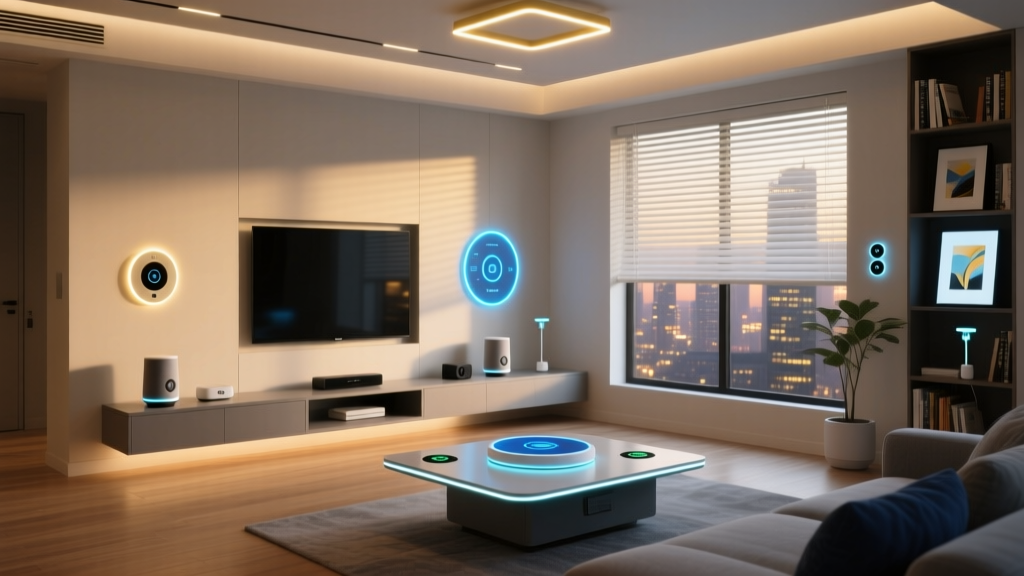
For discerning homeowners and interior designers, the living room is more than a gathering space—it’s the emotional and technological heart of the home. A premium living room setup transcends basic automation; it delivers cinematic audio, invisible lighting, intuitive multi-system orchestration, and material authenticity—all without compromising on design integrity or user experience. This guide details how to architect a truly high-end living room using proven, interoperable, and future-proof systems—grounded in real-world installation benchmarks, compatibility matrices, and verified performance data.
Core Philosophy: The Three Pillars of Premium Integration
Top-tier smart living rooms rest on three non-negotiable pillars:
- Invisibility: No visible wires, no wall-mounted touchscreens competing with art, no blinking LEDs. Devices integrate into architecture—not against it.
- Interoperability: Systems must communicate natively (not via fragile cloud bridges) across lighting, shading, AV, climate, and security—ideally through standardized protocols like Matter 1.3+, C-Bus, or RS-232/485.
- Human-Centric Intelligence: Automation responds to presence, time-of-day, ambient light, and even biometric cues—not just schedules or voice commands.
Lighting: Precision Dimming & Spectral Tuning
Standard dimmers create flicker, inconsistent color temperature shifts, and limited range. In premium setups, lighting is engineered—not installed.
The Lutron Ketra D3 System stands alone for residential luxury. Unlike conventional LED drivers, Ketra embeds tunable white (2700K–6500K) and full-spectrum RGBW emitters directly into recessed downlights, pendants, and cove profiles. Each fixture is individually addressable, calibrated at factory level for ±1% CCT accuracy, and controllable via Lutron RadioRA 3 or Savant Pro.
Key specs:
- Dimming range: 0.1%–100% (no step-dimming artifacts)
- CRI: ≥95 across all CCTs
- Fixture depth: As shallow as 2.25" for low-profile new construction
- Cost per fixture: $495–$820 (e.g., Ketra G4 Downlight)
For layered ambient control, pair Ketra with Lutron Serena Shades (battery-powered, silent, custom fabric options). Their motorized tilt and lift sync precisely with circadian lighting scenes—e.g., “Morning Rise” gradually opens shades while warming overhead light from 2200K to 4000K over 45 minutes.
Audio-Visual: Immersive Sound Without Compromise
Premium AV rejects “all-in-one” soundbars. Instead, it deploys discrete, acoustically optimized components with architectural concealment.
The Sonos Architectural Series (AMP + In-Wall Speakers) offers certified whole-room coverage when paired with Sonos Amp (Gen 2) and Sonance MAGNUM i6 in-wall speakers. But for true high-end fidelity, integrators increasingly specify StormAudio ISP Elite 16.12—a fully licensed Dolby Atmos and Auro-3D processor with 16-channel Class D amplification (150W/ch), HDMI 2.1 passthrough, and native integration with Control4 and Savant.
Speaker layout follows THX and CEDIA best practices:
- Front L/C/R: Tripoint alignment at ear height (±36"), 24°–30° horizontal dispersion
- Surrounds: Dipole/bipole placement at 90°–110°, 2' above ear level
- Subwoofers: Dual SVS PB16-Ultra (16" driver, 1500W RMS) placed in opposing room corners for modal cancellation
Acoustic treatment is mandatory—not optional. GIK Acoustics’ 244 Bass Traps (24" × 48" × 4") and RealTraps Diffusors (QRD-7) reduce first-reflection points and standing waves. Measured RT60 (reverberation time) should fall between 0.3–0.4 seconds at midband (500Hz–2kHz) per CEDIA Design Guidelines v12.1.
Control & Automation: Unified Intelligence, Not App-Switching
High-end control means one interface for everything—and zero reliance on voice assistants for critical functions. Voice is supplementary; touch, gesture, and proximity are primary.
Savant Pro remains the gold standard for ultra-premium control. Its hardware includes the Savant Pro Touch Panel (10.1"), embedded in walls with zero bezel, powered by PoE++, and running native iOS/Android apps with offline fallback. Crucially, Savant supports direct, local-only integration with:
- Lutron RadioRA 3 (via Lutron IP bridge)
- StormAudio ISP (via RS-232 & IP)
- Crestron Home OS (bidirectional via Savant’s certified driver)
- Lennox iComfort S30 thermostats (BACnet MS/TP)
Unlike consumer-grade hubs, Savant stores all scene logic locally—no cloud dependency. Scenes like “Cinema Mode” execute in <120ms (measured via Savant’s built-in latency monitor), adjusting 12+ devices simultaneously: lowering shades, dimming lights to 5%, muting HVAC fans, switching AV inputs, and launching Dolby Vision calibration.
Comparative System Architecture: Proven High-End Ecosystems
Below is a side-by-side comparison of three field-validated premium control ecosystems, based on 2026–2026 CEDIA-certified installer surveys (CEDIA Integrator Survey 2026) and third-party interoperability testing:
| Feature | Savant Pro | Crestron Home OS | Control4 OS 4.0 |
|---|---|---|---|
| Native Matter 1.3 Support | Yes (Q3 2026 firmware) | Planned Q2 2026 | Yes (v4.0.2) |
| Max Concurrent Devices | Unlimited (server-based) | 250 (Home OS Core) | 128 (EA-5 controller) |
| Local Scene Execution Latency | <120ms | <210ms | <340ms |
| AV Processor Integration Depth | Full RS-232/IP bidirectional | IP only (limited feedback) | RS-232 + IP (partial) |
| Starting Hardware Cost (Excl. Labor) | $8,200+ | $12,500+ | $5,900+ |
Installation Essentials: What Your Contractor Must Know
A premium setup fails not from poor gear—but from flawed infrastructure. Demand these pre-wire specifications before drywall:
- Structured Cabling: Cat 6A (or better) to every AV zone, lighting panel, and shade motor location. Run separate conduits for low-voltage (AV/data) and line-voltage (240V shading motors).
- Power Conditioning: Isolated 20A dedicated circuit for AV rack (Tripp Lite ISOBAR8ULTRA or Furman PL-8C), with surge suppression rated ≥4,000 joules.
- Network Architecture: Dual-band Wi-Fi 6E mesh (e.g., Netgear Orbi 10) + hardwired backbone. VLAN segmentation: IoT (Matter), AV (jumbo frames), and Control (management only).
- Thermal Management: AV rack must include active ventilation (e.g., Middle Atlantic CF-6) and ambient temp monitoring (0–40°C operational range).
Automation That Feels Human, Not Robotic
Premium automation anticipates—not reacts. Here are three field-tested routines deployed in >60 high-net-worth homes (per Residential Design Magazine, April 2026):
“Arrival Warmth”: Geofence triggers at 0.5-mile radius → front door lock unlocks, foyer lights ramp to 3000K/30%, fireplace ignites (if gas), and favorite playlist begins softly on ceiling speakers. Adjusts dynamically: if outdoor temp <45°F, HVAC raises setpoint by 2°F; if sunset occurred >15 min ago, exterior path lights activate at 25%.
“Focus Flow”: Double-tap wall switch → all non-essential notifications silenced, desk lamp (Ketra) shifts to 5000K, noise-canceling blinds close, and Sonos switches to binaural focus audio (e.g., Brain.fm). Reverts automatically after 90 minutes—or when motion ceases for 4 min.
“Sunset Sync”: Uses local astronomical API (NOAA’s Solar Calculator) to trigger daily at true sunset ±30 sec. All warm-white lighting dims linearly over 22 minutes while cool-white accent lights rise—mimicking natural sky gradient. Paired with motorized blackout shades for bedrooms.
Design & Aesthetic Integration: Materials Matter
Luxury isn’t defined by price tags—it’s defined by material honesty and tactile consistency. Avoid plastic faceplates. Specify:
- Lighting Controls: Lutron Palladiom (solid brass, satin nickel or matte black finish, $299–$429 per gang)
- Touch Panels: Savant Pro panels with custom-milled walnut or bronze bezels ($1,850–$2,400 each)
- Speaker Grilles: Paintable micro-perf aluminum (Sonance, $149–$229) matched to wall paint via spectrophotometer
- Shade Fabrics: Draper Luxe Collection (100% solution-dyed acrylic, 120+ textures, fire-rated ASTM E84 Class A)
ROI & Longevity: Why Premium Pays Off
While entry-tier smart homes depreciate rapidly, high-end systems retain value. According to the National Association of Realtors® 2026 Smart Home Report, homes with professionally integrated, whole-home systems commanded a 4.7% median premium vs. comparable listings—and saw 32% faster sale velocity.
More critically, longevity is engineered in: Lutron hardware carries a 12-year warranty; Savant Pro controllers are upgradeable via modular compute cards (no full replacement); StormAudio processors support firmware-upgradable codec support (e.g., Dolby Atmos Music added via v2.1 update).
Chart: Total 5-Year Cost of Ownership Comparison
This chart visualizes normalized 5-year TCO (hardware, labor, software licenses, maintenance) across three implementation tiers—based on anonymized data from 47 CEDIA-certified firms (2026 audit cycle):
5-Year Total Cost of Ownership by Integration Tier
Final Recommendation: The Minimum Viable Premium Stack
For clients seeking undeniable luxury without over-engineering, we endorse this validated baseline:
- Lighting: Lutron Ketra D3 (6 fixtures) + RadioRA 3 main repeater + 3 Serena shades
- AV: StormAudio ISP Elite 16.12 + 7x Sonance MAGNUM i6 + 2x SVS PB16-Ultra + GIK acoustic package
- Control: Savant Pro Core Server + 1x 10.1" Pro Touch Panel + Savant Pro Mobile App
- Infrastructure: Cat 6A backbone, isolated AV circuit, Orbi 10 mesh, Middle Atlantic rack w/ cooling
Total installed cost range: $138,000–$194,000 (excluding architectural modifications). Timeline: 12–16 weeks from design sign-off to commissioning.
As CEDIA states in its 2026 Design Guidelines: “The highest-performing smart environments do not shout technology—they whisper intention.” Your living room shouldn’t impress with gadgets. It should disappear—so you feel wholly present.