The Smart Home Ecosystem War: An Overview
Building a smart home is no longer just about buying a single connected lightbulb; it is about choosing a foundational ecosystem that will dictate how your devices communicate, automate, and secure your living space. The smart home landscape is currently dominated by three titans: Amazon Alexa, Google Home, and Apple HomeKit. Each ecosystem offers a distinct philosophy regarding hardware anchors, voice intelligence, privacy, and third-party compatibility. For consumers, this 'ecosystem war' means navigating a complex web of hub requirements, subscription models, and communication protocols like Zigbee, Thread, and the newly established Matter standard.
In this comprehensive comparison, we will dissect the core hardware anchors of each platform, evaluate their voice assistant capabilities, analyze their approach to privacy and security, and break down the total cost of ownership. Whether you are a budget-conscious renter looking for easy automation or a privacy-focused homeowner building a premium, local-first smart home, understanding the nuances of Alexa vs. Google Home vs. Apple HomeKit is critical before making your first purchase.
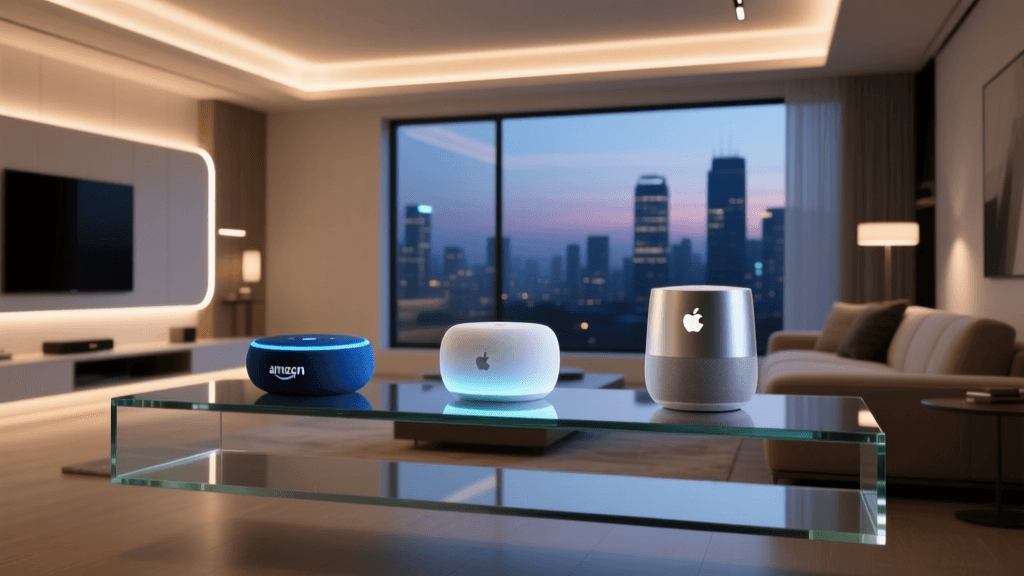
Hardware Anchors: Echo vs. Nest vs. HomePod
The foundation of any smart home ecosystem is its hub and speaker lineup. While smartphones act as primary controllers, dedicated smart speakers and displays serve as the physical anchors for voice commands, local processing, and mesh network routing.
Amazon Echo Ecosystem
Amazon offers the most diverse hardware lineup. The Amazon Echo (4th Gen) remains a powerhouse for budget-conscious users because it includes a built-in Zigbee smart home hub and a Thread Border Router. This eliminates the need for third-party bridges for many popular devices like Philips Hue bulbs or Aqara sensors. For visual control, the Echo Show 15 acts as a centralized smart home dashboard, while the Echo Dot (5th Gen) provides an affordable, room-by-room intercom and voice control network.
Google Nest Ecosystem
Google’s hardware strategy focuses heavily on ambient computing and AI integration. The Google Nest Audio delivers superior room-filling sound compared to the standard Echo, while the Nest Hub (2nd Gen) offers sleep tracking via its Soli radar chip. Crucially, Google’s smart speakers and displays also function as Thread Border Routers, paving the way for low-latency Matter devices. However, Google lacks a dedicated, standalone smart home hub with built-in Zigbee, often requiring users to rely on device-specific bridges or the newer Nest Connect.
Apple HomeKit Ecosystem
Apple approaches the smart home with a premium, hardware-restricted philosophy. The HomePod (2nd Gen) and HomePod Mini serve as both high-fidelity speakers and vital Thread Border Routers. However, to unlock the full potential of HomeKit—specifically remote access and advanced automations—users must designate an Apple TV 4K (Wi-Fi + Ethernet) or a HomePod as a 'Home Hub.' Apple does not support Zigbee natively, relying entirely on Wi-Fi, Thread, and the new Matter standard, which often necessitates purchasing manufacturer-specific hubs for legacy devices.
| Feature | Amazon Echo (4th Gen) | Google Nest Audio | Apple HomePod (2nd Gen) |
|---|---|---|---|
| Approximate Price | $99 | $99 | $299 |
| Built-in Radios | Wi-Fi, Zigbee, Thread | Wi-Fi, Thread | Wi-Fi, Thread, UWB, Thread Border Router |
| Hub Functionality | Native Zigbee & Matter Hub | Thread/Matter Hub only | Thread/Matter Hub (Requires Apple TV for full remote) |
| Audio Quality | Good (Bass-heavy) | Excellent (Balanced) | Superior (Spatial Audio, Room Sensing) |
Voice Assistant Intelligence and Contextual Awareness
The 'smart' in smart home relies heavily on the underlying AI. When comparing Alexa, Google Assistant, and Siri, the differences in natural language processing and contextual awareness are stark.
Google Assistant is widely considered the most intelligent conversationalist. Leveraging Google’s massive Knowledge Graph, it excels at answering complex, multi-part questions, understanding context from previous queries, and accurately deciphering natural speech patterns. If you frequently ask for recipe conversions, local business hours, or nuanced trivia, Google is unmatched.
Amazon Alexa prioritizes smart home utility and third-party extensibility. While its general knowledge base may not be as deep as Google’s, Alexa’s 'Skills' ecosystem allows for deep integration with niche apps, games, and specific device routines. Alexa’s voice recognition is also highly adept at distinguishing between different household members, allowing for personalized routines and shopping lists.
Apple Siri historically lagged in general intelligence but excels in smart home execution speed and privacy. Siri’s integration with iOS means it can seamlessly execute complex Shortcuts and HomeKit automations with high reliability. However, Siri still struggles with complex, multi-step conversational queries outside of direct device control.
Device Compatibility and the Matter Standard
Historically, Amazon Alexa boasted the largest library of compatible smart home devices, followed closely by Google Home, with Apple HomeKit trailing significantly due to its strict (and expensive) MFi certification requirements. However, the introduction of the Matter standard is fundamentally reshaping this landscape.
According to the Connectivity Standards Alliance (CSA), Matter is an open-source, royalty-free connectivity protocol designed to unify the smart home. Matter allows devices to communicate locally over Wi-Fi, Ethernet, or Thread, bypassing proprietary cloud servers. All three ecosystems—Alexa, Google Home, and Apple HomeKit—are founding members and active supporters of Matter.
For consumers, this means a Matter-certified device like the Eve Energy Smart Plug or the Aqara U100 Smart Lock will work natively across all three platforms without requiring a proprietary bridge. While Alexa and Google still maintain larger libraries of legacy Wi-Fi and Zigbee devices, Apple HomeKit users are rapidly gaining access to top-tier hardware via Matter over Thread.
Privacy, Security, and Local Processing
Privacy is arguably the most significant differentiator in the ecosystem wars. Your smart home devices are constantly listening for wake words, mapping your floor plan, and recording your daily routines.
Apple HomeKit is the undisputed leader in privacy. Apple’s architecture mandates end-to-end encryption for all HomeKit data. Furthermore, features like HomeKit Secure Video (HKSV) process video feeds locally on the Apple TV or HomePod to identify people, pets, and vehicles before encrypting and uploading the clips to iCloud. Apple does not monetize your smart home data for advertising. As outlined in Apple's Privacy Framework, data processing is kept on-device whenever possible, ensuring that even Apple cannot view your camera feeds or automation logs.
Amazon and Google rely heavily on cloud-based processing. While both offer robust security measures, two-factor authentication, and options to auto-delete voice recordings, their business models are inherently tied to data collection and targeted advertising. Amazon’s Alexa Guard and Google’s Nest Aware use cloud servers to analyze audio and video feeds for anomalies like breaking glass or familiar faces. While highly effective, this cloud-reliance introduces a larger attack surface and inherent privacy trade-offs that privacy advocates often cite, echoing concerns raised in NIST IoT Cybersecurity Guidelines regarding cloud-dependent consumer IoT devices.
Automations, Routines, and Advanced Logic
A true smart home anticipates your needs without manual intervention. How each platform handles automation logic varies wildly in complexity and user-friendliness.
- Amazon Alexa Routines: Alexa offers a highly visual, easy-to-use routine builder in its mobile app. You can trigger actions based on voice commands, schedules, device states, or even location (geofencing). However, Alexa lacks native support for complex boolean logic (e.g., 'If motion is detected AND it is after sunset BUT the TV is off') without relying on third-party workarounds or specific skill integrations.
- Google Home Routines: Google’s automation interface is clean and integrates deeply with Google services like Calendar and Maps. The 'Starter' and 'Action' logic is straightforward, but like Alexa, it struggles with complex, multi-condition logic natively. Google is increasingly pushing users toward its 'Scripts' feature, which offers more granular control but requires a steeper learning curve.
- Apple HomeKit Automations: HomeKit’s native automation engine is incredibly powerful, supporting complex conditions, time delays, and accessory state triggers. For power users, pairing HomeKit with the third-party Home+ app or creating Apple Shortcuts unlocks unparalleled logic capabilities, including variables, API calls, and intricate conditional branching, all processed locally on your Apple Hub.
Camera Ecosystems and Cloud Storage Costs
Smart home security cameras are a primary driver for ecosystem lock-in, largely due to cloud storage subscription models.
Amazon pushes users toward its Ring and Blink ecosystems. To store video history and access advanced features like person detection, users must subscribe to a Ring Home plan (starting at $4.99/month). Alexa integrates these feeds seamlessly into Echo Show displays.
Google offers the Nest Cam lineup, which features some of the best AI-powered object detection on the market. However, continuous video recording and intelligent alerts require a Nest Aware subscription ($8/month), making it a recurring expense for comprehensive security.
Apple takes a unique approach with HomeKit Secure Video. Instead of a dedicated security subscription, HKSV is bundled with iCloud+. If you already pay for iCloud storage (starting at $0.99/month for 50GB, which supports 1 camera, or $9.99/month for 2TB, which supports unlimited cameras), you get local AI processing and secure cloud storage without an additional 'security tax.' Compatible cameras like the Logitech Circle View or Eve Outdoor Cam integrate flawlessly into the Apple TV interface.
The Verdict: Which Ecosystem is Right for You?
Choosing between Alexa, Google Home, and Apple HomeKit ultimately depends on your budget, your existing tech ecosystem, and your stance on privacy.
Choose Amazon Alexa If:
You want the most affordable, broadest, and most flexible entry point into the smart home. Alexa is ideal for users who want a massive selection of third-party devices, native Zigbee support without extra hubs, and a highly customizable voice assistant. It is the best choice for budget-conscious families and tinkerers who prioritize utility and third-party 'Skills' over absolute data privacy.
Choose Google Home If:
You are heavily invested in Google services (Gmail, Calendar, Android) and prioritize voice assistant intelligence and audio quality. Google Home is perfect for users who want a conversational AI that can answer complex questions, manage household schedules, and provide a seamless ambient computing experience via the Nest Hub displays. It is the strongest choice for mixed-device households (Android and iOS users alike).
Choose Apple HomeKit If:
You are an iPhone user who values privacy, local processing, and a premium, unified interface above all else. While the initial hardware costs are higher (requiring an Apple TV 4K and HomePods), the lack of predatory subscription models for security cameras and the assurance of end-to-end encryption make it the most secure and elegant ecosystem. With the advent of Matter, HomeKit's historical weakness—limited device compatibility—is rapidly disappearing, making it the ultimate choice for the privacy-conscious smart home enthusiast.