August Smart Lock Pro vs Yale Linus Smart Lock: Which Smart Lock Wins?
Choosing the right smart lock for your home can feel overwhelming, especially when two premium options seem to offer nearly identical promises. The August Smart Lock Pro and the Yale Linus Smart Lock are two of the most popular retrofit smart locks on the market, and for good reason. Both let you keep your existing deadbolt, both offer remote access, and both integrate with major smart home platforms. But beneath the surface, these locks differ in meaningful ways that could make one a far better fit for your household than the other.
In this comprehensive comparison, we break down every critical category — from design and installation to smart home compatibility, security features, and overall value. Whether you are deep in the Apple ecosystem, looking for the best smart lock for renters, or simply want a reliable keyless entry solution, this guide will help you decide between the August Smart Lock Pro and the Yale Linus Smart Lock.
For more smart lock reviews and comparisons, browse our full smart lock buying guides or check out our head-to-head product comparisons.
Side-by-Side Specification Comparison
Before diving into detailed analysis, here is a quick-reference table that puts the core specifications of both locks next to each other.
| Feature | August Smart Lock Pro | Yale Linus Smart Lock |
|---|---|---|
| Lock Type | Retrofit (replaces interior thumbturn) | Retrofit (replaces interior thumbturn) |
| Connectivity | Bluetooth, Z-Wave, Wi-Fi (via built-in Wi-Fi Bridge) | Bluetooth, Wi-Fi (via Yale Connect Hub) |
| Smart Home Ecosystems | Amazon Alexa, Google Assistant, Apple HomeKit, Samsung SmartThings, Z-Wave hubs | Amazon Alexa, Google Assistant, Apple HomeKit, Yale ecosystem |
| Auto-Unlock | Yes (geofencing & Bluetooth) | Yes (geofencing & Bluetooth) |
| Auto-Lock | Yes (configurable timer) | Yes (configurable timer) |
| DoorSense Sensor | Yes (included) | No (door status inferred from lock position) |
| Keypad Included | No (August Smart Keypad sold separately) | No (Yale Smart Keypad sold separately) |
| Virtual Keys & Guest Access | Yes (unlimited) | Yes (unlimited) |
| Activity Log | Yes (24/7 activity feed) | Yes (activity feed via app) |
| Power Source | 4x AA batteries | 4x AA batteries |
| Battery Life (estimated) | 3–6 months | 6–12 months |
| Finish Options | Silver, Matte Black | Silver, Matt Black |
| Weight | Approx. 340 g | Approx. 620 g |
| Warranty | 1 year limited | 2 years limited |
| Price Range | Mid-premium | Premium |
Design & Installation: Which Lock Fits Your Door Better?
Both the August Smart Lock Pro and the Yale Linus are retrofit locks, meaning they mount on the interior side of your door and work with your existing deadbolt hardware. This is a major advantage for renters and anyone who does not want to replace their entire lock cylinder. However, there are notable differences in how each lock approaches design and installation.
Form Factor & Aesthetics
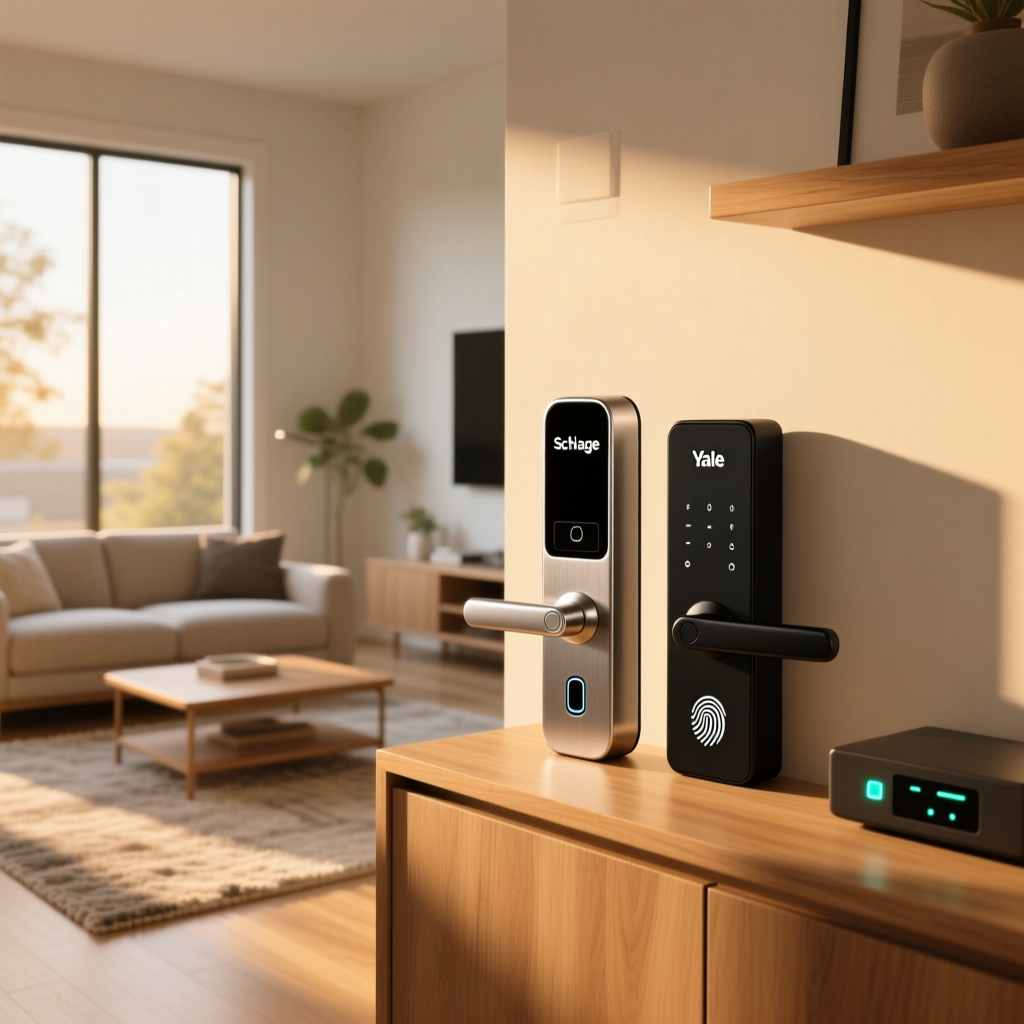
The August Smart Lock Pro has a compact, rounded cylindrical design that sits relatively close to the door surface. Its smaller footprint makes it less obtrusive, and many users appreciate that it does not dominate the interior aesthetic of the door. Available in Silver and Matte Black, it blends into most modern interiors without drawing excessive attention.
The Yale Linus, by contrast, is a larger and heavier unit. Its elongated, rounded-rectangle shape gives it a premium, substantial feel, but it also protrudes more from the door. At roughly 620 grams, it is nearly twice the weight of the August. This can matter if your door is lightweight or if the deadbolt mechanism is already stiff — a heavier lock may put more strain on the thumbturn over time. The Yale Linus is available in Silver and Matt Black finishes with a polished look that complements Yale's broader hardware lineup.
Installation Process
Both locks install in roughly 10 to 15 minutes using nothing more than a screwdriver. The general process involves removing the interior thumbturn, attaching an adapter plate to the existing deadbolt tailpiece, and then mounting the smart lock body onto that plate. Both manufacturers provide detailed app-guided installation wizards that walk you through each step.
Where they diverge is in adapter compatibility. The August Smart Lock Pro ships with a wider variety of adapter rings designed to fit different deadbolt brands, including Schlage, Kwikset, and many generic models. Yale also provides adapters, but user reports suggest that certain European-profile cylinders and less common deadbolt brands may require additional troubleshooting or third-party adapter plates. If you have a standard North American deadbolt, both locks should fit without issue. If you are in Europe or have a specialty lock, the August tends to be more universally compatible out of the box.
One critical installation difference is the DoorSense sensor. The August Smart Lock Pro includes a small magnetic sensor that attaches to your door frame. This sensor tells the app whether the door is physically open or closed — not just whether the bolt is extended or retracted. The Yale Linus does not include an equivalent sensor; it infers door status from the lock's rotational position. In practice, DoorSense gives August a meaningful edge in security awareness, because it can alert you if the door is ajar even when the bolt appears locked.
Performance & Reliability: Day-to-Day Locking Experience
A smart lock's most important job is to lock and unlock reliably every single time. Both the August Smart Lock Pro and the Yale Linus perform well in this regard, but there are nuances worth examining.
Motor Speed & Noise
The August Smart Lock Pro operates with a relatively quiet motor that turns the deadbolt in approximately two seconds. The Yale Linus is slightly slower, taking around three seconds for a full lock or unlock cycle, and it produces a somewhat louder mechanical whir. In a quiet apartment hallway at night, the difference is noticeable. Neither lock is silent, but the August has a slight edge in discreetness.
Auto-Unlock Accuracy
Both locks use a combination of geofencing (via your phone's location services) and Bluetooth proximity to trigger auto-unlock. When you approach your door, the lock detects your phone and automatically retracts the bolt so you can walk in without touching anything.
In real-world testing, the August Smart Lock Pro's auto-unlock tends to be more consistent. Its dual-technology approach — combining GPS geofencing to arm the feature and Bluetooth for the final trigger — reduces false unlocks and missed unlocks. The Yale Linus auto-unlock works well most of the time, but some users report occasional delays where the lock does not detect the phone quickly enough, requiring a manual unlock via the app. Firmware updates have improved this over time, but August's implementation remains the benchmark for the category.
Auto-Lock Functionality
Both locks offer configurable auto-lock, which automatically extends the bolt after a set period (e.g., 30 seconds, 1 minute, 5 minutes). Here again, the August's DoorSense sensor provides an advantage: it will only auto-lock when the door is actually closed. Without a door position sensor, the Yale Linus could theoretically attempt to auto-lock while the door is still open, extending the bolt into open air. This is not dangerous, but it can be an annoyance if you frequently leave the door open while carrying in groceries.
Remote Access
Remote access lets you lock or unlock your door from anywhere via the internet. The August Smart Lock Pro includes a built-in Wi-Fi bridge, so remote access works out of the box without any additional hardware. The Yale Linus requires the separate Yale Connect Hub (often included in certain bundles, but sold separately in others) to enable Wi-Fi connectivity and remote access. If your bundle does not include the Connect Hub, you will need to purchase it as an add-on, adding to the total cost.
Smart Home Ecosystem & App Experience
Smart locks do not exist in isolation — they are part of a broader connected home. How well each lock integrates with your existing devices and preferred voice assistant can be a deciding factor.
Voice Assistant Compatibility
Both the August Smart Lock Pro and the Yale Linus support Amazon Alexa, Google Assistant, and Apple HomeKit. This means you can use voice commands to lock your door, check lock status, and (with appropriate security PINs configured) unlock via any of the major voice platforms.
The August Smart Lock Pro goes further by supporting Samsung SmartThings and Z-Wave hubs. If you have a SmartThings hub or a Z-Wave-based home automation system like Hubitat or Home Assistant with Z-Wave integration, the August can join your mesh network directly without relying on Wi-Fi. This is a significant advantage for power users who prefer local control and want to reduce dependence on cloud services. The Yale Linus does not support Z-Wave or SmartThings natively, limiting its integration to the Yale app, Alexa, Google, and HomeKit.
For a deeper look at building a connected home, explore our smart home hub guides and ecosystem comparison articles.
Mobile App Quality
The August app is widely regarded as one of the best smart lock apps available. Its interface is clean and intuitive, with a prominent lock/unlock toggle, a real-time activity log showing who locked or unlocked the door and when, and straightforward guest access management. The app lets you create virtual keys for family members, friends, or service workers, and you can set recurring or temporary access schedules with ease. Push notifications are reliable, and the app's overall polish reflects years of iterative improvement.
The Yale Access app (which is actually built on the same underlying platform as the August app, since both brands are part of the ASSA ABLOY group) offers a very similar feature set. You get virtual keys, access scheduling, activity logs, and auto-unlock configuration. The Yale app feels slightly more branded and occasionally surfaces promotions for other Yale products, but functionally, the two apps are close cousins. One advantage of the Yale ecosystem is its integration with other Yale security products, such as smart cameras and alarms, giving you a more unified security dashboard if you invest in multiple Yale devices.
IFTTT & Automation
The August Smart Lock Pro supports IFTTT (If This Then That) applets, enabling custom automations like turning on your lights when the door unlocks or sending a text message when a specific guest arrives. The Yale Linus has more limited IFTTT support, relying instead on its native app automations and HomeKit/Alexa routines for advanced scenarios. If IFTTT is a core part of your automation workflow, August has the edge.
Security & Privacy: Keeping Your Home Safe
Security is the entire reason smart locks exist, so this category deserves thorough examination.
Encryption & Communication Security
Both locks use AES 128-bit encryption for Bluetooth communication and TLS encryption for Wi-Fi and cloud communications. Both require account authentication and support two-factor authentication (2FA) for added account security. From a pure encryption standpoint, neither lock has a meaningful advantage — both meet modern security standards.
Door Status Awareness
As mentioned earlier, the August Smart Lock Pro's DoorSense sensor is a genuine security differentiator. Knowing whether your door is physically closed — not just whether the bolt is extended — gives you a more accurate picture of your home's security status. The August app can send you an alert if the door has been left open for an extended period, which is invaluable for families with children or for vacation rental hosts who want to monitor property status remotely.
The Yale Linus relies on the lock mechanism's position to infer whether the door is locked. In most scenarios this works fine, but it cannot distinguish between a door that is closed and locked versus a door that is open with the bolt extended. This is a subtle but real gap in awareness.
Tamper Resistance & Physical Security
Because both locks are interior-mounted retrofit devices, the exterior of your door remains unchanged. This means the physical security of your lock depends entirely on your existing deadbolt. Neither smart lock adds or detracts from the physical strength of your deadbolt. However, both locks feature internal mechanisms that resist forced rotation of the thumbturn from the outside (e.g., through a broken window or mail slot attack).
The Yale Linus benefits from Yale's long reputation as a lock manufacturer, and its build quality reflects that heritage. The August Smart Lock Pro, while designed by a newer company, has undergone rigorous third-party security testing and has maintained a strong track record since its launch.
Access Control & Guest Management
Both locks excel at guest access management. You can issue virtual keys to unlimited users, set time-limited access (e.g., a cleaner who can only enter on Tuesdays from 10 AM to 2 PM), and revoke access instantly at any time. Both apps maintain a detailed activity log so you always know who accessed your home and when.
If you opt for the optional keypad accessory (sold separately for both locks), you can also provide PIN-code access for guests who do not have smartphones. The August Smart Keypad and the Yale Smart Keypad are both well-reviewed, weather-resistant, and easy to install with adhesive mounting.
Battery Life & Maintenance
Smart locks are only as good as their power supply. A dead battery means you are reaching for your physical key — which is always a valid backup, but defeats the convenience purpose.
The August Smart Lock Pro runs on four AA batteries and typically delivers three to six months of battery life, depending on usage frequency and how often auto-unlock is triggered. The August app provides a battery level indicator and sends low-battery warnings well in advance, giving you ample time to swap them out.
The Yale Linus also uses four AA batteries but generally achieves longer battery life — typically six to twelve months under normal usage. The Yale Linus benefits from a more energy-efficient Bluetooth implementation and a slightly different motor configuration that draws less power per cycle. If battery maintenance is a top priority and you want to minimize how often you swap cells, the Yale Linus has a clear advantage here.
Both locks provide low-battery alerts via their respective apps, and both retain physical key access as a fail-safe. Neither lock currently supports rechargeable battery packs, though standard rechargeable AA batteries can be used (with slightly reduced runtime compared to premium alkaline cells).
For tips on maintaining your smart home devices, check out our smart home maintenance guide.
Value & Pricing: Getting the Most for Your Money
Price is always a factor, and the two locks occupy slightly different positions in the market.
The August Smart Lock Pro is typically positioned in the mid-premium range. It includes the Wi-Fi bridge built in, which means you do not need to buy any additional hardware for remote access. When you factor in the included DoorSense sensor and the broad adapter kit, the overall package delivers strong value. The main additional purchase most users make is the August Smart Keypad, which is sold separately.
The Yale Linus Smart Lock is generally priced at a premium. If your bundle does not include the Yale Connect Hub, you will need to add that to your cart, pushing the total cost higher. The Yale Smart Keypad is also a separate purchase. However, the longer battery life and two-year warranty (compared to August's one-year warranty) help offset the higher upfront cost over time.
For budget-conscious buyers, the August Smart Lock Pro typically offers a lower total cost of ownership when you account for the included Wi-Fi bridge and DoorSense sensor. For buyers who prioritize brand heritage, build quality, and longer warranty coverage, the Yale Linus justifies its premium.
For more budget-friendly alternatives, see our roundup of the best smart locks for every budget.
The Verdict: Which Smart Lock Should You Choose?
There is no single winner that is right for everyone. The best choice depends on your priorities, your existing smart home setup, and your budget. Here is a clear breakdown to help you decide.
Choose the August Smart Lock Pro If:
- You want the broadest smart home compatibility. With Z-Wave, SmartThings, HomeKit, Alexa, and Google support, the August works with virtually every ecosystem.
- Door status awareness matters to you. The included DoorSense sensor provides a security advantage the Yale Linus cannot match.
- You want remote access without buying extra hardware. The built-in Wi-Fi bridge means no additional hub purchase is needed.
- Auto-unlock reliability is your top priority. August's dual-technology auto-unlock is the most consistent in its class.
- You are a renter. The compact size, broad adapter compatibility, and easy reversibility make the August ideal for rental properties.
Choose the Yale Linus Smart Lock If:
- Battery life is a major concern. With up to twice the battery longevity of the August, the Yale Linus demands less maintenance.
- You prefer a premium brand with a long warranty. Yale's two-year warranty and century-plus lock-making heritage provide peace of mind.
- You are already invested in the Yale security ecosystem. If you own Yale smart cameras or alarms, the Linus integrates seamlessly into a unified Yale security dashboard.
- You prioritize build quality and a substantial feel. The Yale Linus has a heftier, more premium construction that some users prefer.
- You want a quieter lock motor is not a priority. If motor noise does not bother you, the Yale's slightly louder operation will not be an issue.
Quick Recommendation Summary
| User Profile | Recommended Lock |
|---|---|
| Smart home power user with Z-Wave/SmartThings | August Smart Lock Pro |
| Apple HomeKit user | Either (both support HomeKit) |
| Renter or apartment dweller | August Smart Lock Pro |
| Homeowner who wants low maintenance | Yale Linus Smart Lock |
| Vacation rental host | August Smart Lock Pro (DoorSense advantage) |
| Yale ecosystem loyalist | Yale Linus Smart Lock |
| Budget-conscious buyer | August Smart Lock Pro (lower total cost) |
Frequently Asked Questions
Can I use both the August Smart Lock Pro and Yale Linus with my existing deadbolt?
Yes, both locks are retrofit devices designed to work with your existing single-cylinder deadbolt. They replace only the interior thumbturn, leaving your exterior hardware and key cylinder untouched. Both locks ship with adapter kits to fit the most common deadbolt brands. However, the August Smart Lock Pro tends to have slightly broader adapter compatibility out of the box, especially for North American deadbolt models. If you have a European-profile cylinder or an unusual deadbolt brand, check each manufacturer's compatibility list before purchasing.
Do I need a separate hub for either smart lock?
The August Smart Lock Pro has a built-in Wi-Fi bridge, so no separate hub is required for remote access, app notifications, or voice assistant integration. The Yale Linus requires the Yale Connect Hub for Wi-Fi connectivity and remote access. Some Yale Linus bundles include the Connect Hub, while others sell it separately. Without the Connect Hub, the Yale Linus is limited to Bluetooth range (roughly 30 feet) for app control and cannot be accessed remotely or used with voice assistants. Factor this into your total cost when comparing prices.
What happens if the batteries die — am I locked out?
No, you will not be locked out. Both the August Smart Lock Pro and the Yale Linus leave your exterior key cylinder completely untouched, so your physical key always works as a backup. Both apps also provide low-battery warnings well before the batteries are fully depleted, giving you time to replace them. If you do find yourself with dead batteries, simply open the battery compartment on the interior side (which you can access once you use your physical key to enter) and swap in fresh AA batteries. The lock will resume normal operation immediately.
Which lock is better for managing vacation rental or Airbnb properties?
The August Smart Lock Pro is generally the better choice for vacation rental hosts. The included DoorSense sensor lets you verify that guests have actually closed the door (not just locked it), which is critical for security between guest stays. The built-in Wi-Fi bridge means reliable remote access without needing to install an extra hub in the property. The auto-unlock feature is convenient for guests, and the ability to create time-limited virtual keys means you can automatically revoke access when a guest checks out. The detailed activity log also provides an audit trail for any disputes. That said, the Yale Linus is also a capable vacation rental lock, particularly if you manage multiple Yale products across your properties and want a unified dashboard.
For more smart home product comparisons, visit our complete versus archive or explore our smart lock buying guide for personalized recommendations.