The Smart Home Hub Dilemma: Budget vs. Premium
Building a smart home is an exciting journey, but it quickly becomes a tangled web of incompatible apps, disconnected devices, and conflicting voice assistants. The solution to this chaos is a dedicated smart home controller or hub. A hub acts as the central brain of your ecosystem, translating different wireless protocols like Zigbee, Z-Wave, Thread, and Wi-Fi into a unified language. However, when shopping for a controller, consumers are immediately faced with a stark divide: the mass-market budget options versus the enthusiast-grade premium powerhouses.
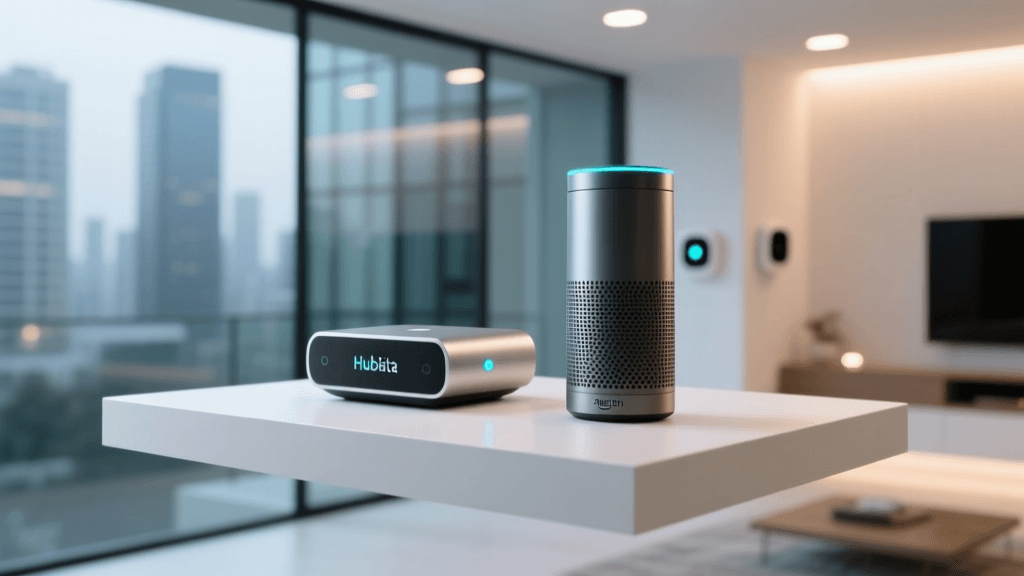
In this comprehensive head-to-head comparison, we are pitting the ultimate budget-friendly, mainstream controller against the undisputed premium heavyweight. In the budget corner, we have the Amazon Echo (4th Gen), a device that doubles as a smart speaker and a surprisingly capable Zigbee and Matter hub, typically retailing around $99 (and frequently dropping to $50 on sale). In the premium corner stands the Homey Pro (Early 2023), a $399 local-processing powerhouse designed for advanced users who demand total control, ultimate privacy, and support for virtually every radio frequency in existence. Which controller deserves a spot on your network rack? Let us dive into the specifications, performance benchmarks, and ecosystem compatibility to find out.
Meet the Contenders
Amazon Echo (4th Gen): The Budget Champion
Amazon revolutionized the smart speaker market, but with the 4th Generation Echo, they also quietly revolutionized the budget smart home hub market. Unlike the smaller Echo Dot, the standard spherical Echo (4th Gen) features a built-in Zigbee 3.0 hub and acts as a Matter controller and Thread border router. This means you can pair compatible smart bulbs, locks, and sensors directly to the Echo without needing a separate bridge for each brand. It relies heavily on Amazon's cloud infrastructure for processing automations (Alexa Routines) and is deeply integrated into the Alexa ecosystem, making it an incredibly easy on-ramp for beginners and existing Amazon users.
Homey Pro: The Premium Powerhouse
Homey Pro is not a smart speaker; it is a dedicated, high-performance smart home controller built for enthusiasts, custom integrators, and privacy advocates. Priced at a premium $399, it justifies its cost through sheer hardware capability and software flexibility. Homey Pro processes all automations locally, meaning your smart home continues to function even if your internet connection goes down. It boasts an unprecedented array of built-in radios: Zigbee, Z-Wave, Matter, Thread, Wi-Fi, Bluetooth Low Energy (BLE), Infrared (IR), and 433MHz. If a device exists in the smart home space, Homey Pro can likely talk to it.
Head-to-Head Specification Breakdown
Before we analyze the real-world performance, let us look at the raw hardware and protocol specifications side-by-side.
| Feature | Amazon Echo (4th Gen) | Homey Pro (2023) |
|---|---|---|
| MSRP / Typical Price | $99 (Often $50 on sale) | $399 |
| Primary Function | Smart Speaker & Hub | Dedicated Smart Home Controller |
| Zigbee Support | Yes (Zigbee 3.0) | Yes (Zigbee 3.0) |
| Z-Wave Support | No | Yes (Z-Wave Plus) |
| Matter & Thread | Yes (Border Router) | Yes (Border Router) |
| Wi-Fi & Bluetooth | Yes | Yes (BLE) |
| IR & 433MHz (RF) | No | Yes |
| Local Processing | Limited (Mostly Cloud) | Yes (100% Local Automations) |
| Automation Engine | Alexa Routines (Basic) | Homey Flow (Advanced Logic) |
| Voice Assistant | Alexa Built-in | None (Integrates with others) |
Protocol Support and Connectivity
The most significant differentiator between a budget and premium controller is the sheer volume of wireless protocols they support. The Amazon Echo (4th Gen) covers the modern basics: Wi-Fi, Bluetooth, and Zigbee 3.0. With recent firmware updates, it also supports Matter and acts as a Thread border router. According to the Connectivity Standards Alliance, Matter is designed to unify the smart home experience across different ecosystems, and having a Matter controller built into a $50 speaker is a massive win for budget-conscious consumers adopting new devices.
However, the Echo completely lacks Z-Wave support. Z-Wave remains a dominant force in smart home security sensors, smart locks, and motorized blinds due to its superior range and wall-penetrating capabilities. As highlighted by the Z-Wave Alliance, Z-Wave operates on sub-GHz frequencies (like 908.42 MHz in the US), which allows the signal to travel much further and interfere less with crowded 2.4GHz Wi-Fi networks than Zigbee does. If you have a large home with Z-Wave security sensors, the Echo (4th Gen) is instantly disqualified as a standalone hub.
Homey Pro, conversely, supports Z-Wave Plus alongside Zigbee, Matter, and Thread. Furthermore, as outlined by the Thread Group, Thread provides a low-power, self-healing mesh network that is critical for battery-operated sensors. Homey Pro supports Thread natively and acts as a border router. But Homey's true premium advantage lies in its legacy and niche radio support. It features built-in Infrared (IR) blasters to control older TVs and air conditioners, and a 433MHz antenna to communicate with budget RF smart plugs, weather stations, and older motorized blinds that lack modern IP connectivity. The Echo simply cannot see these devices.
Automation Capabilities: Routines vs. Flows
A hub is only as good as the automations it can execute. Amazon's Alexa Routines are designed for the masses. They operate on a simple 'When X happens, do Y' logic. You can easily set a routine to turn on your Zigbee living room lights when the Echo detects motion, or to announce 'Someone is at the door' when your video doorbell rings. However, Alexa Routines are severely limited by a lack of variables, complex conditional logic (nested IF/THEN statements), and local execution. Most routines require a ping to Amazon's cloud servers, introducing latency and rendering them useless during an internet outage.
Homey Pro utilizes an automation engine called 'Flow'. Flow is a visual, node-based logic builder that allows for staggering complexity. You can create variables, utilize AND/OR logic gates, execute HTTP webhooks, parse JSON data from local APIs, and introduce time delays or randomizations. For example, with Homey Flow, you can create a 'Vacation Mode' routine that randomly toggles lights between specific hours, checks your local weather API to adjust the thermostat, and sends a Telegram message to your phone if a water leak sensor is triggered—all processed locally on the device's internal processor with zero cloud latency.
Ecosystem Integration and Voice Control
The Amazon Echo is, first and foremost, an Alexa device. If your household is heavily invested in Amazon services, Prime delivery tracking, Alexa Drop-In intercom features, and Alexa Guard security listening, the Echo (4th Gen) is a seamless addition. However, it forces you into the Amazon ecosystem. While you can link third-party accounts (like Philips Hue or TP-Link Kasa), you are always viewing them through the lens of the Alexa app.
Homey Pro takes an agnostic approach. It does not have a built-in microphone or speaker because it believes voice assistants should be separate from the core processing brain. Instead, Homey Pro integrates with Amazon Alexa, Google Home, and Apple HomeKit (via Matter) simultaneously. You can use Siri to turn on a Z-Wave light, Google Assistant to check a Zigbee temperature sensor, and Alexa to trigger a complex Homey Flow script. Homey acts as the universal translator, exposing your unified device list to whichever voice assistant you prefer in each room.
Privacy, Security, and Local Processing
In an era of increasing data privacy concerns, where your smart home data is processed matters immensely. The Amazon Echo relies heavily on cloud processing. When you trigger an automation or pair a new device, that data is routed through Amazon Web Services (AWS). While Amazon employs robust enterprise-grade security, the fundamental architecture requires an active internet connection and trusts a massive corporation with the metadata of your daily routines.
Homey Pro is built on a 'Local-First' philosophy. Once configured, your automations, device states, and sensor data never leave your local network. If a storm knocks out your fiber internet connection, your Zigbee motion sensors will still trigger your local Wi-Fi smart bulbs, and your Z-Wave smoke alarms will still sound the local sirens. For users who prioritize privacy, or those who live in areas with unstable internet connections, the premium price of the Homey Pro is easily justified by the peace of mind and reliability it offers.
Energy Consumption and Hardware Footprint
When deploying a device that runs 24/7/365, power consumption is a valid metric. The Amazon Echo (4th Gen) draws roughly 2W to 4W of power at idle, depending on whether the LED ring is active or the microphone array is processing wake words. It is relatively efficient, costing only a few dollars a year in electricity.
The Homey Pro, despite its massive processing power and eight different radio antennas, is remarkably energy-efficient. It draws approximately 3W to 5W at idle. The physical footprint of the Homey Pro is also much smaller; it is a sleek, glossy black disc that easily mounts to a wall or hides behind a network router, whereas the Echo is a prominent, fabric-wrapped sphere designed to be displayed on a nightstand or kitchen counter. If aesthetics and blending into living spaces are paramount, the Echo wins; if hiding in a server rack or media cabinet is the goal, Homey Pro is superior.
The Final Verdict: Which Controller is Right for You?
The choice between a budget controller and a premium controller ultimately comes down to your technical expertise, the size of your home, and your long-term smart home goals. There is no single 'best' hub, only the best hub for your specific user profile.
Choose the Amazon Echo (4th Gen) if:
- You are a beginner or casual user: You want to buy a few Zigbee smart bulbs and a smart lock, and you want them to work immediately with voice commands without tweaking variables or writing logic scripts.
- You are on a strict budget: At $50 to $99, the value proposition of getting a high-quality smart speaker and a functional Matter/Zigbee hub in one device is unbeatable.
- You live in a smaller home or apartment: You do not need the extended range and wall-penetration of Z-Wave, and a single Zigbee mesh network is sufficient to cover your square footage.
- You are deeply embedded in Amazon's ecosystem: You use Alexa for music, shopping lists, and intercom features daily.
Choose the Homey Pro if:
- You are an enthusiast or power user: You demand advanced logic, local API webhooks, and complex conditional automations that go far beyond basic 'If This Then That' routines.
- You have a mixed-protocol, multi-brand home: You need to bridge Z-Wave security sensors, Zigbee lighting, Thread environmental monitors, and legacy 433MHz blinds into a single, cohesive dashboard.
- Privacy and reliability are paramount: You refuse to let your home's functionality depend on cloud servers and require 100% local processing to ensure your automations survive internet outages.
- You want a universal, assistant-agnostic hub: You want to expose your devices to Apple HomeKit, Google Home, and Alexa simultaneously without managing three separate hub ecosystems.
SmartHomeDeck Pro Tip: You do not necessarily have to choose just one. Many advanced users utilize the Homey Pro as the central, local processing brain for their heavy automations and sensor networks, while placing Amazon Echo Dots and standard Echos in various rooms strictly for voice input and local audio feedback, creating a hybrid system that leverages the strengths of both budget and premium hardware.
In the battle of Budget vs. Premium, the Amazon Echo (4th Gen) democratizes smart home access, making basic automation affordable and accessible to everyone. However, the Homey Pro remains the undisputed king of the hill for those willing to invest in a robust, future-proof, and entirely local smart home infrastructure. Evaluate your current device list, determine your tolerance for cloud reliance, and select the brain that best matches your smart home ambitions.