The Shift from Voice Assistants to Central Smart Hubs
The smart home landscape has evolved dramatically. A few years ago, smart speakers were primarily novel voice assistants used for setting timers, checking the weather, and playing music. Today, they are the central nervous systems of our homes. As the industry pivots toward local processing, mesh networking, and the new Matter interoperability standard, choosing your primary smart speaker is no longer just about audio quality or voice recognition—it is about selecting the foundational hub that will dictate your home's automation capabilities for the next decade.
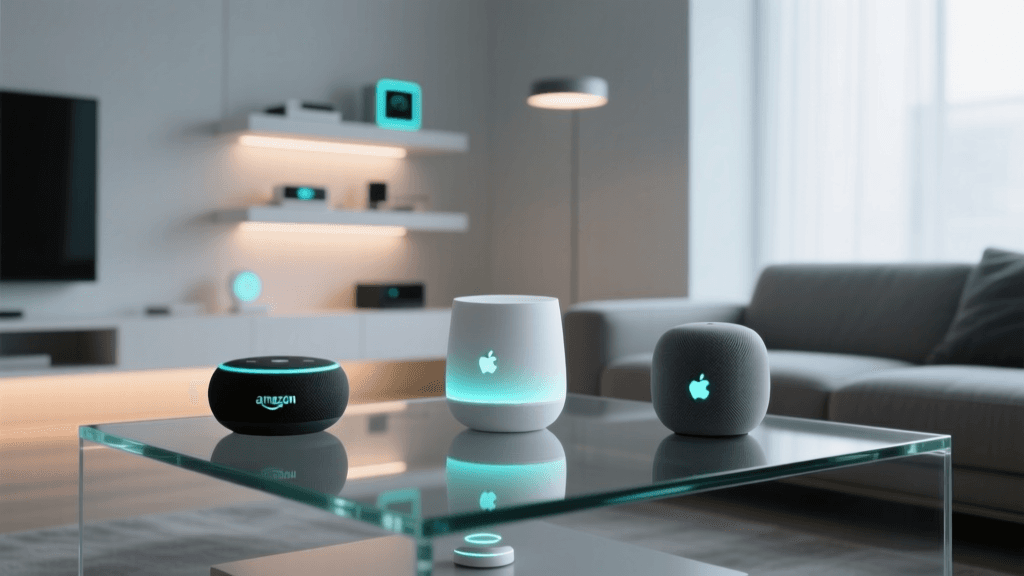
Here at SmartHomeDeck, we have rigorously tested the flagship hub-speakers from the big three ecosystems: the Amazon Echo (4th Gen), the Google Nest Hub (2nd Gen), and the Apple HomePod (2nd Gen). Each device represents a fundamentally different philosophy regarding privacy, protocol support, and ecosystem openness. In this ultimate hub war, we break down the hardware, the software, and the underlying protocols to help you decide which brain belongs in your living room.
The Contenders: Hardware and Audio Profiles
Amazon Echo (4th Gen): The Swiss Army Knife
Amazon’s flagship Echo adopted a spherical design that is not just aesthetic; it acoustically projects sound omnidirectionally. Packed with a 3.0-inch woofer and dual 0.8-inch tweeters, the Echo delivers surprisingly room-filling audio with deep bass for its size. However, its true value proposition lies beneath the fabric. The Echo (4th Gen) is the only device in this lineup that includes a built-in Zigbee radio, alongside Bluetooth and Wi-Fi, making it a bridge for legacy smart home devices that predate the Matter standard.
Google Nest Hub (2nd Gen): The Visual Command Center
Google takes a different approach by integrating a 7-inch touchscreen. While its audio hardware—a single 1.7-inch full-range driver—lags behind its competitors in pure musical fidelity, the Nest Hub excels as a visual dashboard. The Soli radar chip enables touchless sleep sensing and Quick Gestures, allowing you to swipe the air to dismiss alarms or pause media. As a smart home controller, the visual interface makes managing complex lighting scenes and viewing security camera feeds vastly superior to voice-only interactions.
Apple HomePod (2nd Gen): The Audiophile's Fortress
Apple’s HomePod (2nd Gen) is undeniably the audio champion of this trio. Featuring a 5-inch high-excursion woofer and a custom array of five beamforming tweeters, it utilizes spatial audio and room-sensing technology to adapt its sound profile to its environment in real-time. It also includes a built-in temperature and humidity sensor, enabling advanced climate-based automations. However, its premium price tag and strict adherence to Apple's walled garden make it a polarizing choice for non-Apple purists.
Head-to-Head Specifications
| Feature | Amazon Echo (4th Gen) | Google Nest Hub (2nd Gen) | Apple HomePod (2nd Gen) |
|---|---|---|---|
| Price (MSRP) | $99.99 | $99.99 | $299.00 |
| Audio Hardware | 3' Woofer, 2x 0.8' Tweeters | 1.7' Full-Range Driver | 5' Woofer, 5x Beamforming Tweeters |
| Zigbee Hub | Yes (Built-in) | No | No |
| Thread Border Router | Yes | Yes | Yes |
| Matter Support | Yes (via Update) | Yes (via Update) | Yes (Native) |
| Unique Sensors | Temperature, eero Wi-Fi Extender | Soli Radar (Sleep/Gestures) | Temperature, Humidity, Room Sensing |
Protocol Deep Dive: Matter, Thread, and the Zigbee Question
The most critical factor in modern smart home hub selection is protocol support. The industry is currently undergoing a massive transition toward Matter, the unified application layer that allows devices to work across Alexa, Google Home, and Apple HomeKit simultaneously. But Matter relies on underlying transport layers: Wi-Fi and Thread.
Thread Border Routers: The Low-Latency Advantage
All three devices act as Thread Border Routers. Thread is a low-power, mesh-networking protocol that keeps device communication local, meaning your smart bulbs and sensors will continue to function even if your internet connection goes down. Furthermore, Thread drastically reduces the latency of automations. When a Thread-enabled motion sensor triggers a Thread-enabled bulb, the response is nearly instantaneous compared to cloud-reliant Wi-Fi devices.
The Zigbee Legacy Factor
This is where Amazon secures a massive victory for tinkerers and upgraders. According to the Zigbee Alliance, there are hundreds of millions of legacy Zigbee devices already installed in homes worldwide. The Echo (4th Gen) includes a native Zigbee radio, allowing you to connect Philips Hue bulbs (without the Hue Bridge), Aqara sensors, and smart locks directly to the speaker. Neither the Nest Hub nor the HomePod supports Zigbee. If you choose Google or Apple, you must rely on Wi-Fi, Thread, or purchase separate third-party bridges for your older devices.
Ecosystem Automations and Routines
Amazon Alexa: The King of Complexity
Alexa's routine engine is the most robust on the market. You can chain multiple conditions, utilize custom voice commands, and integrate with obscure third-party skills. The ability to use 'Wait' blocks, device state triggers, and even local network requests via Node-RED makes Alexa a favorite for power users. However, the Alexa app interface is notoriously cluttered, making complex routine management a frustrating experience on mobile.
Google Home: Predictive and Visual
Google Home focuses on simplicity and predictive automation. The 'Starter' and 'Action' paradigm is easy for beginners to grasp, and Google's 'Home Dynamics' feature automatically adjusts lighting and thermostat settings based on time of day and sensor data without manual programming. The Nest Hub's screen makes visualizing these routines and manually overriding them via touch incredibly intuitive, though Google still lacks the deep, conditional logic branching found in Alexa or HomeKit.
Apple HomeKit: Secure, Local, and Rigid
Apple's Home app offers the most polished, user-friendly interface, and its automations prioritize local execution and security. HomeKit supports complex logic, including geofencing, time-of-day offsets, and sensor-based triggers. With the introduction of the temperature and humidity sensors in the HomePod (2nd Gen), users can now create climate-based automations natively. The drawback? Siri's voice recognition and natural language processing remain generations behind Alexa and Google Assistant, often failing to understand nuanced commands.
Visualizing Ecosystem Strengths
To help you weigh the priorities, we have scored each device across four critical smart home categories based on our SmartHomeDeck benchmarking methodology. Audio Quality evaluates acoustic fidelity; Hub Versatility measures protocol support (Zigbee/Thread/Matter); Ecosystem Size reflects the number of compatible third-party devices; and Privacy assesses local processing and data anonymization.
Privacy and Local Processing
If privacy is your paramount concern, the ecosystem war has a clear winner: Apple. The HomePod processes Siri requests on-device whenever possible, and Apple does not monetize user data for targeted advertising. HomeKit's architecture requires strict hardware-level encryption from accessory manufacturers.
Conversely, both Amazon and Google rely heavily on cloud processing for voice requests and routine logic. While both companies have introduced local processing APIs to speed up basic commands, complex routines and third-party integrations still bounce off remote servers. Google's Nest Hub does offer some on-device machine learning for sleep sensing and voice matching, but the core ecosystem remains deeply tied to Google's data-harvesting business model.
The Final Verdict: Which Hub Should You Buy?
For the Tinkerer and Legacy Upgrader: Amazon Echo (4th Gen)
If your home is already filled with Zigbee sensors, smart locks, and older smart bulbs, the Echo (4th Gen) is the undisputed champion. Its built-in Zigbee radio saves you from buying multiple proprietary bridges, and its Thread/Matter support ensures it is future-proofed. It offers the best balance of price, protocol versatility, and routine complexity.
For the Visual Commander and Google Purist: Google Nest Hub (2nd Gen)
If you prefer touching a screen to barking orders at a cylinder, the Nest Hub is your best bet. It is the ultimate kitchen companion and bedside dashboard. While it lacks Zigbee and its audio is underwhelming, its integration with Google's predictive AI, Nest cameras, and visual routine management makes it the most practical daily controller for families.
For the Audiophile and Privacy Advocate: Apple HomePod (2nd Gen)
If you are deeply entrenched in the Apple ecosystem, value pristine spatial audio, and demand strict privacy standards, the HomePod (2nd Gen) is a masterpiece. It acts as a phenomenal Thread Border Router and Matter controller, and its new climate sensors open up advanced automation pathways. Just be prepared to pay a premium and accept that your smart home choices will be largely restricted to 'Works with Apple Home' certified devices.
SmartHomeDeck Pro Tip: You do not have to pledge allegiance to just one ecosystem. Thanks to Matter, you can use an Apple HomePod as your primary audio and privacy hub, while keeping an Amazon Echo in the utility room to act as a Zigbee bridge for your legacy sensors. The beauty of the modern smart home is that the walls between ecosystems are finally starting to crumble.