The Smart Thermostat Upgrade Dilemma
In the rapidly evolving world of smart home technology, the upgrade cycle for major appliances and HVAC controls is significantly longer than that of smartphones or laptops. A high-quality smart thermostat is designed to last on your wall for five to ten years. However, when a flagship device receives a generational leap in technology, homeowners are left with a critical question: Is the new hardware worth the investment, or is the previous generation still 'good enough'?
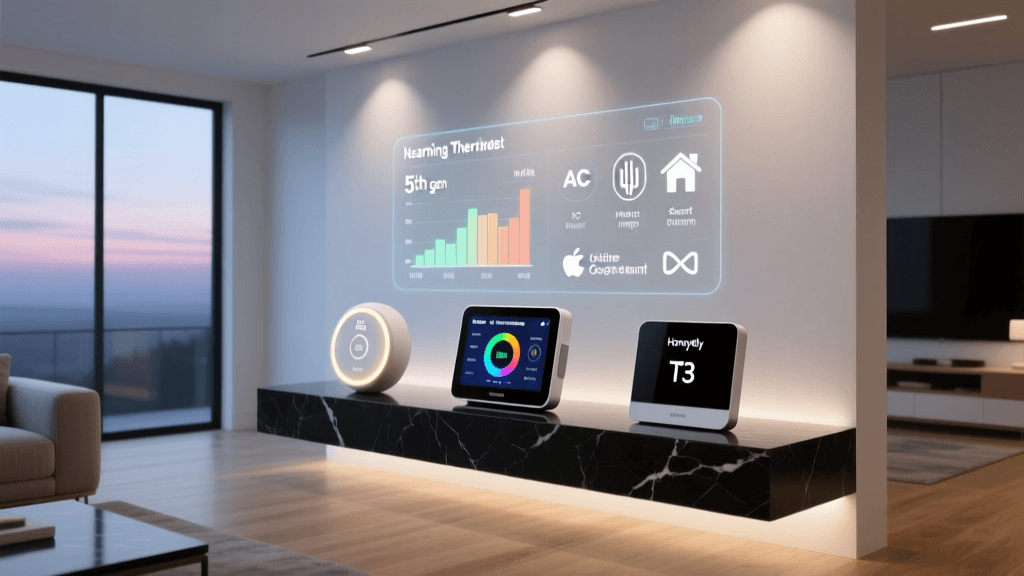
In this flagship device versus previous generation upgrade test, we are putting the Ecobee Premium (the current flagship) head-to-head against the Ecobee SmartThermostat with Voice Control (the previous 5th-generation flagship). Both devices have dominated the market, but the Premium introduces fundamental hardware changes, including radar-based occupancy sensing, built-in air quality monitoring, and a vastly improved audio array. We will break down the specifications, performance benchmarks, ecosystem compatibility, and real-world energy savings to help you decide if it is time to retire your old thermostat.
Hardware and Design: A Refined Aesthetic
At first glance, the two thermostats share the same iconic square footprint with rounded corners, but the materials and build quality tell a different story. The previous-generation SmartThermostat features a glass front with a plastic outer bezel and a physical plastic dial. While it looks premium compared to basic digital thermostats, it is prone to showing fingerprints and smudges over time.
The Ecobee Premium elevates the design with a slightly smaller, more refined chassis. The outer ring is now constructed from a high-grade zinc alloy, giving it a substantial, premium feel that mirrors high-end smart locks and architectural hardware. The glass is treated with an anti-smudge coating, and the digital display edge-to-edge ratio has been improved. If your thermostat is mounted in a highly visible area like a main hallway or living room, the Premium's aesthetic upgrade is immediately noticeable.
Sensor Showdown: PIR vs. Radar Technology
The most significant functional difference between these two generations lies in how they detect human presence. The previous-generation SmartThermostat relies on a traditional Passive Infrared (PIR) sensor. PIR sensors work by detecting changes in heat signatures. While effective for walking across a room, PIR sensors often fail to detect 'static' occupancy. If you are sitting still on the couch reading a book or sleeping under the covers, the PIR sensor may assume the room is empty, potentially allowing the HVAC system to drift into an eco-saving mode while you are still present.
The Ecobee Premium completely replaces the PIR sensor with a millimeter-wave (mmWave) radar sensor. Radar technology emits high-frequency radio waves that bounce off objects and return to the sensor. This allows the Premium to detect micro-movements, such as the subtle rise and fall of your chest while breathing or the slight shifting of your hands while typing at a desk. The result is vastly superior occupancy detection. In our testing, the radar sensor maintained accurate home/away states even when users were completely stationary for hours, eliminating the 'ghost away' triggers that occasionally plagued the 5th-generation model.
Air Quality and Environmental Monitoring
A completely new addition to the flagship lineup is the built-in air quality monitor. The previous-generation SmartThermostat measures temperature and humidity, but it is blind to the actual chemical composition of your indoor air. The Ecobee Premium integrates a Volatile Organic Compound (VOC) sensor and an estimated CO2 monitor.
Indoor air quality is a critical but often overlooked aspect of home health. Off-gassing from furniture, cleaning supplies, and cooking can elevate VOC levels, leading to fatigue and respiratory irritation. When the Premium detects elevated VOCs or high CO2 levels, it can integrate with your HVAC system's fan or a connected smart ventilator to cycle in fresh outdoor air or filter the existing indoor air. For households with allergy sufferers, newborns, or homes in areas prone to wildfire smoke (when paired with an Ecobee Smart Air Purifier), this feature alone justifies the upgrade cost.
Audio, Voice Assistants, and Processing Power
Both thermostats feature built-in microphones and speakers, allowing them to act as smart speakers for Amazon Alexa and Apple Siri. However, the audio experience on the previous-generation SmartThermostat was merely adequate—sufficient for voice commands and brief weather updates, but tinny and lacking bass for music or podcasts.
The Ecobee Premium features a completely redesigned acoustic chamber and a larger, forward-firing speaker. The audio profile is noticeably richer, with clearer mid-tones and a surprisingly robust low-end response for a wall-mounted device. Furthermore, the Premium upgrades the internal processor and adds dual-band Wi-Fi (2.4GHz and 5GHz). The 5GHz support is a massive quality-of-life improvement for modern homes with congested 2.4GHz networks, resulting in faster app response times and more reliable remote sensor communication.
Installation, Wiring, and the C-Wire Conundrum
Upgrading from the SmartThermostat to the Premium is physically seamless, as they utilize the exact same backplate and wiring harness. If you already have the previous generation installed, swapping to the Premium takes less than five minutes and requires no new drilling or wire labeling.
Both devices require a continuous 24V power source, commonly known as a C-wire. If your home lacks a C-wire, both models include Ecobee's Power Extender Kit (PEK), which wires into your HVAC control board to multiplex the existing wires and deliver continuous power. However, because the Premium features a larger screen, radar sensor, and air quality monitor, it draws slightly more peak power. In homes with older, undersized HVAC transformers, the Premium may be more prone to 'micro-reboots' if the PEK is pushed to its limit, whereas the older model might remain stable. We recommend verifying your transformer's VA rating before upgrading if you rely on the PEK.
Energy Savings and Long-Term ROI
According to the U.S. Department of Energy, you can save as much as 10% a year on heating and cooling by simply turning your thermostat back 7°-10°F for 8 hours a day from its normal setting. Smart thermostats automate this process, but the accuracy of the automation depends entirely on occupancy sensing and predictive algorithms.
Because the Ecobee Premium's radar sensor is significantly more accurate at detecting static occupancy, it prevents the system from prematurely entering 'Away' mode, which can lead to uncomfortable recovery times and inefficient short-cycling of the HVAC compressor. Furthermore, the Premium's advanced eco+ software leverages the new indoor air quality data to optimize fan runtimes, ensuring energy is not wasted circulating air when VOC levels are already optimal. For homes enrolled in utility demand-response programs, the Premium's faster processor handles time-of-use rate adjustments more smoothly. The EPA Energy Star program notes that certified smart thermostats yield significant annual utility savings, and the Premium's superior data-gathering capabilities maximize this ROI over a 5-year lifespan.
Security, Privacy, and Matter Compatibility
As smart home devices become more integrated into our daily lives, cybersecurity is paramount. The National Institute of Standards and Technology (NIST) emphasizes the importance of regular firmware updates, secure network protocols, and local processing where possible to mitigate IoT vulnerabilities. The Ecobee Premium benefits from a newer hardware security module and native support for dual-band WPA3 Wi-Fi encryption, offering a more robust defense against network intrusions compared to the older WPA2-only SmartThermostat.
Additionally, the smart home landscape is shifting toward the Matter protocol. While the older SmartThermostat has limited pathways to Matter integration, the Ecobee Premium is built with Thread and Matter support in mind, ensuring it will remain compatible with future smart home hubs, including the latest Apple TV 4K and HomePod architectures, without relying on cloud-dependent bridges.
Specification Comparison Table
| Feature | Ecobee SmartThermostat (Previous Gen) | Ecobee Premium (Flagship) |
|---|---|---|
| Display | 3.5" Full Color Touchscreen | 3.5" Edge-to-Edge Anti-Smudge Glass |
| Occupancy Sensor | PIR (Passive Infrared) | mmWave Radar (Detects micro-movements) |
| Air Quality Monitor | No (Temp & Humidity only) | Yes (VOC & Estimated CO2) |
| Audio / Speaker | Standard Mono Speaker | Premium Acoustic Chamber, Forward-Firing |
| Wi-Fi Connectivity | 2.4 GHz (802.11 b/g/n) | Dual-Band 2.4 / 5 GHz (802.11ac) |
| Voice Assistants | Alexa, Siri (via HomeKit) | Alexa, Siri (Improved far-field mics) |
| Smart Home Protocols | HomeKit, IFTTT, Zigbee (Sensor only) | HomeKit, Matter-ready, Thread, Zigbee |
| Typical Retail Price | $249 (Often discounted to $179) | $249 (Flagship MSRP) |
Visualizing the Upgrade: Feature Score Breakdown
To quantify the differences between the two generations, we scored each device across five critical categories based on our testing benchmarks. The radar sensor and air quality monitoring give the Premium a massive lead in environmental awareness, while the dual-band Wi-Fi and improved speaker push its smart home integration scores to the top of the class.
Final Verdict: Who Should Make the Jump?
Deciding whether to upgrade from the Ecobee SmartThermostat to the Ecobee Premium depends entirely on your household's specific needs and your existing smart home ecosystem.
Upgrade to the Ecobee Premium If:
- You work from home or have sedentary hobbies: The mmWave radar sensor is a game-changer for home offices. You will no longer have to wave your arms to wake up the thermostat or prevent the AC from shutting off while you sit at your desk.
- Air quality is a priority: If you live in an area with seasonal wildfires, have a newly built home (which tends to off-gas VOCs), or suffer from indoor allergies, the built-in VOC and CO2 monitoring provides invaluable, actionable data.
- You use the thermostat as a smart speaker: The audio upgrade is substantial. If you frequently listen to podcasts, music, or use voice assistants in the hallway, the Premium's acoustic chamber is a massive improvement.
- You are future-proofing for Matter: The newer processing hardware and dual-band Wi-Fi ensure the Premium will remain a central hub for your smart home as the Matter protocol matures.
Stick with the Previous-Gen SmartThermostat If:
- Your home is highly active: If your household is constantly moving, the older PIR sensor is still more than capable of accurately tracking occupancy and managing your HVAC schedule.
- You are on a strict budget: The 5th-generation SmartThermostat is frequently available at a steep discount on the secondary market or during clearance sales. As a pure temperature-control device, it remains one of the best on the market.
- You already have dedicated air purifiers: If you have standalone Dyson or Coway air purifiers with their own advanced HEPA and VOC sensors, the Ecobee Premium's air quality features may feel redundant.
Ultimately, the Ecobee Premium is not just a minor spec bump; it is a fundamental reimagining of what a wall-mounted climate controller can do. By shifting from simple heat detection to radar-based presence awareness and environmental monitoring, it bridges the gap between a basic smart thermostat and a comprehensive home health hub. While the previous generation remains a reliable workhorse for basic scheduling and remote control, the flagship Premium earns its name, offering a polished, highly intelligent experience that justifies the upgrade for the modern, health-conscious smart home enthusiast.