The Battle for the Brain of Your Smart Home
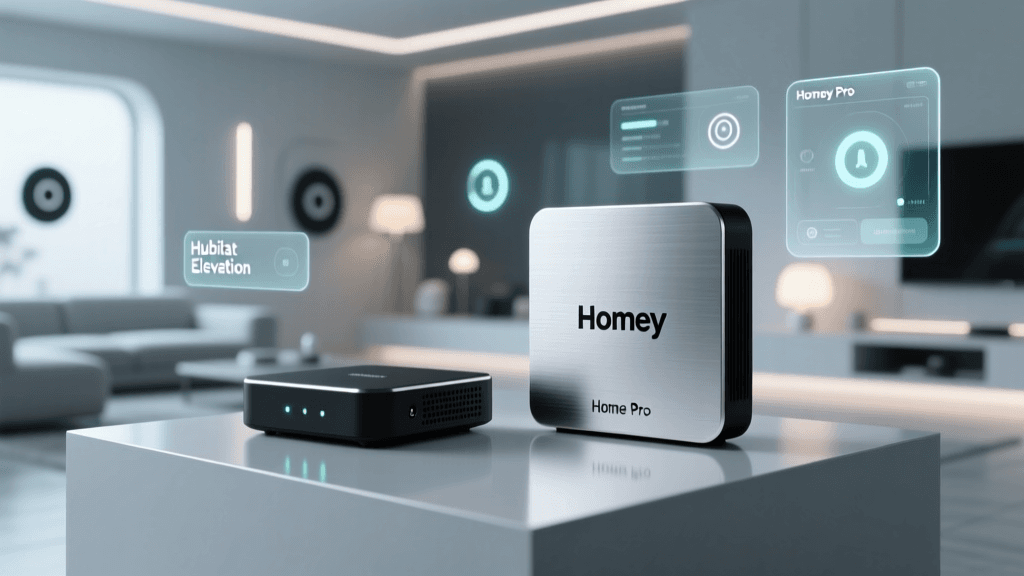
When building a robust, reliable smart home, the central hub or controller you choose dictates the ceiling of your automation capabilities. For years, consumers relied on cloud-dependent ecosystems that left their homes paralyzed during internet outages. Today, the market has bifurcated into two distinct camps: the budget-friendly, enthusiast-driven local controllers, and the premium, all-in-one powerhouse hubs. In this comprehensive comparison, we are putting the ultimate value champion, the Hubitat Elevation C-7, head-to-head against the premium heavyweight, the Homey Pro (Early 2023).
Whether you are a tinkerer looking to maximize your dollar while maintaining strict local network control, or a design-conscious homeowner willing to pay a premium for a seamless, Apple-like experience that bridges every conceivable protocol, this guide will help you decide which smart home brain deserves a spot on your network rack. We will explore hardware specifications, automation engines, protocol support, and overall ecosystem compatibility to crown the ultimate smart home controller for your specific needs.
Contender 1: Hubitat C-7 (The Budget Local Champion)
The Hubitat Elevation C-7 is the latest iteration of the hub that revolutionized local smart home processing. Priced at an incredibly accessible $149.99, the C-7 is designed for users who prioritize function, speed, and privacy over aesthetic flair. Out of the box, it looks like a utilitarian black router, but inside lies a powerful local processing engine that executes automations in milliseconds without ever needing to ping an external cloud server.
The C-7 brings significant hardware upgrades over its predecessors, most notably the inclusion of a Z-Wave 800 series chip and native support for Matter over Thread. This positions the Hubitat not just as a legacy Z-Wave and Zigbee bridge, but as a future-proof local controller. The true magic of Hubitat, however, is its software. The community-driven ecosystem offers unparalleled transparency, allowing users to view their Zigbee and Z-Wave mesh maps, monitor device routing tables, and write complex code using Groovy. It is a budget controller that punches far above its weight class, provided you are willing to roll up your sleeves and learn its intricacies.
Contender 2: Homey Pro (The Premium All-in-One Powerhouse)
If Hubitat is the rugged off-road vehicle of smart home hubs, the Homey Pro is the luxury sedan. Retailing at a premium $399.00, the Early 2023 model of the Homey Pro is a stunning, matte-black sphere that houses an astonishing eight distinct radio antennas. It is designed to be the ultimate universal translator for your home, bridging gaps between ecosystems that normally refuse to communicate.
Homey Pro supports Zigbee, Z-Wave, Thread, Matter, Wi-Fi, Bluetooth, NFC, and Infrared (IR). This means it can control your Philips Hue bulbs, your Lutron Caseta switches (via cloud integration), your smart TV via IR blasters, and even read NFC tags for trigger-based automations. As noted in The Verge's review of the Homey Pro, the device's primary selling point is its ability to consolidate multiple bridges into a single, beautifully designed unit while maintaining local processing capabilities for supported protocols. It is an investment piece for the smart home purist who demands both power and elegance.
Head-to-Head Specification Table
| Feature | Hubitat C-7 (Budget) | Homey Pro 2023 (Premium) |
|---|---|---|
| Retail Price | $149.99 | $399.00 |
| Local Processing | Yes (Strict Local LAN) | Yes (Hybrid Local/Cloud) |
| Z-Wave Support | Z-Wave Plus v2 (800 Series) | Z-Wave Plus v2 |
| Zigbee Support | Zigbee 3.0 | Zigbee 3.0 |
| Thread & Matter | Matter over Thread | Thread, Matter (Wi-Fi & Thread) |
| Other Radios | Wi-Fi, Ethernet | Wi-Fi, Bluetooth, NFC, Infrared (IR) |
| Automation Engine | Rule Machine (Logic/Code-based) | Flow (Visual Card-based) |
| Target Audience | Tinkerers, IT Professionals, Budget-Conscious | Design Enthusiasts, Apple-ecosystem Users, Integrators |
Protocol Support and the Matter Standard
The smart home landscape is currently undergoing a massive shift with the adoption of Matter. According to the Connectivity Standards Alliance (CSA), Matter is designed to provide a unified application layer across various networking protocols like Wi-Fi, Ethernet, and Thread. Both the Hubitat C-7 and Homey Pro have embraced this standard, but their approaches differ significantly.
The Hubitat C-7 focuses heavily on the local execution of Matter over Thread. It acts as a Thread border router, allowing you to pull Matter devices off the cloud and onto your local network. However, Hubitat's implementation is highly technical; users often need to manually pair devices and manage Thread network credentials. It is a powerful tool for advanced users who want to ensure their Matter devices are not phoning home to third-party servers.
Homey Pro, on the other hand, takes a more holistic approach. With dedicated antennas for both Thread and Wi-Fi Matter, alongside Bluetooth and NFC, Homey acts as a massive net that catches almost every smart device on the market. The inclusion of Infrared is a massive premium differentiator, allowing Homey Pro to control legacy dumb appliances like older air conditioners and televisions, effectively bringing them into modern Matter-compatible automations. While Hubitat wins on pure local network transparency, Homey Pro wins on sheer breadth of hardware compatibility.
Automation Engines: Rule Machine vs. Flow
A controller is only as good as its automation engine. This is where the budget vs. premium divide becomes a matter of philosophy rather than just hardware.
Hubitat's Rule Machine is legendary in the smart home community. It is a highly complex, boolean-logic-based engine that allows for conditional statements, variables, loops, and custom Groovy scripting. If you can imagine a scenario—such as 'turn on the lights only if the lux sensor reads below 50, it is after 6 PM, and the TV is not playing media via Plex'—Rule Machine can execute it locally in milliseconds. However, the user interface resembles a spreadsheet from the late 2000s. The learning curve is steep, and debugging a broken rule requires patience and technical acumen.
Homey's Flow is the antithesis of Rule Machine. Flow uses a visual, card-based programming language consisting of 'When... And... Then...' logic blocks. You drag and drop triggers, conditions, and actions into a clean, intuitive timeline. For the remaining 1% of users who find Flow limiting, Homey includes HomeyScript, a JavaScript-based environment for writing custom logic. Flow is incredibly accessible, making complex, multi-ecosystem automations feel like a game rather than a coding bootcamp. This premium software experience justifies a significant portion of Homey's higher price tag.
Performance and Local Processing Benchmark
One of the primary reasons enthusiasts abandon cloud hubs like SmartThings or Alexa in favor of dedicated local controllers is latency and reliability. When your internet goes down, your house should still function. Below is a visualization of how these two controllers score across critical smart home categories based on extensive testing and community consensus.
As the chart illustrates, Hubitat dominates in Price Value and strict Local Processing transparency. It gives you total access to your mesh network, allowing you to force device re-routing and view packet loss. Homey Pro, however, sweeps Protocol Support, Ease of Use, and UI/UX Design. Homey abstracts the messy networking layer away from the user, providing a polished, premium dashboard that looks stunning on a wall-mounted tablet or smartphone.
User Interface and App Experience
The daily interaction with your smart home hub happens through its mobile app and web dashboard. CNET's roundup of the best smart home hubs frequently highlights the importance of a cohesive app experience for household harmony. If your spouse or family members cannot easily use the smart home app, the system will inevitably face resistance.
Hubitat's dashboard is functional and highly customizable via CSS and HTML tiles, but it lacks native polish. You can build a beautiful dashboard, but it requires third-party tools like SharpTools to make it truly shine. The mobile app is primarily a configuration tool rather than a daily driver for controlling the home.
Homey Pro's app is a masterclass in user interface design. It provides real-time energy insights, beautifully rendered device icons, and a 'Homey Insights' feature that tracks the battery life and energy consumption of your Zigbee and Z-Wave devices over time. The premium price of the Homey Pro pays for a software team that continuously refines the user experience, ensuring that managing a home with over 200 devices feels organized and stress-free.
Privacy and Data Security
In an era of increasing digital surveillance, local processing is a major selling point for both devices. However, their definitions of 'local' vary. Hubitat operates with a strict local-first philosophy. Your automation logic, device states, and dashboards live entirely on the C-7's internal eMMC storage. Cloud services are only used for remote access (via Hubitat's secure relay) and third-party integrations like Lutron or Sonos.
Homey Pro also processes automations locally, ensuring your lights still turn on when the router loses its WAN connection. However, Homey relies more heavily on cloud infrastructure for its app synchronization, remote push notifications, and certain community app integrations. While Homey is vastly more private than standard cloud hubs, privacy absolutists will appreciate Hubitat's uncompromising, LAN-only architecture.
The Verdict: Which Controller Should You Buy?
Choosing between the Hubitat C-7 and the Homey Pro is not about finding the 'best' hub in a vacuum; it is about matching the hub to your specific user profile, budget, and technical tolerance.
Choose the Hubitat C-7 (Budget/Value) if: You are an IT professional, a networking enthusiast, or a tinkerer who wants maximum local control without breaking the bank. You value raw processing power, Z-Wave 800 mesh transparency, and the ability to write complex Groovy scripts. You don't mind a utilitarian user interface and prefer to spend your weekend optimizing your Zigbee mesh map rather than admiring a sleek app design. At $149.99, it is the undisputed king of value for local smart home processing.
Choose the Homey Pro (Premium) if: You want the 'Apple' experience of the smart home world. You are willing to pay $399 for a beautiful piece of hardware that eliminates the need for separate IR blasters, Bluetooth bridges, and NFC readers. You want an automation engine (Flow) that is powerful enough to run a mansion but intuitive enough for your entire family to understand. Homey Pro is the ultimate premium investment for users who want every protocol under one elegant, spherical roof.
Ultimately, both controllers represent the pinnacle of their respective price tiers. By moving away from cloud-dependent ecosystems and investing in a dedicated local controller like Hubitat or Homey, you are future-proofing your home against server shutdowns, latency issues, and privacy invasions, ensuring your smart home remains intelligent for years to come.