The Evolution of Smart Lighting: Setting the Stage
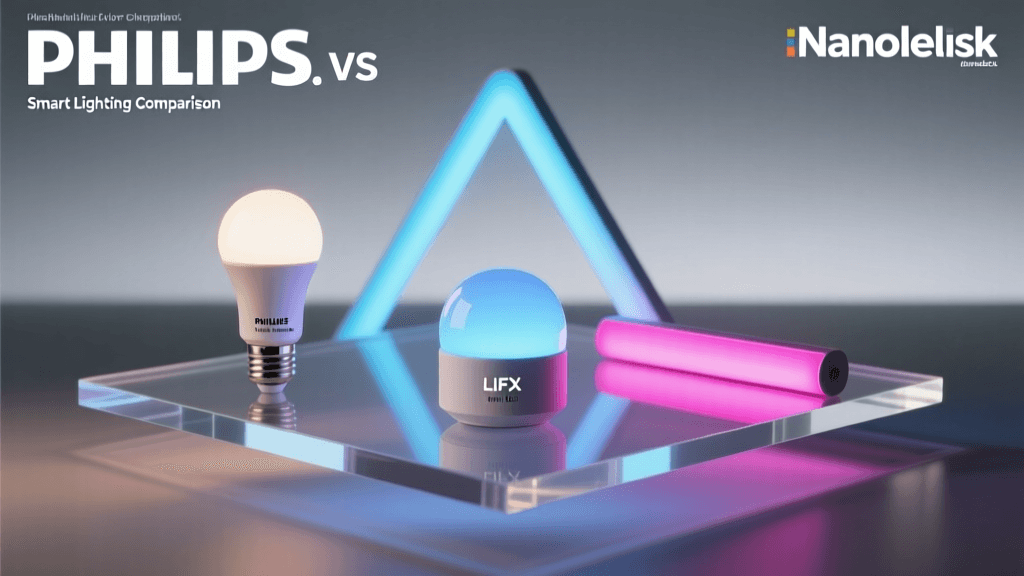
Smart lighting has transitioned from a niche luxury for tech enthusiasts to a foundational pillar of the modern connected home. When it comes to outfitting your space with intelligent illumination, three titans dominate the premium market: Philips Hue, LIFX, and Nanoleaf. Each brand approaches the smart home from a fundamentally different philosophy. Philips Hue relies on a robust, hub-based mesh network to guarantee reliability. LIFX champions hubless, high-powered Wi-Fi bulbs that deliver unparalleled color vibrancy. Nanoleaf bridges the gap between functional lighting and modular art, while pioneering the ultra-low-latency Thread protocol.
Choosing between these three ecosystems is not merely about picking a light bulb; it is about selecting a networking protocol, an app experience, and a long-term smart home strategy. In this comprehensive showdown, we will dissect the hardware specifications, network protocols, ecosystem compatibility, and overall value of Philips Hue, LIFX, and Nanoleaf to help you determine which system deserves a place in your home.
Philips Hue: The Gold Standard of Reliability
Philips Hue, developed by Signify, is widely considered the pioneer and reigning champion of consumer smart lighting. The cornerstone of the Hue ecosystem is the Hue Bridge, a central hub that connects to your router via Ethernet and communicates with the bulbs using a local mesh network (historically Zigbee, and increasingly Matter over Thread). This architecture ensures that your lights operate independently of your Wi-Fi network's congestion and can execute complex automations locally, even if your internet connection drops.
The Philips Hue White and Color Ambiance A19 bulb is the benchmark against which all other smart bulbs are measured. While its maximum brightness of 800 lumens (equivalent to a 60W incandescent) is slightly lower than some competitors, its color accuracy, dimming smoothness, and transition speeds are flawless. The Hue app offers the most mature and feature-rich experience on the market, including dynamic scenes, geofencing, and native integration with virtually every smart home platform on the planet.
Furthermore, the Hue ecosystem extends far beyond standard bulbs. The lineup includes outdoor lighting, smart plugs, motion sensors, the Play HDMI Sync Box for immersive TV lighting, and the Hue Secure camera. However, this premium reliability comes at a premium price. A standard color bulb retails for around $55, and you must factor in the cost of the Bridge (often included in starter kits for around $130). For users who demand rock-solid reliability and expansive ecosystem growth, Hue remains the undisputed king.
LIFX: Hubless Brilliance and Vibrant Colors
LIFX (pronounced "Life-X") took the market by storm by eliminating the need for a central hub. LIFX bulbs connect directly to your home's 2.4GHz Wi-Fi network. This hubless approach lowers the barrier to entry for beginners and renters who may not want to manage extra hardware. The standout feature of LIFX is its sheer luminosity and color saturation. The LIFX Color A21 pushes an astonishing 1100 lumens (75W equivalent), making it significantly brighter than Hue's standard offerings, and its deep reds and blues are notoriously more vibrant than the competition.
Beyond standard illumination, LIFX has carved out unique niches with specialized hardware. The LIFX Clean bulb emits High Energy Visible (HEV) light to reduce surface bacteria, while the LIFX Nightvision bulb incorporates built-in infrared LEDs to enhance the performance of your smart home security cameras in the dark. The LIFX app is visually stunning and includes features like "Paint," which allows you to apply multiple colors to a single bulb, and "Move," which animates those colors across the bulb's surface.
However, the hubless design is a double-edged sword. Wi-Fi was not designed to handle dozens of constantly listening IoT devices. If you install 20 LIFX bulbs, you may experience network congestion, delayed response times, or dropped connections unless you have a high-end, enterprise-grade Wi-Fi router. Additionally, LIFX lacks the extensive accessory ecosystem of Hue, focusing primarily on bulbs and a few light strips.
Nanoleaf: Modular Art and Thread Pioneers
Nanoleaf approaches smart lighting from an entirely different angle: decor and next-generation networking. While they offer standard A19 bulbs under their Essentials line, Nanoleaf is most famous for its modular, geometric light panels like the Shapes Hexagons, Canvas, and Lines. These panels snap together magnetically, allowing users to create custom, touch-reactive murals on their walls and ceilings that double as acoustic dampeners and high-end art pieces.
On the technical front, Nanoleaf is a pioneer in adopting Thread, a low-power, low-latency mesh networking protocol. The Nanoleaf Essentials line was among the very first consumer products to support Matter over Thread. When paired with a Thread Border Router (like an Apple HomePod Mini or Amazon Echo 4th Gen), Nanoleaf Essentials bulbs respond instantaneously to commands, often outperforming both Wi-Fi and traditional Zigbee setups in speed. Furthermore, because Thread is a mesh protocol, every Nanoleaf bulb acts as a signal repeater, strengthening the network as you add more devices.
The primary drawback of Nanoleaf's modular panels is their steep cost and complex installation process, which requires mounting tape and physical routing of connector pins. Their standard Essentials bulbs, while incredibly affordable at around $20 each, have a more utilitarian app experience compared to the polished interfaces of Hue and LIFX. Nanoleaf is the ideal choice for users who want statement wall art or early adopters eager to build a Thread-based Matter ecosystem.
Head-to-Head Specification Comparison
To understand how these ecosystems stack up on paper, review the core specifications of their flagship color offerings below.
| Feature | Philips Hue (Color Ambiance) | LIFX (Color A21) | Nanoleaf Essentials (A19) |
|---|---|---|---|
| Primary Protocol | Zigbee / Matter over Thread | Wi-Fi (2.4GHz) | Bluetooth / Matter over Thread |
| Hub Required? | Yes (Hue Bridge) | No | No (Border Router for Thread) |
| Max Brightness | 800 Lumens (60W) | 1100 Lumens (75W) | 800 Lumens (60W) |
| Color Temperature | 2200K - 6500K | 1500K - 9000K | 2700K - 6500K |
| Avg. Price per Bulb | $54.99 | $44.99 | $19.99 |
| Ecosystem Breadth | Massive (Indoor/Outdoor/Sync) | Moderate (Bulbs/Strips/Switches) | Unique (Modular Panels + Bulbs) |
Smart Bulb Pricing Comparison
Protocol Wars: Zigbee vs. Wi-Fi vs. Thread
The most critical difference between these three brands lies beneath the plastic casing: the networking protocol. Understanding these protocols is essential for long-term smart home stability.
Zigbee (Philips Hue)
Zigbee is a battle-tested, low-power mesh network. Because it operates on the 2.4GHz spectrum but uses a different channel than standard Wi-Fi, it avoids network congestion. The Hue Bridge handles all local processing, meaning automations execute in milliseconds. The limitation is that Zigbee is proprietary to the bridge; if the bridge dies, your smart lights revert to dumb lights until a replacement arrives.
Wi-Fi (LIFX)
Wi-Fi offers high bandwidth, which is great for firmware updates and complex color gradients, but it is power-hungry and prone to congestion. Most consumer routers struggle to maintain stable connections with more than 30-40 IoT devices. If your internet goes down, local control of LIFX bulbs can become erratic unless properly configured with a local smart home hub like Home Assistant.
Thread (Nanoleaf Essentials)
Thread represents the future of smart home networking. According to the Thread Group, Thread is an IP-based, low-power mesh protocol that eliminates single points of failure. Unlike Zigbee, Thread does not rely on a single proprietary hub. Instead, it uses "Border Routers" built into devices you likely already own, such as Apple TVs, HomePods, and newer Nest hubs. If one border router goes offline, the mesh automatically reroutes through another. Nanoleaf's early adoption of Thread makes their Essentials line incredibly fast and resilient.
Ecosystem Compatibility and the Matter Standard
For years, smart home buyers were forced into walled gardens. If you bought Hue, you were tied to the Hue app. Today, the landscape is shifting dramatically thanks to Matter, the new unified smart home standard backed by Apple, Google, Amazon, and Samsung. The Connectivity Standards Alliance (CSA) developed Matter to ensure that devices communicate seamlessly across different ecosystems without relying on cloud-to-cloud integrations.
- Philips Hue: Signify has rolled out Matter support via firmware updates to the Hue Bridge. This means your existing Zigbee Hue bulbs can now be exposed to Matter-compatible controllers (like Apple Home or Google Home) natively, without sacrificing the advanced features of the Hue app.
- LIFX: LIFX has historically relied on cloud-based integrations for Alexa and Google Home, and AirPlay 2 for Apple. While they have announced Matter roadmaps, their Wi-Fi architecture requires more complex firmware bridging to support Matter natively compared to Thread-based devices.
- Nanoleaf: As a Thread pioneer, Nanoleaf Essentials are natively Matter-certified. They can be commissioned directly into Apple Home, Google Home, or Amazon Alexa via QR code, offering instant local control and grouping capabilities across mixed-brand setups.
Energy Efficiency and Long-Term Savings
While smart bulbs carry a higher upfront cost than standard LEDs, their intelligent scheduling and dimming capabilities can lead to long-term energy savings. According to the U.S. Department of Energy, residential LED lighting uses at least 75% less energy, and lasts 25 times longer, than incandescent lighting. Smart systems amplify these savings through automation.
For example, Philips Hue's native geofencing and motion sensor integrations ensure lights are never left on in empty rooms. LIFX's deep dimming capabilities (down to 1500K) reduce power draw significantly during evening hours. Nanoleaf's Thread protocol is inherently designed for ultra-low power consumption, reducing the standby energy draw of the bulbs themselves. When calculating the total cost of ownership, the energy savings and the 25,000+ hour lifespan of these premium LEDs help offset their initial purchase price over a 5-to-10-year period.
Entertainment Syncing: Beyond Illumination
Smart lighting is no longer just about seeing in the dark; it is about immersive entertainment. All three brands offer screen-syncing technologies, but their execution varies wildly.
Philips Hue offers the most premium (and expensive) solution with the Hue Play HDMI Sync Box. This hardware intercepts your TV's HDMI signal, analyzing the colors on the screen in real-time and projecting them onto surrounding Hue bulbs and light strips. The result is a seamless, theater-like experience that extends the edges of your television.
LIFX utilizes a software-based approach called LIFX Beat. Beat analyzes the audio output or screen colors from your PC or smartphone and pulses your LIFX bulbs to the rhythm of your music or the action in your games. While impressive, it can suffer from slight latency compared to Hue's hardware-based processing.
Nanoleaf excels in ambient music visualization. Their modular panels feature built-in microphones that react to the beat of the music in the room, creating stunning, rhythmic light shows that turn your wall art into a visual equalizer.
The Final Verdict: Which System Wins?
There is no single "best" smart lighting system; the winner depends entirely on your specific user profile, budget, and technical comfort level.
Choose Philips Hue If:
You are the Smart Home Purist. If you want a massive, unified ecosystem that includes outdoor lights, security cameras, and HDMI sync boxes, and you value rock-solid, local reliability over absolute peak brightness, Hue is the undisputed champion. The requirement of a hub is a small price to pay for a system that simply works, every single time, without burdening your Wi-Fi network.
Choose LIFX If:
You are the Renter or Color Enthusiast. If you want to start with just one or two incredibly bright, vibrant bulbs without buying extra hubs or bridges, LIFX is your best bet. It is also the superior choice for specialized use cases, such as boosting security camera night vision or utilizing HEV light for surface cleaning. Just be mindful of your router's capacity if you plan to scale up to dozens of bulbs.
Choose Nanoleaf If:
You are the Decorator and Early Adopter. If you view lighting as an extension of your interior design, Nanoleaf's modular Shapes and Canvas lines offer a creative experience that neither Hue nor LIFX can match. Furthermore, if you are heavily invested in the Apple HomeKit ecosystem or want to future-proof your home with the ultra-fast, low-latency Matter over Thread protocol, the Nanoleaf Essentials line offers the best price-to-performance ratio on the market.
Ultimately, thanks to the rollout of the Matter standard, you no longer have to pledge absolute loyalty to just one brand. You can mix the reliable mesh of Philips Hue in your living room, the vibrant brilliance of LIFX in your reading nook, and the Thread-powered efficiency of Nanoleaf in your bedroom, all controlled from a single, unified smart home dashboard.