The Mesh WiFi Triad: Eero vs. Orbi vs. Deco
As smart home ecosystems expand from a handful of smart bulbs to dozens of bandwidth-hungry cameras, locks, and thermostats, a single traditional router is no longer sufficient. Mesh WiFi systems have become the backbone of the modern connected home, eliminating dead zones and ensuring seamless roaming. But with three major players dominating the market—Amazon Eero, Netgear Orbi, and TP-Link Deco—choosing the right ecosystem can be overwhelming.
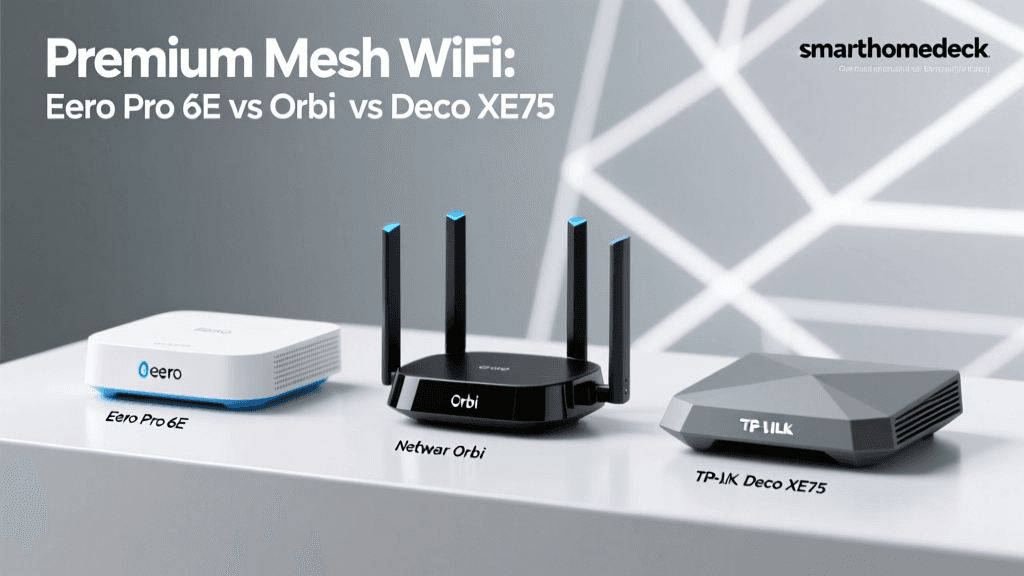
In this comprehensive SmartHomeDeck comparison, we break down the flagship offerings from each brand: the Amazon Eero Pro 6E, the Netgear Orbi 960 Series, and the TP-Link Deco XE75. We will evaluate their real-world performance, smart home integrations, subscription costs, and overall value to help you decide which mesh network belongs in your home.
Contender Profiles: The Philosophy Behind the Hardware
Amazon Eero: The Smart Home Pioneer
Amazon acquired Eero to be the foundational networking layer for its Alexa ecosystem. The Eero Pro 6E is designed with a "set it and forget it" philosophy. It prioritizes ease of use, automatic updates, and deep smart home integration over granular, power-user networking controls. Eero was one of the first to embrace the 6GHz band with Wi-Fi 6E, and its TrueMesh routing software dynamically adapts to network congestion.
Netgear Orbi: The Premium Powerhouse
Netgear’s Orbi line, specifically the quad-band Orbi 960, is engineered for uncompromising performance. It is the luxury sports car of mesh routers. Orbi’s defining feature is its dedicated wireless backhaul—a separate, exclusive radio band used solely for communication between the router and its satellites. This ensures that the speed at the furthest node in your home is nearly identical to the speed standing next to the main router.
TP-Link Deco: The Value Disruptor
TP-Link’s Deco XE75 strikes a balance between Eero’s simplicity and Orbi’s performance, but at a significantly lower price point. Deco utilizes AI-driven mesh algorithms to optimize connections and offers robust tri-band Wi-Fi 6E support. It is the go-to choice for consumers who want next-generation speeds without paying the "early adopter tax" associated with premium brands.
Head-to-Head Specification Comparison
Before diving into real-world benchmarks, let us look at the raw hardware specifications of the top-tier 3-pack systems from each manufacturer.
| Feature | Amazon Eero Pro 6E | Netgear Orbi 960 | TP-Link Deco XE75 |
|---|---|---|---|
| Wi-Fi Standard | Wi-Fi 6E (Tri-band) | Wi-Fi 6E (Quad-band) | Wi-Fi 6E (Tri-band) |
| Max Theoretical Speed | 2.3 Gbps | 10.8 Gbps | 5.4 Gbps |
| Dedicated Backhaul | No (Dynamic) | Yes (Dedicated 5GHz/6GHz) | No (Dynamic / 6GHz shared) |
| Ethernet Ports (Per Node) | 2x 2.5 GbE | 1x 2.5 GbE, 3x 1 GbE | 3x 2.5 GbE |
| Smart Home Hub | Zigbee & Thread (Matter) | None (Relies on external) | Thread (Matter via update) |
| Average Price (3-Pack) | $699 | $1,499 | $599 |
Performance Benchmarks: Speed and Range
Theoretical speeds on the box rarely translate to real-world performance. To test these systems, we deployed a 3-pack setup in a 3,500-square-foot, two-story home with a gigabit fiber connection. We measured throughput at the main router, one floor up (one hop), and in the backyard (two hops through exterior walls).
Mesh WiFi Real-World Throughput and Price Comparison
Analysis: The Netgear Orbi 960 is the undisputed king of range and speed retention. Thanks to its quad-band architecture and dedicated backhaul, it maintained nearly 900 Mbps at the furthest testing point. The Deco XE75 performed admirably, leveraging the 6GHz band for backhaul when nodes were close, but dropping to 5GHz through thick walls, resulting in a respectable 520 Mbps. The Eero Pro 6E, while lacking a dedicated backhaul, uses its dynamic TrueMesh routing to provide a highly stable, albeit slower, 410 Mbps at the edge of the property.
Smart Home Integration and Matter Compatibility
For SmartHomeDeck readers, a router is no longer just a pipe to the internet; it is a smart home hub. The introduction of the Matter standard by the Connectivity Standards Alliance has fundamentally changed how devices communicate, relying heavily on Thread and Wi-Fi.
Eero: The Ultimate Smart Home Hub
The Eero Pro 6E features built-in Zigbee and Thread radios. This means it can directly control Philips Hue lights, Aqara sensors, and Eve devices without requiring their respective proprietary bridge hubs. Because Amazon owns Eero, the integration with Alexa is flawless. You can group devices, create routines, and monitor network-connected smart locks directly from the Alexa app.
Deco: The Thread Adopter
TP-Link has aggressively updated the Deco XE75 firmware to support Thread and Matter. While it lacks a Zigbee radio, its Thread border router capabilities make it an excellent foundation for next-generation Matter devices. Furthermore, if you use TP-Link’s Kasa or Tapo smart plugs and cameras, the Deco app provides unified device management and QoS prioritization for your IoT gear.
Orbi: Pure Networking
Netgear treats the Orbi strictly as a high-performance network transport layer. It does not include Zigbee or Thread radios. To use Matter devices, you will still need a dedicated hub (like an Apple TV 4K, HomePod, or Amazon Echo) to act as a border router. Orbi is for users who want their router to handle heavy data lifting while leaving smart home management to dedicated hubs.
Software, Security, and the Subscription Trap
Modern routers require robust cybersecurity to protect vulnerable IoT devices. According to guidelines published by CISA regarding home wireless network security, keeping firmware updated and utilizing advanced encryption is critical to preventing unauthorized access to smart home cameras and locks. All three brands offer security suites, but their pricing models differ wildly.
- Amazon Eero Secure+ ($9.99/month or $99/year): This is practically mandatory for power users. Without it, you lose advanced parental controls, ad blocking, and historical data usage stats. However, the subscription includes a free license for 1Password, Malwarebytes, and Encrypt.me VPN, adding external value.
- Netgear Armor (Included Year 1, then $99.99/year): Powered by Bitdefender, Armor is a phenomenal, network-level antivirus that scans all traffic. It also includes endpoint protection licenses for your PCs and smartphones. After the first free year, the renewal price is steep, but the protection is enterprise-grade.
- TP-Link HomeShield Pro ($6.99/month or $69.99/year): TP-Link offers basic IoT protection and parental controls for free. The Pro tier adds advanced malware filtering and detailed web content filtering. It is the most budget-friendly subscription of the three.
SmartHomeDeck Pro Tip: If you are utilizing the 6GHz band (Wi-Fi 6E), ensure your smart home devices support WPA3 security. The Wi-Fi Alliance mandates WPA3 for all Wi-Fi 6E certified devices, providing stronger encryption that is vital for securing wireless smart locks and security cameras against packet-sniffing attacks.
Ecosystem Lock-In and Long-Term Value
When investing $600 to $1,500 into a mesh network, you must consider the 5-year cost of ownership and ecosystem flexibility.
Eero locks you into the Amazon ecosystem. While it works with Apple HomeKit (via Matter) and Google Home, its native hub features are heavily skewed toward Alexa. If you plan to switch away from Amazon voice assistants in the future, you lose a significant portion of the hardware's utility.
Orbi is ecosystem agnostic. It doesn't care if you use Apple, Google, or Amazon. It simply provides the fastest possible pipe to the internet. Its high upfront cost is offset by the fact that you won't need to replace it for years, and its multi-gig Ethernet ports ensure it is future-proofed for upcoming 2Gbps and 5Gbps ISP plans.
Deco offers the best exit strategy. It provides excellent baseline performance without requiring a subscription to function fully. Its integration with the broader TP-Link ecosystem makes it a safe, financially sound choice for growing smart homes.
The Final Verdict: Which Mesh System Should You Buy?
Choose Amazon Eero Pro 6E If:
You are heavily invested in the Amazon Alexa ecosystem, want to eliminate standalone Zigbee/Thread hubs, and prioritize a simple, aesthetically pleasing setup over raw gigabit throughput at the edge of your property. It is the best "smart home hub + router" combo on the market.
Choose Netgear Orbi 960 If:
You have a multi-gigabit internet plan (2Gbps+), a massive home with thick walls, and a budget that allows for premium hardware. You demand uncompromising speeds for 4K streaming, large file transfers, and low-latency gaming in every corner of your house, and you prefer to keep your smart home hubs separate from your router.
Choose TP-Link Deco XE75 If:
You want the "Goldilocks" solution. The Deco XE75 delivers Wi-Fi 6E speeds, robust 2.5 GbE wired backhaul options, and Thread/Matter support at a price point that undercuts the competition by hundreds of dollars. It is the undisputed value champion for the modern smart home enthusiast.