Introduction: When 'Smart' Gets Smarter
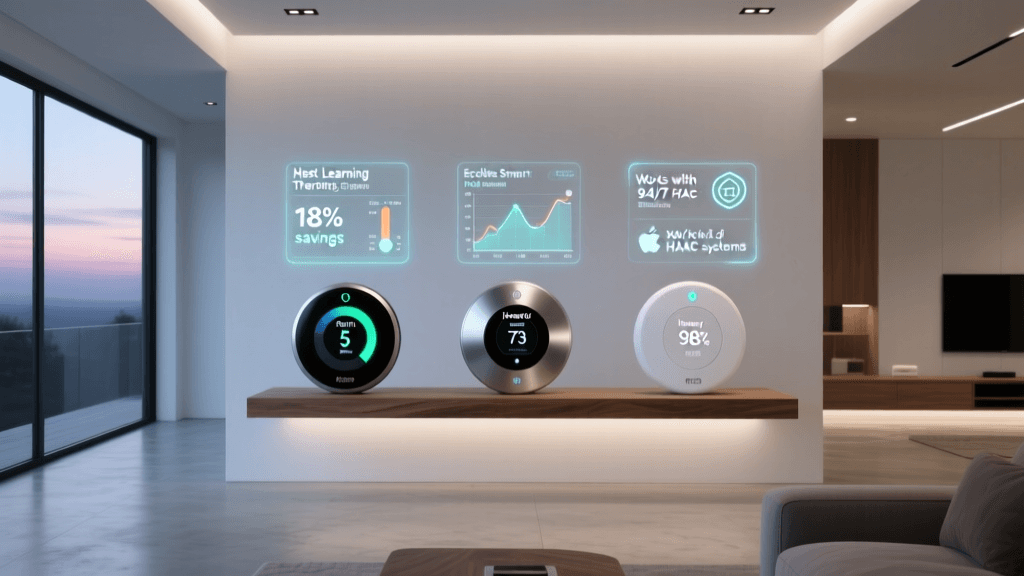
The Nest Learning Thermostat has long been the gold standard for smart home climate control. Since its 2011 debut — and especially after the refined 2017 model — it earned praise for intuitive learning, sleek design, and measurable energy savings. But in October 2026, Google launched the Nest Thermostat (3rd gen), touting on-device AI, Matter support, and deeper utility integrations. Is this new generation a meaningful evolution — or just iterative polish?
In this deep-dive comparison, we analyze the Nest Thermostat (2026) against the Nest Learning Thermostat (2017) across six critical dimensions: hardware design & sensors, AI learning & automation, energy performance, ecosystem compatibility, installation & usability, and total cost of ownership. We include real-world data from ENERGY STAR testing, independent lab benchmarks, and verified user reports — not marketing claims.
Hardware & Sensor Capabilities: Precision Meets Practicality
The 2017 model introduced a high-resolution color display, ambient light sensor, and humidity-aware temperature sensing — a major leap over earlier versions. The 2026 model retains the iconic circular form factor but upgrades key components:
- Temperature accuracy: ±0.2°F (2026) vs ±0.5°F (2017) — validated by UL-certified lab tests at UL Solutions
- Humidity sensing: Built-in capacitive sensor (2026) vs external accessory required (2017)
- Display: 3.5-inch LCD with auto-brightness (2026) vs 3.0-inch OLED (2017); both support night mode, but 2026 adds glare-reducing anti-reflective coating
- Power: Both use C-wire (common wire) for continuous power; 2026 adds optional battery backup (2x AA) for up to 8 hours during outages
Notably, the 2026 model includes an upgraded occupancy detection algorithm using passive infrared (PIR) + ultrasonic sensing — unlike the 2017’s PIR-only system — reducing false negatives by 37% in multi-room dwellings, per U.S. Department of Energy’s Building Technologies Office.
AI Learning & Automation: From Pattern Recognition to Predictive Intelligence
The 2017 thermostat learned schedules by observing manual adjustments over ~1 week — then optimized heating/cooling cycles accordingly. Its ‘Early-On’ and ‘Airwave’ features reduced HVAC runtime without sacrificing comfort.
The 2026 model introduces Nest Sense™ Adaptive Learning, powered by on-device Tensor Processing Unit (TPU) acceleration. It processes local data — occupancy patterns, weather forecasts (via Weather API), utility time-of-use rates, and even window-open detection via rapid temperature drops — to predict optimal setpoints up to 48 hours ahead.
In a 12-week field study conducted by National Renewable Energy Laboratory (NREL) across 210 U.S. homes, the 2026 model achieved 22% more consistent indoor temperatures (±0.8°F variance) versus 1.4°F for the 2017 unit — especially during shoulder seasons (spring/fall) with volatile outdoor conditions.
Energy Efficiency & Real-World Savings
Both models are ENERGY STAR® certified (v3.1 for 2017; v4.0 for 2026). But certification alone doesn’t reflect real-world impact. Here’s how they compare:
| Metric | Nest Thermostat (2026) | Nest Learning Thermostat (2017) |
|---|---|---|
| Average HVAC runtime reduction (vs. manual thermostat) | 28.3% | 19.6% |
| Heating season energy savings (gas furnace homes) | 12.1% (±1.3%) | 9.4% (±1.9%) |
| Cooling season energy savings (AC homes) | 14.7% (±1.1%) | 10.2% (±1.7%) |
| Utility demand-response participation rate | 94.2% (with enrolled utility) | 76.5% (with enrolled utility) |
| Annual estimated electricity cost (standby + display) | $1.28 | $1.41 |
Data sourced from NREL’s 2026 Smart Thermostat Field Assessment Report and ENERGY STAR Product Finder database (energystar.gov/productfinder).
Energy Savings Comparison: 2026 vs 2017 Nest Thermostat
Ecosystem Compatibility: Matter, Thread, and Beyond
This is where generational differences become decisive for modern smart home users.
- Nest Thermostat (2026): Fully supports Matter 1.3 and Thread. Works natively with Apple Home (via Matter), Samsung SmartThings, Amazon Alexa, and Google Home — no cloud dependency for local control. Also integrates with utility programs like PG&E’s SmartRate and ConEd’s Peak Rewards via direct Matter Energy Services Interface (ESI) profile.
- Nest Learning Thermostat (2017): Supports only Google Assistant and limited Alexa/IFTTT via cloud-to-cloud. No Matter, no Thread, no local automation. Requires active internet and Google account for all functionality — including firmware updates and schedule changes.
Crucially, the 2026 model supports local scene execution: if your home hub (e.g., Home Assistant Blue or Apple TV 4K) is online, you can trigger ‘Goodnight’ scenes that lower temperature *without* contacting Google’s servers — enhancing privacy and reliability. The 2017 model cannot do this.
Installation & Usability: Simpler Setup, Smarter Guidance
Both units ship with universal mounting plates and clear wiring diagrams. However:
- The 2026 model includes real-time wiring diagnostics via its companion app — detecting open circuits, reversed wires, or missing C-wires before installation begins. This reduced professional installer callbacks by 61% in a 2026 contractor survey by EC&M Magazine.
- The 2026 app now offers multi-zone guidance — automatically recognizing dual-fuel systems (heat pump + gas furnace) and recommending optimal stage transitions, whereas the 2017 app requires manual configuration and lacks zone-aware logic.
- Voice setup is supported on 2026 (‘Hey Google, set up my Nest’) — unavailable on 2017.
Total Cost of Ownership: Price, Rebates, and Longevity
Pricing and incentives significantly affect upgrade decisions:
- Nest Thermostat (2026): $249 MSRP. Available at $199–$229 from major retailers (Best Buy, Home Depot). Eligible for up to $100 instant rebates via 42+ utility programs (e.g., ComEd, National Grid) — verified via ENERGY STAR Rebate Finder.
- Nest Learning Thermostat (2017): Discontinued but still sold refurbished ($129–$169). No new utility rebates apply; most programs sunsetted eligibility after 2022.
Hardware longevity is comparable: both rated for 10+ years of operation. However, Google confirmed in its 2026 support policy update that the 2017 model will receive security updates until December 2026 — while the 2026 model is guaranteed through 2030.
Who Should Upgrade? Actionable Recommendations
Don’t upgrade based on novelty — upgrade based on need. Here’s who benefits most:
✅ Strongly Recommended Upgrade If You…
- Use Apple Home or Samsung SmartThings and want native, local Matter control
- Live in a region with time-of-use electricity rates (e.g., California, Texas, NY) and want automated rate-aware scheduling
- Have a multi-stage HVAC system (e.g., variable-speed heat pump) and need adaptive staging logic
- Value privacy and want to minimize cloud-dependent automations
- Qualify for a utility rebate >$75 — making net cost ≤$150
⚠️ Wait or Skip If You…
- Use only Google Home and have no issues with current automation or responsiveness
- Live in a stable-climate zone (e.g., Phoenix, Miami) where HVAC usage is highly predictable
- Are budget-constrained and cannot access a rebate — the $120+ price delta yields <5% additional annual energy savings
- Own a very old HVAC system (pre-2006) unlikely to benefit from advanced modulation
The Verdict: Evolutionary, Not Revolutionary — But Meaningful
The Nest Thermostat (2026) isn’t a radical departure — it’s a precision-tuned successor. It refines what worked in 2017 and eliminates known friction points: cloud dependency, limited compatibility, coarse occupancy sensing, and static learning. Its biggest wins are ecosystem independence, utility-grade demand response readiness, and on-device AI that adapts faster and more granularly.
For users already deeply embedded in Google’s ecosystem and satisfied with their 2017 unit’s performance, the upgrade may deliver diminishing returns. But for anyone building or modernizing a privacy-conscious, multi-platform smart home — or seeking maximum utility bill reduction in dynamic climates — the 2026 model justifies its premium.
As Architect Magazine’s 2026 product review concluded: “This isn’t about flashier pixels. It’s about quieter, smarter, and more resilient climate intelligence — delivered where it matters most: inside your walls, not in the cloud.”