The Evolution of the Premium Smart Speaker
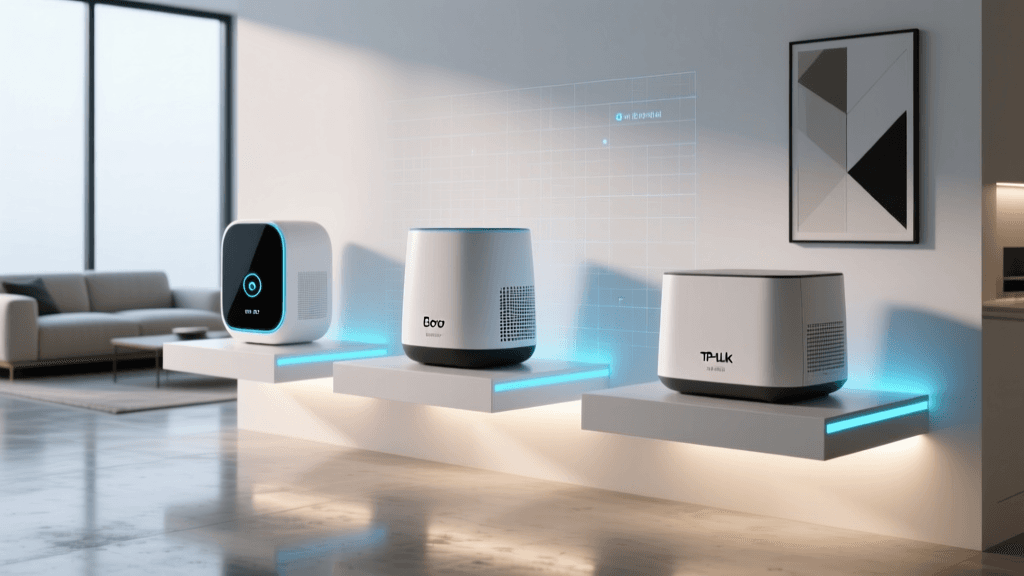
The smart speaker market has matured significantly over the last few years. What began as a race to produce the most affordable novelty internet radio has evolved into a highly competitive arena of audiophile-grade soundbars, spatial audio hubs, and central smart home controllers. For smart home enthusiasts and audio purists alike, the flagship offerings from Amazon, Google, and Apple represent the pinnacle of this convergence. But when you pit the Amazon Echo Studio against the Google Nest Audio and the Apple HomePod (2nd Generation), which ecosystem truly deserves the prime real estate in your living room?
At SmartHomeDeck, we do not just look at the sound quality; we evaluate the underlying smart home protocols, voice assistant latency, ecosystem lock-in, and long-term viability through the lens of the new Matter standard. In this comprehensive head-to-head comparison, we break down the hardware specifications, acoustic performance, and smart home integration capabilities of the big three premium smart speakers to help you make an informed purchasing decision.
The Flagship Contenders: Profiles and Pricing
Amazon Echo Studio ($199.99)
Amazon's answer to high-fidelity audio is the Echo Studio. Priced aggressively at $199.99, it undercuts its primary premium rival while offering a robust feature set that includes Dolby Atmos support, spatial audio processing, and a built-in Zigbee smart home hub. It is designed to be the acoustic anchor of the Alexa ecosystem, doubling as a home theater center when paired with a Fire TV.
Google Nest Audio ($99.99)
Google takes a slightly different approach with the Nest Audio. While it is technically positioned as a mid-tier device in Google's broader lineup (with the Nest Hub Max taking the visual premium spot), the Nest Audio is Google's dedicated audiophile speaker. At just $99.99, it offers incredible value, focusing on clean, room-filling stereo sound and seamless Google Assistant integration. Its true power is unlocked when you purchase two and pair them in a stereo configuration.
Apple HomePod 2nd Generation ($299.00)
Apple's re-entry into the premium audio space is the HomePod (2nd Gen). Priced at a steep $299.00, it is the most expensive option in this lineup. However, it justifies its cost through Apple's proprietary computational audio, spatial awareness, and deep integration into the Apple HomeKit and Matter ecosystems. It is a device built exclusively for those already entrenched in the Apple hardware ecosystem.
Hardware Specifications and Audio Architecture
To understand how these devices perform, we must first look at the acoustic engineering and internal hardware that drives them. Below is a detailed specification table comparing the core hardware elements of each flagship speaker.
| Feature | Amazon Echo Studio | Google Nest Audio | Apple HomePod (2nd Gen) |
|---|---|---|---|
| Price (MSRP) | $199.99 | $99.99 | $299.00 |
| Tweeters | 3 x 20mm | 1 x 19mm | 5 x Horn-loaded |
| Mid-Range | 1 x 52mm | N/A | N/A |
| Woofer | 1 x 146mm | 1 x 75mm | 1 x High-excursion |
| Spatial Audio | Yes (Dolby Atmos) | No | Yes (Dolby Atmos) |
| Room Calibration | Automatic Room Tuning | Fixed DSP / Ambient IQ | Computational Room Sensing |
| Smart Home Radios | Zigbee, Thread, Matter | Wi-Fi / Bluetooth only | Thread, Matter |
| Dimensions | 8.1 x 6.9 x 6.9 in | 6.9 x 4.9 x 3.1 in | 6.6 x 5.6 x 5.6 in |
As noted in Amazon Echo Studio product documentation, the inclusion of an upward-firing speaker allows the Echo Studio to bounce sound off the ceiling, creating a virtual 3D audio dome. Conversely, Apple relies on advanced beamforming and computational audio to direct sound precisely where the listener is located, a feature detailed extensively on Apple's official HomePod technical specifications page. Google, meanwhile, focuses on traditional forward-firing acoustic chambers that prioritize vocal clarity and bass response over spatial trickery.
Sound Quality and Spatial Audio Performance
Amazon Echo Studio: The Dolby Atmos Powerhouse
The Echo Studio is a beast when it comes to raw output and spatial rendering. With a total amplifier output of 330W, it easily fills large, open-concept living rooms. The 3D audio processing is particularly impressive when streaming Dolby Atmos Music via Amazon Music Unlimited or Tidal. The bass is deep and resonant, thanks to the large 146mm woofer, though it can occasionally muddy the mid-range if placed too close to a wall. Fortunately, the built-in microphone array performs automatic room tuning, analyzing the acoustics of your space and adjusting the frequency response to compensate for corners or hard surfaces.
Apple HomePod 2: The Computational Audio Marvel
If the Echo Studio is about raw power, the HomePod 2 is about precision. Apple uses its S7 chip to run computational audio algorithms in real-time. The result is a remarkably balanced soundstage that separates vocals from instruments with surgical precision. The spatial audio implementation is arguably the best in the industry, creating a wide, immersive soundstage from a single cylindrical device. The bass response is incredibly tight and controlled, avoiding the boominess that plagues lesser smart speakers. However, it lacks the sheer volume and room-shaking low-end of the Echo Studio.
Google Nest Audio: The Stereo Pairing Champion
On its own, a single Nest Audio ($99) sounds excellent but cannot compete with the spatial width of the HomePod or the Atmos height of the Echo Studio. However, the Nest Audio's true potential is realized when you buy two and configure them as a stereo pair for $199. In this configuration, the Google speakers deliver a wide, detailed, and incredibly balanced stereo image that rivals dedicated bookshelf speakers. The ambient IQ feature also adjusts the EQ based on the time of day and ambient noise levels, ensuring late-night listening does not disturb the household.
Smart Home Integration and Protocol Support
For the SmartHomeDeck audience, audio quality is only half the equation. The true value of a premium smart speaker lies in its ability to act as the brain and nervous system of your connected home. This is where the hardware radios built into these devices become critical.
The Matter and Thread Advantage
The introduction of the Matter smart home standard has fundamentally shifted how we evaluate smart speakers. According to the Connectivity Standards Alliance (CSA) Matter protocol overview, Matter relies heavily on Thread—a low-power, mesh-networking protocol—to ensure devices communicate reliably without clogging up your home Wi-Fi network. To support Thread devices, your home needs a Thread Border Router.
- Amazon Echo Studio: Acts as a fully functional Thread Border Router and includes a built-in Zigbee hub. This means you can connect older Zigbee sensors and lights directly to the speaker without needing a third-party bridge, while simultaneously routing Thread traffic for newer Matter devices.
- Apple HomePod 2: Also serves as a robust Thread Border Router and fully supports Matter over both Thread and Wi-Fi. It acts as a central home hub, processing automations locally for incredibly fast response times and enhanced security.
- Google Nest Audio: Lacks both Thread and Zigbee radios. While it supports Matter over Wi-Fi, it cannot act as a Thread Border Router. To utilize Thread devices in a Google Home ecosystem, you must rely on a separate Nest Hub (2nd Gen) or Nest Wifi Pro router.
If you are building a modern smart home utilizing Thread-enabled sensors, locks, and lighting, the Echo Studio and HomePod 2 offer a distinct infrastructural advantage over the Nest Audio.
Voice Assistant Intelligence: Alexa vs. Google vs. Siri
The audio hardware is only as useful as the intelligence driving it. The natural language processing (NLP) capabilities of Alexa, Google Assistant, and Siri vary wildly depending on your use case.
Amazon Alexa
Alexa remains the undisputed king of third-party integrations and smart home routines. The Echo Studio's far-field microphone array is exceptional, capable of hearing a whispered command over the sound of a blasting Dolby Atmos movie. Alexa's routines engine is the most granular, allowing for complex, multi-step automations based on sensor triggers, time of day, and device states.
Google Assistant
Google Assistant is widely considered to have the most natural conversational NLP. It excels at answering complex, multi-part questions and handling follow-up queries without needing the wake word repeated. However, Google's smart home automation engine, while powerful, can sometimes suffer from cloud latency compared to the local processing capabilities of Apple and Amazon's hub devices.
Apple Siri
Siri has historically lagged behind in general knowledge and conversational fluidity. However, for smart home control, Siri has improved dramatically with the advent of SiriKit and HomeKit. Commands like "Hey Siri, turn off the lights and lock the front door" are executed with near-zero latency because the HomePod processes HomeKit commands locally on the network. Furthermore, Siri's strict privacy model means fewer voice recordings are sent to the cloud for training.
Multi-Room Audio and Ecosystem Lock-In
When investing $200 to $300 into a smart speaker, you are inevitably buying into an ecosystem. Multi-room audio is a key feature for premium buyers, and each company handles it differently.
Pro Tip: If you plan to mix and match speakers across different rooms, be prepared for ecosystem friction. Cross-platform multi-room audio remains a largely unsolved problem in the consumer space, despite the promises of Matter.
Amazon Multi-Room Music: Alexa allows you to group any combination of Echo devices, Sonos speakers, and Fire TVs into multi-room audio groups. It is highly flexible and supports high-resolution streaming tiers.
Google Home Groups: Google's speaker grouping is seamless and supports Chromecast built-in, making it incredibly easy to cast audio from any Android or iOS device directly to a group of Nest speakers.
Apple AirPlay 2: Apple's AirPlay 2 is the gold standard for lossless, synchronized multi-room audio. It allows you to group HomePods with third-party AirPlay 2-compatible speakers (like Sonos or Bose) directly from your iPhone or Mac, bypassing the need to use a proprietary app. This is a massive advantage for users who value audio fidelity and cross-brand hardware compatibility.
Privacy and Security Considerations
In an era of increasing digital surveillance, the privacy architecture of your smart speaker matters. All three devices feature physical or capacitive mute switches that electrically disconnect the microphones. However, their data handling policies differ.
Apple has built its brand on privacy, processing many Siri requests on-device and utilizing randomized identifiers for HomeKit accessories. Amazon and Google have made significant strides in local processing (such as Amazon's AZ2 Neural Edge processor), but their business models still rely heavily on cloud data to train their respective AI models and serve targeted advertisements. For the privacy-conscious smart home builder, the HomePod offers the most secure out-of-the-box experience.
The Final Verdict: Which Ecosystem Wins?
Choosing between the Echo Studio, Nest Audio, and HomePod 2 ultimately comes down to your existing hardware ecosystem, your budget, and your smart home infrastructure needs.
Best for the Smart Home Power User: Amazon Echo Studio
At $199.99, the Echo Studio offers an unbeatable combination of spatial audio, Dolby Atmos, and crucial smart home radios. The inclusion of both a Zigbee hub and a Thread Border Router makes it the ultimate foundational device for a hybrid smart home. If you want premium sound without paying the Apple tax, and you rely on complex Alexa routines, this is the clear winner.
Best for Apple Purists and Audiophiles: Apple HomePod (2nd Gen)
If you live in an all-Apple household, use Apple Music, and prioritize AirPlay 2 multi-room flexibility, the $299 HomePod 2 is worth the premium. Its computational audio delivers the cleanest, most precise soundstage of the three, and its local Thread/Matter processing ensures your smart home automations are lightning-fast and secure.
Best for Budget-Conscious Stereo Audio: Google Nest Audio
If your primary goal is high-quality stereo music listening and you are on a budget, purchasing two Google Nest Audio speakers for a combined $199.99 is the best value in the smart speaker market. While it lacks the Thread radios and spatial audio tricks of its rivals, the stereo separation and vocal clarity of a paired Nest Audio setup are incredibly difficult to beat at this price point.