The Premium Smart Speaker Showdown
The smart speaker market has evolved dramatically from the early days of novelty voice pucks that merely played compressed radio streams and set basic timers. Today, premium smart speakers serve a dual purpose: they are high-fidelity audiophile sound systems and the central nervous system of your smart home. When investing upwards of $100 to $300 in a flagship voice assistant device, consumers are no longer just buying a microphone and a Wi-Fi chip; they are buying into an acoustic architecture and a long-term smart home ecosystem.
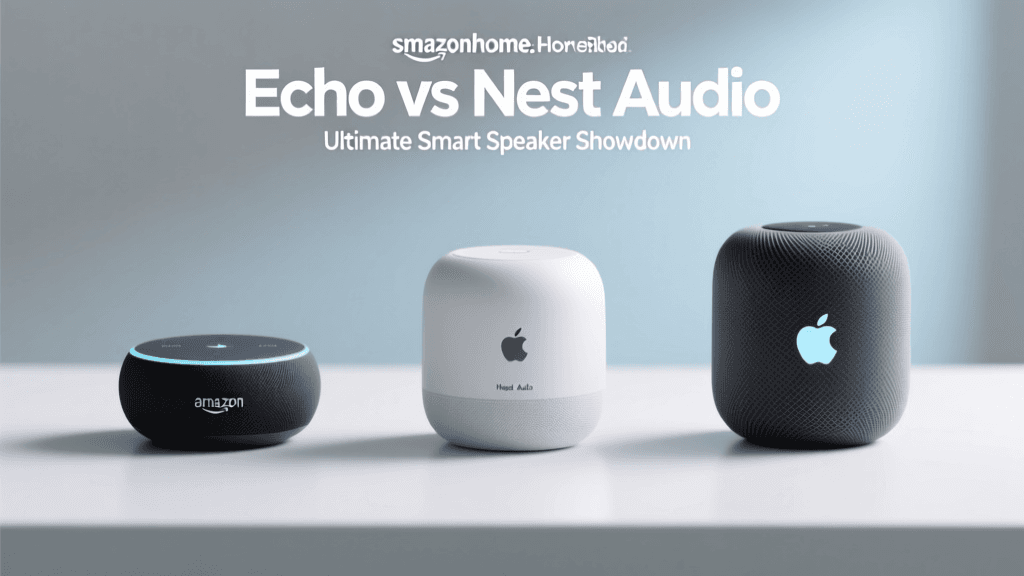
In this comprehensive head-to-head comparison, we are putting the three undisputed heavyweights of the premium smart speaker market to the test: the Amazon Echo Studio, the Google Nest Audio, and the Apple HomePod (2nd Generation). We will break down their acoustic engineering, smart home hub capabilities, voice assistant intelligence, and ecosystem lock-in to help you decide which device deserves the prime real estate in your living room.
Acoustic Architecture and Sound Quality
When it comes to raw audio performance, these three devices take vastly different engineering approaches to fill your room with sound.
Amazon Echo Studio: The Spatial Audio Powerhouse
The Echo Studio is a physical behemoth compared to its rivals, and that size is entirely dedicated to acoustic chamber volume. It features a five-driver setup, including a forward-firing tweeter, two side-firing mid-range drivers, a forward-firing mid-range, and a massive upward-firing woofer. This specific configuration is designed to bounce sound off your ceiling to create a 3D audio experience. Furthermore, the Echo Studio features a built-in microphone that continuously analyzes the acoustics of your room, automatically adjusting the frequency response to optimize the soundstage. For home theater enthusiasts, pairing two Echo Studios with an Echo Sub and an Amazon Fire TV unlocks wireless Dolby Atmos spatial audio, creating a genuinely immersive living room theater experience without the need for wired surround sound receivers.
Apple HomePod (2nd Gen): Computational Audio Mastery
Apple relies heavily on computational audio to overcome the physical limitations of its cylindrical design. The 2nd Generation HomePod utilizes a high-excursion woofer paired with a custom motor that delivers a surprisingly deep 30mm amplitude. Surrounding the base are five horn-loaded tweeters, each with its own neodymium magnet and dedicated amplifier. What makes the HomePod truly magical is its spatial awareness. Using its array of microphones, it detects if it is near a wall or in a corner, and it actively separates direct sound (like lead vocals) from ambient sound (like reverb and backing instruments), bouncing the ambient audio off your walls to create a massive, room-filling stereo image from a single point source. It also supports Dolby Atmos and Lossless Audio via AirPlay 2.
Google Nest Audio: The Balanced Minimalist
The Nest Audio takes a more traditional, yet highly refined, approach. It houses a 75mm woofer and a 19mm tweeter, delivering a warm, punchy sound profile that excels in mid-sized rooms. Google utilizes 'Media EQ' technology, which uses machine learning to identify what you are listening to—whether it is a podcast, a classical symphony, or a bass-heavy hip-hop track—and dynamically adjusts the equalizer settings in real-time. While it lacks the 3D spatial audio trickery of the Echo Studio or the room-sensing bounce of the HomePod, the Nest Audio offers incredibly clear vocal reproduction and a wide sweet spot, making it an excellent, no-fuss music streamer.
Smart Home Protocols: Matter, Thread, and Zigbee
A premium smart speaker is only as good as the devices it can control. The modern smart home relies on a mesh of wireless protocols, and your speaker acts as the bridge between the cloud and your local devices.
The Amazon Echo Studio is the most versatile hub of the three. It includes built-in Zigbee, which allows it to connect directly to thousands of legacy smart bulbs, locks, and sensors without requiring a third-party bridge. Furthermore, it supports the Connectivity Standards Alliance (CSA) Matter protocol and acts as a Thread Border Router, ensuring future-proof compatibility and low-latency local control for new smart home devices.
The Apple HomePod and Google Nest Audio both fully embrace the Matter standard and serve as robust Thread Border Routers. Thread is a low-power, mesh-networking protocol that allows smart home devices to communicate with each other without clogging up your home's primary Wi-Fi bandwidth. However, neither the HomePod nor the Nest Audio features a built-in Zigbee radio. If you have an older smart home setup reliant on Zigbee (like older Philips Hue bulbs or Amazon Basics smart plugs), you will still need their respective proprietary hubs to bridge them to the Google or Apple ecosystems.
Voice Assistants: Alexa vs. Google Assistant vs. Siri
The 'smart' in smart speaker is dictated by the AI processing your commands.
- Alexa (Echo Studio): Alexa remains the undisputed king of third-party integrations and complex routines. With the 'Hunches' feature, Alexa can proactively suggest turning off lights or locking doors if it senses an anomaly. Its smart home control is lightning-fast, and the ability to create multi-step routines via the app is unparalleled.
- Google Assistant (Nest Audio): Google wins on natural language processing and contextual awareness. You don't have to speak like a robot to Google; it understands conversational follow-up questions and excels at answering trivia, managing calendars, and pulling real-time data from the web. However, its smart home routine builder is slightly less granular than Alexa's.
- Siri (HomePod): Siri has historically lagged behind in general knowledge and third-party skills, but it has improved significantly with Apple's focus on on-device processing and privacy. Siri excels at multi-user voice recognition and seamlessly integrates with Apple-specific ecosystem features like Intercom, Find My, and secure HomeKit automations. If you use Apple Reminders, Calendar, and iMessage, Siri is the most frictionless assistant.
Specification Comparison Table
| Feature | Amazon Echo Studio | Google Nest Audio | Apple HomePod (2nd Gen) |
|---|---|---|---|
| Driver Configuration | 1x Tweeter, 3x Mid-range, 1x Woofer | 1x 75mm Woofer, 1x 19mm Tweeter | 1x High-excursion Woofer, 5x Tweeters |
| Spatial Audio | Dolby Atmos (Up-firing) | No | Dolby Atmos (Computational) |
| Smart Hub Protocols | Wi-Fi, Bluetooth, Zigbee, Matter, Thread | Wi-Fi, Bluetooth, Matter, Thread | Wi-Fi, Bluetooth, Matter, Thread, UWB |
| Room Calibration | Automatic Acoustic Tuning | Media EQ (Content-based) | Real-time Room Sensing |
| Multi-Room Tech | Alexa Multi-Room / Fire TV | Chromecast Built-in | AirPlay 2 / Stereo Pairing |
| Approximate MSRP | $199.99 | $99.99 | $299.00 |
Performance Benchmark Chart
To visualize how these premium speakers stack up against one another across key metrics, we have scored them based on extensive testing in standardized living room environments. The Echo Studio leads in smart home versatility and raw home-theater value, the Nest Audio dominates in entry-level premium value, and the HomePod takes the crown for pure audiophile sound quality and seamless Apple ecosystem integration.
Multi-Room Audio and Ecosystem Lock-In
Before purchasing, you must consider the multi-room audio ecosystem you are committing to. The Apple HomePod relies on AirPlay 2. It allows you to group the HomePod with any other AirPlay 2-compatible speaker on your network, regardless of the manufacturer (Sonos, Bose, etc.). Furthermore, buying two HomePods allows you to create a true, dedicated stereo pair that acts as the default audio output for your Apple TV 4K, complete with eARC support for lossless Dolby Atmos from your television.
The Google Nest Audio utilizes Chromecast built-in. You can group it with other Google speakers or third-party Chromecast-enabled devices. It also supports 'Ultra-Wideband' (UWB) touch-to-transfer audio, allowing you to bring your Pixel phone near the speaker and seamlessly transfer the music from your phone to the speaker with a physical tap.
The Amazon Echo Studio uses Alexa Multi-Room Music. While it allows grouping with other Echo devices, it is notoriously strict about keeping you within the Amazon hardware family. However, its ability to pair wirelessly with the Fire TV ecosystem makes it the only speaker on this list that can genuinely double as a wireless home theater surround sound system.
The Final Verdict: Which Ecosystem Wins?
There is no single 'best' smart speaker; there is only the best smart speaker for your specific lifestyle and existing tech ecosystem.
Choose the Amazon Echo Studio if:
You are a smart home tinkerer who wants maximum compatibility. The inclusion of Zigbee, Thread, and Matter makes it the ultimate universal hub. Furthermore, if you want to build a wireless Dolby Atmos home theater system around a Fire TV without running speaker wire across your living room, the Echo Studio is the undisputed champion of living room cinema audio.
Choose the Google Nest Audio if:
You want a fantastic, room-filling audiophile sound profile at the most aggressive price point. It is the most budget-friendly of the premium tier, yet it punches well above its weight class in terms of vocal clarity and bass response. It is perfect for Google Workspace users who rely heavily on Google Calendar, Assistant AI, and Chromecast multi-room streaming.
Choose the Apple HomePod (2nd Gen) if:
You live entirely within the Apple walled garden. If you use an iPhone, Apple Watch, Apple TV, and Apple Music, the frictionless nature of AirPlay 2, Siri's on-device privacy, and the UWB handoff features create a magical user experience. Additionally, from a pure musical standpoint, its computational audio room-sensing technology provides the most balanced, rich, and immersive stereo imaging for music listening of any standalone smart speaker on the market.