The Great Security Divide: DIY Weekend Project vs. White-Glove Professional Service
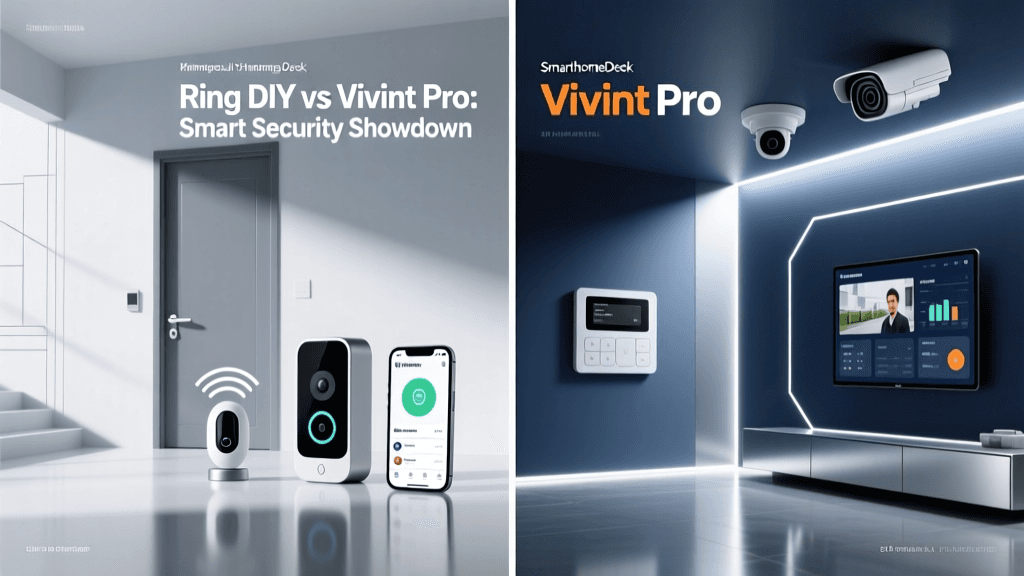
The smart home security landscape has fundamentally bifurcated over the last decade. Gone are the days when securing your home exclusively required scheduling a technician, signing a multi-year contract, and drilling holes into every doorframe. Today, homeowners and renters face a distinct choice: embrace the empowerment and cost-savings of a Do-It-Yourself (DIY) ecosystem, or invest in the reliability and hands-off convenience of a professionally installed and monitored system. To explore this dichotomy, we are putting the ultimate DIY champion, the Ring Alarm Pro, head-to-head against the industry titan of professional service, the ADT Command system (powered by the Qolsys IQ Panel 4).
According to the Federal Trade Commission (FTC), understanding the nuances of installation requirements, monitoring contracts, and hidden fees is paramount before committing to a home security ecosystem. This comprehensive comparison will break down the hardware, the physical installation experiences, long-term costs, and performance benchmarks to help you decide which route aligns with your lifestyle, technical aptitude, and home layout.
Hardware and Ecosystem Compatibility
Before we discuss how these systems are installed, we must understand what is actually being installed. The hardware dictates the complexity of the setup and the breadth of your smart home ecosystem.
Ring Alarm Pro: The Mesh Network Hub
The Ring Alarm Pro is not just a security base station; it is a high-end Eero Wi-Fi 6 mesh router. This dual-purpose device utilizes Z-Wave Plus for security sensors and Zigbee for smart home integration. Because it acts as a network hub, the DIY installation involves not only placing security sensors but also optimizing your home's wireless network topology. It is an ecosystem designed for the modern tinkerer who wants their security system and smart home devices (like Ring cameras, smart locks, and third-party Z-Wave sensors) to operate on a dedicated, localized mesh network that survives internet outages.
ADT Command: The Commercial-Grade Powerhouse
ADT Command is ADT’s branding for the Qolsys IQ Panel 4, a commercial-grade, Android-based touchscreen panel. It features a built-in camera, Bluetooth disarming, and tri-path communication (Wi-Fi, Ethernet, and LTE Cellular). More importantly, it utilizes PowerG wireless technology for its sensors. PowerG is widely considered the gold standard in wireless security, offering adaptive transmission power that extends sensor battery life up to 5-7 years and provides an incredible line-of-sight range of up to 2 kilometers. This hardware is built for large estates, complex partitions, and absolute signal reliability.
The Installation Experience: Sweat Equity vs. Professional Expertise
The core of this comparison lies in the physical act of securing your home. The installation process will test your patience, your toolbox, and your understanding of RF (Radio Frequency) signal propagation.
Ring Alarm Pro: The Ultimate DIY Weekend Project
Installing the Ring Alarm Pro is an exercise in digital onboarding and physical placement. Out of the box, the app guides you through a remarkably intuitive setup process. However, the DIY route requires you to act as your own network engineer and security consultant.
- Network Configuration: Because the base station is an Eero router, you must first configure your mesh network. You will need to run Ethernet to the base station and strategically place additional Eero nodes to ensure both Wi-Fi and Z-Wave coverage.
- Sensor Placement and Mounting: Ring relies heavily on 3M VHB (Very High Bond) adhesive tape for mounting contact sensors and motion detectors. While this is renter-friendly, pro tip: you must clean the surface with isopropyl alcohol and allow the tape to cure for 24 hours before subjecting it to the tension of a heavy exterior door. Many DIYers make the mistake of testing the sensor immediately, only for it to fall off a week later.
- Signal Testing: You must manually test Z-Wave signal strength via the app. If a sensor on your detached garage fails to connect, you are responsible for purchasing and installing a Z-Wave range extender and finding an outlet halfway between the base station and the sensor.
Time Investment: 3 to 6 hours for a standard 3-bedroom home, spread over a weekend to allow for adhesive curing and network optimization.
ADT Command: The White-Glove Professional Experience
When you choose ADT, you are paying for the mitigation of risk and labor. The professional installation process is methodical, standardized, and backed by a workmanship guarantee.
- The RF Survey: Before drilling a single hole, an ADT technician will conduct an RF survey using specialized tools to measure the RSSI (Received Signal Strength Indicator) of PowerG sensors in their intended locations. They know exactly where dead zones exist and will adjust sensor placement or install commercial-grade repeaters if necessary.
- Hardwiring and Concealment: While PowerG sensors are wireless, the main ADT Command panel and any integrated hardwired zones (like existing recessed door contacts or glass break detectors) require professional wire management. Technicians will drill into studs, fish wires through drywall, and ensure the main panel is securely mounted and backed by a sealed backup battery.
- Advanced Programming: The technician will program complex logic that DIY systems often lack. This includes setting up duress codes (which silently alert the police), configuring bypass zones for specific times of day, and creating distinct partitions (e.g., arming the detached garage while leaving the main house disarmed).
Time Investment: 4 to 8 hours, but zero physical labor required from the homeowner. You simply walk through the app and learn the system at the end of the day.
Cost Breakdown: Upfront vs. Long-Term Ownership
The financial comparison between DIY and Professional installation is stark. DIY systems shift the capital expenditure (CapEx) to the consumer while keeping operational expenditure (OpEx) low. Professional systems often subsidize the hardware in exchange for lucrative, long-term monitoring contracts.
| Feature | Ring Alarm Pro (DIY) | ADT Command (Professional) |
|---|---|---|
| Base Hardware Cost | $249.99 (Base Station) | $0 - $299 (Often subsidized) |
| Sensor Cost (Per Unit) | $20 - $35 | $75 - $150 (Retail/Upcharge) |
| Installation Fee | $0 (Your Time) | $99 - $299 (Promo dependent) |
| Monthly Monitoring | $20/mo (Ring Home Plus) | $45 - $65/mo |
| Contract Requirement | None (Month-to-Month) | 36 to 60 Months |
| Relocation Fee | $0 (Unbox and move) | $99 - $199 (Technician visit) |
Note: ADT pricing varies heavily based on regional promotions and dealer networks, but long-term contracts are a universal constant.
5-Year Cost of Ownership Comparison
As visualized in the chart above, the 5-year cost of ownership heavily favors the DIY route. Assuming a $250 initial hardware investment and a $20/month premium monitoring subscription, Ring costs roughly $1,450 over five years. Conversely, an ADT system with a $199 installation fee and a $55/month monitoring contract will cost upwards of $3,299 over the same period, not including early termination fees if you move.
Performance Benchmarks and Monitoring Protocols
Installation methodology directly impacts system performance, particularly regarding signal integrity and monitoring response times.
Signal Resilience and Battery Life
Ring’s Z-Wave mesh network is highly resilient inside a standard home, but it struggles with penetrating dense materials like brick, stucco, or metal siding. If you install a Ring contact sensor on a detached shed, you will likely experience latency or dropouts unless you install a Z-Wave repeater. Furthermore, Ring sensors require battery replacements every 12 to 18 months.
ADT’s PowerG technology is a different beast entirely. Because the sensors dynamically adjust their transmission power based on their distance from the panel, they conserve immense amounts of energy. It is common for PowerG sensors to operate for 5 to 7 years on a single CR123A battery. The signal penetration is vastly superior, easily reaching detached garages and basements without the need for repeaters.
The Monitoring Center Experience
When an alarm triggers, the monitoring protocol begins. Ring offers professional monitoring through its Ring Home Plus subscription. A unique feature of Ring is the ability to set up verified response, where the monitoring center can access your outdoor Ring cameras to visually verify a break-in before dispatching police, drastically reducing false alarms. However, as a DIY system, the burden of maintaining the system's health (e.g., replacing dead sensor batteries, ensuring the Wi-Fi is connected) falls entirely on you. If a sensor goes offline and you fail to notice the push notification, your perimeter is compromised.
ADT operates a network of UL-listed, Five-Diamond certified central monitoring stations. Their systems feature advanced anti-tamper and crash-and-smash protection. If an intruder destroys the ADT Command panel before it can transmit the cellular signal, the remote server recognizes the abrupt disconnect and dispatches authorities anyway. Furthermore, ADT technicians proactively monitor system health and will often call you if a sensor battery is low or a zone is experiencing RF interference.
Insurance Implications and ROI
One area where professional installation traditionally holds an edge is home insurance discounts. According to the Insurance Information Institute (III), homeowners can often receive discounts ranging from 5% to 20% on their premiums for installing centrally monitored security systems, particularly those that include fire, carbon monoxide, and water leak detection.
Historically, insurance providers demanded a certificate of professional installation from a recognized brand like ADT to grant the maximum discount. Today, the landscape has shifted. Ring’s professional monitoring tier is widely accepted by major insurance carriers for these discounts, provided you can generate a certificate of monitoring through the Ring app. However, you must proactively submit this documentation to your insurer. ADT, on the other hand, often has direct partnerships with insurers, and the professional installation certificate is automatically recognized as meeting the highest tier of underwriting requirements.
Smart Home Integration and App Experience
The post-installation experience is defined by how well the security system plays with the rest of your smart home.
Ring Alarm Pro is inextricably linked to Amazon Alexa. The integration is seamless, allowing for voice arming, routines based on security states (e.g., turning on all interior lights if the alarm is triggered), and native integration with Ring’s vast ecosystem of video doorbells and floodlights. However, its integration with non-Amazon ecosystems like Apple HomeKit is virtually non-existent without third-party bridges like Homebridge.
ADT Command offers a surprisingly robust smart home experience. The Qolsys panel natively supports Z-Wave, Zigbee, and Wi-Fi devices. It integrates with both Google Home and Amazon Alexa, and its app allows for complex automation rules, such as locking smart locks and closing garage doors when the system is armed. Because it is installed by a professional, the technician can pair your existing smart thermostats and locks directly to the panel, creating a unified dashboard that DIY systems often struggle to replicate across disparate apps.
Verdict: Which Installation Route is Right for You?
The choice between Ring Alarm Pro and ADT Command is not merely a choice of hardware; it is a choice of philosophy regarding home ownership and time management.
Choose Ring Alarm Pro (DIY) If:
- You are a renter or plan to move within the next 3 to 5 years, as you can easily uninstall the system and take it with you without facing early termination fees.
- You possess basic technical literacy, enjoy weekend home improvement projects, and want to upgrade your home's Wi-Fi mesh network simultaneously.
- You want to avoid long-term contracts and prefer a month-to-month subscription model that you can cancel at any time.
- You are heavily invested in the Amazon Alexa and Ring camera ecosystem.
Choose ADT Command (Professional) If:
- You own a large, multi-story home, or a property with detached structures, where PowerG’s superior RF range and professional signal surveying are necessary to eliminate dead zones.
- You value your time and prefer a white-glove experience where a certified technician handles all drilling, wire management, and complex programming.
- You require advanced commercial-grade features like duress codes, multi-zone partitioning, and crash-and-smash protection.
- You want the peace of mind that comes with a system backed by a corporate workmanship guarantee and proactive health monitoring.
Ultimately, the DIY route offers unparalleled financial flexibility and ecosystem control, while the professional route delivers robust, hands-off reliability and commercial-grade hardware. Assess your technical comfort level, your home's physical layout, and your long-term housing plans to make the smartest investment in your family's safety.