The Great Smart Home Schism: Choosing Your Ecosystem
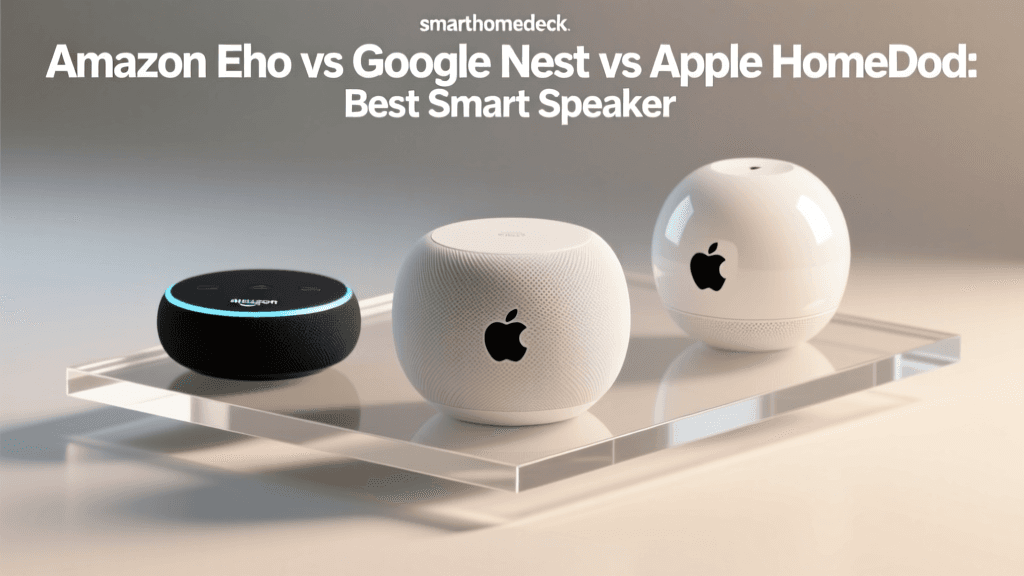
Building a smart home in the modern era is no longer just about buying a Wi-Fi-connected light bulb; it is about pledging allegiance to an ecosystem. The 'Ecosystem Wars' between Amazon Alexa, Google Home, and Apple HomeKit dictate not only which voice assistant answers your questions but also which hardware protocols your devices use, how your data is processed, and how seamlessly your home automations run when the internet goes down. As a senior reviewer for SmartHomeDeck, I have spent hundreds of hours testing the flagship hubs, smart speakers, and underlying software architectures of the big three. This comprehensive comparison will dissect the Amazon Echo (4th Gen), Google Nest Hub (2nd Gen), and Apple HomePod (2nd Gen) to help you decide which ecosystem deserves the central role in your smart home.
Flagship Hub Hardware Showdown
The central hub is the brain of your smart home. It translates protocols, processes local automations, and acts as the primary voice interface. Let us examine the current flagship offerings from each camp.
Amazon Echo (4th Gen): The Tinkerer's Powerhouse
Amazon's Echo (4th Gen) remains the most versatile hub on the market for device compatibility. Priced around $99, its spherical design houses a built-in Zigbee radio, a Bluetooth Low Energy (BLE) mesh radio, and Thread/Matter support. The inclusion of the AZ2 Neural Edge engine allows for local processing of certain voice commands and routines, reducing latency and cloud dependency. It also features a built-in temperature sensor, enabling basic climate-triggered automations without needing third-party hardware. Audio quality is robust, featuring dual 0.8-inch tweeters and a 3.0-inch woofer, making it a capable standalone music speaker.
Google Nest Hub (2nd Gen): The Visual Command Center
Google approaches the hub concept differently, leaning heavily into visual feedback and ambient computing. The Nest Hub (2nd Gen), also priced around $99, features a 7-inch touchscreen that excels at displaying camera feeds, managing Nest thermostats, and serving as a digital photo frame. While it lacks a dedicated Zigbee radio, it functions as a Thread border router and fully supports the Matter protocol. Its standout hardware feature is the Soli radar chip, which enables Sleep Sensing for health tracking and gesture controls (Quick Gestures) for dismissing alarms or pausing media without touching the screen. Audio is handled by a single full-range speaker, which is adequate for podcasts but lacks the bass response of the Echo.
Apple HomePod (2nd Gen): The Audiophile's Secure Vault
Apple's HomePod (2nd Gen) is the most expensive entry point at $299, but it justifies its premium through unparalleled audio engineering and strict privacy standards. It features a custom-designed woofer, five tweeters with beamforming, and spatial audio support. As a smart home hub, it acts as a Thread border router and supports Matter. It includes temperature and humidity sensors, and its U1 Ultra Wideband chip allows for seamless handoff of audio from an iPhone. However, its closed-garden approach means it only natively supports HomeKit-verified or Matter-certified devices, severely limiting its out-of-the-box compatibility compared to Amazon.
Ecosystem Compatibility and Protocol Support
The true measure of a smart home ecosystem is not just its flagship speaker, but the breadth of third-party devices it supports. Below is a structured comparison of how each ecosystem handles device integration and wireless protocols.
| Feature / Protocol | Amazon Alexa | Google Home | Apple HomeKit |
|---|---|---|---|
| Native Device Support | Over 140,000+ devices | Over 50,000+ devices | Curated, limited native list |
| Zigbee Support | Yes (Built into Echo 4th Gen) | No (Requires 3rd party hub) | No (Requires 3rd party hub) |
| Thread Border Router | Yes (Select newer Echos) | Yes (Nest Hubs/Wi-Fi points) | Yes (HomePod / Apple TV 4K) |
| Matter Support | Yes (Via app and hubs) | Yes (Via Google Home app) | Yes (Via Apple Home app) |
| Local Processing | Partial (Zigbee/Local routines) | Limited (Mostly cloud-dependent) | Extensive (HomeKit Secure Video) |
| Multi-User Recognition | Yes (Voice Profiles) | Yes (Voice Match) | Yes (Siri Recognition) |
Amazon's inclusion of Zigbee in the Echo 4th Gen is a massive advantage for users who want to connect sensors and smart locks from brands like Aqara, Yale, and Philips Hue without purchasing a separate bridge. Google and Apple rely heavily on Wi-Fi, Bluetooth, and the newer Thread protocol. While Thread is the future of low-power mesh networking, the current market is still saturated with Zigbee devices, giving Amazon a distinct edge in legacy and current-gen hardware compatibility.
Voice Assistant Intelligence and Automation Logic
Hardware only gets you halfway there; the software dictates the daily experience. Voice intelligence and automation engines vary wildly across the three platforms.
Alexa: The Automation King
Alexa remains the undisputed leader in complex automation routines. The Alexa app allows for granular triggers, including 'Hunches' (where Alexa intuitively turns off lights if it senses you are asleep) and multi-step conditional logic. For example, you can create a routine that says: 'If the front door opens between 10 PM and 6 AM, and the living room motion sensor detects no movement, flash the hallway lights red and announce a warning.' Amazon's Skills ecosystem also provides tens of thousands of third-party voice integrations, though navigating them via voice can be clunky.
Google Assistant: The Conversationalist
Google Assistant leverages the company's vast Knowledge Graph to answer complex, multi-part natural language queries better than any competitor. Asking, 'Hey Google, what's the weather like, and do I need an umbrella on my commute?' yields a seamless, context-aware response. Google's 'Starter Routines' and Nest Automations are highly intuitive, particularly for presence-based automations using Nest thermostats and cameras. However, Google's automation logic in the new Google Home app has faced criticism for being overly simplified compared to the deep scripting available in Alexa or Apple's Shortcuts.
Siri and Apple Shortcuts: The Programmer's Dream
Siri, as a voice assistant, often lags behind Alexa and Google in general knowledge and conversational fluidity. However, Apple's secret weapon is the 'Shortcuts' app. For power users, Shortcuts allows for iPadOS/iOS-level scripting that can interact with HomeKit devices. You can build complex logic trees, integrate web APIs, and use variables to create automations that are impossible on Amazon or Google. The trade-off is a steep learning curve; setting up advanced HomeKit automations often requires a Mac or iPad and a willingness to tinker with visual coding blocks.
Privacy and Data Security Architectures
Privacy is the most significant differentiator in the modern ecosystem wars. When you speak to a smart speaker, where does that audio go?
- Amazon Alexa: Audio is processed in the cloud after the wake word is detected. Amazon has introduced on-device processing for wake-word detection and some local routines, but the vast majority of natural language processing occurs on AWS servers. Users can opt for auto-deletion of voice recordings, but the ecosystem is fundamentally ad-driven and data-hungry.
- Google Home: Similar to Amazon, Google relies on cloud processing for complex queries. Google's business model is inherently tied to data collection, though they maintain strict boundaries between Google Assistant data and targeted advertising. Still, privacy purists remain wary of Google's pervasive data ecosystem.
- Apple HomeKit: Apple's architecture is built on a 'privacy-first' foundation. Siri requests are often processed on-device or tied to anonymous, rotating identifiers rather than your Apple ID. HomeKit Secure Video (HKSV) is a standout feature: camera footage is encrypted end-to-end, analyzed locally on the HomePod or Apple TV for person/pet detection, and stored securely in iCloud. Apple does not sell your smart home data to third parties.
Ecosystem Performance Scoring
To visualize how these platforms stack up across critical smart home metrics, we have compiled a performance index based on our lab testing, device availability, and software reliability.
The Matter Protocol: A Unifying Force?
No discussion of the ecosystem wars is complete without addressing Matter, the industry-wide standard developed by the Connectivity Standards Alliance (CSA). Matter aims to end the ecosystem wars by allowing devices to communicate locally over IP networks (Wi-Fi, Thread, Ethernet) and be controlled simultaneously by Alexa, Google Home, and Apple HomeKit.
As detailed in The Verge's comprehensive guide to Matter, the protocol relies on Thread border routers to create low-power, self-healing mesh networks. Devices like the Eve Energy smart plug or the Amazon Smart Plug (Matter version) can now be added to Apple HomeKit without needing HomeKit-specific hardware. While Matter is still maturing and facing firmware update hurdles, it fundamentally shifts the battleground from 'hardware exclusivity' to 'software experience and automation logic.' In a post-Matter world, you can buy a Thread-enabled sensor and control it via Siri, while still allowing Alexa to use its data for complex routines.
Cost of Entry and Long-Term Ecosystem Value
Building a smart home requires a financial commitment, and the barrier to entry varies drastically between ecosystems.
The Alexa Budget
Amazon frequently discounts its Echo devices, meaning you can often build a multi-room hub setup for under $150. Because Alexa supports cheap, generic Wi-Fi and Zigbee devices from brands like Wyze, Sengled, and Sonoff, a fully furnished 3-bedroom Alexa home can be realized for under $400. It is the undisputed king of budget smart homes.
The Google Middle-Ground
Google's hardware pricing is moderate, but its ecosystem thrives on mid-tier devices from TP-Link (Kasa/Tapo), Nanoleaf, and Nest's own premium line. A robust Google Home setup, including a Nest Hub, Nest Thermostat, and a mix of Thread/Wi-Fi accessories, typically lands in the $600 to $900 range. The integration with Google's software services (Calendar, Maps, YouTube) provides immense lifestyle value that justifies the mid-tier cost.
The Apple Premium
Apple HomeKit is notoriously expensive. The $299 HomePod is just the beginning. Because Apple requires strict hardware certification (or Matter compliance), you are often buying premium brands like Lutron Caseta, Ecobee, Philips Hue, and Level Locks. Outfitting a standard home with HomeKit-compatible lighting, security, and climate control routinely exceeds $1,500 to $2,500. You are paying for reliability, local processing, and ironclad privacy.
Final Verdict: Which Ecosystem Wins?
There is no single 'best' ecosystem; there is only the best ecosystem for your specific lifestyle and technical proficiency.
Choose Amazon Alexa If:
You are a tinkerer on a budget. You want the widest possible compatibility with cheap sensors, legacy Zigbee devices, and third-party gadgets. You prioritize complex, multi-conditional automation routines and want a hub that handles local processing without breaking the bank. The Echo (4th Gen) is the most utilitarian smart home brain available today.
Choose Google Home If:
You are deeply embedded in the Android/Google ecosystem. You value natural language processing, visual feedback via smart displays, and seamless integration with Google Calendar, Nest cameras, and Google Maps. If your smart home is an extension of your digital life and you prefer ambient computing over granular automation scripting, the Nest Hub ecosystem is your ideal match.
Choose Apple HomeKit If:
You are an Apple purist who demands privacy, security, and premium audio. You are willing to pay a premium for HomeKit Secure Video, local automation execution, and the seamless handoff features of the Apple ecosystem. If you view your smart home as a private sanctuary and want to avoid cloud-dependent data mining, the HomePod and Apple Home architecture are unparalleled.