The Smart Home Hub Showdown: Setting the Stage
The smart home landscape has evolved far beyond simple voice commands for turning lights on and off. Today, the central hub of your home is a complex gateway responsible for local processing, mesh network routing, and cross-platform interoperability. As the industry shifts toward unified standards, the 'Big Three' tech giants are locked in a fierce battle to control the nerve center of your living space. In this comprehensive comparison, we are putting the flagship smart home hubs head-to-head: the Amazon Echo (4th Gen), the Google Nest Hub Max, and the Apple HomePod (2nd Gen).
Choosing the right hub is no longer just about picking a virtual assistant; it is about committing to an underlying protocol ecosystem, privacy architecture, and long-term hardware compatibility. Whether you are a tinkerer building a massive sensor network, a family heavily invested in security cameras, or an audiophile who demands pristine sound while prioritizing data privacy, this guide will dissect the hardware, software, and hidden costs of each ecosystem.
Meet the Contenders: Hardware and Design
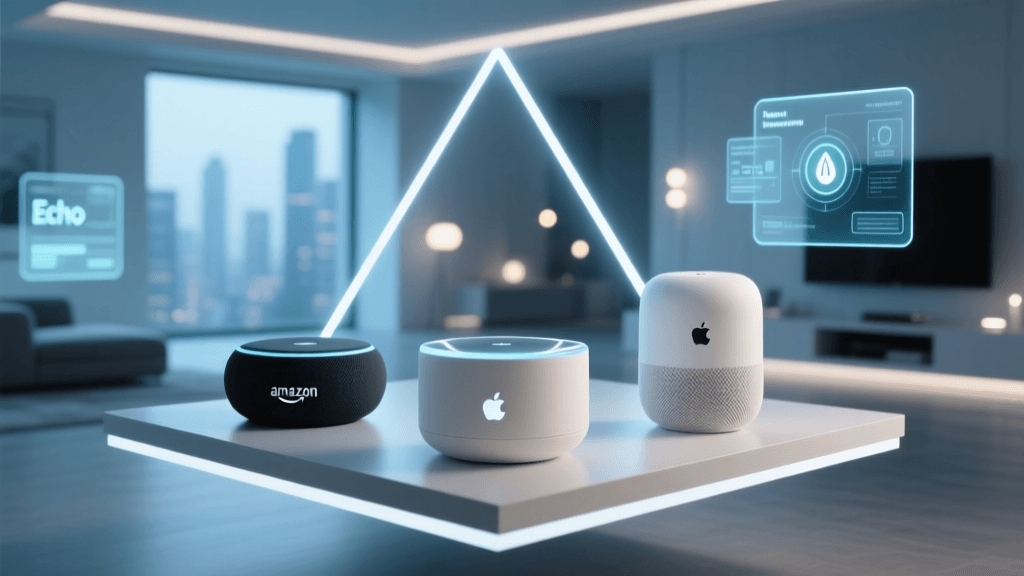
The physical footprint of your smart hub dictates where it can live and how it interacts with your space. Each company has taken a radically different approach to hardware design, reflecting their core ecosystem priorities.
Amazon Echo (4th Gen)
Amazon abandoned the cylindrical puck design of its early generations for a spherical, fabric-wrapped orb. The Echo (4th Gen) is a powerhouse disguised as a minimalist speaker. Its most critical hardware feature is hidden inside: a built-in Zigbee radio and an Amazon Sidewalk gateway. This allows it to connect directly to hundreds of third-party sensors and bulbs without requiring proprietary bridges. The LED ring at the base provides clear visual feedback for voice listening and notifications, though it lacks a screen for visual media consumption.
Google Nest Hub Max
Google's approach centers on the visual experience. The Nest Hub Max features a stunning 10-inch HD touchscreen mounted on a fabric-wrapped speaker base. It is designed to be the family command center, offering a dedicated dashboard for Google Calendar, Nest Cam feeds, and YouTube. Under the hood, it utilizes a Soli radar chip for presence detection, allowing the screen to wake and display contextual information when you walk into the room. However, it lacks native Zigbee support, relying heavily on Wi-Fi and Thread for smart home device communication.
Apple HomePod (2nd Gen)
Apple's HomePod (2nd Gen) is a masterclass in industrial design and acoustic engineering. Wrapped in a seamless recycled mesh fabric, it features a touch-sensitive glass top that illuminates with Siri's colorful waveform. Unlike its competitors, Apple does not treat the HomePod as a general-purpose information kiosk; it is a premium music speaker first and a smart home hub second. It features an array of five tweeters and a high-excursion woofer that utilizes spatial audio and room-sensing technology to adapt its sound profile to your specific living space.
Protocol Wars: Zigbee, Thread, and Matter
The most critical differentiator between these hubs is how they speak to your smart devices. The introduction of Matter has changed the game, but legacy protocols still dictate your day-to-day experience. According to the Connectivity Standards Alliance, Matter is designed to unify the smart home, but the underlying transport layers (Wi-Fi, Thread, Zigbee) still matter immensely for network stability.
| Feature | Amazon Echo (4th Gen) | Google Nest Hub Max | Apple HomePod (2nd Gen) |
|---|---|---|---|
| Approximate Price | $99 | $229 | $299 |
| Zigbee Hub | Yes (Built-in) | No | No |
| Thread Border Router | Yes | Yes | Yes |
| Matter Support | Yes (via Wi-Fi/Thread) | Yes (via Wi-Fi/Thread) | Yes (via Wi-Fi/Thread) |
| Bluetooth LE | Yes | Yes | Yes |
| Local Processing | Partial (Zigbee/Thread) | Partial (Thread) | Extensive (HomeKit/Matter) |
The Zigbee Advantage
Amazon's inclusion of a Zigbee radio in the Echo (4th Gen) is a massive advantage for budget-conscious tinkerers. You can pair affordable Aqara motion sensors, Sonoff switches, and older Philips Hue bulbs directly to the Echo without buying a separate hub. Google and Apple have entirely abandoned Zigbee in their flagship speakers, forcing users to rely on Wi-Fi (which clogs your router) or Thread.
Thread and the Future of Mesh
All three devices act as Thread Border Routers. Thread is a low-power, low-latency mesh networking protocol that does not rely on your home Wi-Fi. If you buy a modern Eve Energy smart plug or a Nanoleaf Essentials bulb, they will use Thread to communicate locally with your hub. This means your automations will execute instantly, even if your internet connection goes down. Apple and Google have been the most aggressive in pushing Thread, making the HomePod and Nest Hub excellent anchors for a modern, low-latency mesh network.
Assistant Intelligence: Alexa vs. Google vs. Siri
The brain behind the hub dictates how smoothly your daily routines operate. Each assistant has distinct strengths and frustrating limitations.
Alexa: The Automation King
Alexa remains the undisputed champion of complex routines and third-party integration. The Alexa app allows for granular triggers, such as 'When the front door unlocks, and it is after sunset, turn on the hallway lights to 50%.' Alexa's ecosystem is vast, and its ability to pull from thousands of third-party skills makes it the most versatile assistant for general queries and smart home control. However, the Alexa app interface has become increasingly cluttered with ads and shopping prompts.
Google Assistant: The Contextual Genius
Google Assistant leverages the company's search pedigree to offer superior natural language processing. You can ask complex, multi-part questions like, 'What is the weather like today, and remind me to bring an umbrella if it rains.' Google's Nest ecosystem is deeply integrated with Google Calendar, Maps, and YouTube, making the Nest Hub Max an incredible family organizer. However, Google has a history of deprecating smart home features and splitting its app experience between the legacy Google Home app and the newer, somewhat limited Google Nest app.
Siri: The Private Concierge
Siri has historically been the weakest link in Apple's smart home strategy, often failing to understand basic commands compared to its rivals. However, recent architectural updates to Apple Home have vastly improved Siri's reliability and speed. Siri's true advantage is its deep integration with iOS. You can use the Shortcuts app to create incredibly powerful, multi-step automations that trigger via Siri voice commands. Furthermore, Siri processes most requests locally on the device or via iCloud Private Relay, ensuring your voice data is not mined for advertising profiles.
Audio Performance and Media Consumption
If your smart hub is going to sit in your living room or kitchen, audio quality is a major factor.
- Apple HomePod (2nd Gen): The clear winner for audiophiles. Its room-sensing technology uses built-in microphones to analyze the acoustics of your space and adjust the audio output in real-time. The bass is rich, and the vocal clarity is exceptional. Two HomePods can be paired for true stereo sound.
- Amazon Echo (4th Gen): Offers surprisingly robust bass for its size, thanks to a 3-inch neodymium woofer and dual tweeters. It supports Dolby Atmos and Amazon Music HD, making it a great value for music listeners who do not want to pay Apple's premium.
- Google Nest Hub Max: While it has a larger footprint, the audio is tuned more for vocal clarity and room-filling background noise rather than deep bass. Its primary media strength is its 10-inch screen, which is perfect for watching YouTube, following cooking recipes, or viewing security camera feeds.
Privacy and Security: The Hidden Cost of Convenience
When you place a microphone in your bedroom or kitchen, privacy must be a primary consideration. The Mozilla Foundation's Privacy Not Included guide has consistently highlighted the data-harvesting practices of major tech companies, making the choice of ecosystem a matter of personal security.
Apple's Walled Garden
Apple treats the smart home as a privacy extension of the iPhone. HomeKit and the new Matter implementations rely heavily on end-to-end encryption. Features like HomeKit Secure Video encrypt your security camera footage locally before it is uploaded to iCloud, meaning not even Apple can view your camera feeds. Siri requests are tied to a random, rotating device identifier rather than a persistent user profile.
Amazon and Google: The Cloud Giants
Both Amazon and Google rely on cloud processing for the vast majority of voice queries. While both companies offer physical mute switches and the ability to delete voice recordings, the fundamental business model of these corporations involves data aggregation. If you are placing a hub in a sensitive area of the home, or if you simply object to your voice interactions being stored on corporate servers, Apple's local-first architecture provides significantly more peace of mind.
Ecosystem Costs and Long-Term Value
The initial price tag of the hub is only the beginning of your investment. Each ecosystem carries hidden long-term costs.
With Amazon, the barrier to entry is incredibly low. The Echo 4th Gen is frequently discounted, and Alexa's cloud-based remote access is completely free. You can control your Zigbee devices from anywhere in the world without buying additional hardware.
With Google, the ecosystem is relatively open, but to get the most out of features like HomeKit Secure Video alternatives (Nest Aware), you must pay a monthly subscription fee per camera. Furthermore, Google's reliance on Wi-Fi for older devices may force you to upgrade your home mesh Wi-Fi router to handle the network congestion.
With Apple, the 'Apple Tax' is very real. While the HomePod is a premium device, the hidden cost lies in remote access and camera storage. To control your HomeKit devices while away from home, you must have an Apple TV 4K or a HomePod acting as a home hub. Furthermore, to utilize HomeKit Secure Video for your cameras, you are required to pay for a monthly iCloud+ storage tier. Apple's ecosystem is the most expensive to build and maintain, but it offers the highest resale value and the most seamless integration for households entirely invested in iOS.
Final Verdict: Which Ecosystem Wins?
There is no single 'best' smart home hub; there is only the best hub for your specific lifestyle and technical expertise.
Choose the Amazon Echo (4th Gen) if:
You are a budget-conscious tinkerer who wants to connect dozens of affordable Zigbee sensors and bulbs without buying proprietary bridges. Alexa's unparalleled routine engine and massive third-party compatibility make it the most versatile choice for complex smart home setups.
Choose the Google Nest Hub Max if:
Your household relies heavily on Google services, shared calendars, and visual media. The 10-inch screen is unmatched for kitchen recipe viewing, video calls, and monitoring Nest security cameras. It is the ultimate family command center.
Choose the Apple HomePod (2nd Gen) if:
You are an iPhone user who prioritizes audiophile-grade sound, local processing, and uncompromising data privacy. While the initial setup cost is higher and device compatibility is more restricted, the Apple Smart Home experience offers the most secure, polished, and frictionless automation for those already inside the Apple ecosystem.