The Matter Revolution: Why Your Old Hub is Obsolete
The smart home landscape is undergoing its biggest seismic shift in a decade. For years, consumers have been trapped in a fragmented ecosystem of proprietary hubs, conflicting radio frequencies, and walled gardens. If you bought a Zigbee sensor from one brand, it likely would not talk to a Z-Wave hub from another, and integrating both into a single automation required clunky third-party workarounds. Enter Matter: the new, unified, open-source connectivity standard backed by the industry’s biggest players, including Apple, Google, Amazon, and Samsung.
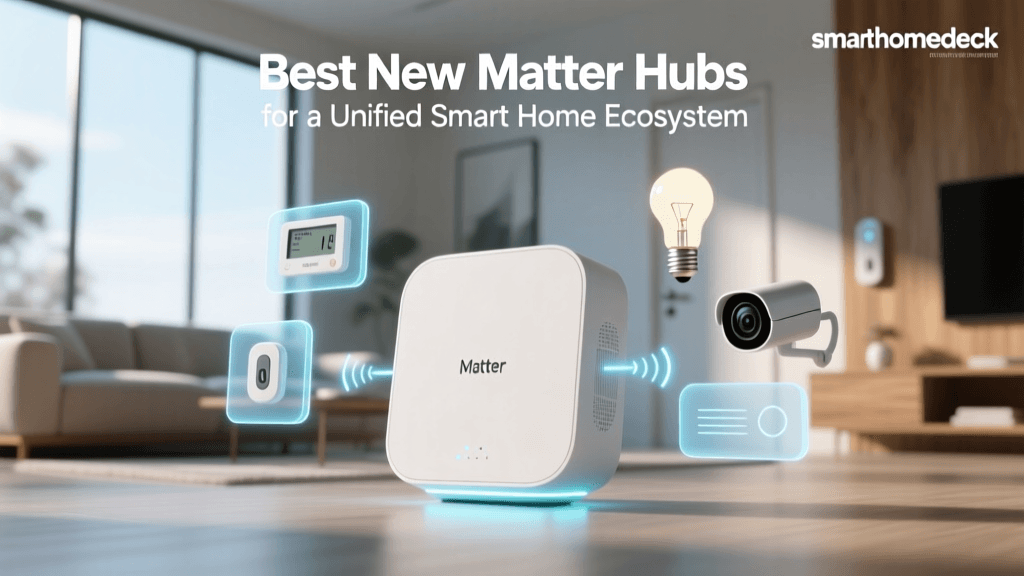
According to the Connectivity Standards Alliance (CSA), Matter is designed to simplify the consumer experience by ensuring that certified devices can communicate seamlessly across different ecosystems. However, to unlock the full potential of Matter—especially its low-power, mesh-networking backbone known as Thread—you need the right hardware. Legacy hubs simply lack the silicon required to act as Thread Border Routers or Matter Controllers. This guide explores the best new releases and upcoming smart home hubs that will serve as the central nervous system for your next-generation connected home.
Top Picks: Best New Matter Hubs and Controllers
1. Aqara Smart Hub M3 (Best Overall Powerhouse)
The Aqara Smart Hub M3 is arguably the most versatile and forward-thinking hub released in recent memory. Designed to be the ultimate bridge for both legacy Aqara devices and new Matter-over-Thread products, the M3 is a masterclass in hardware engineering. It features a built-in Thread Border Router, a Zigbee 3.0 coordinator, an IR blaster for older appliances, and Wi-Fi 6 connectivity.
What truly sets the M3 apart is its support for Power over Ethernet (PoE). For smart home enthusiasts who despise Wi-Fi dropouts, the ability to hardwire the hub directly into a network switch via an Ethernet cable that also delivers power is a game-changer. Furthermore, the M3 features local automation processing, meaning your routines will execute even if your internet connection goes down. The circular design includes a customizable LED light ring that can serve as a nightlight or a visual notification system for alarms and doorbell rings.
- Pros: PoE support, local processing, IR blaster, Thread and Zigbee 3.0, customizable LED ring.
- Cons: Premium price point, requires PoE injector if your router does not support it.
- Cost Range: $120 - $140
2. Home Assistant Green (Best for Local Control & Enthusiasts)
Home Assistant has long been the gold standard for privacy-focused, local-first smart home automation, but setting it up previously required repurposing an old PC or tinkering with a Raspberry Pi. The Home Assistant Green changes everything. This plug-and-play hub is custom-designed by the Home Assistant team to make local control accessible to everyone, right out of the box.
The Green runs the full Home Assistant OS, which includes native support for Matter and Thread (when paired with a compatible USB dongle like the SkyConnect). It acts as a Matter Controller, allowing you to import Matter devices directly into your local dashboard without relying on cloud servers. The hardware is completely silent, featuring a passive aluminum heatsink, and includes a slot for an NVMe SSD for ultra-fast database logging. It is the ultimate gateway drug for users looking to escape cloud-dependent ecosystems and take true ownership of their smart home data.
- Pros: 100% local control, no cloud reliance, silent operation, massive community support, NVMe support.
- Cons: Requires a separate USB dongle for native Zigbee/Thread radios, steeper learning curve for advanced automations.
- Cost Range: $95 - $110
3. SwitchBot Hub 2 (Best for IR Devices & Renters)
SwitchBot has carved out a unique niche by bridging the gap between modern smart home tech and legacy 'dumb' appliances. The SwitchBot Hub 2 is a compact, wall-mounted or desk-standing device that features a brilliant E-Ink display, showing real-time temperature, humidity, and custom text alerts. More importantly, it houses a powerful IR blaster capable of controlling thousands of air conditioners, TVs, and fans.
With recent firmware updates, the Hub 2 now functions as a Matter Controller over Thread. This means you can expose your SwitchBot ecosystem—including their popular smart curtains, locks, and blinds—to Apple Home, Google Home, and Amazon Alexa via the Matter standard. The E-Ink display is a fantastic touch, consuming virtually no power while providing a visual interface for routines and environmental data. It is an excellent choice for renters who cannot rewire their homes but want to automate climate control and window treatments seamlessly.
- Pros: E-Ink display, powerful IR blaster, built-in temp/humidity sensor, Matter over Thread support.
- Cons: Limited to the SwitchBot ecosystem for direct Thread connections, no Ethernet port.
- Cost Range: $75 - $90
4. Aeotec Smart Home Hub (Best Z-Wave to Matter Bridge)
While Matter and Thread are the future, millions of homes are already heavily invested in Z-Wave, the ultra-reliable, low-frequency mesh network. The Aeotec Smart Home Hub (powered by SmartThings) is a critical piece of hardware for legacy users. Built on the Z-Wave 700 series chip with Long Range (LR) support, it offers vastly improved range and battery life for connected sensors.
The hub acts as a bridge, translating your existing Z-Wave devices into the Matter protocol so they can be controlled natively in Apple Home or other Matter-compatible ecosystems. It also includes Zigbee and Wi-Fi radios, making it a true tri-protocol powerhouse. If you have dozens of Z-Wave door sensors, smart locks, and water valves, this hub ensures they are not left behind as the industry transitions to Matter.
- Pros: Z-Wave Long Range support, Matter bridging, backwards compatible with older Z-Wave devices.
- Cons: SmartThings app ecosystem can feel bloated, premium pricing.
- Cost Range: $130 - $150
Feature Comparison Table
| Feature | Aqara Hub M3 | Home Assistant Green | SwitchBot Hub 2 | Aeotec Smart Hub |
|---|---|---|---|---|
| Matter Controller | Yes | Yes | Yes | Yes (Bridge) |
| Thread Border Router | Yes | Requires Dongle | Yes | No |
| Zigbee Support | Yes (3.0) | Requires Dongle | No | Yes (3.0) |
| Z-Wave Support | No | Requires Dongle | No | Yes (700 LR) |
| Local Processing | Yes | Yes (100%) | No | Limited |
| IR Blaster | Yes | No | Yes | No |
| Ethernet / PoE | Yes (PoE) | Yes (Ethernet) | No | Yes (Ethernet) |
Price Comparison Chart
Buying Guide: What to Look for in a Next-Gen Hub
When shopping for a new smart home hub in the post-Matter era, the specifications can be overwhelming. Here are the critical features you must evaluate before making a purchase:
1. Thread Border Router Capabilities
Thread is the secret weapon of the Matter standard. Unlike Wi-Fi, which drains batteries quickly, or Zigbee, which requires proprietary hubs, Thread is an IP-based, low-power mesh network. A hub with a built-in Thread Border Router allows Thread-enabled devices (like smart locks, sensors, and smart plugs) to connect directly to your network without an intermediary bridge. If a hub lacks Thread support, you are missing out on the fastest and most reliable aspect of the Matter ecosystem.
2. Local Processing vs. Cloud Reliance
The best smart homes operate locally. If your internet goes down, your motion sensors should still trigger your lights. Hubs like the Home Assistant Green and Aqara M3 process automations locally on the device itself. Conversely, hubs that rely heavily on cloud processing will experience latency and fail during internet outages. Always check the manufacturer’s documentation regarding local execution capabilities.
3. Power over Ethernet (PoE) and Hardwiring
Wi-Fi congestion is the enemy of smart home reliability. Hubs that offer Ethernet ports—especially PoE—allow you to place the hub in the optimal physical location for radio coverage (like the center of your home or mounted on a ceiling) without worrying about finding a nearby power outlet. PoE delivers both data and electricity over a single Cat6 cable, resulting in a cleaner, more professional installation.
4. Protocol Bridging
You likely already own smart devices that are not Matter-compatible. A great modern hub should act as a bridge, translating older protocols like Zigbee, Z-Wave, or Bluetooth into Matter so they can be exposed to your primary ecosystem (Apple Home, Google Home, etc.). This protects your previous investments and prevents e-waste.
Upcoming Matter Devices: What is on the Horizon?
The Matter standard is not static; it is continuously evolving through regular updates from the CSA. As noted by tech publications like The Verge, the initial rollout of Matter focused heavily on basic lighting, plugs, and sensors. However, the upcoming Matter 1.3 and 1.4 updates are expanding the protocol into complex, high-value home infrastructure.
EV Chargers and Solar Panels
Matter 1.3 introduces standardized support for Electric Vehicle (EV) chargers and solar panel inverters. This means your smart home hub will soon be able to monitor your solar energy production in real-time and automatically trigger your EV charger to run only when excess solar power is available, all without relying on proprietary manufacturer apps.
Water Leak Shutoff Valves
Water damage is one of the most expensive home insurance claims. Upcoming Matter certifications include major water shutoff valves and leak detectors. A Matter-compatible hub will be able to instantly close your home’s main water valve the millisecond a Thread-enabled leak sensor detects moisture under the sink, operating entirely on the local mesh network.
Robotic Vacuums and Major Appliances
The industry is currently working on standardizing the commands for robotic vacuums, refrigerators, and washing machines. In the near future, your hub will be able to tell your robot vacuum to start cleaning when your smart lock registers that the house is empty, regardless of whether the vacuum is made by iRobot, Roborock, or Ecovacs.
Frequently Asked Questions
Do I need a new hub if I already have an Apple TV or Echo?
Modern Apple TV 4K (Wi-Fi + Ethernet model) and Amazon Echo (4th Gen) devices already function as Matter Controllers and Thread Border Routers. However, dedicated third-party hubs like the Aqara M3 or Home Assistant Green offer superior local processing, broader protocol support (like Z-Wave bridging), and advanced automation logic that voice assistants cannot handle natively.
Will Matter replace Zigbee and Z-Wave?
Not entirely. Matter is an application layer that runs on top of Thread and Wi-Fi. Zigbee and Z-Wave will continue to exist, especially in commercial and industrial settings, but for the consumer market, new devices will increasingly default to Matter over Thread. The best new hubs act as bridges, supporting the old protocols while embracing the new.
Is Thread the same as Wi-Fi?
No. Wi-Fi is high-bandwidth but power-hungry, making it unsuitable for battery-operated sensors. Thread is a low-power, low-bandwidth mesh network designed specifically for smart home devices. A Thread Border Router (found in the hubs listed above) bridges the Thread mesh network to your standard Wi-Fi/Ethernet network so your phone and cloud services can communicate with the devices.
Final Verdict
The transition to Matter is the most exciting development in the smart home industry since the invention of the wireless router. To future-proof your home, investing in a dedicated Matter Controller and Thread Border Router is essential. For the ultimate power user who demands local control and privacy, the Home Assistant Green is an unbeatable investment. If you want a polished, plug-and-play powerhouse with PoE and IR capabilities, the Aqara Smart Hub M3 takes the crown. Finally, renters and those with legacy IR appliances will find immense value in the SwitchBot Hub 2. Whichever path you choose, upgrading your hub today ensures your home is ready for the next decade of connected living.