The Unique Challenges of Large and Multi-Story Smart Homes
When outfitting a large or multi-story home with smart technology, standard networking equipment simply will not suffice. Expansive properties and vertical layouts introduce severe signal attenuation. Materials like concrete, brick, HVAC ductwork, and even radiant floor heating can block or degrade wireless signals, creating frustrating dead zones. In a smart home, a dead zone does not just mean a buffering video; it means a smart lock that fails to respond, a security camera that drops offline, or a thermostat that loses connection to its remote sensors.
For large homes, you are actually dealing with two distinct networking challenges. First, you need a robust Wi-Fi Mesh to handle high-bandwidth devices like 4K security cameras, smart TVs, and laptops. Second, you need a resilient Smart Home Hub Mesh (utilizing protocols like Zigbee, Thread, or Z-Wave) to connect dozens of low-power devices like door sensors, smart bulbs, and leak detectors. Historically, this required buying a high-end mesh router system and plugging in multiple standalone smart home bridges. Today, the best solution is a unified Smart Mesh Router with built-in hub capabilities and support for the new Matter and Thread standards.
In this guide, we break down the best smart mesh routers designed specifically for large, multi-story estates, focusing on raw coverage, built-in smart home radios, and seamless vertical signal propagation.
Top Smart Mesh Routers for Expansive Properties
1. Amazon eero Pro 6E (Best Overall Smart Hub and Mesh)
The Amazon eero Pro 6E is our top pick for large smart homes because it brilliantly bridges the gap between high-speed Wi-Fi and low-power IoT device management. Each node in the eero Pro 6E system features a built-in smart home hub that natively supports Zigbee, Thread, and the new Matter standard. This means you can completely eliminate standalone hubs like the Philips Hue Bridge or the Samsung SmartThings Station.
Performance and Coverage: Utilizing the newly opened 6GHz band, the eero Pro 6E avoids the congestion of the crowded 2.4GHz and 5GHz bands. A standard 3-pack covers up to 6,000 square feet. For multi-story homes, eero's TrueMesh software dynamically routes traffic to ensure that a device on the third floor maintains a stable backhaul connection to the main router on the first floor.
Smart Home Integration: Because it is an Amazon product, it features built-in Alexa capabilities, allowing you to use any eero node as a voice-controlled smart speaker and intercom. The inclusion of a Thread Border Router is crucial for large homes, as Thread devices create their own self-healing mesh network that piggybacks on your eero nodes, extending the range of your smart sensors far beyond the physical Wi-Fi nodes.
Cost: Approximately $599 for a 3-pack.
2. Google Nest Wifi Pro (Best for Google Ecosystem and Thread)
If your smart home is heavily invested in the Google Home ecosystem, the Nest Wifi Pro is the undisputed champion for large properties. Like the eero, the Nest Wifi Pro is a Wi-Fi 6E mesh system that doubles as a Thread Border Router and Matter controller. Its sleek, unobtrusive design makes it easy to place in central locations on multiple floors without hiding it behind furniture.
Performance and Coverage: A 3-pack of Nest Wifi Pro nodes provides up to 6,600 square feet of coverage. Google's mesh algorithms are exceptionally good at managing handoffs. As you walk from your first-floor living room to your third-floor bedroom, your phone and smart devices seamlessly switch to the closest node without dropping packets.
Smart Home Integration: The Nest Wifi Pro's Thread Border Router capabilities are best-in-class. According to the Thread Group, Thread networks are designed to be self-healing and highly reliable for IoT devices. By placing a Nest Wifi Pro node on each floor of your home, you create a vertical Thread mesh that ensures your smart blinds, locks, and environmental sensors never lose connection, even if your primary Wi-Fi internet connection temporarily drops.
Cost: Approximately $499 for a 3-pack.
3. TP-Link Deco XE75 (Best Value for Massive Coverage)
For homeowners who need to cover massive square footage (7,000+ sq ft) without spending over a thousand dollars, the TP-Link Deco XE75 is the ultimate value pick. While it does not have a dedicated Zigbee radio built into the hardware, it fully supports Matter and Thread via firmware updates, making it a future-proof hub for the modern smart home.
Performance and Coverage: The Deco XE75 uses AI-driven mesh routing to learn your network environment and optimize traffic paths. A 3-pack can cover an astonishing 7,200 square feet, making it ideal for sprawling single-story ranches or tall, narrow townhomes where vertical signal penetration is a challenge.
Smart Home Integration: You will need to rely on Wi-Fi-based smart devices or purchase a dedicated Thread/Zigbee border router (like an Apple TV 4K or a standalone Thread border router) to manage low-power sensors. However, for homes primarily using Wi-Fi smart plugs, smart thermostats, and cloud-based cameras, the Deco XE75 provides unmatched stability per dollar.
Cost: Approximately $449 for a 3-pack.
4. Netgear Orbi RBKE963 (Best Premium Performance for Estates)
If you live in a luxury estate, a multi-building property, or a home with thick masonry walls, the Netgear Orbi RBKE963 is the heavy-duty solution you need. This is a quad-band Wi-Fi 6E system that dedicates an entire 5GHz band exclusively to backhaul (the communication between the router and the satellites).
Performance and Coverage: The dedicated backhaul ensures that a 4K security camera on your detached garage or third-floor attic receives the exact same bandwidth as a device sitting next to the main router. A 3-pack covers up to 9,000 square feet. The sheer transmission power of the Orbi system is capable of punching through dense materials like concrete and stucco that would cripple lesser mesh systems.
Smart Home Integration: The Orbi acts as a robust Matter controller and supports Thread. While it lacks native Zigbee, its sheer Wi-Fi dominance ensures that high-bandwidth smart home devices (like video doorbells and smart displays) operate flawlessly across massive properties.
Cost: Approximately $1,499 for a 3-pack.
Comprehensive Comparison Table
| Model | Wi-Fi Standard | Smart Hub Protocols | Max Coverage (3-Pack) | Estimated Price |
|---|---|---|---|---|
| Amazon eero Pro 6E | Wi-Fi 6E (Tri-Band) | Zigbee, Thread, Matter | 6,000 sq ft | $599 |
| Google Nest Wifi Pro | Wi-Fi 6E (Tri-Band) | Thread, Matter | 6,600 sq ft | $499 |
| TP-Link Deco XE75 | Wi-Fi 6E (Tri-Band) | Thread, Matter (via FW) | 7,200 sq ft | $449 |
| Netgear Orbi RBKE963 | Wi-Fi 6E (Quad-Band) | Thread, Matter | 9,000 sq ft | $1,499 |
Visualizing Coverage vs. Investment
The Role of Matter and Thread in Large Homes
When networking a large home, understanding the shift toward the Matter standard is critical. Matter, developed by the Connectivity Standards Alliance (CSA), is a unifying protocol that allows smart devices from different brands to communicate locally without relying on the cloud. For large homes, local communication is vital; it reduces latency and ensures your smart lights and locks respond instantly, even if your internet service provider experiences an outage.
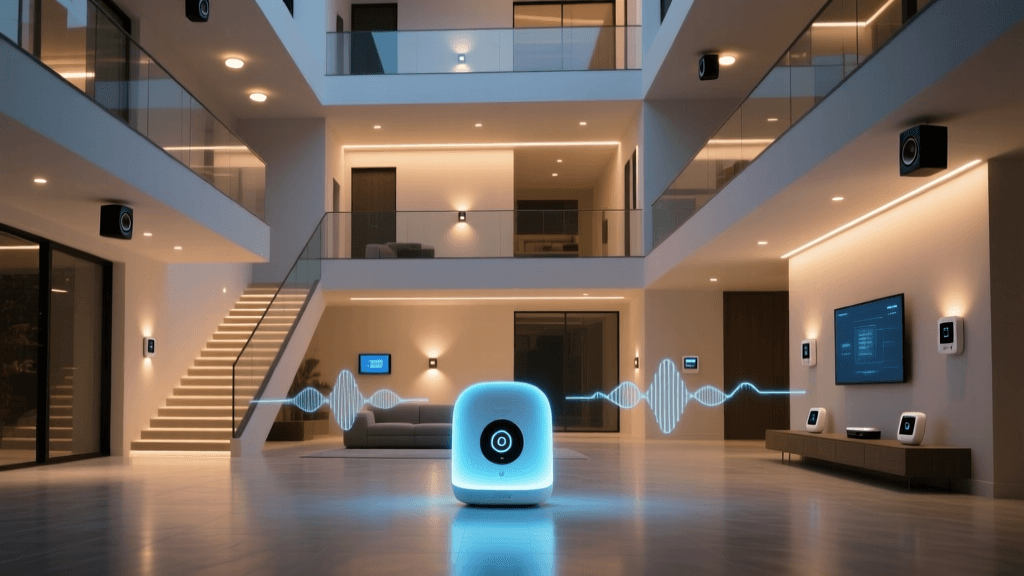
Thread is the wireless networking protocol that powers many Matter devices. Unlike Wi-Fi, which relies on a central router, Thread devices create a decentralized mesh network. A smart plug on your second floor can act as a repeater for a door sensor on your third floor, eventually passing the signal down to a Thread Border Router (like the Nest Wifi Pro or eero Pro 6E) on your first floor. This 'self-healing' capability means that the more Thread devices you add to your large home, the stronger and more resilient your smart home network becomes.
Furthermore, the adoption of Wi-Fi 6E by the Wi-Fi Alliance has been a game-changer for smart homes. By utilizing the 6GHz spectrum, Wi-Fi 6E routers bypass the interference caused by microwaves, baby monitors, and neighboring Wi-Fi networks, ensuring that your smart home hubs maintain pristine connections to their satellites.
Strategic Node Placement for Multi-Story Homes
Even the most expensive mesh router system will underperform if the nodes are placed incorrectly. In multi-story homes, vertical signal propagation is your biggest hurdle. Follow these rules for optimal placement:
- The Stairwell Strategy: Wi-Fi signals travel best through open air. Place your secondary nodes near stairwells or open atriums. This provides a clear 'line of sight' for the signal to travel between floors without having to punch through floorboards, subflooring, and ceiling drywall.
- Avoid Radiant Heating and Metal: If your home features hydronic radiant floor heating, the water and metal piping in the floors will severely block Wi-Fi signals traveling vertically. In these homes, you must rely on the stairwell strategy or use wired Ethernet backhaul (MoCA adapters or hardwired CAT6) to connect nodes on different floors.
- The 30-Foot Rule for Hubs: When placing your smart home hubs or mesh nodes, try to keep them within 30 feet of one another through walls, or 50 feet in open spaces. This ensures that the backhaul connection remains strong enough to handle the data requests from dozens of smart sensors.
- Elevate Your Nodes: Never place a mesh node on the floor or behind a television. Place them on shelves or mount them high on walls. In a multi-story home, placing a node on the ceiling of the first floor (or high on a wall near the ceiling) can dramatically improve the signal reach to the second floor.
Final Verdict: Which System Should You Choose?
Choosing the right smart mesh router for a large home depends on your specific ecosystem and the physical layout of your property. If you want the most comprehensive, all-in-one smart home hub that eliminates the need for extra dongles and bridges, the Amazon eero Pro 6E is the best overall choice. Its native Zigbee and Thread support make it the ultimate brain for a sprawling smart home.
For Google Home loyalists who prioritize a clean aesthetic and robust Thread border routing, the Google Nest Wifi Pro offers exceptional multi-story handoff performance. If you are covering a massive area on a budget and primarily use Wi-Fi-based smart devices, the TP-Link Deco XE75 provides unbeatable value and range. Finally, for luxury estates with thick walls and high-bandwidth security camera networks, the premium investment in the Netgear Orbi RBKE963 is entirely justified by its quad-band dominance.
By investing in a Wi-Fi 6E mesh system with built-in Matter and Thread capabilities, you are not just solving today's dead zones; you are future-proofing your large home for the next decade of smart home innovation.