The Paradigm Shift: Why Matter Needs Thread
The smart home industry has historically been plagued by fragmentation. Consumers were forced to choose between competing ecosystems, relying on proprietary hubs and cloud-dependent protocols that often resulted in delayed responses and unreliable automations. The introduction of the Matter standard by the Connectivity Standards Alliance (CSA) promised to solve this by creating a universal application layer. However, Matter is not a wireless protocol itself; it is a unified language that requires a robust transport layer to function efficiently. For low-power, high-reliability devices, that transport layer is Thread.
Thread is an IPv6-based, low-power wireless mesh networking protocol built on the IEEE 802.15.4 standard. While Wi-Fi is excellent for high-bandwidth devices like security cameras, it is overkill and too power-hungry for battery-operated sensors and smart locks. Zigbee and Z-Wave have historically filled this gap, but they require proprietary translation hubs. Thread eliminates the single point of failure by creating a decentralized mesh where every mains-powered device acts as a router, ensuring that if one node drops, the network instantly heals itself. When combined with Matter, Thread provides the ultimate foundation for a local, secure, and lightning-fast smart home ecosystem.
The Anatomy of a Thread Mesh Network
To build a reliable Matter over Thread network, it is crucial to understand the distinct roles devices play within the mesh topology. Unlike legacy star networks where all devices must communicate directly with a central hub, a Thread mesh is highly resilient and self-healing.
1. Thread Border Routers
The Border Router is the bridge between your Thread mesh network and your home's primary IP network (Wi-Fi or Ethernet). It translates the 802.15.4 Thread radio signals into standard IP packets, allowing your Thread devices to communicate with Matter controllers (like your smartphone or smart speaker) without relying on external cloud servers. A robust smart home should have at least two to three Border Routers to ensure redundancy and optimal coverage.
2. Thread Routing Devices
Any Thread device that is connected to a continuous power source (such as smart plugs, smart bulbs, and hardwired switches) automatically acts as a Routing Device. These devices extend the mesh network, passing encrypted messages between Sleepy End Devices and the Border Router. The more routing devices you have, the stronger and more expansive your mesh becomes.
3. Sleepy End Devices (SEDs)
Battery-powered devices, such as motion sensors, door/window contacts, and smart locks, operate as Sleepy End Devices. To preserve battery life—often lasting up to two years on a single coin cell or set of AAs—these devices sleep most of the time and only wake up to transmit data or poll their parent router for pending messages. They do not route traffic for other devices.
Choosing the Right Thread Border Routers
You likely already own a Thread Border Router without realizing it. Over the past few years, major tech companies have quietly integrated Thread radios into their flagship smart speakers and displays. Below is a comparison of the most reliable Border Routers currently available for building a Matter network.
| Device | Ecosystem Integration | Thread Border Router | Approximate Cost |
|---|---|---|---|
| Apple TV 4K (3rd Gen, Wi-Fi + Ethernet) | Apple HomeKit | Yes (Primary/Backup) | $129 - $149 |
| Apple HomePod (2nd Generation) | Apple HomeKit | Yes (Primary/Backup) | $299 |
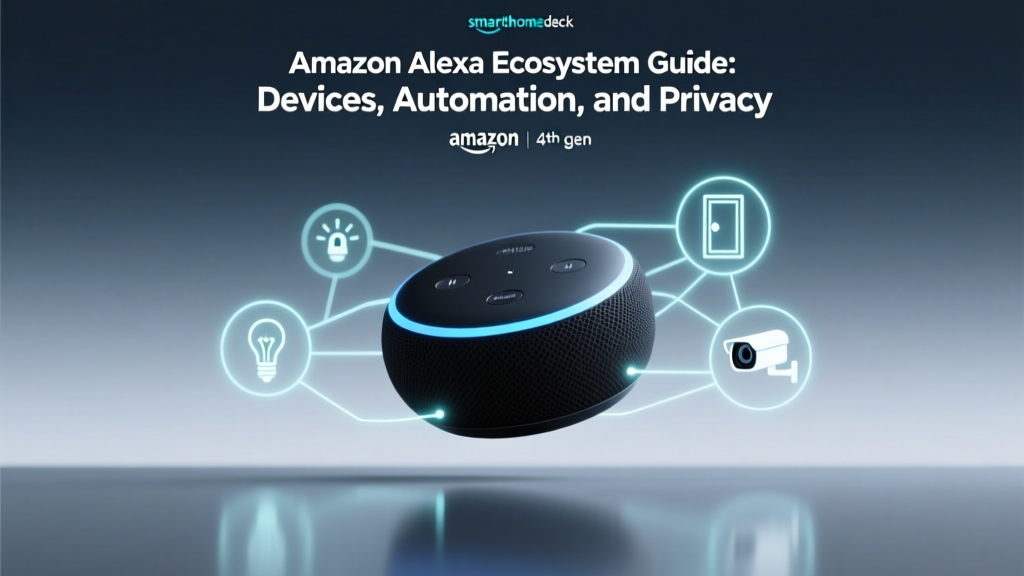
| Amazon Echo (4th Generation) | Amazon Alexa | Yes (Zigbee + Thread) | $79 - $99 |
| Google Nest Hub (2nd Gen) | Google Home | Yes | $99 |
| Eve Energy (Smart Plug) | Matter / Multi-Admin | Yes (Standalone) | $49 - $79 |
| Nanoleaf Lines Connector | Matter / Multi-Admin | Yes (Standalone) | $199 (Kit) |
Note: When deploying Border Routers, it is highly recommended to mix brands only if they support the open Thread Border Router specification seamlessly, though sticking to a primary ecosystem (like multiple Apple HomePods or multiple Nest Hubs) often yields the most stable mesh routing tables.
Latency and Reliability: Thread vs. Legacy Protocols
One of the most significant advantages of Matter over Thread is local execution and reduced latency. Because Thread utilizes native IPv6, devices communicate directly with the controller on the local network without traversing a proprietary cloud bridge. This results in near-instantaneous command execution, which is critical for automations like turning on lights when a motion sensor is triggered.
The Thread Group emphasizes that their protocol is designed specifically for low-latency, high-reliability IoT environments. Below is a visual comparison of average command latency across popular smart home protocols.
As the data illustrates, Thread consistently outperforms legacy mesh protocols and Wi-Fi in localized command latency, providing a much snappier user experience.
The Commissioning Process: Adding Devices to Your Fabric
Adding a Thread device to a Matter ecosystem is vastly superior to the legacy pairing processes of Zigbee or Z-Wave. Thread utilizes Bluetooth Low Energy (BLE) for secure, out-of-band commissioning. When you unbox a new Matter over Thread device—such as an Eve Motion sensor or an Aqara smart lock—you simply scan the QR code or enter the alphanumeric setup code printed on the device.
Your smartphone uses BLE to securely transfer your Thread network credentials (the operational dataset) to the new device. Once the credentials are received, the device activates its 802.15.4 radio, joins the mesh, and registers itself on your local IP network. This process is encrypted end-to-end, ensuring that no rogue device can intercept your network keys during setup.
Multi-Admin: The Holy Grail of Smart Home Interoperability
A defining feature of the Matter protocol is 'Multi-Admin.' In the past, if you paired a smart plug to Apple HomeKit, it was locked to Apple. With Matter over Thread, you can pair a single device to multiple ecosystems simultaneously. You can commission a Nanoleaf smart bulb to your Apple Home app for Siri control, while simultaneously granting administrative access to your partner's Google Home app and your Amazon Alexa routines.
This is achieved through a cryptographic 'Fabric' system. Each ecosystem controller creates its own fabric on the device, allowing it to respond to commands from Apple, Google, and Amazon concurrently without the need to reset or re-pair the device. This completely eliminates household friction where family members prefer different voice assistants or mobile platforms.
Practical Setup: Optimizing Your Thread Mesh
While Thread is designed to be self-healing, physical placement and spectrum management are vital for achieving optimal performance. Follow these actionable steps to build a bulletproof Thread network:
- Deploy Multiple Border Routers: Never rely on a single Border Router. Place an Apple TV 4K in the living room and a HomePod Mini in the bedroom. Thread will automatically elect a 'Primary' Border Router and keep the others on standby to instantly take over if the primary fails or loses connection.
- Manage 2.4GHz Spectrum Congestion: Thread operates on the 2.4GHz spectrum, sharing airspace with Wi-Fi, Bluetooth, Zigbee, and microwaves. To prevent interference, configure your home Wi-Fi router to use channels 1, 6, or 11, and ensure your Thread/Zigbee networks are pushed to channel 15, 20, or 25 where possible.
- Strategic Placement of Routing Devices: Place mains-powered Thread devices (like smart plugs and lamps) in central locations, such as hallways or stairwells, to act as signal repeaters between isolated rooms and your Border Routers.
- Avoid Metal Enclosures: Do not install Thread smart switches in metal electrical boxes without external antennas, as the Faraday cage effect will severely degrade the 802.15.4 signal.
Privacy, Security, and Data Handling
Security is not an afterthought in the Thread and Matter ecosystem; it is fundamentally baked into the architecture. Thread requires AES-128 encryption for all network traffic. Furthermore, Matter introduces Device Attestation, a cryptographic process where the device proves its identity and certification status to the controller before it is allowed to join the network. This prevents counterfeit or compromised hardware from infiltrating your smart home.
From a privacy standpoint, Matter over Thread is a massive victory for consumers. Because the protocol relies on local IP communication, your smart home routines execute entirely on your local network. If your internet connection goes down, your motion sensors will still trigger your lights, and your smart locks will still respond to local keypad inputs. Your data is not routed through third-party cloud servers, drastically reducing the risk of mass data breaches or unauthorized telemetry harvesting.
Cost Analysis: Thread vs. Legacy Ecosystems
Transitioning to a Matter over Thread network requires an upfront investment, but it often proves more cost-effective in the long run. Legacy systems required purchasing proprietary hubs (often costing $100-$150 each) that were limited to a single brand's ecosystem. With Thread, your existing smart speakers double as Border Routers, eliminating the need for dedicated, single-purpose hubs.
While individual Matter over Thread devices (like the Eve Energy plug or Aqara G3 Hub) may carry a slight premium over generic Wi-Fi alternatives due to the inclusion of secure elements and 802.15.4 radios, the elimination of cloud-subscription requirements and the extended battery life of Sleepy End Devices result in significant long-term savings. Furthermore, the interoperability of Matter ensures that your hardware investment is protected against ecosystem lock-in and future platform shifts.
The Future of the Thread Ecosystem
As more manufacturers adopt the CSA's standards, the market is rapidly shifting toward Matter over Thread for all non-video smart home devices. We are already seeing advanced implementations in smart HVAC controls, leak detectors, and motorized blinds. The continuous evolution of the Thread specification, including upcoming enhancements for lower latency and higher throughput, guarantees that it will remain the backbone of the professional and enthusiast smart home for the next decade. By investing in Thread Border Routers and compatible devices today, you are future-proofing your home against the inevitable sunset of proprietary, cloud-dependent smart home walled gardens.