The End of Smart Home Fragmentation
For over a decade, the smart home industry has been plagued by a frustrating reality: fragmentation. Consumers have historically been forced to choose sides, locking themselves into proprietary ecosystems like Apple HomeKit, Amazon Alexa, Google Home, or Samsung SmartThings. If you bought a Zigbee smart lock, it likely would not communicate with your Wi-Fi-based smart lights without a complex third-party bridge. This siloed approach stifled innovation, confused consumers, and slowed the mainstream adoption of home automation. Enter the Connectivity Standards Alliance (CSA) with a revolutionary solution: Matter.
Matter is not just another wireless protocol; it is a universal application layer that sits on top of existing network technologies like Wi-Fi, Ethernet, and Thread. Its primary goal is interoperability. When a device features the Matter logo, it guarantees out-of-the-box compatibility with all major smart home platforms simultaneously. However, Matter's true power is unlocked when paired with Thread, a low-power, IPv6-native mesh networking protocol designed specifically for IoT devices. Together, Matter and Thread form the backbone of the next-generation smart home ecosystem, promising faster response times, local execution without cloud dependency, and unparalleled reliability.
In this comprehensive guide, we will dissect the Matter and Thread ecosystem. We will explore the critical role of Thread Border Routers, review the best compatible devices currently on the market, provide a step-by-step setup guide, and compare this new standard against legacy protocols like Zigbee and Z-Wave.
Demystifying Matter and Thread: How They Work Together
To understand the ecosystem, you must separate the 'language' from the 'highway'. Matter is the language. It defines how devices communicate, how they are paired, and how they execute commands. Whether a device uses Wi-Fi or Thread, if it speaks Matter, your Apple TV, Amazon Echo, and Google Nest Hub will all understand it natively. Matter relies on blockchain-based security and Device Attestation Certificates (DAC) to ensure that every certified device is authentic and secure.
Thread is the highway. It is a low-power, mesh networking protocol that operates on the 2.4 GHz spectrum (specifically IEEE 802.15.4). Unlike Wi-Fi, which can overwhelm your router when you connect 50 smart bulbs, Thread devices communicate with each other to form a self-healing mesh network. If one smart plug loses its connection to the main router, it simply routes its data through the smart bulb next to it. Furthermore, Thread is IPv6 native, meaning every sensor and switch gets its own IP address, eliminating the need for proprietary translation hubs.
'The combination of Matter's universal application layer and Thread's robust, low-power mesh networking represents the most significant architectural shift in the smart home industry since the introduction of Wi-Fi.' - SmartHomeDeck Ecosystem Analysis Team
The Backbone: Understanding Thread Border Routers
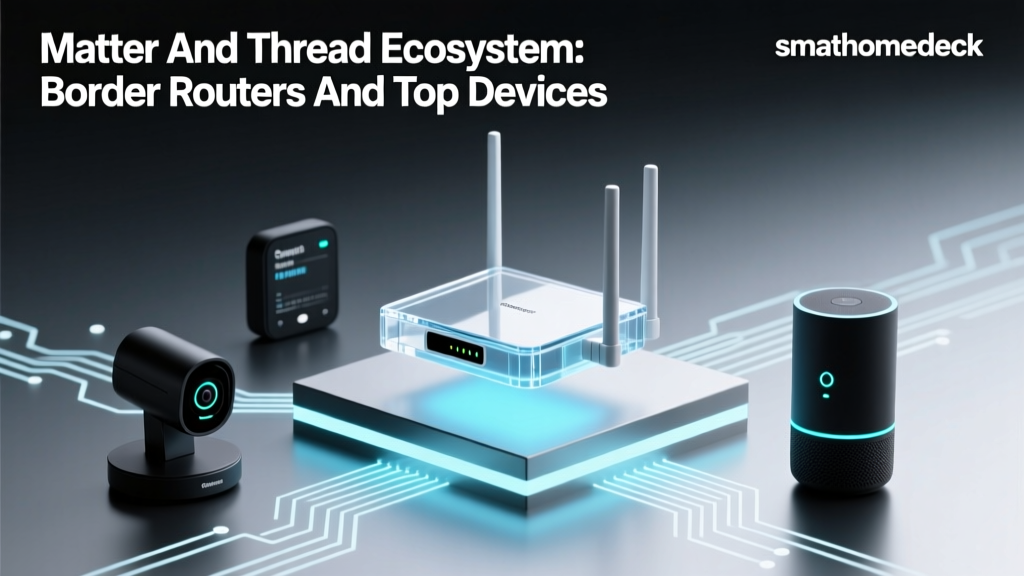
A common misconception among consumers is that they need to purchase a 'Matter Hub' or a 'Thread Router' to get started. In reality, the industry has integrated Thread Border Routers into devices you likely already own. A Border Router is the bridge that connects your local Thread mesh network to your home's Wi-Fi or Ethernet network, allowing Thread devices to communicate with the cloud and your smartphone.
You do not need to buy a dedicated standalone border router. Instead, you can utilize existing smart speakers, streaming boxes, or mesh Wi-Fi nodes. Here are the most reliable Thread Border Routers currently available:
- Apple TV 4K (3rd Generation, Wi-Fi + Ethernet): Priced around $149, this is widely considered the gold standard for Thread border routing, offering exceptional stability and acting as the primary home hub for Apple HomeKit.
- Apple HomePod Mini: At $99, this compact speaker contains a dedicated Thread radio. If you have multiple HomePod Minis, they automatically pool their routing capabilities to expand your Thread mesh coverage.
- Google Nest Hub (2nd Gen) & Nest Hub Max: Priced between $99 and $229, these smart displays serve as excellent border routers for the Google Home ecosystem, seamlessly bridging Thread devices to your Wi-Fi.
- Amazon Echo (4th Gen) & Echo Show 8 (3rd Gen): Amazon's premium speakers include Zigbee, Bluetooth, and Thread radios, making them versatile hubs that retail between $99 and $149.
- eero 6 / eero Pro 6E Mesh Routers: If you use eero for your home Wi-Fi, your primary router and every satellite node act as Thread Border Routers, providing whole-home Thread coverage without needing extra smart speakers.
Pro Tip: For the best experience, ensure your Border Router is centrally located in your home. Thread signals, like all 2.4 GHz signals, can struggle to penetrate thick concrete walls or metal appliances.
Top Matter and Thread Compatible Devices
The market for Matter over Thread devices is expanding rapidly. Because Thread is optimized for low-power, battery-operated, and continuously powered small devices, it is the ideal protocol for smart plugs, lighting, sensors, and locks. Below is a curated list of the best devices currently available, complete with specifications and pricing.
| Device Name | Category | Protocol | Key Specifications | Approx. Cost |
|---|---|---|---|---|
| Eve Energy (Matter/Thread) | Smart Plug | Thread | 15A max, 110V-240V, Energy Monitoring, 2.1 x 2.1 inches | $49.99 |
| Aqara Door & Window Sensor P2 | Contact Sensor | Thread | CR2032 Battery (up to 2 yrs), 40ms latency, Matter native | $29.99 |
| Nanoleaf Essentials A19 Bulb | Smart Lighting | Thread | 800 Lumens, 11W, 2700K-6500K, Adaptive Lighting | $19.99 |
| Yale Assure Lock 2 (Matter Module) | Smart Lock | Wi-Fi/Matter | Keypad, Auto-unlock, 4x AA Batteries, BHMA Grade 2 | $239.00 |
| Eve MotionBlinds Upgrade Kit | Window Treatment | Thread | Motorized roller retrofit, 12V rechargeable battery | $199.95 |
When shopping, always look for the official Matter logo on the packaging. Devices like the Aqara P2 sensor were among the first to hit the market, proving that Thread's low latency is perfect for security applications where a 2-second delay in a door sensor triggering a siren is unacceptable.
Step-by-Step Setup and the Magic of Multi-Admin
Setting up a Matter device is designed to be frictionless, regardless of which ecosystem you prefer. The days of downloading a manufacturer's proprietary app, creating an account, and linking it via clunky OAuth tokens are over. Here is how you set up a Matter over Thread device:
- Ensure Border Router Readiness: Verify that your Apple TV, HomePod, or Nest Hub is updated to the latest firmware and connected to the same 2.4 GHz or 5 GHz Wi-Fi network you intend to use for your smart home.
- Power the Device: Plug in your Eve Energy plug or pull the battery tab on your Aqara P2 sensor. The device will enter pairing mode, usually indicated by a blinking LED.
- Scan the Matter QR Code: Open your preferred smart home app (Apple Home, Google Home, or Samsung SmartThings). Tap the '+' icon to add a device and use your phone's camera to scan the 11-digit numeric code or QR code printed on the device or its packaging.
- Thread Network Commissioning: Your phone will use Bluetooth Low Energy (BLE) to securely pass your Thread network credentials to the new device. The device will then join the Thread mesh automatically.
- Assign to a Room: Name the device and assign it to a room (e.g., 'Living Room Lamp').
The Multi-Admin Feature
The most powerful feature of Matter is Multi-Admin. In legacy ecosystems, if you paired a smart plug to Apple HomeKit, it was locked there. If your spouse preferred Google Home, they were out of luck. With Matter, you can pair the device to Apple Home first, and then immediately open the Google Home app, scan the same QR code again, and add it to Google Home simultaneously. Both platforms have equal, local control over the device without conflicting with one another. This is a game-changer for multi-platform households.
Matter/Thread vs. Legacy Ecosystems: Zigbee, Z-Wave, and Wi-Fi
How does this new stack compare to the protocols that built the smart home industry? Let us break down the technical and practical differences.
Thread vs. Zigbee
Zigbee has been the king of low-power mesh networks for a decade. However, Zigbee requires a proprietary hub (like the Philips Hue Bridge or Samsung SmartThings Station) to translate Zigbee radio signals into IP (Internet Protocol) signals your router can understand. Thread, conversely, is built on IPv6 from the ground up. A Thread Border Router simply passes the IP packets through; it does not need to translate the application layer. This results in lower latency, fewer points of failure, and the elimination of single-vendor hub lock-in.
Matter vs. Wi-Fi
Wi-Fi is excellent for high-bandwidth devices like security cameras and smart displays. However, connecting 40 Wi-Fi smart bulbs to a standard consumer router will cause network congestion, IP conflicts, and dropped connections. Matter over Wi-Fi is still supported and useful for high-power devices (like smart plugs and thermostats), but Matter over Thread is vastly superior for whole-home lighting and sensor deployments due to its mesh capabilities and minimal router strain.
Matter vs. Z-Wave
Z-Wave operates on sub-1 GHz frequencies (908.42 MHz in the US), giving it excellent wall penetration. However, Z-Wave is proprietary, requires expensive, specific hubs, and has a much slower data transfer rate. While Z-Wave remains highly reliable for security systems, Matter over Thread offers a more open, future-proof, and cost-effective alternative for general home automation.
Privacy, Security, and Data Handling
Security is not an afterthought in the Matter ecosystem; it is a foundational requirement. To receive Matter certification from the CSA, every device must undergo rigorous testing and include a hardware-based Device Attestation Certificate (DAC). This functions similarly to an SSL certificate on a website. When you scan the QR code to pair a device, your smartphone cryptographically verifies the DAC against the CSA's blockchain ledger to ensure the device is a genuine, certified Matter product and not a spoofed or malicious clone.
Furthermore, all local communication over the Thread mesh network is secured using AES-128 encryption. Because Matter prioritizes local execution, your smart switch can trigger your smart bulb directly over the Thread mesh without sending a signal to a cloud server in another country and back. This not only ensures that your automations work when your internet connection goes down, but it also drastically reduces the amount of telemetry data sent to corporate servers, preserving your household's privacy.
Consumers should note that while the *control* of Matter devices is standardized and local, the *advanced features* (like detailed historical energy graphs or AI-driven camera recognition) may still require the manufacturer's proprietary app and cloud services. Always review the privacy policy of the hardware manufacturer regarding data collection for these supplementary features.
Future-Proofing Your Smart Home
Transitioning to a Matter and Thread ecosystem does not mean you must throw away your existing Zigbee or Wi-Fi devices. Matter is designed to be an inclusive umbrella. Platforms like Samsung SmartThings and Apple HomeKit are rolling out software updates that allow their proprietary hubs to bridge older Zigbee devices into the Matter ecosystem. This means your legacy Philips Hue bulbs can eventually be exposed to your Google Nest Hub via Matter, even if the bulbs themselves do not have a Thread radio.
As we look toward the future, the inclusion of Thread in upcoming standards for smart appliances, HVAC systems, and EV chargers will create a truly unified, energy-efficient home. By investing in a solid Thread Border Router setup and prioritizing Matter-certified devices for your next purchases, you are building a resilient, interoperable, and privacy-respecting smart home that will adapt to whatever platforms and technologies emerge in the next decade.