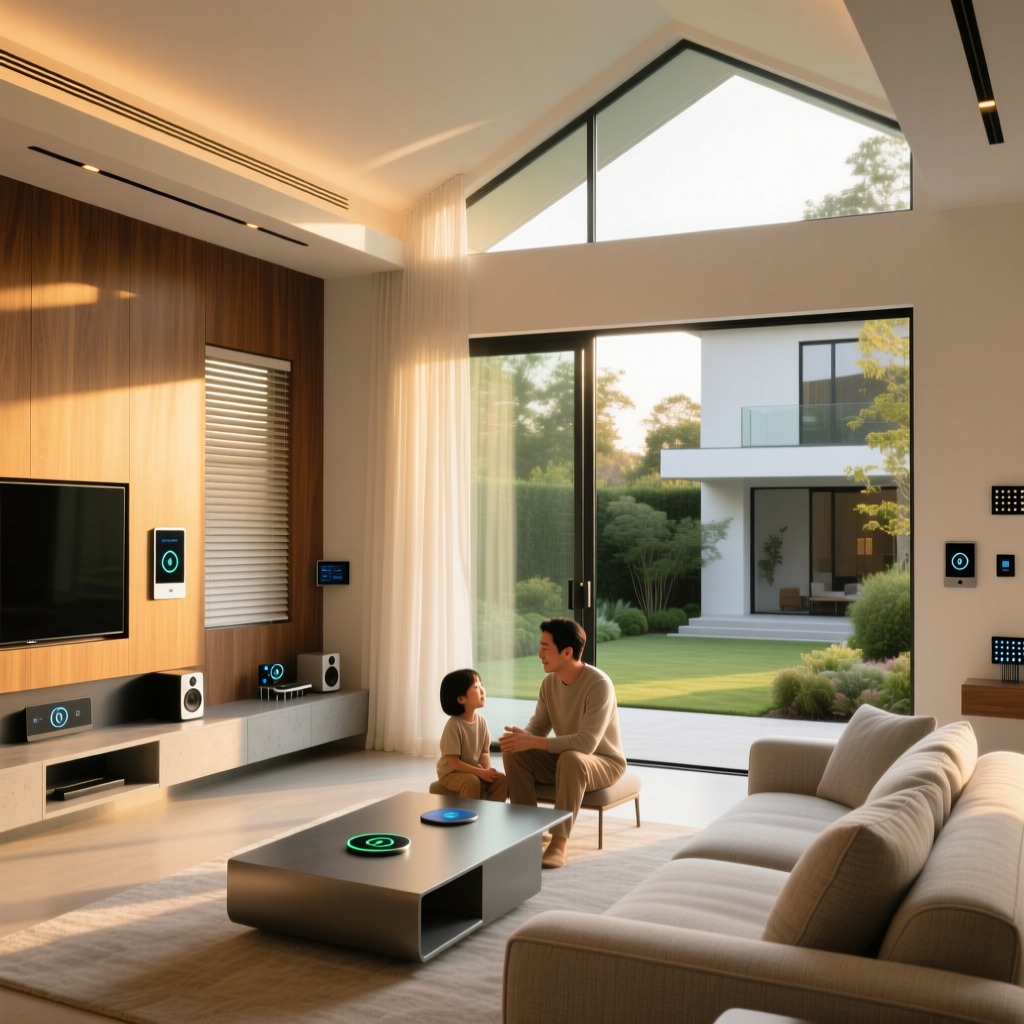
The Evolution of Smart Home Hub Hardware
The smart home landscape has transitioned from a fragmented collection of cloud-dependent gadgets to a cohesive, locally-controlled ecosystem. At the heart of this transformation is the smart home hub. Early iterations of smart home hubs were little more than simple radio bridges designed to translate Zigbee or Z-Wave signals into Wi-Fi packets, offloading the actual processing logic to remote cloud servers. Today, the hardware requirements for smart home hubs have grown exponentially. Modern ecosystems demand robust local processing power, advanced neural engines for voice recognition, and multiprotocol radios capable of handling Thread, Matter, Zigbee, and Z-Wave simultaneously.
Understanding the hardware requirements across different ecosystem platforms—such as Apple HomeKit, Samsung SmartThings, Home Assistant, and Amazon Alexa—is critical for building a reliable, future-proof smart home. In this comprehensive guide, we compare the physical hardware, processing capabilities, memory requirements, and radio configurations necessary to power today's leading smart home ecosystems.
The Core Components of a Modern Smart Home Hub
Before diving into specific ecosystems, it is essential to understand the baseline hardware architecture that defines a modern smart home hub. Whether you are looking at a consumer-friendly smart speaker or a DIY enthusiast's local server, the core components remain consistent:
- System on Chip (SoC) / CPU: The brain of the hub. Modern hubs utilize ARM Cortex-A series chips (like the A53 or A76) for energy efficiency, or Intel Celeron processors for heavy local automation workloads.
- Memory (RAM): Crucial for managing device states, running local automation engines, and caching network data. While early hubs survived on 256MB of RAM, modern ecosystems require between 1GB and 8GB to handle Matter fabric management and local voice processing.
- Storage: Ranging from MicroSD cards (prone to corruption) to eMMC flash storage and NVMe SSDs. Reliable storage is mandatory for logging automation histories and storing local media or security footage.
- Radio Arrays: The physical antennas and baseband chips that communicate with end devices. This includes 802.15.4 chips for Thread and Zigbee, 900MHz radios for Z-Wave, and Bluetooth Low Energy (BLE) for initial device provisioning.
Ecosystem Hardware Requirements Breakdown
Apple HomeKit and the Home Ecosystem
Apple’s approach to smart home hardware is heavily integrated and premium. To act as a true hub and Thread Border Router within the Apple Home ecosystem, you cannot use a standalone bridge; you must use specific Apple hardware. The Apple TV 4K (3rd Generation) with Ethernet and the HomePod (2nd Gen) or HomePod mini serve as the primary hubs.
According to Apple's official support documentation, these devices utilize Apple’s proprietary silicon (such as the A15 Bionic chip in the latest Apple TV 4K) to process HomeKit Secure Video, manage Thread mesh networks, and handle Matter controller duties. The hardware requirements here are vastly over-specified for basic smart home tasks because the SoC is primarily designed for 4K media decoding and spatial audio processing. However, this immense processing overhead guarantees near-zero latency for local automations and end-to-end encryption for all camera feeds.
Samsung SmartThings: Bridging Cloud and Local
Samsung SmartThings has historically relied on dedicated, puck-shaped hubs. The SmartThings Hub v3 (now manufactured by Aeotec) features a modest ARM Cortex-A7 processor, 512MB of RAM, and 4GB of eMMC storage. Its standout hardware feature is the inclusion of dedicated, physically separated radios for both Zigbee 3.0 and Z-Wave Plus, alongside a Wi-Fi/Ethernet backhaul.
Recently, Samsung introduced the SmartThings Station, a much smaller, budget-friendly hub that acts as a Matter controller and Thread Border Router. The Station lacks Z-Wave and Zigbee radios, relying entirely on the 802.15.4 Thread protocol and Wi-Fi. This represents a hardware shift: Samsung is moving processing logic back to the cloud and relying on edge devices (like Samsung Galaxy smartphones and Smart TVs) to act as supplementary hub nodes within the home's mesh network.
Home Assistant: The Local Processing Powerhouse
For enthusiasts demanding total local control, Home Assistant sets the highest baseline hardware requirements. Because Home Assistant runs a full Python-based automation engine, a local database (SQLite or MariaDB), and a web server, it requires genuine computing hardware.
The Home Assistant Green was engineered specifically to meet these demands without the complexity of a DIY build. It features a Rockchip RK3566 64-bit quad-core processor, 4GB of LPDDR4 RAM, and 32GB of eMMC storage. For power users managing hundreds of devices, local AI voice pipelines (like Whisper and Piper), and Frigate NVR camera processing, the community often recommends an Intel NUC with an i3 or i5 processor, 8GB to 16GB of RAM, and a 256GB NVMe SSD. Home Assistant proves that true local autonomy requires dedicated, desktop-class hardware resources.
Amazon Alexa and Google Home
Amazon and Google have successfully disguised their smart home hubs as consumer audio products. The Amazon Echo (4th Gen) and Nest Hub (2nd Gen) serve as the primary hub nodes for their respective ecosystems.
The Echo 4th Gen is notable for its inclusion of the AZ1 Neural Edge processor. This dedicated silicon is designed specifically to handle local voice recognition and smart home routing, reducing the reliance on Amazon's AWS cloud infrastructure. It also houses a combined Zigbee and Thread/Matter radio. Google’s Nest Hub utilizes a similar local-processing approach for Thread, but relies heavily on Google's Tensor chips and cloud infrastructure for complex voice queries and Google Home automations.
Connectivity Protocols: The Radio Hardware
The most critical hardware differentiator between smart home hubs is the physical radio array. The introduction of Matter has complicated the hardware landscape, as hubs must now support legacy protocols while simultaneously broadcasting new mesh networks.
The 802.15.4 Standard: Zigbee and Thread
Both Zigbee and Thread operate on the 2.4 GHz spectrum using the IEEE 802.15.4 standard. Modern hubs utilize multiprotocol chips, such as the Silicon Labs EFR32MG24 or the Nordic nRF52840, which can theoretically run Zigbee and Thread concurrently on a single physical radio. However, running both simultaneously on one chip can lead to network congestion and dropped packets. Premium hubs, like the Home Assistant Yellow or high-end commercial controllers, often feature physically separate 802.15.4 antennas to dedicate one exclusively to Zigbee and another to Thread.
Z-Wave: The 900 MHz Advantage
Z-Wave operates on sub-GHz frequencies (908.42 MHz in the US, 868.42 MHz in Europe), allowing it to penetrate walls and floors far better than 2.4 GHz signals. Because it uses a completely different frequency and modulation scheme, a hub must have a dedicated, secondary physical radio chip (like the Silicon Labs Z-Wave 700 or 800 series) to support it. This is why newer, budget-friendly Matter hubs often drop Z-Wave support entirely to save on hardware costs and physical space.
The shift toward local processing and multiprotocol radios is not just about speed; it is fundamentally about privacy, reliability, and reducing the cloud dependency that plagued early smart home generations.
Data Comparison: Hub Hardware Specifications
To visualize the hardware disparities across ecosystems, review the detailed specification table below. This table highlights the processing and connectivity differences that dictate how each platform handles local versus cloud commands.
| Ecosystem Hub | Processor / SoC | RAM | Storage | Supported Radios | Avg. Cost |
|---|---|---|---|---|---|
| Home Assistant Green | Rockchip RK3566 (Quad-Core) | 4GB LPDDR4 | 32GB eMMC | Ethernet, USB (for external dongles) | $99 |
| Apple TV 4K (Ethernet) | Apple A15 Bionic | 4GB | 64GB / 128GB | Wi-Fi 6, Ethernet, Thread (802.15.4) | $129 - $149 |
| SmartThings Hub v3 | ARM Cortex-A7 | 512MB | 4GB eMMC | Zigbee 3.0, Z-Wave Plus, Wi-Fi | $80 - $120 |
| Amazon Echo (4th Gen) | Quad-Core + AZ1 Neural Edge | 1GB | N/A (Cloud-dependent) | Zigbee, Thread, BLE, Wi-Fi | $99 |
| Home Assistant Yellow | Raspberry Pi CM4 (up to Quad-Core) | Up to 8GB | NVMe SSD Support | Built-in 802.15.4, Ethernet, Wi-Fi | $199+ |
Local vs. Cloud Processing: The Hardware Toll
Why do Home Assistant and Apple require vastly more RAM and processing power than a traditional SmartThings or Wink hub? The answer lies in the Local vs. Cloud processing paradigm.
When a hub relies on cloud processing, its hardware requirements are minimal. The hub's only job is to maintain a persistent WebSocket connection to an AWS or Google Cloud server and relay raw radio signals back and forth. The cloud server handles the automation logic, state tracking, and natural language processing. The latency for a cloud-based command typically ranges from 200ms to 500ms, and it completely fails during an internet outage.
Conversely, local processing requires the hub to maintain a real-time state machine of every device in the home. If you have 150 smart bulbs, motion sensors, and locks, the hub must cache their statuses in RAM, evaluate automation logic trees locally, and execute commands via the radio array in under 50ms. Furthermore, local voice assistants (like Apple's Siri offline commands or Home Assistant's local Whisper AI) require dedicated Neural Processing Units (NPUs) and gigabytes of RAM to translate audio waves into text and intent without ever contacting an external server.
Matter and Thread: The New Hardware Baseline
The introduction of the Matter protocol has fundamentally shifted the hardware requirements for smart home hubs. According to the Connectivity Standards Alliance, Matter is designed to run over Thread, Wi-Fi, and Ethernet. Thread, in particular, requires a hub to act as a Thread Border Router.
A Thread Border Router is a hardware gateway that bridges the low-power, mesh-based 802.15.4 Thread network to your home's IP network (Wi-Fi/Ethernet). To be a certified Thread Border Router, a hub must possess specific IPv6 routing capabilities and sufficient memory to manage the Thread mesh routing tables. This is why older Zigbee-only hubs cannot simply receive a software update to support Matter over Thread; they physically lack the 802.15.4 radios tuned for Thread's IPv6 networking stack and the RAM required to manage the border routing duties.
Power Consumption and Thermal Considerations
With increased local processing and multiple radios broadcasting simultaneously, thermal management and power consumption have become vital hardware considerations. An Intel NUC running Home Assistant with Frigate NVR can easily draw 15 to 30 watts of continuous power and requires active fan cooling. In contrast, the Apple TV 4K and Home Assistant Green are passively cooled, drawing between 3 to 7 watts, making them highly efficient for 24/7 operation. When selecting a hub, factoring in the continuous annual power cost and the physical footprint required for heat dissipation is just as important as the initial purchase price.
Future-Proofing Your Hub Hardware
If you are investing in a smart home hub today, hardware modularity is the key to future-proofing. The smart home industry is moving at a breakneck pace, and radios that are standard today may be obsolete in five years.
- USB Dongles over Soldered Radios: Platforms like Home Assistant allow you to use external USB coordinators (like the Sonoff Zigbee 3.0 Plus or Home Assistant Connect ZBT-1). If a new wireless standard emerges, you simply replace the $30 USB dongle rather than throwing away the entire hub.
- Ethernet Backhaul: Always prioritize hubs with physical Gigabit Ethernet ports. Thread and Matter generate significant local network traffic. Relying on Wi-Fi for the hub's backhaul connection to your router introduces unnecessary latency and network congestion.
- RAM Headroom: Never buy a hub that meets only the bare minimum RAM requirements. As firmware updates add support for new Matter device types and local AI features, memory usage will inevitably climb. Opting for 4GB or 8GB of RAM ensures your hub will not require replacement when the next major software update drops.
Conclusion
The era of the simple, low-power smart home bridge is over. Today's ecosystem platforms require sophisticated, multi-radio, high-memory computing nodes to deliver the local, private, and instantaneous smart home experience that consumers demand. Whether you choose the premium, highly-integrated silicon of the Apple TV 4K, the budget-friendly mesh routing of the SmartThings Station, or the raw, customizable power of the Home Assistant Green, understanding the underlying hardware requirements is the first step toward building a truly resilient smart home.