The Walled Garden Dilemma in Modern Smart Homes
The smart home industry has experienced explosive growth over the last decade, yet it remains plagued by a persistent and frustrating issue: ecosystem fragmentation. As consumers, we rarely commit to a single brand for every device in our homes. You might rely on Amazon Echo speakers for voice control in the kitchen, prefer Apple HomeKit for its stringent privacy standards in the living room, and utilize Google Nest thermostats for superior climate algorithms. While each of these platforms excels within its own walled garden, getting them to communicate seamlessly with one another is a notorious challenge.
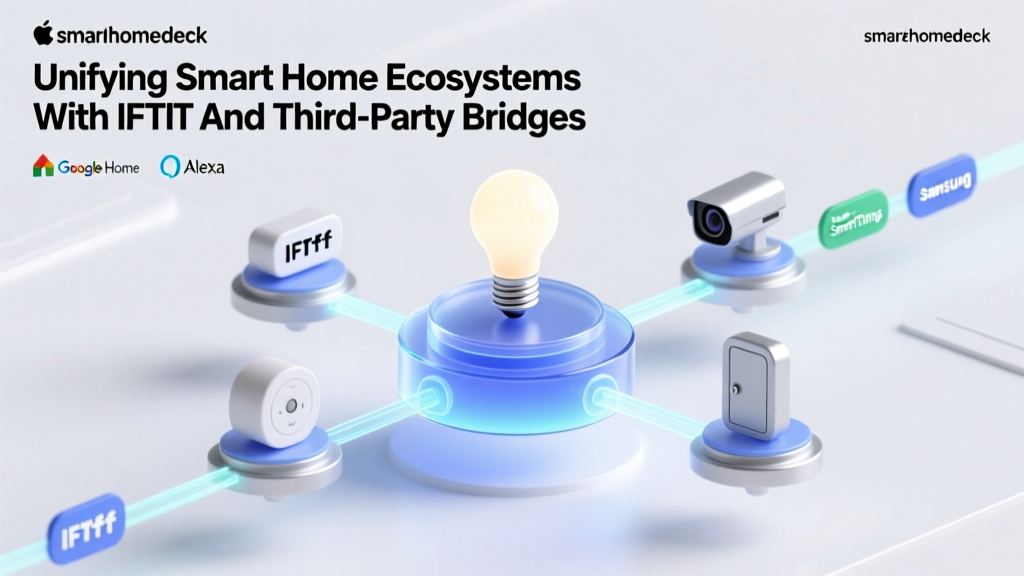
Native integrations often fall short. A Ring security camera (owned by Amazon) will not natively trigger your HomeKit-compatible Nanoleaf light panels to flash red when motion is detected. Similarly, a Google Nest doorbell cannot easily initiate a complex sequence of actions on a Samsung SmartThings hub without significant friction. This is where third-party integration platforms and middleware hubs become essential. By leveraging tools like IFTTT (If This Then That), Home Assistant, and Hubitat, advanced users can bridge these divides, creating a truly unified smart home that operates on logic rather than brand loyalty.
IFTTT: The Original Cloud Bridge for Cross-Ecosystem Automation
IFTTT has long been the duct tape of the internet of things (IoT). Operating primarily in the cloud, IFTTT connects disparate web services and smart home APIs using simple conditional statements known as Applets. The premise is straightforward: 'If This' (a trigger from one ecosystem) happens, then 'That' (an action in another ecosystem) is executed.
Setting Up Cross-Platform Triggers
Consider a practical scenario: you want your Shelly Wi-Fi relays (which integrate beautifully with Home Assistant but lack native HomeKit support for advanced scenes) to turn on your Philips Hue lights (which are deeply embedded in Apple HomeKit) when your Arlo Pro 4 camera detects a person. Neither Apple nor Amazon offers a native way to link these specific cross-brand actions directly. Through IFTTT, you can create an Applet where the Arlo API serves as the trigger, and the Hue API serves as the action.
Furthermore, IFTTT's Webhooks service (formerly the Maker API) is a powerhouse for custom integrations. If a smart device supports sending a simple HTTP POST request upon an event, you can route that webhook into IFTTT, which then translates it into an action for virtually any supported ecosystem. This allows niche devices, like custom ESP32 sensors or local network tools, to interact with mainstream platforms like Alexa and Google Home.
IFTTT Pro vs. Free Tier Limitations
While IFTTT is incredibly versatile, it has evolved into a premium service. The free tier is now severely restricted, limiting users to just two Applets. To build a comprehensive cross-ecosystem automation network, you must subscribe to IFTTT Pro, which costs approximately $3.99 per month. This tier unlocks up to 20 Applets, faster execution speeds, and the ability to use multiple actions per trigger. You can review the current tier structures and API limits on the official IFTTT Plans page. However, because IFTTT relies entirely on cloud-to-cloud communication, it is inherently subject to internet latency and API changes made by device manufacturers.
Local Hubs: The Superior Alternative to Cloud Bridging
While IFTTT is excellent for web-based triggers and simple API bridging, serious smart home enthusiasts often migrate toward local processing hubs. Local hubs execute automation logic on your own network, eliminating cloud latency, ensuring privacy, and maintaining functionality even when your internet connection goes down.
Home Assistant: The Ultimate Open-Source Unifier
Home Assistant is widely considered the gold standard for smart home integration. It is an open-source platform that supports over 2,000 integrations, effectively pulling devices from Amazon, Google, Apple, Samsung, and countless niche manufacturers into a single, unified dashboard. For users who want a plug-and-play experience without the need to configure Linux servers or flash SD cards, the Home Assistant Green (priced around $99) offers an accessible entry point. You can explore the hardware and software ecosystem directly via the Home Assistant official documentation.
One of Home Assistant's most powerful features for ecosystem bridging is the 'HomeKit Bridge' integration. This allows you to expose non-HomeKit devices—such as Ring cameras, Nest thermostats, and generic Zigbee sensors—directly into Apple's Home app. Home Assistant acts as the translator, making your entire fragmented smart home appear as a native Apple HomeKit setup on your iPhone. For advanced users, pairing Home Assistant with Node-RED allows for visual, flow-based programming that can handle incredibly complex, multi-condition logic that native ecosystems simply cannot process.
Hubitat Elevation: The Privacy-Focused Middle Ground
For users who desire local processing and robust Zigbee/Z-Wave support but find Home Assistant's learning curve or YAML configuration too daunting, Hubitat Elevation is the ideal alternative. The Hubitat Elevation C-8 hub (retailing around $149.95) processes all automation logic locally on the device itself. You can dive deeper into their local-first philosophy on the Hubitat website.
Hubitat shines in its 'Rule Machine' application, a built-in logic engine that allows users to create highly complex cross-device automations via a graphical user interface. If you have a Zooz Z-Wave motion sensor and a LIFX Wi-Fi bulb, Hubitat bridges the gap between the Z-Wave mesh network and your local Wi-Fi network instantly, with zero cloud dependency. Furthermore, Hubitat natively supports exposing its devices to both Amazon Alexa and Google Home, and with community-developed drivers, it can also bridge into Apple HomeKit.
Integration Methods Compared
Choosing the right bridging method depends on your technical expertise, budget, and tolerance for cloud dependency. Below is a structured comparison of the leading third-party integration platforms.
| Platform | Processing Location | Setup Difficulty | Cost Range | Best Use Case |
|---|---|---|---|---|
| IFTTT Pro | Cloud | Very Easy | $3.99 / month | Webhooks, API bridging, cross-platform notifications |
| Home Assistant | Local | Steep | $99 - $200+ (Hardware) | Total unification, HomeKit bridging, complex logic |
| Hubitat Elevation | Local | Moderate | $149.95 (Hub) | Zigbee/Z-Wave local mesh, Rule Machine logic |
| Native Ecosystems | Cloud / Local | Easy | Free (with device purchase) | Single-brand homes, basic voice commands |
Visualizing Integration Latency and Reliability
One of the most critical factors in smart home automation is latency—the time it takes for a trigger to result in an action. Cloud-based bridges like IFTTT must send data to an external server, process the logic, and send a command back to your home, which can result in noticeable delays. Local hubs process this data instantly on your LAN. The chart below illustrates the average execution latency across different integration methods.
As the data demonstrates, local hubs like Home Assistant and Hubitat execute automations in roughly 50 to 60 milliseconds, making them feel truly instantaneous. IFTTT, while highly compatible, can suffer from latency spikes exceeding 1.5 seconds, which is particularly jarring for lighting automations where immediate feedback is expected.
The Impact of Matter on Third-Party Bridges
With the rollout of the Matter protocol and the underlying Thread networking standard, many consumers assume that third-party bridges will become obsolete. It is crucial to understand that Matter is a device-level communication language, not an automation brain. Matter ensures that a Thread-enabled smart plug can be onboarded and controlled by both Apple HomeKit and Amazon Alexa simultaneously.
However, Matter does not dictate complex automation logic, nor does it bridge the gap between smart home hardware and external web services. If you want your Matter-enabled Aqara FP2 presence sensor to trigger a non-Matter web API, send a customized Telegram message, or interact with a legacy infrared blaster, you still need the logic engine provided by Home Assistant, Hubitat, or IFTTT. Matter solves the onboarding and basic control fragmentation, but middleware platforms remain the undisputed kings of advanced, cross-brand automation logic.
Privacy and Data Handling Considerations
When bridging ecosystems, you must consider how your data is handled. Cloud-based services like IFTTT require you to grant broad OAuth permissions to third-party servers. Every time a sensor trips, that data point is transmitted to IFTTT's cloud infrastructure before being routed to its destination. For outdoor cameras or basic lighting, this is generally acceptable. For indoor occupancy sensors or smart locks, this cloud dependency introduces unnecessary privacy risks.
"The true promise of the smart home is convenience without the compromise of privacy. Relying entirely on cloud bridges undermines the security of your local network."
Local hubs like Home Assistant and Hubitat inherently solve this issue. Because the automation logic executes on a server physically located inside your home, your occupancy data, lock statuses, and camera triggers never need to leave your local network. You maintain complete sovereignty over your data while still enjoying the convenience of unified control.
Conclusion: Building Your Unified Smart Home
Escaping the confines of walled gardens requires a strategic approach to third-party integration. If your needs are limited to simple web-based triggers, API connections, and cross-platform notifications, IFTTT Pro remains a highly accessible and user-friendly tool. However, for homeowners seeking instantaneous latency, robust privacy, and the ability to expose any device into any ecosystem—such as forcing Ring cameras into Apple HomeKit—investing in a local hub is non-negotiable.
Home Assistant offers unparalleled flexibility and integration depth for those willing to climb the learning curve, while Hubitat Elevation provides a reliable, local-first alternative for Zigbee and Z-Wave enthusiasts. By understanding the strengths and limitations of each platform, you can transcend brand rivalries and build a smart home that operates exactly the way you envision, seamlessly and securely.