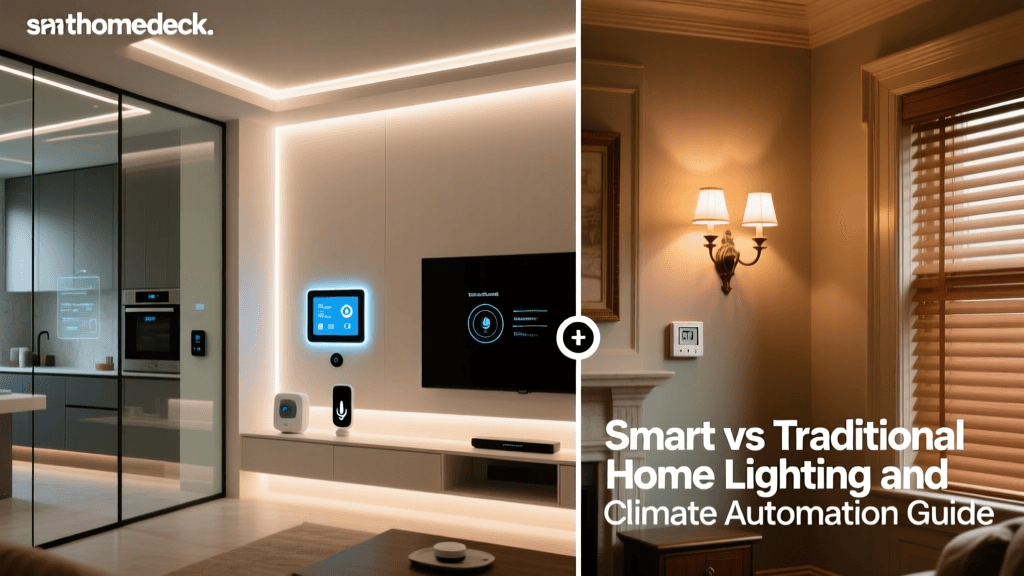
The Paradigm Shift: Smart vs. Traditional Home Automation
When upgrading a living space, homeowners and renters alike face a fundamental crossroads: should you invest in traditional, hardwired home systems, or pivot toward a fully connected smart home ecosystem? The decision is rarely straightforward. It involves balancing upfront costs, installation complexity, long-term energy savings, and daily convenience. While traditional automation—such as mechanical timers and basic programmable thermostats—has served homes reliably for decades, the Internet of Things (IoT) has introduced a new layer of intelligence, adaptability, and remote control.
This comprehensive decision guide breaks down the technical, financial, and practical differences between smart and traditional home automation. We will focus on the two most impactful areas of home automation: lighting control and climate management. By understanding the infrastructure requirements, ecosystem compatibility, and return on investment (ROI), you can make an informed choice that aligns with your lifestyle, budget, and property type.
Defining the Landscape: What Separates 'Smart' from 'Traditional'?
At its core, the distinction between traditional and smart automation lies in connectivity and contextual awareness. Traditional automation relies on local, pre-programmed logic. A mechanical light timer turns on at 6:00 PM because a physical dial or digital clock tells it to, regardless of whether you are home or if the sun is still shining. A traditional programmable thermostat follows a rigid schedule that you must manually input via a clunky interface.
Smart automation, conversely, relies on sensors, cloud computing, and machine learning. Smart devices communicate via wireless protocols like Wi-Fi, Zigbee, Z-Wave, or the newer Matter and Thread standards to create a responsive environment. They do not just execute commands; they react to context. They know when your phone crosses a geofence, they detect when a room is occupied, and they adjust based on real-time weather data.
Lighting Automation: Switches, Bulbs, and Dimmers
Lighting is often the entry point for home automation. The traditional approach involves installing hardwired dimmer switches, occupancy sensors, or digital timers. The smart approach utilizes smart bulbs, smart switches, and centralized hubs.
Traditional Lighting Controls
Traditional dimmers, such as the popular Lutron Maestro or Leviton Decora lines, require direct wiring into your home's electrical boxes. They are incredibly reliable, do not depend on an internet connection, and cost between $15 and $30 per switch. However, they lack remote access, cannot simulate natural sunlight color temperatures, and require complex 3-way or 4-way wiring if you want to control a single light from multiple locations.
Smart Lighting Ecosystems
Smart lighting divides into two main categories: smart bulbs (like Philips Hue or LIFX) and smart switches (like Lutron Caseta or GE Cync). Smart bulbs offer millions of colors and tunable whites, but they require the physical wall switch to remain 'on' at all times to maintain network connectivity. Smart switches, on the other hand, replace your wall switch and allow you to use standard LED bulbs while retaining physical and app-based control.
According to the U.S. Department of Energy, combining LED technology with smart controls like dimmers and occupancy sensors can yield significant energy reductions, as dimming an LED light reduces its energy consumption proportionally.
Feature and Cost Comparison: Lighting Tech
| Feature | Traditional Dimmer/Switch | Smart Bulbs (e.g., Hue) | Smart Switches (e.g., Caseta) |
|---|---|---|---|
| Average Cost per Zone | $15 - $35 | $40 - $60+ per bulb | $60 - $80 per switch |
| Installation | Wiring required (Neutral wire often optional) | Screw-in (No wiring) | Wiring required (Neutral wire usually required) |
| Remote Access | No | Yes (Requires Hub or Wi-Fi) | Yes (Requires Hub or Wi-Fi) |
| Color/CCT Tuning | No | Yes | No (Depends on bulb used) |
| Reliability Offline | 100% | Limited (Physical switch cuts power) | 100% (Functions as normal switch) |
Climate Control: Programmable vs. Smart Thermostats
Heating and cooling account for nearly half of a typical home's utility bills. Upgrading your thermostat is one of the most effective ways to automate energy savings, but the choice between traditional programmable models and smart thermostats is heavily debated.
The Limitations of Traditional Programmable Thermostats
Traditional programmable thermostats, like the Honeywell RTH9585WF (which bridges the gap but relies on rigid scheduling) or older non-connected models, require users to manually set schedules for weekdays and weekends. Studies have historically shown that many users find these interfaces frustrating, leading them to abandon the scheduling features entirely and simply hold the temperature at a constant setting, negating any potential energy savings.
The Intelligence of Smart Thermostats
Smart thermostats, such as the Ecobee SmartThermostat Premium or the Google Nest Learning Thermostat, cost between $150 and $250. They justify this premium through advanced features:
- Machine Learning: The Nest learns your manual adjustments over a week and automatically builds an optimized schedule.
- Geofencing: Using your smartphone's location, the system drops the temperature when the last person leaves the house and resumes comfort levels when you are five miles away.
- Room Sensors: Ecobee utilizes remote Bluetooth sensors to detect occupancy and temperature in distant bedrooms, solving the issue of a central hallway thermostat misreading the whole house's comfort level.
According to the U.S. Department of Energy, you can save as much as 10% a year on heating and cooling by simply turning your thermostat back 7°-10°F for 8 hours a day from its normal setting. Smart thermostats automate this process entirely, ensuring the savings are realized without sacrificing comfort.
As illustrated in the chart above, while the upfront cost of a smart thermostat is higher, the automated energy savings compound over time. By Year 3, the smart thermostat typically achieves a break-even point compared to a traditional model that is not rigorously managed, and by Year 5, it has paid for itself in pure utility savings.
The Hidden Variables: Infrastructure and Installation Realities
The decision between smart and traditional is rarely just about the devices themselves; it is about the infrastructure hiding behind your walls.
The Neutral Wire and C-Wire Dilemma
Traditional switches and thermostats often operate on simple line/load circuits or battery power. Smart devices, however, require constant standby power to maintain their Wi-Fi or Zigbee radios.
- Lighting: Most smart switches (like Lutron Caseta or Kasa) require a 'neutral wire' in the electrical box. Homes built before the 1980s frequently lack neutral wires at the switch box, making smart switch installation impossible without hiring an electrician to pull new wire. (Note: Lutron Caseta is a notable exception that does not require a neutral wire, making it a premium choice for older homes).
- Climate: Smart thermostats require a 'C-wire' (Common wire) to provide continuous 24V AC power. While some smart thermostats include power extender kits or attempt to 'steal' power from the heating control wires, this can cause clicking relays or short-cycling in modern HVAC systems. Running a new C-wire or installing a 24V plug-in transformer is often a mandatory step for smart climate automation.
Network Bandwidth and Mesh Protocols
A traditional home operates entirely offline. A smart home relies heavily on your network. Connecting 30 smart bulbs and a thermostat directly to a standard ISP-provided Wi-Fi router will likely crash the network. Smart home adopters must often invest in a robust Mesh Wi-Fi system (like Eero or Orbi) or utilize hub-based protocols like Zigbee and Z-Wave, which create their own low-power mesh networks separate from your primary Wi-Fi bandwidth.
Ecosystems and Compatibility: The Matter Standard
When choosing smart automation, you are not just buying a device; you are buying into an ecosystem. Traditional devices are brand-agnostic; a Leviton dimmer works with any bulb and any home. Smart devices historically suffered from fragmentation—Apple HomeKit devices wouldn't talk to Amazon Alexa, and Google Home required specific 'Works with Nest' certifications.
However, the industry is currently undergoing a massive shift with the introduction of Matter, an open-source connectivity standard backed by Apple, Google, Amazon, and Samsung. When deciding to go smart, prioritizing Matter-compatible devices ensures that your investment is future-proofed, allowing you to switch voice assistants or smart hubs without replacing your hardwired switches and thermostats.
Making the Decision: Which Path Should You Choose?
To finalize your decision, map your living situation to one of the following profiles:
1. The Renter or Short-Term Owner
Recommendation: Smart Bulbs and Smart Plugs (No Wiring)
If you cannot open up electrical boxes or run C-wires, traditional hardwired automation is off-limits. Smart bulbs (Philips Hue) and smart plugs allow you to automate lighting and lamps without altering the property. When you move, you simply unscrew the bulbs and take them with you. Avoid smart thermostats unless your landlord permits the swap and you are comfortable managing the C-wire adapter.
2. The Budget-Conscious Homeowner
Recommendation: Traditional Programmable & High-Quality Dimmers
If your budget is tight and you do not care about voice control or remote app access, traditional LED dimmers and a high-quality, Wi-Fi-enabled programmable thermostat offer 90% of the functional benefits at a fraction of the cost. You will still save energy, provided you have the discipline to program the schedules and stick to them.
3. The 'Forever Home' Tech Enthusiast
Recommendation: Hub-Based Smart Switches and Smart Thermostats
If you plan to stay in your home for 5+ years, invest in hardwired smart switches (like Lutron Caseta or Leviton Decora Smart) and a premium smart thermostat (Ecobee or Nest). The upfront cost will be $1,000+, but the seamless integration, automated energy savings, and ability to create complex routines (e.g., 'Goodnight' routine that locks doors, arms security, sets thermostat to 68°F, and fades lights to 0%) provide an unmatched quality of life.
Conclusion
The transition from a traditional home to a smart home is not an all-or-nothing endeavor. The most successful automation strategies often involve a hybrid approach: utilizing traditional, reliable hardwired solutions where simplicity is key, and deploying smart, sensor-driven devices where context, remote access, and energy optimization provide a tangible return on investment. By carefully evaluating your home's wiring infrastructure, your commitment to ecosystem management, and your long-term financial goals, you can build an automated environment that works for you, rather than leaving you troubleshooting Wi-Fi connections in the dark.