The Fundamental Divide: Manual vs. Automated Living
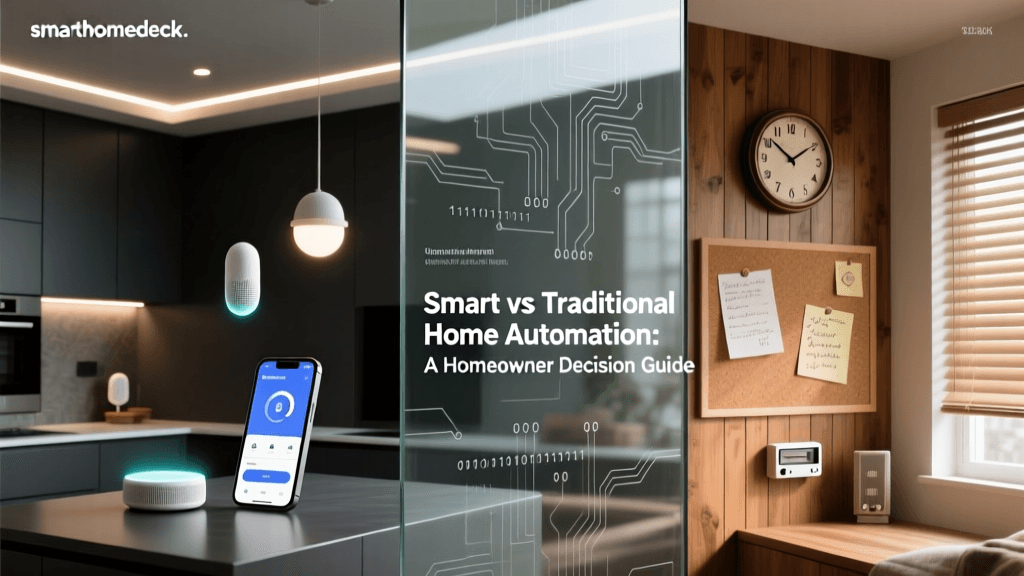
When deciding how to equip your living space, the choice between a smart home and a traditional home setup is no longer just about luxury; it is a fundamental decision about how you interact with your environment, manage your energy consumption, and secure your property. A traditional home relies on localized, manual control. You flip a switch to turn on a light, adjust a dial to change the temperature, and use a physical key to lock your door. A smart home, conversely, introduces a layer of digital automation, remote connectivity, and artificial intelligence that allows these systems to operate autonomously or be controlled from anywhere in the world.
For homeowners and renters alike, the decision to upgrade from traditional infrastructure to a connected ecosystem requires careful consideration of upfront costs, long-term savings, technical complexity, and privacy. This comprehensive decision guide will break down the core differences between smart and traditional home automation across lighting, climate control, security, and infrastructure, providing you with the actionable data needed to choose the right path for your lifestyle.
Feature-by-Feature Comparison
Before diving into the financial and technical specifics, it is essential to understand how daily interactions differ between the two paradigms. The following table outlines the primary operational differences across major home systems.
| System | Traditional Home Setup | Smart Home Setup |
|---|---|---|
| Lighting | Manual wall switches, standalone dimmers, plug-in mechanical timers. | Smart bulbs (Philips Hue), smart switches (Lutron Caseta), motion sensors, geofencing. |
| Climate Control | Manual or basic programmable thermostats (e.g., Honeywell non-Wi-Fi models). | Learning thermostats (Ecobee, Nest), automated smart vents, remote temperature sensors. |
| Security | Physical deadbolts, peepholes, hardwired alarm systems with basic keypads. | Smart locks (August, Yale), video doorbells (Ring), AI-powered indoor/outdoor cameras. |
| Infrastructure | Standard copper wiring, basic electrical panels, no network dependency. | Requires robust Wi-Fi (Wi-Fi 6), mesh networks, smart hubs, and backup power solutions. |
Lighting and Climate: Convenience vs. Reliability
The Lighting Dilemma
In a traditional home, lighting is inherently reliable. A standard mechanical switch has a lifespan of decades and requires zero software updates. However, it lacks flexibility. If you want to simulate occupancy while on vacation, you must rely on clunky plug-in mechanical timers that are limited to simple on/off cycles.
Smart lighting offers unparalleled convenience and ambiance control. Systems like the Lutron Caseta line replace your wall switches and communicate via a dedicated low-frequency radio protocol (Clear Connect), bypassing the congestion of your home Wi-Fi network. This ensures that your lights respond instantly, even if your internet goes down. Alternatively, smart bulbs like Philips Hue offer millions of color options and tunable whites that can adjust to your circadian rhythm. The trade-off? Smart bulbs require the physical wall switch to remain "on" at all times, which can confuse guests, and they draw a small amount of "vampire" power even when turned off.
Climate Control and Energy Efficiency
Traditional programmable thermostats have been the standard for decades. They allow you to set a schedule, but studies have consistently shown that users find their interfaces confusing, often resulting in manual overrides that negate any potential energy savings. Furthermore, they cannot react to real-time changes in your schedule or local weather patterns.
Smart thermostats, such as the Ecobee SmartThermostat or the Google Nest Learning Thermostat, utilize machine learning, occupancy sensors, and geofencing to optimize your HVAC usage. According to the EPA Energy Star program, certified smart thermostats can save homeowners an average of 8% on heating and 10% on cooling bills annually. For a household spending $2,000 a year on energy, this translates to tangible, compounding savings that actively offset the initial $150 to $250 hardware investment.
The Financial Reality: Upfront Costs vs. Long-Term Savings
One of the most significant barriers to smart home adoption is the initial capital required. Outfitting a standard 3-bedroom, 2-bathroom home with traditional switches, a basic programmable thermostat, and standard deadbolts might cost between $500 and $800 in materials. Upgrading that same home with smart switches, a premium smart thermostat, smart locks, and a video doorbell can easily push the hardware costs past $2,500.
However, evaluating the cost over a 5-year period reveals a different narrative, particularly when factoring in utility savings, insurance discounts, and the prevention of costly damages (such as smart water leak detectors shutting off your main valve before a pipe burst ruins your flooring).
Estimated 5-Year Costs: Traditional vs. Smart Home Automation
As the data illustrates, while the smart home demands a higher upfront investment in hardware, the reduction in 5-year utility bills and the potential for lower home insurance premiums (often offered by providers who recognize the risk-mitigation of smart leak detectors and monitored security cameras) help bridge the financial gap.
Security: Deadbolts vs. Digital Access
Traditional home security relies on physical barriers and localized alarms. A Grade 1 deadbolt and a solid wood or metal door provide excellent physical security. Traditional monitored alarm systems (like legacy ADT packages) use hardwired sensors and landlines or cellular backups, offering immense reliability but often requiring multi-year contracts and professional installation fees.
Smart security shifts the focus from purely physical barriers to situational awareness and remote management. A Yale Assure Lock 2 or August Wi-Fi Smart Lock allows you to grant temporary digital keys to dog walkers or contractors, eliminating the need to hide a physical key under the mat. When paired with a Ring Video Doorbell or Arlo Pro 4 cameras, you gain real-time visibility into your property from your smartphone.
However, smart security introduces cyber vulnerabilities that traditional homes simply do not possess. A physical deadbolt cannot be hacked from another continent. The Federal Trade Commission (FTC) strongly advises consumers to secure their connected home devices by utilizing strong, unique passwords, enabling two-factor authentication (2FA), and keeping device firmware updated to prevent unauthorized digital access. You can review the FTC guidelines on connected home devices to ensure your digital perimeter is as secure as your physical one.
The Complexity Factor: Ecosystems, Networks, and Matter
A traditional home operates entirely independently of the internet. If your neighborhood loses power or your ISP experiences an outage, your manual switches and physical keys continue to work flawlessly. A smart home, however, is heavily dependent on network infrastructure.
The Network Requirement
To support a modern smart home, a standard ISP-provided router is rarely sufficient. Smart homes require robust mesh Wi-Fi systems (like Eero or TP-Link Deco) to ensure that devices in the garage, basement, and backyard maintain a stable connection. Furthermore, as you add dozens of IoT devices, they can congest your 2.4GHz Wi-Fi band. This is why advanced smart home users often rely on dedicated protocols like Zigbee or Z-Wave, which require a separate hub but keep IoT traffic off your primary Wi-Fi network.
The Promise of Matter
Historically, the smart home market was plagued by fragmentation. Consumers had to worry whether a new smart plug would work with Apple HomeKit, Google Home, or Amazon Alexa. This ecosystem lock-in forced many to stick to a single brand, limiting choice and innovation. Today, the industry is undergoing a massive unification thanks to Matter. Backed by the Connectivity Standards Alliance (CSA), Matter is an open-source, royalty-free connectivity standard that ensures devices from different manufacturers can communicate seamlessly across different ecosystems. If you are starting a smart home journey today, prioritizing Matter-compatible devices ensures your investment is future-proofed against shifting tech giants and abandoned proprietary apps.
Maintenance and Troubleshooting
When a traditional light switch breaks, the diagnosis is simple: the mechanical contacts have worn out, or a wire has come loose. You or an electrician replace the $5 switch, and the system is restored.
Smart home troubleshooting requires a different skill set. If a smart light fails to respond, the issue could stem from a Wi-Fi dropout, a cloud server outage at the manufacturer's end, a firmware bug, or a hub desynchronization. While smart homes offer incredible automation, they demand a user who is comfortable rebooting routers, checking IP address reservations, and managing software updates. For those who view their home as a sanctuary that should not require "IT support," this complexity can lead to automation fatigue.
Decision Matrix: Which Path is Right for You?
The choice between a smart home and a traditional home is rarely binary. Most modern homeowners adopt a hybrid approach, automating specific areas while leaving others traditional. Use the following matrix to guide your purchasing decisions.
Choose a Traditional Home Setup If:
- You prioritize absolute reliability: You want systems that work 100% of the time, regardless of internet outages or power grid fluctuations.
- You are on a strict upfront budget: You are renovating a home and need to minimize immediate hardware and installation costs.
- You value privacy above all else: You are uncomfortable with the idea of tech companies collecting data regarding your daily routines, occupancy patterns, and voice commands.
- You dislike technical troubleshooting: You do not want to spend your weekend rebooting a smart hub or configuring mesh network nodes.
Choose a Smart Home Setup If:
- You want to optimize energy consumption: You are motivated by the environmental and financial benefits of automated HVAC scheduling and intelligent lighting.
- You require remote management: You travel frequently and need to monitor your property, grant access to guests, or check if you left the garage door open.
- You are planning for aging-in-place: Voice-controlled lighting, automated blinds, and smart locks provide immense accessibility benefits for individuals with mobility challenges.
- You enjoy technological customization: You love the idea of creating complex "routines" (e.g., a "Goodnight" scene that locks the doors, arms the cameras, lowers the thermostat, and turns off the lights with a single voice command).
Final Verdict: Bridging the Gap
The debate between smart home and traditional home automation is ultimately about finding the right balance between convenience and control. A purely traditional home is a fortress of reliability, but it lacks the efficiency and proactive security of modern technology. A fully automated smart home offers a glimpse into the future of living, but it requires a robust network, a willingness to manage software, and an acceptance of digital privacy trade-offs.
The smartest approach for most homeowners is a targeted hybrid strategy. Keep critical infrastructure—like your main electrical panel and primary physical entry points—grounded in traditional reliability. Meanwhile, layer smart technology over your climate control, exterior security, and ambient lighting to harvest the energy savings and convenience that IoT devices provide. By understanding the distinct advantages and limitations of both paradigms, you can build a living space that is not only responsive to your needs but also secure, efficient, and uniquely yours.