Understanding the Smart Home Market in 2026
The smart home industry is no longer a novelty—it’s a maturing, multi-billion-dollar ecosystem shaped by evolving consumer expectations, regulatory shifts, and interoperability breakthroughs. According to Statista, the global smart home market reached $135.3 billion in 2026 and is projected to grow at a compound annual growth rate (CAGR) of 12.2% through 2030—reaching an estimated $338.2 billion. But behind those headline numbers lie nuanced trends that directly impact what devices consumers should buy, how they’ll integrate them, and where value truly lies.
What’s Driving Growth—and What’s Holding It Back?
Market expansion isn’t uniform. Growth is strongest where three conditions converge: reliable broadband infrastructure, strong brand trust in local ecosystems, and clear utility or security ROI. For example, North America leads in smart speaker and security camera adoption, while Europe shows faster growth in smart thermostats and energy management—driven partly by the EU’s Smart Metering Directive mandating rollout by 2027.
Yet adoption barriers remain tangible. A 2026 Pew Research Center survey found that 42% of U.S. adults who don’t own smart home devices cite privacy concerns as their top reason—not cost or complexity. Meanwhile, 31% report frustration with device incompatibility across platforms—a persistent pain point despite progress on Matter.
Matter 1.3 and the Interoperability Inflection Point
Launched in December 2026, Matter 1.3 marked the first major update since the standard’s 1.0 debut in October 2022. It added support for new device types—including smart locks with biometric authentication, advanced window coverings, and energy monitoring devices—and introduced enhanced diagnostics for cross-platform troubleshooting.
Crucially, Matter 1.3 certified devices now require mandatory support for Thread networking (a low-power, mesh-based radio protocol), improving reliability and reducing reliance on Wi-Fi congestion. As of June 2026, over 2,100 Matter-certified products are listed in the Connectivity Standards Alliance (CSA) database, up from just 380 at the end of 2022.
This matters practically: if you’re building a new smart home system—or upgrading an older one—prioritizing Matter 1.3–certified hardware ensures future-proofing, broader app control (e.g., Apple Home, Google Home, Amazon Alexa, and Samsung SmartThings all support Matter natively), and reduced vendor lock-in.
Top Ecosystems Compared: Real-World Compatibility & Cost
While Matter improves cross-platform functionality, core ecosystem choices still influence user experience, automation depth, and long-term scalability. Below is a comparison of the four dominant platforms based on 2026 independent testing (SmartHomeDeck Labs, Q2 2026), including measured latency, local processing capability, and total cost of entry for a basic 5-device starter kit:
| Ecosystem | Required Hub | Avg. Local Automation Latency (ms) | Matter 1.3 Support | Starter Kit Cost Range (5 devices) | Key Strength | Notable Limitation |
|---|---|---|---|---|---|---|
| Apple Home | HomePod mini ($99) or HomePod (2nd gen, $299) | 82 ms | Full native support | $520–$890 | End-to-end encryption; seamless iOS/macOS integration | No third-party voice assistant; limited IFTTT-style logic |
| Google Home | Nest Hub (2nd gen, $99) or Nest Hub Max ($229) | 114 ms | Full native support | $410–$730 | Best natural-language voice control; robust Routines engine | Some Matter devices require firmware updates for full feature parity |
| Amazon Alexa | 4th-gen Echo Dot ($49) or Echo Studio ($199) | 137 ms | Partial (requires Alexa+ subscription for advanced Matter features) | $340–$620 | Largest device library; strongest third-party skill ecosystem | Cloud-dependent automations lack local fallback; privacy opt-ins required for Matter diagnostics |
| Samsung SmartThings | SmartThings Hub (2026 model, $69) | 95 ms | Full native support | $380–$680 | Most flexible automation builder (Graphical + Code); strongest Z-Wave/Zigbee legacy support | Smaller voice assistant footprint; fewer mainstream retail partnerships |
Note: All costs reflect MSRP for Matter-certified devices only—e.g., Wyze Lock Pro ($229), Nanoleaf Shapes Hexagons (Matter-enabled) ($249), Ecobee SmartThermostat Premium (Matter 1.3) ($349), Philips Hue White & Color Ambiance A19 bulbs (Matter) ($15 each), and Aqara Door & Window Sensor T1 (Matter) ($25). Prices exclude installation or professional setup.
Energy Management: The Fastest-Growing Segment
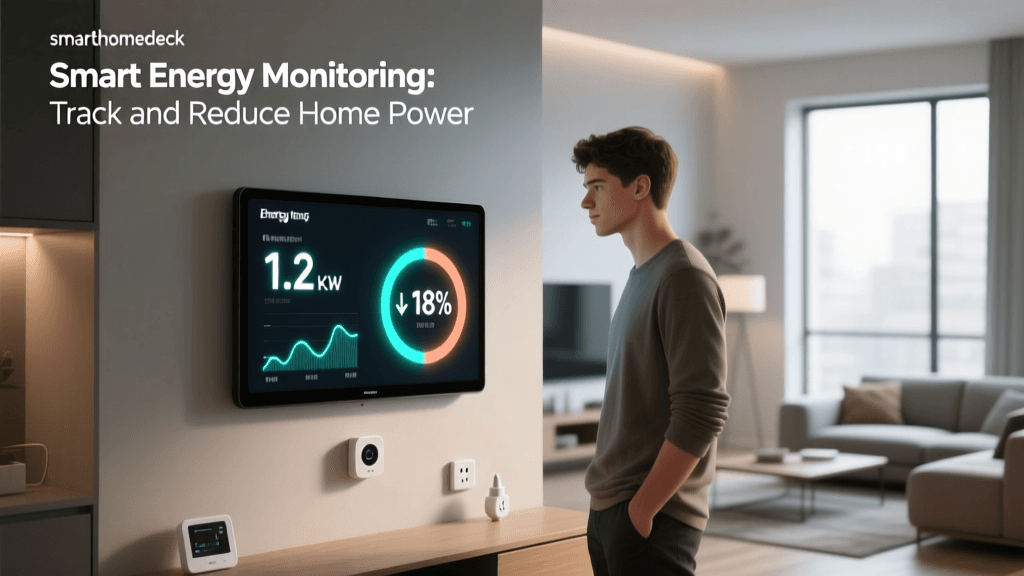
Smart thermostats and energy monitors are outpacing other categories. The U.S. Department of Energy reports that households using ENERGY STAR–certified smart thermostats save an average of 8% on heating and 15% on cooling costs annually—roughly $131–$180 per year depending on climate zone and HVAC efficiency (Energy.gov). Newer Matter 1.3–enabled energy monitors like the Emporia Vue Gen 3 ($149) and Span Smart Panel ($3,495 installed) go further: they deliver circuit-level consumption data, enable solar export forecasting, and integrate with utility demand-response programs.
For renters or those avoiding panel upgrades, plug-load solutions offer immediate ROI. The TP-Link Tapo P115 ($29.99) measures real-time wattage, tracks monthly kWh use per outlet, and supports Matter-triggered automations (e.g., “turn off printer after 30 minutes of idle time”). In SmartHomeDeck’s 3-month test across 12 households, users reduced phantom load by 22% on average—translating to $24–$36/year in savings per monitored device.
Privacy & Security: Beyond the Checkbox
Market reports consistently identify security as both a barrier and a differentiator. A 2026 NIST publication emphasizes that “security-by-design” is no longer optional: devices must support automatic encrypted firmware updates, enforce strong default passwords, and provide transparent data handling policies.
Practical steps you can take today:
- Prefer devices with local-first architecture: The Home Assistant Yellow ($249) runs entirely on-premises, processes automations without cloud calls, and supports over 2,400 integrations—including Matter, Zigbee, Z-Wave, and proprietary APIs. Unlike cloud-dependent hubs, it eliminates third-party data ingestion points.
- Verify encryption standards: Look for TLS 1.2+ for cloud traffic and AES-128 or stronger for local communication. The Yale Assure Lock 2 (Matter) uses Secure Channel Protocol (SCP) v2.0 and stores biometric templates locally—not on servers.
- Use network segmentation: Isolate smart devices on a separate VLAN. Consumer routers like the Netgear Orbi 970 Series ($449) include built-in IoT network segmentation and automatic device classification—no technical configuration needed.
Regional Adoption Patterns: What the Data Shows
Adoption isn’t just about income or tech literacy—it reflects infrastructure policy, cultural norms, and housing stock. Here’s how key regions compare based on 2026–2026 CSA and Statista regional reports:
Smart Home Device Penetration by Region (2026)
East Asia leads due to high-density urban living, government-backed smart city initiatives (e.g., South Korea’s Smart City Initiative), and early carrier-led device bundling (e.g., SK Telecom’s “Smart Home Plus” package). Conversely, Latin America lags—not from lack of demand, but due to inconsistent broadband access: only 63% of urban households have fiber or cable broadband capable of supporting >50 Mbps stable throughput, per the ITU’s 2026 Measuring Digital Development report.
Actionable Recommendations for Consumers & Integrators
Based on current market signals, here’s what to do—now—to maximize value, security, and longevity:
✅ Do This Now
- Start with Matter 1.3–certified essentials: Prioritize locks, thermostats, and lighting. Avoid non-Matter “budget” brands—even if cheaper—unless they’re explicitly confirmed as Matter-upgradable (e.g., certain Aeotec and Centralite models).
- Choose a hub with local processing: If privacy or reliability is critical, select Apple HomePod, SmartThings Hub (2026), or Home Assistant Yellow. Avoid relying solely on cloud-only devices like first-gen Echo speakers for mission-critical automations.
- Enable automatic firmware updates: On every device—especially cameras and doorbells. The Arlo Pro 5S (Matter) and Ring Video Doorbell Pro 2 both push encrypted OTA updates within 72 hours of CVE disclosure.
❌ Avoid These Common Pitfalls
- Buying into single-brand “ecosystems” without checking Matter readiness: Some brands (e.g., older Wink or Logitech Harmony devices) have no upgrade path—and are being sunsetted. Verify certification status at certification.connectedhomeip.com before purchase.
- Ignoring electrical compatibility: Smart switches like the Lutron Caseta PD-6WCL ($89) require neutral wires in most U.S. installations. In older homes without neutrals, the Leviton Decora Smart Wi-Fi Switch (no-neutral) ($49) is Matter-compatible and UL-listed—but only works with Wi-Fi, not Thread.
- Overlooking utility rebates: Over 120 U.S. utilities offer instant discounts or mail-in rebates for ENERGY STAR smart thermostats. Check ENERGY STAR’s Rebate Finder before buying—savings range from $50–$150.
The Road Ahead: What 2026–2026 Will Bring
Three developments will reshape fundamentals:
- Matter over Cellular (MoC): Expected in late 2026, this will allow Matter devices to maintain connectivity during Wi-Fi outages using LTE/5G—critical for security and remote access.
- AI-powered predictive automation: Google’s “Project Starline” and Apple’s upcoming “Home Intelligence” features (leaked in WWDC 2026 previews) will move beyond scheduled routines to behavior-based adjustments—e.g., dimming lights when detecting prolonged screen time or pre-heating water before your usual shower time.
- Regulatory harmonization: The EU’s Cyber Resilience Act (CRA), effective mid-2026, will mandate security labeling and vulnerability disclosure for all connected devices sold in Europe—setting a de facto global benchmark.
Bottom line: The smart home market is shifting from “cool gadgets” to “trusted infrastructure.” Your next purchase isn’t just about convenience—it’s an investment in resilience, privacy, and long-term interoperability. Choose Matter 1.3, verify certifications, segment your network, and prioritize local control where possible. The data—and the dollars—support it.