The Buzzword Epidemic in Smart Home Marketing
If you have browsed the smart home aisle recently, you have likely noticed that "Artificial Intelligence" is plastered across nearly every product box. From refrigerators that claim to predict your grocery needs to lightbulbs that supposedly learn your mood, the marketing hype surrounding AI in the smart home space has reached a fever pitch. For consumers trying to build a reliable, automated living space, this creates a significant problem: it becomes nearly impossible to distinguish between genuine technological advancement and clever marketing repackaging basic automation as "AI."
As we look toward the future of home automation, it is critical to separate science fiction from science fact. True artificial intelligence in the smart home is not about a sentient butler that chats with you about your day. Instead, it is about narrow, highly specialized machine learning algorithms that process vast amounts of sensor data to optimize energy usage, enhance security, and reduce friction in your daily routines. In this comprehensive guide, we will dissect the current state of AI in smart homes, debunk the biggest myths, and provide actionable advice on which devices actually deliver on their promises.
The Hype: Sentient, Conversational Home Butlers
The most pervasive myth in smart home marketing is the idea of the "Jarvis-style" conversational assistant. Tech giants frequently demonstrate large language models (LLMs) integrated into smart speakers, suggesting that your home can understand complex, nuanced, multi-step verbal commands and hold natural conversations. While cloud-based LLMs have made incredible strides in natural language processing, applying this to real-time, local smart home control remains largely in the realm of hype for the average consumer.
The reality is that most voice assistants still rely on rigid, intent-based scripting rather than true contextual understanding. When you ask a smart speaker to "turn on the lights in the living room and set the mood for a movie," it is usually matching predefined keywords to pre-programmed routines, not reasoning through the concept of a "movie mood." Furthermore, routing complex conversational queries to the cloud introduces latency and significant privacy concerns. While companies are beginning to test on-device generative AI, the processing power required for a truly conversational, context-aware home butler is still years away from being a standard, affordable, and private reality in mainstream smart home hubs.
The Reality: Predictive Climate and Energy Management
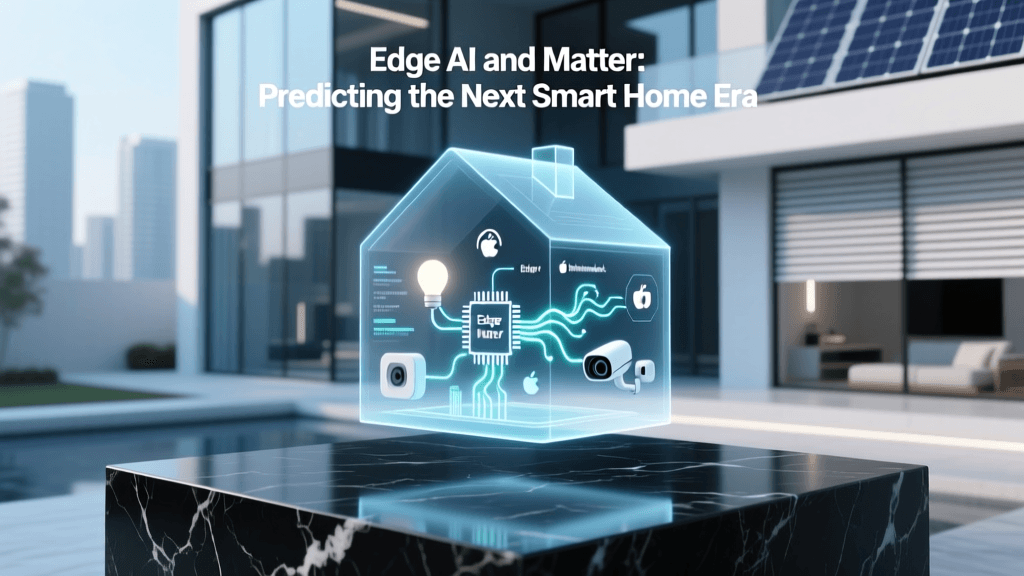
Where AI truly shines in the modern smart home is in the background, specifically in predictive climate control and energy management. Unlike conversational AI, which requires massive computational power and cloud connectivity, predictive AI relies on narrow machine learning models that can run locally on the device's microprocessor. This is often referred to as "Edge AI."
Smart thermostats are the undisputed champions of real-world smart home AI. Instead of simply following a rigid schedule, devices like the Google Nest Learning Thermostat and the Ecobee Smart Thermostat Premium use a combination of passive infrared (PIR) sensors, geofencing, and historical data to build a predictive model of your household's behavior. According to the U.S. Department of Energy, smart thermostats can significantly reduce heating and cooling costs by learning when a home is typically empty and adjusting the HVAC system accordingly, without requiring manual input from the user.
The AI here is not conversational; it is statistical. It analyzes variables such as local weather forecasts, the thermal mass of your home (how quickly it heats up or cools down), and your manual overrides to optimize energy consumption. The EPA Energy Star program certifies these devices based on their proven ability to deliver measurable energy savings, proving that this application of AI is a tangible reality, not a marketing gimmick.
Real-World AI Thermostats: A Comparison
To understand what you are actually paying for, here is a breakdown of the top AI-driven thermostats on the market, their specific machine learning features, and their compatibility ecosystems.
| Product | Estimated Cost | Core AI Feature | Sensor Technology | Ecosystem Compatibility |
|---|---|---|---|---|
| Google Nest Learning Thermostat (4th Gen) | $270 - $290 | Auto-Schedule & Adaptive Eco (learns thermal mass of home) | Soli Radar (mmWave) & PIR Occupancy | Google Home, Matter (via update) |
| Ecobee Smart Thermostat Premium | $220 - $250 | SmartSensor AI (balances hot/cold rooms based on occupancy) | PIR Occupancy & Ambient Temp (Remote sensors) | Apple HomeKit, Alexa, Google, Matter |
| Honeywell Home T9 | $160 - $190 | Multi-Room Focus (prioritizes occupied rooms over whole-home average) | PIR & Humidity (Remote sensors) | Alexa, Google Home (No native HomeKit) |
Note: When purchasing remote sensors for these AI thermostats, expect to spend an additional $40 to $80 per sensor pack to maximize the machine learning accuracy across larger homes.
The Reality: Advanced Security and Anomaly Detection
The second major area where AI has moved from hype to reality is in home security, specifically through computer vision and anomaly detection. Early smart cameras simply sent you a push notification every time a pixel changed on the screen, resulting in "alert fatigue" from swaying trees, passing cars, and neighborhood cats.
Modern AI security cameras utilize Edge-based computer vision to classify objects in real-time. Devices like the Ring Pan-Tilt Indoor Cam or the UniFi Protect AI series use neural processing units (NPUs) built directly into the camera hardware to distinguish between humans, animals, vehicles, and packages. This processing happens locally on the device, meaning the AI can identify a package on your porch and trigger a specific automation without sending a continuous video stream to the cloud.
This local AI processing is a massive leap forward for both privacy and reliability. If your internet connection drops, a camera with Edge AI will still accurately detect a person walking up your driveway and trigger local alarms or smart lighting routines via your local hub. When shopping for security cameras, look specifically for terms like "On-Device Person Detection" or "Local AI Processing" to ensure you are getting real technology rather than cloud-dependent motion sensors.
The Hype vs. Reality Matrix
To visualize the current landscape of smart home AI, we have mapped common marketing claims against their actual real-world capabilities. This chart highlights where your money is best spent.
Smart Home AI: Marketing Hype vs Actual Capability
As the data illustrates, predictive HVAC and security anomaly detection are the undisputed leaders in practical AI application. Conversely, appliance predictive maintenance (like a washing machine that predicts its own motor failure) remains largely in the experimental or high-end luxury tier, representing high marketing hype but low real-world availability for the average consumer.
Actionable Advice: How to Buy for Real AI, Not Marketing
Navigating the smart home market requires a critical eye. To ensure you are investing in genuine AI capabilities rather than rebranded automation, follow these actionable buying guidelines:
- Prioritize Edge AI and Local Processing: Look for devices that advertise on-device machine learning. This ensures faster response times, continued functionality during internet outages, and vastly superior privacy. Apple's HomeKit Secure Video and devices utilizing the Matter protocol over Thread are excellent examples of ecosystems pushing toward local, secure processing.
- Invest in Sensor Density: AI is only as good as the data it receives. A smart thermostat cannot learn your habits if it only has one sensor in the hallway. Budget for a multi-sensor ecosystem. Spending $200 on a smart thermostat and $150 on room sensors will yield vastly better AI-driven comfort than spending $350 on a single, high-end thermostat with no remote sensors.
- Ignore "Smart" Appliances with Cloud Dependencies: Many smart refrigerators and ovens market AI features that require constant cloud connectivity and proprietary apps. Unless a device uses local computer vision (like an oven camera that recognizes a chicken vs. a pizza to set the temperature automatically), treat its "AI" claims with deep skepticism.
- Check the Protocol: True AI automation requires devices to talk to each other seamlessly without cloud bottlenecks. Ensure the devices you buy support Matter and Thread. Thread creates a low-latency, local mesh network that allows AI hubs to gather sensor data and execute decisions in milliseconds, entirely within your home's walls.
The Future: What is Actually Coming Next?
While the sentient home butler is still a distant dream, the immediate future of smart home AI is incredibly promising. The next major leap will be the integration of localized Small Language Models (SLMs) directly into smart home hubs. With the upcoming integration of Neural Processing Units (NPUs) in standard consumer routers and smart displays, we will see a shift from rigid "If This Then That" (IFTTT) automations to natural, intent-based local routines.
Instead of programming a complex routine for "Movie Night," you will simply tell your local hub, "It's too bright in here and I'm cold," and the on-device SLM will understand the context of the living room, dim the specific lights, and bump the thermostat up two degrees, all without sending a single byte of audio to the cloud. Furthermore, the upcoming Matter 1.3 and 1.4 specifications are heavily focused on granular energy management, allowing AI hubs to coordinate solar panel output, EV charging, and battery storage in real-time to minimize grid dependency.
Conclusion
The smart home industry is currently in a transitional phase. The marketing hype surrounding conversational AI and sentient appliances often distracts consumers from the quiet, highly effective machine learning algorithms that are already saving money and securing homes today. By focusing your investments on Edge AI, predictive climate control, and local computer vision, you can build a truly intelligent home that works for you behind the scenes. Forget the sci-fi fantasies for now; the real AI revolution in the smart home is happening in the thermostat, the doorbell, and the local mesh network, delivering efficiency and security that is very much real today.