The Next Frontier: Beyond the Smartphone App
The era of using a smartphone app to turn on a light bulb or start a coffee maker is rapidly drawing to a close. While the first decade of the smart home was defined by novelty, remote access, and fragmented ecosystems, the next decade will be defined by invisibility, interoperability, and predictive intelligence. As we look toward the future of home automation, three foundational pillars are emerging to redefine how our living spaces interact with us: the Matter protocol, Thread mesh networking, and Ambient AI.
For homeowners, tech enthusiasts, and real estate investors alike, understanding these shifts is no longer optional—it is essential for protecting your investment and ensuring your home remains compatible with tomorrow's technology. This comprehensive guide explores the predictions shaping the smart home landscape and provides actionable, cost-effective strategies to future-proof your setup today.
The Matter Protocol: Ending the Ecosystem Wars
For years, the smart home market was plagued by a frustrating reality: if you bought a smart lock from one brand, it might not work with your existing voice assistant or security hub. The introduction of the Matter protocol, spearheaded by the Connectivity Standards Alliance (CSA), represents the most significant shift in IoT (Internet of Things) history.
What is Matter and Why Does It Matter?
Matter is an open-source, royalty-free connectivity protocol that operates on the application layer. It does not replace your existing Wi-Fi or Thread networks; rather, it provides a universal language that devices use to communicate. If a device is 'Matter-certified,' it guarantees out-of-the-box compatibility with Apple HomeKit, Amazon Alexa, Google Home, and Samsung SmartThings.
- Local Control: Matter prioritizes local network communication. This means your smart switches respond instantly, even if your internet connection goes down, eliminating cloud latency and enhancing privacy.
- Multi-Admin Capability: A single Matter device can be controlled by multiple ecosystems simultaneously. An Apple user and an Android user can both control the same smart thermostat from their native apps without complex workarounds.
- Device Attestation: Matter utilizes blockchain-inspired cryptographic certificates (DAC) to verify that a device is genuinely secure and authentic before it joins your network.
How to Prepare Your Home for Matter
To utilize Matter, you need a 'Matter Controller' (the brain) and a compatible network. Most modern smart speakers and hubs are receiving firmware updates to act as Matter controllers. If you are upgrading your home, consider investing in a dedicated local hub like the Home Assistant Green ($99) for ultimate privacy, or a mainstream hub like the Apple TV 4K 3rd Gen ($129-$149) which doubles as a Thread Border Router.
Thread Networking: The Backbone of Tomorrow's IoT
While Matter provides the language, Thread provides the roads. Traditional smart home devices rely on Wi-Fi, which is power-hungry and prone to network congestion when dozens of devices are connected to a single router. Zigbee and Z-Wave offered mesh alternatives, but they required proprietary, single-purpose hubs.
Thread, an IPv6-based, low-power mesh networking protocol championed by the Thread Group, solves these issues elegantly. Because Thread devices use IPv6, every smart sensor or lightbulb has its own IP address, making routing incredibly efficient.
The Mesh Advantage and Self-Healing
In a Thread network, every mains-powered device (like a smart plug or a wired light switch) acts as a router, extending the network's reach. If one device loses power, the network instantly 'self-heals' by rerouting data through neighboring devices. This eliminates the 'dead zones' that plague large smart homes.
'Thread is not just a replacement for Zigbee; it is the foundational IP-based layer that allows Matter to function seamlessly without burdening your home's primary Wi-Fi router.'
Recommended Thread Devices for 2024 and Beyond
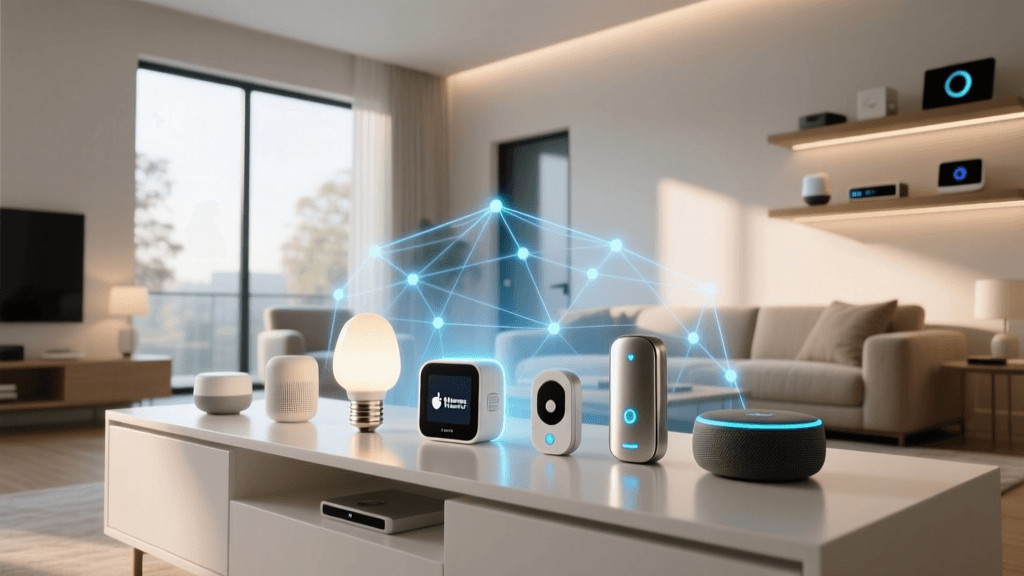
To build a robust Thread mesh, you need 'Border Routers' (devices that bridge Thread to your Wi-Fi/Ethernet) and 'End Devices'.
- Border Routers: Amazon Echo (4th Gen, $99), Google Nest Hub Max ($229), and Eve Energy Smart Plugs ($49).
- End Devices: Nanoleaf Essentials Lightstrips ($79) and Eve Motion Sensors ($49). These devices consume so little power that their batteries can last for years.
Ambient Computing and Predictive AI
The ultimate prediction for the smart home is that it will stop waiting for your commands. Ambient computing refers to technology that fades into the background, anticipating your needs based on context, presence, and behavioral patterns. The days of shouting 'Hey Google, turn on the lights' are being replaced by environments that illuminate automatically because the house knows you are reading in the corner.
The Rise of mmWave Presence Sensing
Traditional Passive Infrared (PIR) motion sensors only detect gross motor movement. If you sit still on the couch reading a book, the lights turn off. The future belongs to millimeter-wave (mmWave) radar sensors. These sensors detect micro-movements, including the rise and fall of your chest as you breathe.
Product Spotlight: Aqara FP2 Presence Sensor ($59)
The Aqara FP2 uses mmWave technology to divide a room into multiple distinct zones. It can detect if someone is in the kitchen cooking versus sitting at the dining table, triggering entirely different automation routines for lighting, HVAC, and music without a single voice command.
AI-Driven Energy Optimization
Predictive AI will also revolutionize home energy management. According to the National Institute of Standards and Technology (NIST), the modernization of the smart grid relies on homes that can dynamically respond to grid demands. Future smart panels, like the Span Smart Panel (starting around $5,000 installed), use AI to learn your household's energy habits. During a grid outage or peak pricing hours, the AI can automatically deprioritize the EV charger and HVAC compressor while keeping the refrigerator and Wi-Fi running, stretching your backup battery life by up to 40%.
Hub Comparison: Upgrading for the Future
Choosing the right central hub is the most critical step in future-proofing your home. Below is a comparison of the top Matter and Thread-compatible hubs available today.
| Device | Protocol Support | Price Range | Best For |
|---|---|---|---|
| Apple TV 4K (3rd Gen) | Matter, Thread, Wi-Fi 6 | $129 - $149 | HomeKit & Apple Ecosystem Users |
| Amazon Echo (4th Gen) | Matter, Zigbee, Thread | $99 | Alexa Users & Budget Mesh |
| Home Assistant Green | Matter (via Add-ons), Local | $99 | Privacy Advocates & Power Users |
| SwitchBot Hub 2 | Matter, Wi-Fi, BLE, IR | $69 | Retrofitting Legacy IR Devices |
| Google Nest Hub (2nd Gen) | Matter, Thread, Wi-Fi | $99 | Google Home & Sleep Tracking |
Smart Home Protocol Adoption Forecast
Industry analysts predict an exponential curve in Matter-certified device adoption as legacy manufacturers update their silicon and new products hit the market. The chart below illustrates the projected growth of Matter-compatible devices over the next five years.
Energy Management: The Grid-Interactive Home
As utility companies shift toward time-of-use (TOU) pricing, the smart home of the future will act as a microgrid participant. We are moving beyond simple smart thermostats toward whole-home energy intelligence.
Smart EV Chargers and Solar Integration
Products like the Wallbox Pulsar Plus ($650) and Enphase IQ System Controller are pioneering bidirectional energy flows. In the near future, your home's AI will predict weather patterns to optimize solar battery storage, pre-cool your home before peak electricity rates hit, and even sell excess power back to the grid via your EV's vehicle-to-home (V2H) capabilities. For those not ready for a $10,000 solar and battery overhaul, starting with smart plugs that feature energy monitoring (like the Eve Energy Matter, $49) is a practical way to begin mapping your home's energy vampire loads.
Actionable Steps to Future-Proof Your Home Today
You do not need to tear out your walls to prepare for the next era of smart home technology. Follow this phased approach to ensure your home is ready for Matter, Thread, and Ambient AI.
Phase 1: Audit and Upgrade Your Network Infrastructure
Thread and Matter rely on a robust underlying IP network. Ensure your primary router supports Wi-Fi 6 or Wi-Fi 6E. These standards handle high device densities much better than older Wi-Fi 5 routers. If you have a home larger than 2,000 square feet, invest in a mesh Wi-Fi system like the Eero Pro 6E ($399 for a 2-pack), which natively includes a Thread Border Router and Zigbee radio, future-proofing your network hardware in one step.
Phase 2: Establish a Thread Mesh Perimeter
Begin replacing battery-operated Zigbee or Wi-Fi sensors with Thread equivalents. Start with high-traffic areas. Install Thread-enabled smart plugs in every room; because they are mains-powered, they will immediately begin acting as Thread routers, strengthening the mesh network for future sensors and smart locks.
Phase 3: Shift to Local Control
Cloud-reliant smart homes are vulnerable to server shutdowns and internet outages. Wherever possible, prioritize devices that support local LAN control. If you are technically inclined, purchasing a Home Assistant Green ($99) or building a Home Assistant Yellow ($199) kit will give you a centralized, entirely local brain that bridges Matter, Thread, Zigbee, and legacy Wi-Fi devices into a single, lightning-fast dashboard that never relies on external servers.
Phase 4: Upgrade Your Sensing Layer
Replace aging PIR motion sensors with mmWave presence sensors in key living spaces (living rooms, home offices, and kitchens). Pair these sensors with your hub's automation engine to create 'scene-less' automations. For example, instead of a 'Movie Mode' button, configure the room to automatically dim the lights to 20% and lower the smart blinds only when the mmWave sensor detects two people sitting on the couch after 7:00 PM.
Conclusion: Embracing the Invisible Home
The future of the smart home is not about adding more screens, more apps, or more voice commands. It is about creating an environment that intuitively understands and adapts to its inhabitants. By investing in the open standards of Matter and Thread today, and by integrating the granular awareness of Ambient AI sensors, you are not just buying gadgets—you are building a resilient, interoperable, and intelligent infrastructure. The homes of tomorrow will not demand our attention; they will quietly and efficiently support our lives, operating seamlessly in the background. The transition has already begun, and the tools to build this future are available right now.