The Shift from Reactive to Proactive Living
For the past decade, the smart home industry has been defined by a fundamental paradigm: reactivity. You press a button on your smartphone, and the lights turn on. You speak a command to a voice assistant, and the thermostat adjusts. While this level of remote control and basic automation has undeniably added convenience to our daily lives, it requires constant human intervention. The true promise of smart home technology has always been to anticipate our needs rather than merely respond to our commands. Today, we are standing on the precipice of a massive technological shift, moving away from app-dependent control and toward a future shaped by predictive artificial intelligence (AI) and ambient computing.
This evolution represents the transition from a 'connected home' to an 'intelligent home.' In the near future, the most advanced smart homes will not require you to open an app, configure complex IFTTT routines, or even speak a wake word. Instead, the home will silently observe, learn, and adapt to your lifestyle in the background. By leveraging advanced machine learning algorithms, localized edge computing, and next-generation spatial sensors, tomorrow's smart home will shape the way we live by becoming entirely invisible, seamlessly integrating into the architecture of our daily routines without demanding our attention.
What is Ambient Computing?
The concept of ambient computing was first envisioned by computer scientist Mark Weiser in the early 1990s. Weiser proposed that the most profound technologies are those that disappear, weaving themselves into the fabric of everyday life until they are indistinguishable from it. In the context of the modern smart home, ambient computing refers to an ecosystem of interconnected devices, sensors, and processors that work together to provide services and automation without explicit user interaction.
Unlike the current hub-and-spoke model, where a central smart speaker acts as a glorified remote control, an ambient computing environment relies on a mesh of contextual awareness. It utilizes data from environmental sensors, occupancy trackers, biometric feedback, and external APIs (such as local weather patterns or utility grid load) to make micro-decisions in real-time. The home essentially develops a 'nervous system.' When you walk into a room, the ambient system doesn't just detect motion; it understands who you are, what time it is, what the current ambient light level is, and what your historical preferences are for that specific context, adjusting the environment instantly and silently.
The Engine of Tomorrow: Predictive AI
At the core of this ambient revolution is predictive AI. While traditional automation relies on rigid, rule-based logic (e.g., 'If motion is detected, turn on light'), predictive AI utilizes machine learning to identify patterns and anticipate outcomes. This is most evident in climate control and energy management, where predictive algorithms can drastically reduce utility bills while maximizing comfort.
Take, for example, the Ecobee Smart Thermostat Premium (retailing around $249) or the Google Nest Learning Thermostat (approximately $279). These devices do not simply hold a target temperature. They utilize predictive AI to learn the thermal dynamics of your specific home—calculating how long it takes to cool down or heat up based on external weather conditions, insulation quality, and historical occupancy. According to the EPA's Energy Star program, certified smart thermostats can save households an average of 8% on heating and cooling bills. However, next-generation predictive models go further by integrating with utility company APIs to pre-cool or pre-heat your home during off-peak hours when electricity is cheaper, automatically shifting energy usage without you ever noticing a change in comfort.
Predictive AI also extends to automated replenishment and maintenance. Future smart appliances will monitor their own consumable levels and mechanical health, predicting when a water filter needs replacing or when dishwasher detergent is running low, automatically placing orders or scheduling maintenance before a failure occurs.
Sensor Evolution: PIR vs. mmWave Radar
For ambient computing to work flawlessly, the home's 'nervous system' requires highly accurate sensory input. For years, the smart home relied on Passive Infrared (PIR) sensors to detect occupancy. PIR sensors work by detecting changes in heat signatures across a grid. While inexpensive, they suffer from a major flaw: they cannot detect static presence. If you sit perfectly still on the couch reading a book, a PIR sensor will assume the room is empty and turn off the lights—a frustrating hallmark of early smart homes.
The future belongs to millimeter-wave (mmWave) radar sensors. Operating at high frequencies (typically 24GHz or 60GHz), mmWave sensors emit radio waves that bounce off objects and return to the receiver. This technology is sensitive enough to detect sub-millimeter movements, including the subtle rise and fall of a human chest during breathing. Products like the Aqara Presence Sensor FP2 ($69) and the Everything Presence One ($99) utilize mmWave radar to provide zone-level, static occupancy detection. Furthermore, advanced mmWave sensors can perform gesture recognition and fall detection, making them invaluable for aging-in-place applications, where the home can alert caregivers if a resident experiences a sudden fall, all without the privacy invasion of optical cameras.
Data Table: Reactive vs. Proactive Smart Home Systems
| Feature | Reactive (Current Standard) | Proactive (Ambient Future) |
|---|---|---|
| Control Interface | Smartphone apps, voice commands, physical switches | Contextual automation, predictive adjustments, invisible |
| Occupancy Sensing | PIR motion sensors (requires continuous movement) | mmWave radar & LiDAR (detects static presence & breathing) |
| Climate Management | Scheduled setpoints or remote manual adjustments | AI-driven thermal modeling, grid-aware pre-conditioning |
| Lighting Control | Time-based schedules or basic motion triggers | Circadian rhythm tracking, localized task-based illumination |
| Processing Location | Cloud-dependent (requires internet connection) | Edge computing (local processing for speed and privacy) |
Market Shift Toward AI-Driven Devices
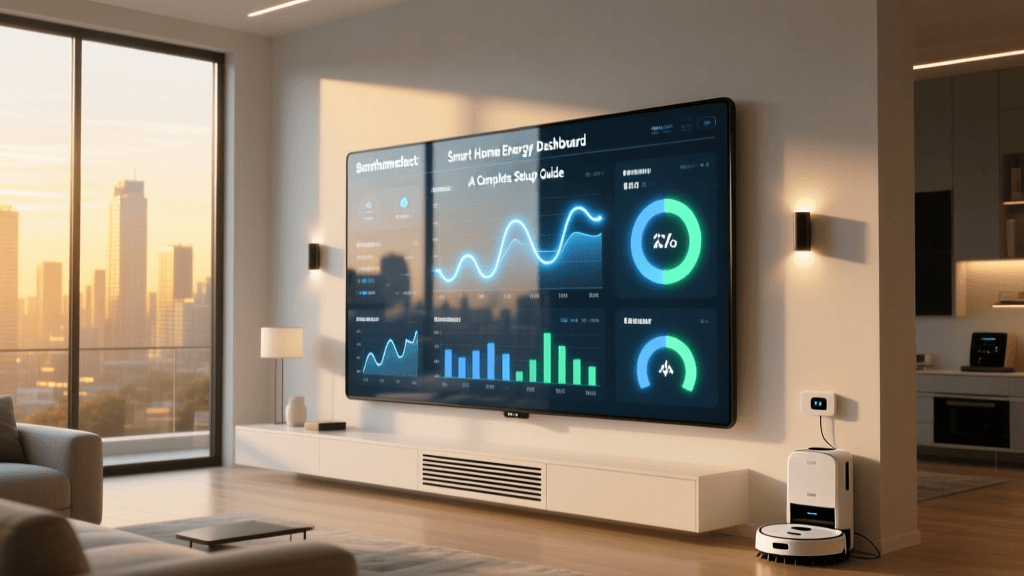
As the technology matures and manufacturing costs for advanced sensors and local AI chips decrease, the market is rapidly pivoting toward ambient solutions. The following chart illustrates the projected adoption rates of traditional reactive devices versus AI-driven predictive devices over the next several years.
The Foundation: Matter and Edge Computing
None of this ambient intelligence is possible without a unified language and localized processing power. Historically, smart homes were fragmented by proprietary ecosystems that refused to communicate. The introduction of the Matter protocol, backed by the Connectivity Standards Alliance (CSA), is solving this interoperability crisis. As detailed by the CSA's official Matter overview, this open-source standard allows devices from Apple, Amazon, Google, and Samsung to communicate seamlessly over local Wi-Fi and Thread networks. This local communication is critical because it removes the latency of cloud round-trips, allowing ambient automations to trigger in milliseconds.
Furthermore, the rise of Edge AI—processing machine learning models directly on the device or a local hub rather than sending data to a remote server—is a game-changer. Edge computing ensures that your home's predictive routines continue to function even if your internet connection drops. It also vastly reduces the bandwidth required to run a smart home, allowing dozens of high-fidelity sensors to operate simultaneously without clogging your network.
Privacy in the Ambient Era
The transition to a home that constantly watches, listens, and learns inevitably raises significant privacy concerns. The 'creepy factor' is a major barrier to adoption for many consumers. If a home knows when you sleep, what rooms you occupy, and your daily routines, that data is incredibly sensitive. This is precisely why the industry's shift toward Edge AI and local processing is not just a performance upgrade, but a privacy necessity.
When data is processed locally on an Edge device, your personal habits never leave your home network. To navigate this landscape safely, consumers should look for devices that explicitly advertise local processing and adhere to rigorous cybersecurity frameworks. The National Institute of Standards and Technology (NIST) provides comprehensive guidelines for IoT cybersecurity, emphasizing the need for secure device authentication, encrypted local communications, and regular firmware updates. When building an ambient smart home, prioritize devices that support Matter (which includes built-in security protocols like AES-128 encryption) and avoid cheap, off-brand sensors that rely on opaque, cloud-only architectures.
Actionable Steps to Future-Proof Your Home Today
While fully autonomous ambient homes are still evolving, you can lay the groundwork for predictive living today by making strategic hardware and software upgrades. Here is how to transition your home from reactive to proactive:
- Invest in a Local Processing Hub: Move away from cloud-dependent hubs. Devices like the Home Assistant Green ($99) or the Hubitat Elevation ($149) allow you to run complex, multi-condition automations locally. This ensures your ambient routines execute instantly and remain operational during internet outages.
- Upgrade Your Occupancy Sensors: Replace aging PIR motion sensors with mmWave radar alternatives. Start with high-traffic areas like the living room or home office. The Aqara FP2 allows you to divide a room into multiple zones, enabling the home to adjust lighting and climate based on exactly where you are sitting, rather than just knowing someone is in the room.
- Adopt Circadian Lighting: Ambient computing isn't just about turning lights on and off; it's about biological alignment. Utilize smart bulbs like the Philips Hue White and Color Ambiance line or Wyze Bulb Color, paired with local automation software, to gradually shift color temperatures from cool, energizing blue-whites in the morning to warm, melatonin-friendly ambers in the evening, completely hands-free.
- Embrace Thread and Matter: When purchasing new sensors or smart plugs, ensure they carry the Matter logo and support the Thread networking protocol. Thread creates a self-healing, low-latency mesh network that is essential for supporting the high density of sensors required for true ambient computing.
Conclusion
The future of the smart home is not about adding more screens, more apps, or more complex voice commands. It is about subtraction. By harnessing the power of predictive AI, mmWave spatial awareness, and local Edge computing, the smart home is evolving into an ambient environment that anticipates our needs, conserves energy, and protects our privacy. As these technologies become more accessible and standardized through protocols like Matter, the homes of tomorrow will finally fulfill the original promise of domestic technology: working tirelessly in the background to make our lives simpler, safer, and profoundly more comfortable.