The "Smart" Illusion: Basic Automation vs. True AI
When you browse the aisles of your local electronics store or scroll through online marketplaces, the term "AI" is plastered across nearly every Wi-Fi-enabled device. From smart plugs to refrigerators, manufacturers are eager to capitalize on the artificial intelligence boom. However, for consumers entering the smart home space, it is crucial to understand the fundamental difference between basic rule-based automation and true predictive artificial intelligence.
Most "smart" devices on the market today rely on deterministic logic. This is the classic "If This, Then That" (IFTTT) model. For example, if a passive infrared (PIR) motion sensor detects movement, the smart switch turns on the light. If the clock strikes 10:00 PM, the thermostat drops the temperature by three degrees. This is not artificial intelligence; this is simple scheduling and conditional triggering. It requires constant manual programming and fails to adapt to the nuances of human behavior.
True AI in the smart home context involves machine learning (ML), pattern recognition, and probabilistic modeling. A genuinely intelligent system does not just react to a trigger; it anticipates your needs based on historical data, environmental variables, and contextual awareness. It learns that you typically turn off the living room lights at 11:15 PM on weekdays but stay up until 1:00 AM on weekends, and it adjusts its automated routines accordingly without requiring manual reprogramming. Understanding this distinction is the first step in building a home that actually works for you, rather than a home that just adds complexity to your daily life.
Where AI is Real: Predictive Climate and Energy Management
The most mature and undeniably "real" application of AI in the smart home is predictive climate control. Heating and cooling account for nearly half of the average home's energy consumption, making it a prime target for machine learning optimization. According to the U.S. Department of Energy, smart thermostats can significantly reduce energy waste by learning your schedule and adjusting temperatures automatically.
Take the Ecobee Smart Thermostat Premium (retailing around $249) and the Google Nest Learning Thermostat (around $279). These devices do not merely follow a schedule. They utilize complex algorithms to calculate the "thermal decay" of your specific home. By analyzing how long it takes your house to drop five degrees when the outdoor temperature is 30°F, the AI calculates exactly when to fire up the HVAC system so that your home reaches your desired temperature precisely when you wake up, rather than running the heater prematurely and wasting energy.
Furthermore, these thermostats integrate with remote occupancy sensors. The Ecobee SmartSensor uses PIR technology to detect which rooms are actually occupied, overriding the baseline schedule to ensure comfort where you are, while allowing unused zones to drift, saving energy. This is a practical, measurable application of machine learning that pays for itself over time through reduced utility bills.
Edge AI vs. Cloud AI: The Future of Local Processing
Historically, smart home AI relied heavily on cloud processing. Your device would collect data, send it over the internet to a remote server farm, wait for the server to process the machine learning model, and send a command back to your device. This cloud-dependent architecture introduces three massive problems: latency, reliability, and privacy.
If your internet connection drops, a cloud-dependent smart home becomes a dumb home. Furthermore, sending intimate details of your daily routines, voice commands, and occupancy patterns to corporate servers raises severe privacy concerns. The National Institute of Standards and Technology (NIST) has repeatedly highlighted the cybersecurity vulnerabilities inherent in cloud-reliant IoT ecosystems, urging a shift toward localized security protocols.
This is where Edge AI enters the conversation. Edge computing moves the machine learning processing from remote servers directly to the local hub inside your home. The Amazon Echo (4th Gen) and the Apple HomePod mini are pioneering this shift. With Edge AI, voice recognition, occupancy prediction, and automated routines are processed locally on the device's neural engine. This results in near-zero latency, ensures your home continues to function during internet outages, and keeps your personal data trapped behind your home's firewall.
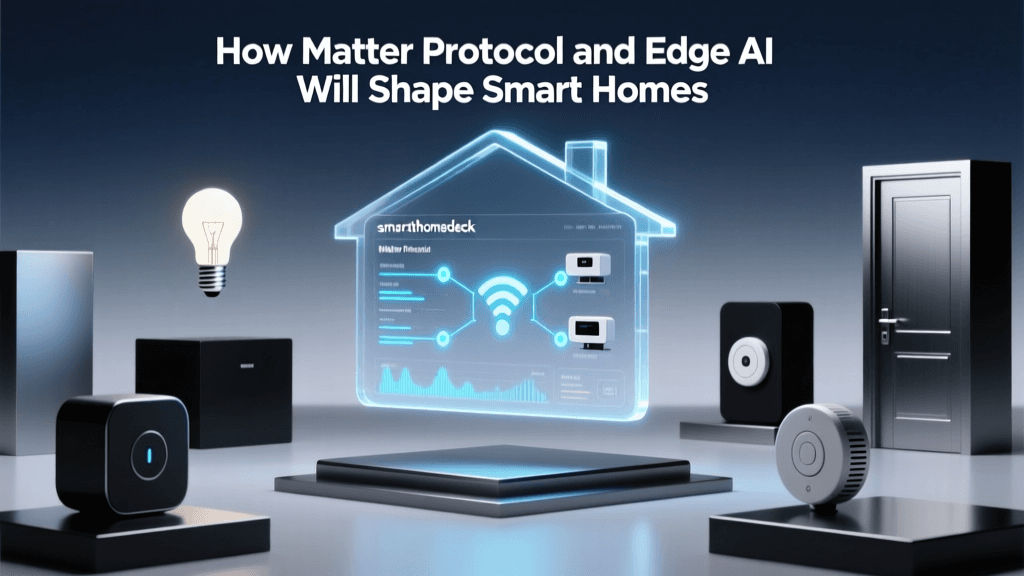
The introduction of the Matter smart home standard, spearheaded by the Connectivity Standards Alliance (CSA), is accelerating the Edge AI revolution. Matter mandates local control capabilities, ensuring that devices from different ecosystems can communicate and execute AI-driven routines locally over your network without pinging a cloud server.
The Hype: "AI-Powered" Appliances and Gimmicks
While climate control and local processing represent genuine AI advancements, many appliance manufacturers are engaging in blatant "AI washing." The most notorious example is the smart refrigerator, such as the Samsung Family Hub (priced upwards of $3,000). These fridges boast internal cameras and "AI food recognition" software that supposedly tracks your inventory and suggests recipes.
In reality, the image recognition models struggle with overlapping items, poor internal lighting, and generic packaging. Users frequently find themselves manually correcting the AI's inventory, turning a supposed time-saving feature into a tedious chore. This is not predictive AI; it is a poorly implemented computer vision gimmick designed to justify a premium price tag.
Similarly, many "AI washing machines" claim to use artificial intelligence to optimize wash cycles. In truth, they are simply using basic load-weighing strain gauges and turbidity sensors to measure water dirtiness. While these are excellent automated sensors, adjusting a timer based on weight and water clarity is deterministic logic, not machine learning. Consumers should be highly skeptical of any appliance that slaps the "AI" label on basic sensor automation.
Comparison Table: Real AI vs. Marketing Hype
| Feature Category | Rule-Based Automation (The Baseline) | True Predictive AI (The Reality) | Marketing Gimmick (The Hype) |
|---|---|---|---|
| Lighting | Turns on at sunset via geofencing. | Learns your circadian rhythm and adjusts color temperature based on time and historical manual overrides. | "AI bulbs" that just change color via a randomizing algorithm. |
| Climate | Follows a rigid 7-day programmable schedule. | Calculates thermal decay and pre-heats based on real-time weather forecasts and occupancy patterns. | "Smart" vents that restrict airflow without understanding HVAC static pressure limits. |
| Security | Sends an alert when any motion is detected. | Uses local edge processing to distinguish between pets, vehicles, and known family members, reducing false alarms. | Cloud cameras that require a paid subscription to unlock basic person-detection. |
Smart Home AI Adoption vs Privacy Concerns
Where AI Shines: Robotic Navigation and Spatial Awareness
While smart fridges fail the AI test, robotic vacuums represent one of the most impressive consumer applications of edge AI and computer vision. The Roborock S8 Pro Ultra (retailing around $1,599) utilizes a technology called ReactiveAI. It combines LiDAR mapping with structured light 3D imaging and an RGB camera to identify and avoid obstacles in real-time.
Unlike older models that relied on bumping into furniture to map a room, modern AI-driven vacuums can distinguish between a shoe, a power cable, and pet waste. The machine learning model processes these images locally on the robot's internal processor, allowing it to navigate complex, dynamic environments without human intervention. This is a perfect example of AI solving a genuine consumer pain point through advanced spatial computing.
Actionable Advice: How to Build a Truly Predictive Home
If you want to move beyond basic scheduling and build a home that genuinely anticipates your needs, you must prioritize local processing, advanced sensor arrays, and robust network protocols. Here is a practical blueprint for upgrading your smart home infrastructure.
1. Ditch Cloud-First Hubs for Local Controllers
To run true predictive routines without relying on external servers, you need a hub capable of local execution. The Home Assistant Green ($99) is an exceptional entry point for enthusiasts. It runs locally, processes automations in milliseconds, and keeps your data entirely offline. For those who prefer a more polished, out-of-the-box experience, the Hubitat Elevation ($149) offers robust local processing for Zigbee and Z-Wave devices, ensuring your AI-driven routines survive internet outages.
2. Upgrade to mmWave Presence Sensors
Machine learning models are only as good as the data they are fed. Traditional PIR motion sensors fail when you are sitting still, reading a book, or working at a desk, causing the lights to turn off and forcing you to wave your arms to reset them. The solution is millimeter-wave (mmWave) technology.
The Aqara FP2 Presence Sensor ($70) uses mmWave radar to detect micro-movements, including the subtle rise and fall of your chest as you breathe. It can divide a room into multiple zones and feed highly accurate, real-time occupancy data to your local hub. This rich dataset allows your hub's automation engine to make highly accurate, context-aware decisions about lighting and climate control.
3. Build a Thread Mesh Network
For local AI to function flawlessly, the communication layer between your sensors and your hub must be bulletproof. Wi-Fi is too congested and power-hungry for dozens of sensors. Instead, invest in devices that support Thread (an IP-based, low-power mesh networking protocol). Thread devices act as nodes, passing signals from one to another, creating a self-healing network. By adding a Thread Border Router—such as the Apple TV 4K ($129) or the Aqara Smart Hub M3 ($129)—you ensure that your predictive automations have the low-latency, high-reliability foundation they need to operate seamlessly.
Conclusion: Demanding Better from the Smart Home Industry
The future of the smart home is undeniably tied to artificial intelligence, but consumers must remain vigilant against marketing hyperbole. True AI in the home is not about a refrigerator that tweets or a washing machine with a fancy algorithm; it is about invisible, frictionless automation. It is about Edge AI processing that respects your privacy, predictive climate models that reduce your carbon footprint, and spatial computing that adapts to your physical presence.
By understanding the difference between deterministic rules and probabilistic machine learning, and by investing in local hubs, mmWave sensors, and Matter-compatible Thread networks, you can build a smart home that is not just connected, but genuinely intelligent. As the industry continues to mature, the brands that prioritize local Edge AI and open standards like Matter will lead the charge, leaving cloud-dependent gimmicks in the dust.