The Shift from Reactive to Proactive Smart Homes
For the past decade, the smart home industry has been defined by reactivity. You press a button on your phone, and the lights turn on. You speak a specific, rigid command to a smart speaker, and the thermostat adjusts. While this level of automation offers convenience, it fundamentally requires the human to act as the primary sensor and decision-maker. However, as we look toward the future of smart home technology, a massive paradigm shift is underway: the transition from reactive automation to proactive, predictive ambient intelligence (AmI).
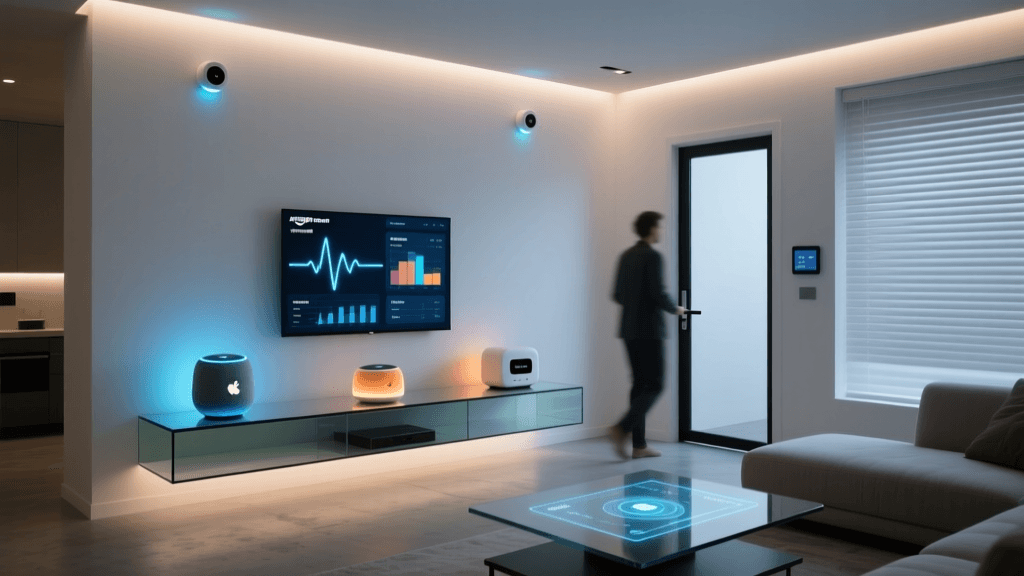
Predictive smart homes utilize advanced machine learning algorithms, edge computing, and sophisticated sensor fusion to anticipate your needs before you even realize them. Instead of waiting for a voice command, the home observes your habits, monitors environmental variables, and autonomously adjusts lighting, climate, and security settings to optimize comfort, health, and energy efficiency. This evolution is not science fiction; it is actively being integrated into high-end consumer hardware and standardized protocols today.
"The true promise of the smart home is not that you can control it from your phone, but that you never have to control it at all."
Core Technologies Driving the Predictive Home
The transition to a predictive living environment relies on three foundational pillars: localized artificial intelligence, advanced sensor arrays, and unified communication protocols.
Edge AI and Local Machine Learning
Historically, smart home data was sent to the cloud for processing, introducing latency, internet dependency, and severe privacy concerns. The future lies in Edge AI—processing machine learning models directly on local hardware. Devices like the Apple HomePod (2nd Gen), which utilizes an M-series neural engine, and modern hubs equipped with Qualcomm Snapdragon chips, can now process complex behavioral patterns locally. This means your home learns that you typically wake up at 6:30 AM, make coffee, and read in the living room, adjusting the environment accordingly without ever sending your personal schedule to a remote server.
Advanced Sensor Fusion and mmWave Radar
Standard Passive Infrared (PIR) motion sensors only detect large movements; if you sit still reading a book, the lights turn off. The predictive home replaces PIR with millimeter-wave (mmWave) radar technology. Operating at frequencies around 60GHz, mmWave sensors can detect micro-movements, including the subtle expansion and contraction of your chest as you breathe.
Products like the Aqara FP2 Presence Sensor (retailing around $70) utilize mmWave radar to not only confirm room occupancy with 100% accuracy but also track multiple people simultaneously, monitor posture (sitting vs. standing), and even detect falls. When fused with thermal sensors and acoustic monitors, the home builds a comprehensive, real-time 3D map of human activity, allowing the AI to make highly nuanced predictive decisions.
The Matter Protocol and Unified Ecosystems
Predictive AI requires vast amounts of cross-device data to function accurately. If your smart lock, thermostat, and lighting system operate in siloed ecosystems, the AI cannot correlate your arrival with your preferred climate settings. The Connectivity Standards Alliance developed the Matter protocol to solve this fragmentation. By providing a unified, IP-based application layer, Matter allows devices from different manufacturers to share data locally over your network via Thread and Wi-Fi, giving the central AI hub the holistic data access required to make accurate predictions.
Practical Applications of Ambient Intelligence
How does this technology manifest in daily life? Here are the most impactful applications of predictive AI currently entering the market.
Predictive Energy Management and Grid Interaction
Heating and cooling account for nearly half of a typical home's energy usage. Predictive AI transforms the thermostat from a simple scheduling tool into an intelligent energy broker. Devices like the Ecobee Smart Thermostat Premium (approximately $250) use remote SmartSensors to track occupancy, but they also pull in local weather forecasts, analyze the thermal mass of your specific home, and monitor utility Time-of-Use (TOU) rates.
If the AI knows a heatwave is coming and electricity rates will surge at 4:00 PM, it will proactively pre-cool your home at 1:00 PM when energy is cheap and abundant, then coast through the peak hours without running the compressor. According to the U.S. Department of Energy, smart thermostats can save homeowners up to 10-15% on heating and cooling costs annually, but predictive AI models that integrate with dynamic grid pricing can push those savings even further while reducing strain on the local power grid. The EPA's Energy Star Program also highlights that certified smart thermostats learn your schedule and optimize energy use without sacrificing comfort.
Health, Wellness, and Circadian Alignment
Future smart homes act as passive health monitors. By integrating predictive lighting with air quality sensors, the home actively supports your biological rhythms. For example, an AI hub connected to an Awair Element ($299) monitors CO2, VOCs, and humidity. If CO2 levels rise in your bedroom while you sleep—a condition proven to disrupt deep sleep cycles and cause morning grogginess—the AI will proactively trigger the HVAC fan to circulate fresh air before the air quality degrades enough to wake you up.
Simultaneously, predictive lighting systems adjust color temperature based on the sun's position and your historical sleep data. As your smart mattress or radar sensor detects you waking up, the lights gradually shift from a warm 2000K amber to a bright 5000K daylight spectrum to suppress melatonin and boost cortisol, naturally energizing you for the day.
Generative AI and Conversational Intent
The rigid, keyword-based voice control of the past is being replaced by local Large Language Models (LLMs). Instead of memorizing specific device names and commands, you can express intent. You might say, "I'm trying to read, but the glare on my screen is too harsh and I'm a bit chilly." The generative AI understands the context, identifies which room you are in via mmWave radar, closes the automated blinds (like Eve MotionBlinds, starting at $150 per window) to block the glare, adjusts the smart bulbs to a focused 4000K task light, and bumps the thermostat up by two degrees.
Data Visualization: Smart Home AI Energy Impact
Predictive AI's most measurable impact is in energy conservation. By anticipating needs and optimizing run-times, AI-driven devices drastically reduce waste compared to standard programmable or reactive smart devices.
Privacy and Security in the Age of Predictive AI
The trade-off for a home that anticipates your every move is the continuous collection of intimate behavioral data. A predictive home knows when you sleep, when you leave, what rooms you occupy, and even your breathing patterns. If this data is processed in the cloud, it presents a massive privacy risk.
To mitigate this, the future smart home must prioritize local processing and zero-trust architecture. Enthusiasts and privacy-conscious consumers are increasingly turning to local-first hubs like the Hubitat Elevation ($150) or the Home Assistant Green ($99). These devices run open-source or localized automation engines that keep all predictive machine learning models entirely within your home's LAN. By utilizing local voice assistants (like the Rhasspy project or Willow) and local vision AI (like Frigate for security cameras), you can achieve the benefits of ambient intelligence without exposing your behavioral data to corporate servers or risking cloud-based data breaches.
Preparing Your Home for the Predictive Future
Transitioning to a predictive smart home requires a strategic approach. It is not about buying the most expensive gadgets, but rather investing in a robust foundational infrastructure that supports local processing and unified protocols.
| Feature Category | Reactive Setup (Current Standard) | Predictive Setup (Future Standard) | Estimated Upgrade Cost |
|---|---|---|---|
| Occupancy Sensing | PIR Motion Sensors (Zigbee/Z-Wave) | mmWave Radar + Thermal Fusion Sensors | $70 - $120 per room |
| Climate Control | Programmable or App-Controlled Thermostat | AI Thermostat with Room Sensors & Grid Integration | $200 - $300 |
| Processing Hub | Cloud-Dependent Smart Speaker | Local Edge AI Hub (Matter/Thread Border Router) | $100 - $250 |
| Voice Control | Keyword-Based Cloud Assistant | Intent-Based Local LLM / Generative AI | Software/Existing Hardware |
| Network Backbone | Standard Wi-Fi Mesh | Dedicated Thread Mesh + VLAN IoT Segregation | $150 - $400 |
Actionable Steps for Upgrading
- Upgrade Your Network: Predictive homes generate constant local telemetry. Ensure your router supports VLANs to isolate IoT devices from your personal computers and phones, protecting against lateral network attacks.
- Adopt Matter and Thread: When purchasing new sensors or smart plugs, look for the Matter logo. Thread provides a low-latency, self-healing mesh network that ensures your sensors never drop offline, which is critical for continuous AI learning.
- Invest in a Local Hub: If you are technical, deploy Home Assistant on a dedicated mini-PC. If you prefer a plug-and-play experience, invest in an Apple TV 4K or a high-end Hubitat hub to serve as your local Thread Border Router and automation brain.
- Focus on Sensor Density: AI is only as good as its data. Instead of buying one expensive camera, buy five affordable mmWave and door/window contact sensors to give the AI a granular understanding of your home's state.
Conclusion
The future of smart home technology is invisible, intuitive, and deeply integrated into the fabric of our daily lives. By moving away from reactive, app-based control and embracing predictive AI, ambient intelligence, and local edge processing, our homes will evolve from collections of novelty gadgets into proactive partners that safeguard our health, optimize our energy consumption, and anticipate our needs. As protocols like Matter mature and local AI hardware becomes more accessible, the predictive smart home will transition from an enthusiast's luxury to a fundamental standard of modern living.