The Paradigm Shift: From Reactive to Proactive Smart Homes
The smart home industry is currently undergoing a massive structural evolution. For the past decade, the market has been dominated by reactive, app-driven ecosystems. Consumers have been forced to act as the central processing unit of their homes, manually toggling switches via smartphone apps or shouting voice commands into cylindrical speakers. However, market analysis and industry forecasting point toward a radically different horizon: the era of ambient computing and proactive automation. Future smart homes will not wait for commands; they will anticipate needs, adapt to environmental changes, and manage energy consumption autonomously.
This transition is being driven by three primary market forces: the universal adoption of the Matter protocol, the integration of millimeter-wave (mmWave) sensor fusion, and the rise of edge-computing AI. For consumers and real estate investors alike, understanding these macro-trends is no longer optional—it is essential for protecting the long-term value of home technology investments. Upgrading a home with legacy, cloud-dependent Wi-Fi devices today is akin to buying a 3G smartphone on the eve of the 4G LTE rollout. To navigate this shift, we must analyze the foundational technologies reshaping the smart home market and outline actionable strategies for future-proofing your living space.
The true value of a smart home is not realized when you control it from your phone, but when it operates so seamlessly that you forget it is there at all. The future belongs to invisible, predictive technology.
The Matter Protocol: Ending the Ecosystem Wars
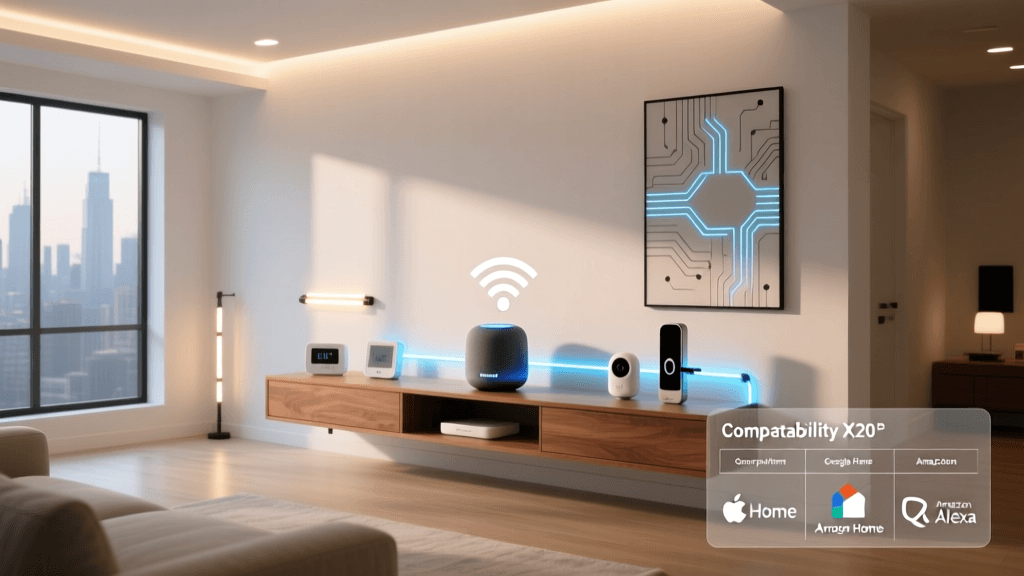
For years, the smart home market was heavily fragmented. Consumers had to choose sides: Apple HomeKit, Amazon Alexa, Google Home, or Samsung SmartThings. Devices were often locked behind proprietary hubs, leading to high abandonment rates and consumer frustration. The introduction of the Matter protocol has fundamentally altered this market dynamic. According to the Connectivity Standards Alliance (CSA), Matter is an open-source, royalty-free standard designed to ensure reliable, secure, and seamless communication between smart home devices, regardless of the manufacturer or the voice assistant ecosystem you prefer.
From a market analysis perspective, Matter is driving a massive hardware refresh cycle. Manufacturers are rushing to update their chipsets to support Matter over Thread (a low-power, mesh-networking protocol). For the consumer, this means unprecedented flexibility. A smart lock from Yale, a lighting system from Nanoleaf, and a thermostat from Ecobee can now communicate locally on the same network without relying on third-party cloud servers.
Thread: The Backbone of the Future Smart Home
Matter is the language devices speak, but Thread is the infrastructure they use to communicate. Unlike traditional Wi-Fi, which can congest your router when dozens of low-bandwidth IoT devices connect, Thread creates a self-healing, low-latency mesh network. Every Thread-enabled device acts as a node, extending the range and reliability of the network. To build a Thread network, you need a Thread Border Router. Fortunately, many modern hubs already include this hardware. The Apple TV 4K (Wi-Fi + Ethernet model, roughly $149), the Amazon Echo (4th Gen, $99), and the Google Nest Hub Max ($229) all feature integrated Thread Border Routers. When shopping for future-proof accessories, prioritizing 'Matter over Thread' devices—such as the Eve Energy Outlet ($25-$35) or the Nanoleaf Shapes starter kit ($199)—ensures your network remains robust and locally controlled, drastically reducing latency and cloud-dependency.
Predictive AI and the Rise of Sensor Fusion
While voice assistants like Alexa and Siri have achieved near-ubiquity, they represent the infancy of AI in the smart home. The next frontier of market growth lies in predictive AI and advanced sensor fusion. Traditional Passive Infrared (PIR) motion sensors have severe limitations: they only detect significant heat signatures and fail to register occupancy if a person is sitting still, often resulting in lights turning off while you are reading or working.
The market is rapidly pivoting toward millimeter-wave (mmWave) radar technology. mmWave sensors emit high-frequency radio waves that can detect micro-movements, such as the rise and fall of a human chest during breathing. This allows the smart home to achieve true, continuous occupancy detection. The Aqara Presence Sensor FP2 (retailing around $60) is a prime example of this market shift. It utilizes mmWave to map a room in 3D, allowing users to create distinct automation zones within a single room. Furthermore, it includes fall-detection capabilities, making it a highly sought-after device in the aging-in-place and eldercare markets.
Similarly, climate control is evolving from schedule-based programming to predictive environmental management. The Ecobee Smart Thermostat Premium ($250) utilizes built-in radar occupancy sensors and AI algorithms to learn the thermal properties of your home. It calculates exactly how long it takes to heat or cool specific rooms based on outdoor weather forecasts and historical data, optimizing HVAC runtime to reduce energy waste. As utility rates continue to climb globally, AI-driven climate management is shifting from a luxury feature to a financial necessity.
Grid-Interactive Homes and Advanced Energy Management
The intersection of smart home technology and the electrical grid is one of the most lucrative and rapidly expanding sectors in the industry. The U.S. Department of Energy highlights the rise of Grid-Interactive Efficient Buildings (GEBs), which are designed to dynamically manage energy loads, integrate renewable generation, and even feed power back to the grid during peak demand events.
At the residential level, this trend is materializing through the adoption of smart electrical panels and bidirectional EV charging. Traditional circuit breakers are being replaced by intelligent energy management systems like the Span Smart Panel or Schneider Electric's Wiser Energy. While the upfront cost of a smart panel is significant (ranging from $1,500 to $3,000 plus professional installation), it provides circuit-level visibility into energy consumption. Homeowners can identify energy vampires, automate solar battery usage during time-of-use (TOU) peak pricing windows, and prioritize critical circuits during power outages.
Furthermore, the automotive and smart home markets are colliding through Vehicle-to-Home (V2H) technology. Electric vehicles like the Ford F-150 Lightning and the Hyundai Ioniq 5 are essentially rolling 77 kWh battery banks. When paired with a compatible smart home energy hub and bidirectional charger, these vehicles can power a home for days during grid failures. Market analysts project that as V2H hardware costs decrease and utility demand-response programs expand, smart energy management will become the primary driver of smart home ROI over the next five years.
Edge Computing: The Solution to the Privacy Dilemma
As smart homes become more predictive, they require vast amounts of data to function effectively. This raises significant privacy concerns. Consumers are increasingly wary of sending video feeds, audio recordings, and daily behavioral patterns to remote cloud servers. The market's response to this friction is edge computing—processing AI and automation logic locally within the home.
Apple has long championed local processing via its HomeKit Secure Video and the neural engines inside the HomePod mini. However, the open-source community and advanced users are driving massive growth in local home automation servers like Home Assistant. The recently released Home Assistant Green ($99) offers a plug-and-play local server that integrates with thousands of devices across Zigbee, Z-Wave, Thread, and Wi-Fi, entirely bypassing the cloud. By processing automations locally, homeowners achieve sub-millisecond latency, maintain total data sovereignty, and ensure their smart home continues to function even if their internet connection drops.
Actionable Guide: Future-Proofing Your Smart Home
To ensure your home technology remains relevant and avoids premature obsolescence, consumers must adopt a strategic approach to purchasing and network design. Below is a comparative analysis of the primary wireless protocols shaping the future market, followed by actionable steps for upgrading your home.
| Protocol | Frequency | Power Draw | Best Use Case | Future Market Outlook |
|---|---|---|---|---|
| Matter over Thread | 2.4 GHz | Ultra-Low | Sensors, smart locks, lighting, switches | High Growth: The new industry standard for local IoT. |
| Wi-Fi 6E / 7 | 2.4/5/6 GHz | High | Cameras, smart displays, high-bandwidth hubs | Stable: Essential for data-heavy devices, but poor for battery IoT. |
| Zigbee 3.0 | 2.4 GHz | Low | Legacy lighting (Hue), basic sensors | Declining: Being phased out in favor of Thread/Matter. |
| Z-Wave (800 Series) | 900 MHz | Low | Security systems, motorized blinds, locks | Niche/Stable: Excellent wall penetration, avoids 2.4GHz congestion. |
Five Steps to Upgrade Your Infrastructure Today
- 1. Audit and Upgrade Your Router: Your router is the foundation of your smart home. Upgrade to a Wi-Fi 6E or Wi-Fi 7 mesh system (e.g., TP-Link Deco XE75, approx. $299 for a 3-pack) that includes a dedicated Thread Border Router and can handle 100+ simultaneous device connections without latency.
- 2. Transition to Local Control Hubs: Move away from cloud-dependent hubs. Invest in an Apple TV 4K, a Home Assistant Green, or a Samsung Station to ensure your automations run locally on your LAN.
- 3. Replace PIR Sensors with mmWave: Identify high-traffic areas where lights frequently turn off while you are stationary. Replace aging motion sensors with mmWave presence sensors like the Aqara FP2 or the Third Reality mmWave sensor.
- 4. Prioritize Matter-Certified Purchases: Before buying any new smart plug, switch, or sensor, check the packaging for the official Matter logo. This guarantees cross-platform compatibility and protects your investment against ecosystem lock-in.
- 5. Explore Smart Energy Monitoring: If you have solar panels or an EV, consult with a licensed electrician about installing a smart energy monitor (like the Emporia Vue 2, approx. $150) in your electrical panel to begin tracking circuit-level energy data and preparing for future TOU utility rates.
Conclusion
The smart home market is maturing from a collection of novelty gadgets into a cohesive, intelligent infrastructure. The convergence of the Matter protocol, mmWave sensor fusion, and edge-computing AI is creating homes that are inherently more efficient, secure, and responsive. By understanding these macro-trends and strategically investing in open standards and local processing, consumers can build a resilient smart home ecosystem that will adapt and thrive in the decade to come. The future of the smart home is not about controlling your environment; it is about your environment intelligently adapting to you.