The Plateau of Interoperability: Why Matter Isn't the Finish Line
When the Connectivity Standards Alliance officially launched Matter, it was hailed as the holy grail of smart home technology. For the first time, industry titans like Apple, Google, Amazon, and Samsung agreed on a unified application layer, effectively dismantling the walled gardens that had plagued consumers for a decade. Matter solved the interoperability crisis, ensuring that a smart plug or light bulb purchased from any brand would seamlessly integrate into any major ecosystem. However, as the initial wave of Matter-certified devices floods the market, a critical realization is dawning on smart home enthusiasts and engineers alike: Matter is primarily a control plane protocol. It is exceptionally good at telling a device what to do, but it is fundamentally blind to the context of the environment and lacks the bandwidth required for the next generation of ambient computing.
Matter operates primarily over Thread (a low-power, low-bandwidth mesh network) or Wi-Fi. While Thread is perfect for sending simple on/off commands or temperature readings at 250 kbps, it cannot support the high-definition data streams required for local AI processing, nor can it provide the centimeter-level spatial awareness needed for true contextual automation. The smart home of the future doesn't just need to know that a command was sent; it needs to know exactly who is in the room, where they are sitting, and how to process multi-gigabit sensor data locally without relying on cloud latency. This is where the post-Matter frontier begins, defined by two transformative technologies: Ultra-Wideband (UWB) and Wi-Fi 7 (802.11be).
Ultra-Wideband (UWB): The Spatial Awareness Revolution
While Passive Infrared (PIR) sensors and millimeter-wave (mmWave) radar have dominated presence detection, they are inherently limited. PIR requires physical movement to trigger, leading to the infamous "lights turning off while you are reading" problem. Millimeter-wave radar solves the motion issue by detecting micro-movements like breathing, but it struggles with identity recognition and precise multi-story Z-axis mapping. Ultra-Wideband (UWB), governed by the IEEE 802.15.4z standard, represents a paradigm shift. By transmitting billions of ultra-short radio pulses across a wide spectrum of frequencies, UWB calculates the Time-of-Flight (ToF) and Angle-of-Arrival (AoA) of signals with staggering precision, achieving spatial accuracy down to 10 centimeters.
This level of precision unlocks "spatial computing" within the home. According to Apple's documentation on Ultra Wideband technology, UWB allows devices to understand their exact physical relationship to one another. In a smart home context, this means your environment can react not just to presence, but to specific identity and precise location. Imagine walking from the kitchen to the living room; UWB anchors in your smart speakers and lighting hubs track your exact trajectory, seamlessly transferring your podcast audio to the nearest speaker and adjusting the directional lighting to follow you, all without requiring a wearable device or voice command.
Furthermore, UWB introduces unparalleled security for smart access. Traditional Bluetooth Low Energy (BLE) or NFC-based smart locks are vulnerable to relay attacks, where hackers amplify the signal from your phone inside your house to trick the front door lock into opening. Because UWB measures the exact time it takes for a signal to travel, it is physically impossible to spoof the distance, making UWB-enabled smart locks virtually immune to relay attacks.
Leading UWB Smart Home Products:
- Apple HomePod mini & HomePod (2nd Gen): Equipped with the U1 and U2 chips, these act as spatial anchors for Apple HomeKit, enabling precise Handoff features and directional awareness.
- Samsung SmartThings Station: A UWB-enabled hub that acts as a spatial anchor for the SmartThings ecosystem, allowing for precise device tracking and automated routines based on exact room presence.
- Tile Pro & AirTag: While primarily item trackers, these UWB tags are increasingly being integrated into home automation routines via NFC and UWB taps to trigger specific "scenes" when placed on designated smart coasters or nightstands.
Wi-Fi 7 (802.11be): Unleashing Local Edge AI
If UWB provides the spatial context, Wi-Fi 7 provides the massive data pipeline required to power the brain of the future smart home: Local Edge AI. The current reliance on cloud-based AI for voice assistants and security camera analysis introduces privacy concerns, recurring subscription costs, and latency issues. The industry is rapidly moving toward local Large Language Models (LLMs) and edge-based computer vision, which require massive, uninterrupted bandwidth to stream uncompressed 4K video from multiple security cameras and high-fidelity audio from distributed microphones to a central local server (such as a high-end Home Assistant Yellow or a custom local AI rig).
Wi-Fi 7, officially designated as 802.11be, is not just an incremental speed bump; it is a fundamental restructuring of wireless data transmission. The Wi-Fi Alliance highlights several key features that make Wi-Fi 7 the ultimate backbone for the post-Matter home. First, it introduces 320 MHz ultra-wide channels in the 6 GHz band, effectively doubling the maximum bandwidth compared to Wi-Fi 6E. Second, it utilizes 4K QAM (Quadrature Amplitude Modulation), allowing for denser data packing and higher throughput.
However, the most revolutionary feature for smart homes is Multi-Link Operation (MLO). In previous Wi-Fi generations, a device connected to a router on a single band (e.g., 5 GHz). If that band experienced interference from a neighbor's router or a microwave, the connection stuttered, causing smart home cameras to drop or local AI voice processing to lag. MLO allows a single Wi-Fi 7 client device to connect across multiple bands (2.4 GHz, 5 GHz, and 6 GHz) simultaneously. It dynamically routes packets across the clearest path in real-time, ensuring near-zero latency and absolute reliability. For a local AI security hub processing eight 4K camera feeds, MLO guarantees that the data pipeline never bottlenecks.
Leading Wi-Fi 7 Smart Home Mesh Systems:
- TP-Link Deco BE85: A tri-band Wi-Fi 7 mesh system offering up to 22 Gbps speeds. It features dedicated 6 GHz backhaul, ensuring that high-bandwidth smart home hubs communicate with the main router without congesting the network used by your phones and laptops. (Cost: ~$800 - $1,000 for a 2-pack).
- Netgear Orbi 970 Series: Utilizing quad-link backhaul and MLO, this system is designed for massive estates with heavy IoT deployments and local server racks. It provides unparalleled stability for local Edge AI processing. (Cost: ~$1,700 - $2,300).
- Eero Max 7: Amazon's premium mesh offering, designed to integrate deeply with Alexa's local processing capabilities, ensuring that voice commands and camera feeds are processed on-device with minimal latency. (Cost: ~$1,100 for a 2-pack).
The Convergence: Context-Aware Automation
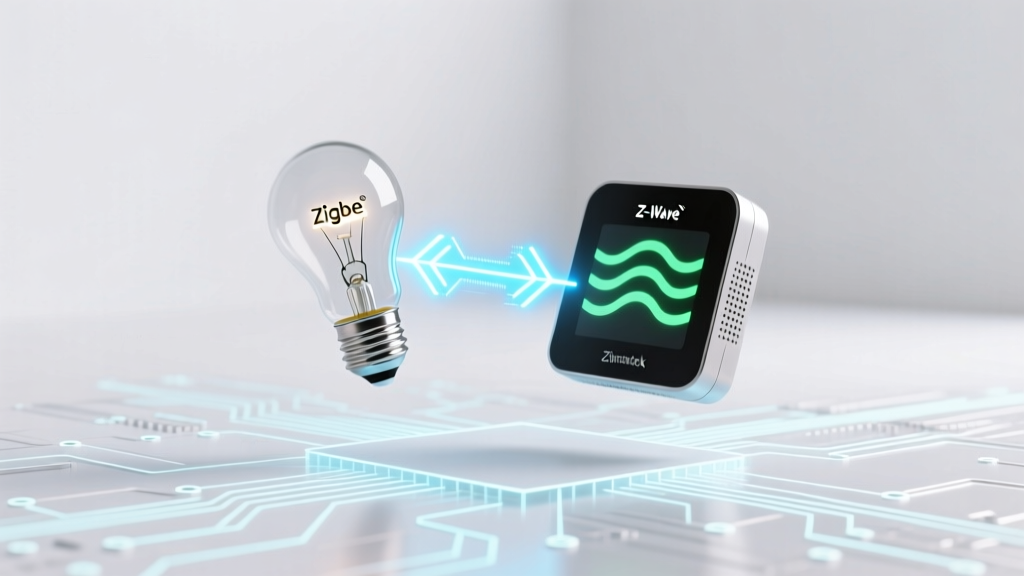
The true magic of the post-Matter era lies in the convergence of these protocols. Matter remains the universal language for device control, ensuring that a Philips Hue bulb and a Lutron switch can talk to the same hub. Wi-Fi 7 acts as the high-speed nervous system, carrying massive data loads for local AI processing. UWB acts as the sensory cortex, providing exact spatial context.
Consider a practical scenario: You walk through your front door. A UWB anchor in the hallway instantly identifies your specific smartphone and calculates your exact vector of movement. It communicates this via Thread/Matter to the central hub. Simultaneously, Wi-Fi 7 streams data from your smart wearable, informing the local AI that your heart rate is elevated and your core temperature is high. The local Edge AI processes this context in milliseconds. Using Matter commands over Thread, the hub adjusts the HVAC zoning to cool the living room, lowers the color temperature of the lights to a calming amber, and queues a specific relaxation playlist on the nearest speaker. No cloud servers were involved, no voice commands were spoken, and the automation was entirely personalized to your real-time physical and biometric state.
Protocol Comparison Matrix
To understand how these technologies complement rather than replace one another, review the technical comparison below:
| Protocol | Primary Function | Max Bandwidth | Range / Precision | Best Use Case |
|---|---|---|---|---|
| Matter (Thread) | Device Control & State | 250 kbps | ~30m (Mesh) / Low Precision | Lighting, Locks, Sensors, Plugs |
| Matter (Wi-Fi) | High-Power Control & Video | Up to 9.6 Gbps (Wi-Fi 6) | ~50m / Low Precision | Smart Displays, Cameras, Hubs |
| UWB (802.15.4z) | Spatial Awareness & Ranging | ~27 Mbps | ~50m / 10cm Precision | Precision Presence, Secure Access |
| Wi-Fi 7 (802.11be) | Massive Data & Edge AI Backbone | Up to 46 Gbps | ~100m / MLO Reliability | Local AI Servers, 8K Video, AR/VR |
| Zigbee | Legacy Mesh Control | 250 kbps | ~20m (Mesh) / Low Precision | Legacy Sensors, Budget Lighting |
Smart Home Protocol Adoption Forecast
As manufacturers transition from basic connectivity to contextual awareness, the integration of UWB and Wi-Fi 7 in premium smart home devices is expected to accelerate rapidly over the next five years.
Actionable Advice: Future-Proofing Your Home Today
Navigating the transition from the Matter era to the Spatial/Edge AI era requires strategic purchasing decisions. Here is how you should allocate your smart home budget today to prepare for tomorrow:
- Invest in Wi-Fi 7 Infrastructure Now: While your smart bulbs do not need Wi-Fi 7, your central hubs, local AI servers, and high-end mesh nodes do. Upgrading to a Wi-Fi 7 mesh system like the TP-Link Deco BE85 today ensures that your network backbone is ready for the massive local data pipelines required by upcoming Edge AI devices. The cost is high ($800+), but it is a foundational infrastructure investment that will last a decade.
- Standardize on Matter for the Basics: For all standard devices—switches, plugs, blinds, and basic sensors—strictly purchase Matter-over-Thread devices. Thread's low power consumption and mesh reliability remain unmatched for these simple tasks. Do not overspend on Wi-Fi-based devices for simple relays; keep your Wi-Fi spectrum clear for heavy data.
- Experiment with UWB Anchors: If you are deep in the Apple HomeKit or Samsung SmartThings ecosystem, purchase a HomePod mini or SmartThings Station. Place them in high-traffic areas (living room, entryway) and begin experimenting with presence-based automations. While the broader industry standardizes UWB implementation, getting familiar with spatial triggers now will put you ahead of the curve when third-party UWB tags and anchors become mainstream in 2026.
- Wait on Native UWB Smart Locks: While UWB car keys (like BMW's Digital Key Plus) are prevalent, native UWB smart locks for homes are still in their infancy and carry a massive premium. Stick to Thread-based or Z-Wave smart locks for now, and upgrade to UWB when the technology is integrated into standard deadbolt form factors at a sub-$300 price point.
Conclusion
Matter was a necessary and monumental step forward, rescuing the smart home industry from fragmented chaos. But it was never meant to be the final destination. As our homes evolve from reactive command-takers to proactive, ambient environments, the reliance on spatial context and massive local data processing becomes paramount. Ultra-Wideband and Wi-Fi 7 are not just incremental upgrades; they are the foundational pillars of the post-Matter smart home, enabling a level of security, personalization, and AI-driven automation that was previously confined to science fiction. By understanding and investing in these protocols today, you are not just building a smart home—you are building a home that truly understands you.