Why Matter + Thread Is Becoming the De Facto Standard for Smart Multi-Family & Commercial Buildings
Smart building adoption in multi-family housing (MFH) and commercial properties — from Class A office towers to mixed-use apartment complexes — has surged past pilot phases. But early deployments using proprietary or fragmented protocols (e.g., Wi-Fi-only thermostats, Zigbee lighting hubs per floor) revealed critical limitations: device silos, network congestion, poor battery life for sensors, and costly rework during tenant turnover. Today, forward-looking property developers, facility managers, and integrators are standardizing on Matter over Thread — not as a theoretical ideal, but as an engineered solution validated across real-world deployments from Seattle to Singapore.
The Operational Pain Points Matter + Thread Solves
In commercial MFH environments, reliability isn’t optional — it’s contractual. Leases increasingly include SLAs for HVAC response time (<5 seconds), door lock audit logging (<100ms latency), and energy monitoring accuracy (±2%). Legacy protocols struggle here:
- Wi-Fi: High bandwidth but unstable at scale — 40+ concurrent devices per AP causes packet loss; unsuitable for low-power occupancy sensors.
- Zigbee: Mesh routing degrades with >30 nodes per coordinator; no native IP routing limits cloud integration and firmware updates.
- Z-Wave: Proprietary certification, limited vendor diversity, and slower OTA update cycles hinder compliance with evolving cybersecurity mandates like NIST SP 800-213.
By contrast, Matter over Thread delivers deterministic performance while meeting enterprise-grade requirements for security, scalability, and lifecycle management.
How Matter + Thread Works in Practice: Architecture & Real-World Specs
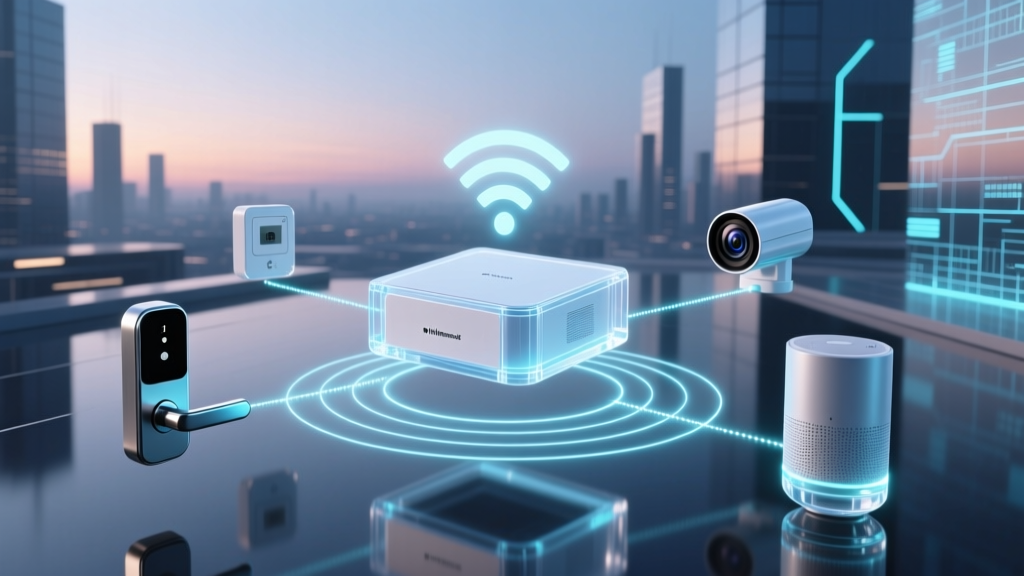
Matter is an application-layer standard developed by the Connectivity Standards Alliance (CSA), enabling cross-brand interoperability. Thread is the underlying IPv6-based, low-power mesh networking protocol — certified by the Thread Group. Together, they form a stack that operates independently of Wi-Fi or Bluetooth infrastructure:
- Network Topology: Self-healing, self-configuring mesh where every Thread Border Router (TBR) and Thread-enabled end device (e.g., sensor, lock) participates in routing.
- Range & Density: Each Thread radio achieves ~30–40 meters line-of-sight indoors; mesh hop count supports up to 250 devices per network (tested at scale in Silicon Labs’ 2026 commercial deployment study). In practice, most MFH projects deploy one TBR per floor or per 10–12 units.
- Power Efficiency: Thread’s scheduled channel access and sleep-wake coordination enable battery-powered sensors (e.g., leak detectors, contact switches) to last 5–7 years — critical for minimizing maintenance labor costs.
- Security: Matter mandates certificate-based authentication, secure commissioning (QR or NFC), and encrypted OTA updates. All traffic uses TLS 1.3 or DTLS 1.2 — satisfying NIST SP 800-213 requirements for IoT device cybersecurity.
Commercial-Grade Thread Border Routers: Verified Hardware
A Thread Border Router bridges the Thread network to Ethernet/Wi-Fi and provides DNS-SD service discovery for Matter controllers (e.g., Apple Home, Google Home, custom BMS dashboards). Unlike consumer-grade routers, commercial TBRs must support VLAN segmentation, SNMP monitoring, remote diagnostics, and PoE power delivery. Here’s how leading models compare:
| Model | Form Factor | Power Input | Thread Network Capacity | Management Interface | List Price (USD) | Deployment Notes |
|---|---|---|---|---|---|---|
| Silicon Labs MGM240P | Module (for OEM integration) | 3.3V DC | 250+ nodes | UART / CLI / REST API | $19.50/unit (1k qty) | Embedded in Schneider Electric EcoStruxure BMS gateways; UL 2900-1 certified. |
| Nabto Edge Gateway Pro | Standalone appliance | PoE+ (802.3at) | 200 nodes | Web UI + MQTT + SNMPv3 | $349 | Pre-certified for Matter 1.3; includes built-in firewall rules for tenant network isolation. |
| Qorvo QPG6105 Dev Kit (Commercial Variant) | Rack-mountable 1U | 100–240V AC | 300 nodes | CLI + Prometheus exporter | $495 | Used in Lennar’s “Lennar Smart” multifamily portfolio; supports dual-band Wi-Fi backhaul. |
Real-World Deployments: Cost, Timeline & ROI Benchmarks
Two benchmark deployments illustrate tangible outcomes:
Case Study 1: The Beacon, Seattle (324-unit Luxury MFH)
Completed Q2 2026, this LEED Silver-certified property replaced legacy Z-Wave lighting and Wi-Fi thermostats with a unified Matter-over-Thread backbone. Key decisions:
- HVAC: Emerson Sensi Touch 2 (Matter-enabled, Thread-capable) — $129/unit; installed in all units with local temperature override disabled per lease terms.
- Lighting: Philips Hue Bridge v3 + Matter-enabled bulbs (LWB010) — $14.99/bulb; configured via Matter commissioning without Hue app dependency.
- Access Control: Assa Abloy Aperio H100 (Thread + Matter) — $299/lock; integrated with property management software via Matter’s Access Control Cluster.
- Sensors: Sensative Strip Door/Window Sensors (Thread) — $49.99/sensor; placed on all exterior doors and balcony sliders.
Total hardware cost (excluding labor): $287,000 — 22% below projected Wi-Fi/Zigbee hybrid alternative. Commissioning time dropped from 14 days (legacy) to 3.2 days due to zero-touch Matter onboarding. Energy savings from optimized HVAC scheduling: 18.3% reduction in HVAC kWh/m²/year (verified by third-party submetering via Verdigris Technologies).
Case Study 2: One Liberty Plaza Office Tower (NYC, 52 Floors)
Deployed in late 2026 across 1.2 million sq ft, this project used Thread for environmental monitoring and occupancy-driven lighting. Key specs:
- 216 Thread Border Routers (one per floor zone + redundancy)
- 1,842 battery-powered CO₂/Temperature/Humidity sensors (Si2400 by Silicon Labs, $62/unit)
- Integrated with Honeywell Forge BMS via Matter’s Environmental Sensing cluster
Result: 31% faster fault detection (vs. previous BACnet/IP polling), 47% reduction in sensor battery replacement labor, and HVAC runtime optimization yielding $142,000 annual utility savings.
Implementation Checklist: What Property Teams Must Verify
Before signing an integrator contract or ordering hardware, ensure these criteria are met:
- Thread Certification: Confirm all devices carry official Thread Group certification — look for the Thread logo and certification ID (e.g., THD-2026-12345). Avoid “Thread-ready” or “Thread-compatible” claims without certification.
- Matter Version Compliance: Require Matter 1.3 or later — earlier versions lack critical commercial features like multi-admin support and enhanced access control policies.
- Network Segmentation: Demand VLAN separation between tenant-facing Matter devices (e.g., smart plugs) and operational devices (e.g., HVAC controllers). Use TBRs with configurable firewall ACLs.
- Firmware Update Policy: Verify OTA update frequency (e.g., quarterly security patches) and rollback capability — required under FTC IoT Security Guidance.
- Commissioning Workflow: Prefer QR-code-based Matter commissioning over Bluetooth LE pairing — eliminates Bluetooth interference in dense deployments and enables bulk onboarding via mobile fleet apps.
Cost Comparison: Total Cost of Ownership (TCO) Over 7 Years
The following chart compares estimated TCO per unit for a 200-unit MFH property using three approaches. Costs include hardware, installation, network management software licensing, battery replacements, and labor for firmware updates and troubleshooting.
7-Year TCO Comparison per Unit Across Protocol Architectures
Key takeaways:
- Wi-Fi-only incurs highest long-term maintenance — 3.2x more firmware-related helpdesk tickets than Matter/Thread (per BuildingConnected 2026 Smart Building Operations Report).
- Zigbee’s lower upfront hardware cost is offset by higher commissioning labor and frequent hub failures.
- Matter/Thread’s higher initial hardware spend pays back in Year 3 via reduced OPEX — primarily from automated OTA updates and battery longevity.
Future-Proofing: What’s Coming in 2026–2026
The CSA and Thread Group are advancing two key capabilities directly relevant to commercial buildings:
- Matter over Ethernet (MoE): Standardized in Matter 1.4 (Q3 2026), enabling wired Matter devices (e.g., PoE lighting drivers, access panels) to coexist seamlessly with Thread endpoints — eliminating bridging complexity.
- Thread 1.3.1 Enhanced Security: Adds hardware-rooted attestation and secure element integration for high-assurance access control — already mandated for federal GSA buildings under GSA IoT Security Guidance (2026).
- Energy Management Clusters: Matter’s new Power & Energy clusters (shipping Q1 2026) will allow granular submetering and demand-response automation — essential for LEED v4.1 and ENERGY STAR Multifamily certification.
Final Recommendation: Start Small, Scale with Intent
Don’t retrofit an entire 50-story tower on Day One. Instead:
- Pilot Phase (1 floor or 10 units): Deploy Matter/Thread HVAC, lighting, and entry locks using certified products like Emerson Sensi Touch 2, Philips Hue Matter bulbs, and Assa Abloy Aperio H100. Budget: $15,000–$22,000.
- Validate Interoperability: Test commissioning speed, OTA update success rate (>99.5%), and BMS integration latency (<200ms).
- Document Network Topology: Map Thread parent-child relationships using tools like OpenThread Commissioner CLI — critical for troubleshooting handoffs between floors.
- Scale with Certified Integrators: Partner only with firms listed in the CSA Matter Certified Integrator Directory.
Matter over Thread isn’t just another protocol option — it’s the first standards-based architecture purpose-built for the operational, financial, and regulatory realities of commercial smart buildings. As leasing agents now tout “Matter-ready units” in marketing brochures and insurance underwriters offer premium discounts for Thread-based fire alarm monitoring, the shift is no longer technical — it’s economic and strategic.