The Unique Challenges of Multi-Family Smart Deployments
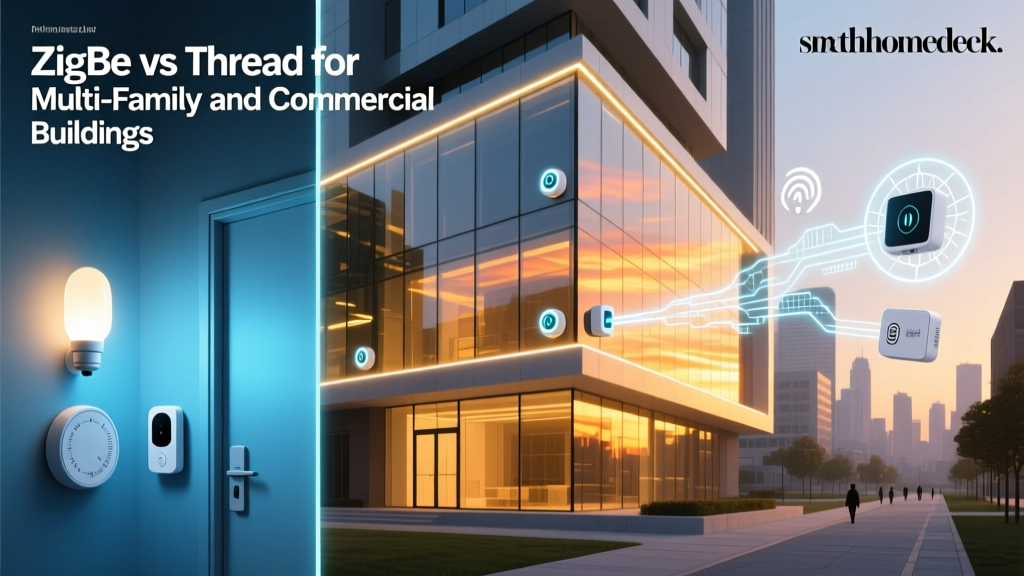
Scaling smart home technology from a single-family residence to a Multi-Dwelling Unit (MDU) or commercial building introduces a labyrinth of technical hurdles. In a standard 2,500-square-foot home, a single Wi-Fi router or a centralized Zigbee hub can comfortably manage dozens of devices. However, in a 200-unit apartment complex or a multi-story commercial office, property managers face severe RF (Radio Frequency) interference, dense concrete and steel attenuation, and the critical need for centralized, cloud-based Property Management Software (PMS) integration.
Choosing the right wireless protocol is no longer just about consumer convenience; it is a capital expenditure decision that impacts Net Operating Income (NOI), tenant retention, and long-term maintenance costs. A failed smart lock or an offline leak sensor in a multi-family building can lead to thousands of dollars in property damage or compromised security. In this comprehensive guide, we evaluate the leading smart home protocols—Thread, Zigbee, and Wi-Fi 6—specifically through the lens of multi-family and commercial building deployments.
Evaluating the Core Protocols for High-Density Environments
When deploying IoT devices across dozens or hundreds of units, the physical environment dictates protocol viability. Concrete floors, steel rebar, and the sheer density of neighboring Wi-Fi networks create a hostile environment for wireless signals. Let us break down how the major protocols perform under these conditions.
Thread: The IPv6 Mesh Powerhouse
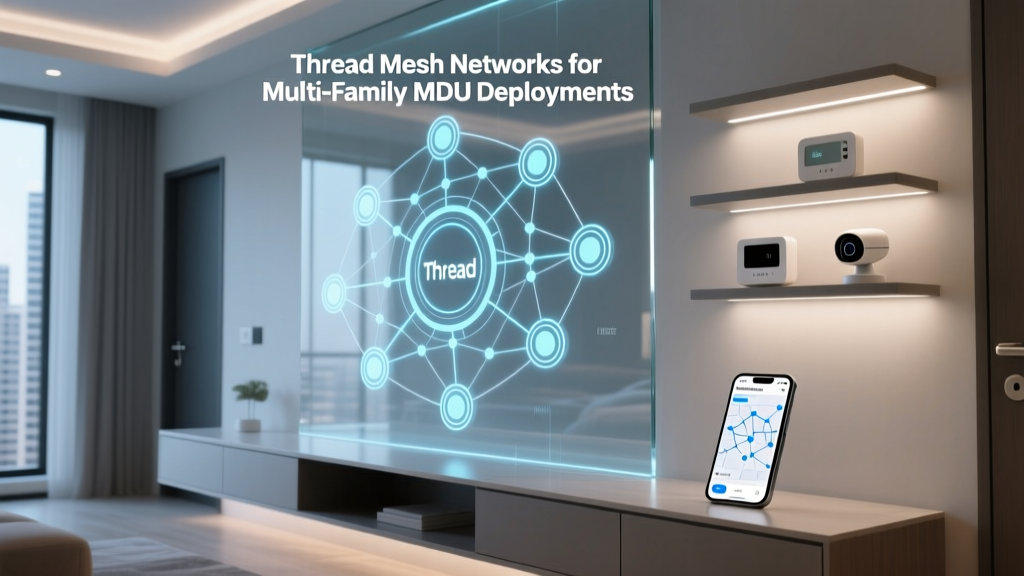
Thread is rapidly becoming the gold standard for new multi-family smart building deployments. Built on the IEEE 802.15.4 radio standard and utilizing 6LoWPAN for IPv6 networking, Thread creates a self-healing, low-power mesh network. According to the Thread Group, the protocol's defining feature is its lack of a single point of failure. Unlike traditional hub-and-spoke models, Thread devices communicate with one another, and the network is bridged to the IP network via Thread Border Routers.
In a commercial or MDU setting, this is revolutionary. Instead of placing a consumer-grade hub in every single apartment unit, property managers can integrate Thread Border Routers directly into enterprise-grade Wi-Fi Access Points (such as those from Aruba or Cisco) installed in the hallways. This allows a single, building-wide Thread mesh to service hundreds of low-power sensors, locks, and thermostats, all while remaining isolated from the tenants' personal Wi-Fi networks.
Thread's native IPv6 support means every sensor has its own IP address, making integration with commercial Building Management Systems (BMS) and cloud-based PMS platforms like Yardi or RealPage significantly more straightforward than legacy protocols.
Zigbee: The Proven Legacy Mesh
Zigbee has been the workhorse of the smart home and light-commercial industry for over a decade. Operating primarily on the 2.4 GHz band, Zigbee also utilizes mesh networking, allowing devices to route signals through one another to reach a central coordinator. The Connectivity Standards Alliance (CSA) notes that Zigbee's mature ecosystem offers the widest variety of commercial-grade sensors, lighting controllers, and HVAC actuators on the market.
However, Zigbee faces severe challenges in high-density MDUs. The 2.4 GHz spectrum is heavily congested by tenants' personal Wi-Fi routers, Bluetooth devices, and microwaves. In a 200-unit building, the noise floor can be so high that Zigbee signals experience massive packet loss. To mitigate this, commercial integrators must perform rigorous RF site surveys and strictly lock Zigbee coordinator channels to 11, 15, 20, or 25 to avoid overlapping with standard Wi-Fi channels. Furthermore, Zigbee requires a dedicated coordinator (hub) per network, which complicates building-wide centralized management without expensive enterprise gateway hardware.
Wi-Fi 6: The High-Bandwidth Standard
Wi-Fi is ubiquitous, but it is generally a poor choice for battery-operated IoT sensors in multi-family buildings. However, the advent of Wi-Fi 6 (802.11ax) has changed the conversation for hardwired, high-bandwidth commercial devices. The Wi-Fi Alliance highlights that Wi-Fi 6 introduces OFDMA (Orthogonal Frequency-Division Multiple Access) and BSS Coloring, which drastically reduce interference in dense environments like apartment hallways and commercial lobbies.
For devices like smart access control cameras, video intercoms, and hardwired smart thermostats (e.g., ecobee SmartThermostat Premium), Wi-Fi 6 is ideal. It leverages the building's existing enterprise IT infrastructure, eliminating the need for secondary IoT networks. However, Wi-Fi's power consumption remains too high for wireless leak sensors or battery-powered smart locks, keeping it from being a universal MDU solution.
Protocol Comparison: Multi-Family Building Matrix
To help property managers and commercial integrators make informed decisions, we have compiled a comparison matrix focusing on the metrics that matter most in large-scale deployments.
| Protocol | Frequency Band | Max Nodes per Network | MDU Hub Strategy | Battery Life (Sensors) | Best MDU Use Case |
|---|---|---|---|---|---|
| Thread | 2.4 GHz | 250+ (per Border Router) | Enterprise AP Integration | 2-5 Years | Leak sensors, smart locks, lighting |
| Zigbee | 2.4 GHz | 65,000 (theoretical) | Dedicated Unit Hubs / Enterprise Gateways | 1-3 Years | Lighting control, HVAC actuators |
| Wi-Fi 6 | 2.4 / 5 / 6 GHz | Limit of AP capacity | Existing IT Infrastructure | Days/Months (High drain) | Cameras, intercoms, hardwired thermostats |
Deployment Costs and ROI in a 100-Unit MDU
When pitching a smart building upgrade to stakeholders, the Total Cost of Ownership (TCO) is the ultimate deciding factor. Below is a visualization of the estimated 5-year costs per unit when deploying a standard smart package (smart lock, thermostat, and leak sensor) across a 100-unit multi-family building.
Average deployment cost per unit for smart locks and thermostats across different protocols in a 100-unit MDU
As the chart illustrates, while Wi-Fi hardware might appear cheaper upfront due to the lack of specialized IoT hubs, the hidden costs of network upgrades, VLAN configuration, and IT support can inflate the budget. Thread offers the most balanced TCO, as the Border Routers are often absorbed into the building's necessary Wi-Fi infrastructure upgrades, and the low-power mesh drastically reduces maintenance calls for dead batteries.
Real-World Device Recommendations for MDUs
Selecting the right protocol is only half the battle; choosing commercial-grade hardware that supports these protocols reliably is equally critical. Here are our top recommendations for multi-family deployments.
Smart Access Control
- Schlage Encode Plus (Thread/Wi-Fi): Priced around $300 per unit, this lock is a favorite for MDUs. Its Thread support ensures low-latency unlocking via Apple Home Key, while its Wi-Fi fallback allows for robust OTA (Over-The-Air) firmware updates and remote access via property management portals.
- Yale Assure Lock 2 (Zigbee/Z-Wave/BLE): At $250, this is the legacy champion. If your building utilizes a centralized SmartThings or Hubitat commercial gateway, the Zigbee variant provides excellent mesh routing through hallway repeaters.
Leak Detection and Water Shutoff
- Eve Water Guard (Thread): Water damage is the leading cause of insurance claims in multi-family buildings. The Eve Water Guard uses Thread to communicate instantly with a Thread Border Router, triggering automated shutoff valves without relying on tenant Wi-Fi passwords.
- Moen Flo Smart Water Monitor (Wi-Fi): For whole-building or per-unit mainline shutoffs, the $500 Moen Flo requires hardwiring and a stable Wi-Fi connection, but its AI-driven leak detection algorithms are unmatched in commercial insurance mitigation.
HVAC and Energy Management
- ecobee SmartThermostat Premium (Wi-Fi): Essential for buildings where the landlord pays utilities. Priced at $249, it integrates seamlessly with commercial demand-response programs and utilizes Wi-Fi for high-bandwidth data reporting to energy dashboards.
- Aqara Smart Radiator Thermostat E1 (Zigbee): Ideal for older commercial buildings with hydronic radiator heating. Its Zigbee mesh allows dozens of units on a single floor to route data back to a central gateway efficiently.
Strategic Advice for Property Managers and Integrators
Deploying IoT in a multi-family or commercial environment requires a paradigm shift from residential "plug-and-play" mentality to enterprise-grade network engineering. Follow these actionable strategies to ensure success:
- Conduct an RF Site Survey: Before purchasing hardware, use spectrum analyzers to map the 2.4 GHz noise floor in the building. In dense urban MDUs, you may find that Zigbee is entirely unviable on certain floors due to neighboring buildings' Wi-Fi bleed-over.
- Standardize on Matter over Thread: The Matter standard is bridging the gap between consumer ecosystems and commercial BMS. By specifying Matter-compatible Thread devices, you future-proof the building, allowing tenants to use their preferred voice assistants while the property manager retains backend control via IP-based APIs.
- Implement PoE Border Routers: Do not rely on tenant-facing smart speakers as Thread Border Routers. They will be unplugged, reset, or stolen. Instead, utilize Power over Ethernet (PoE) commercial access points that feature built-in Thread radios, mounted securely in hallway drop ceilings.
- Isolate IoT on Dedicated VLANs: Security is paramount. Smart building devices should never share the same network segment as tenant Wi-Fi or the building's financial PCs. Use VLAN tagging and firewall rules to restrict IoT devices to only communicate with their required cloud PMS endpoints.
Conclusion
The transition from single-family smart homes to multi-family and commercial smart buildings demands a rigorous approach to protocol selection. While Zigbee remains a reliable legacy option for specific lighting and HVAC applications, its vulnerability to 2.4 GHz congestion in high-density environments is a major liability. Wi-Fi 6 is indispensable for high-bandwidth, hardwired commercial devices but falls short for scalable, battery-operated sensor networks.
Thread has emerged as the clear victor for the future of multi-family IoT deployments. Its IPv6 architecture, self-healing mesh capabilities, and seamless integration with enterprise IT infrastructure via Border Routers make it the most robust, scalable, and cost-effective protocol for modern MDUs. By investing in Thread and Matter-compatible hardware today, property owners can significantly reduce maintenance overhead, lower insurance premiums through proactive leak detection, and command higher rental premiums in an increasingly competitive real estate market.