The evolution of the smart home has transitioned from manual switches to voice commands, and now, to predictive automation. However, the true holy grail of home automation is contextual awareness—specifically, knowing exactly where you are and what you are doing at any given moment. While protocols like Bluetooth Low Energy and Wi-Fi have provided rough estimates of proximity, they lack the centimeter-level precision required for truly seamless interactions. Enter the Ultra-Wideband (UWB) protocol, a revolutionary wireless technology that is redefining spatial awareness in modern smart homes.
Unlike traditional wireless protocols that rely on signal strength to guess proximity, UWB measures the literal time it takes for radio waves to travel between devices. This allows your home to understand not just that you are inside, but exactly which room you are standing in, which direction you are facing, and whether you are reaching for a specific smart device. In this comprehensive technical guide, we will explore the physics behind UWB, its ecosystem compatibility, security advantages, and the best ways to integrate UWB-enabled devices into your smart home.
Protocol Overview: What is Ultra-Wideband (UWB)?
Ultra-Wideband (UWB) is a short-range, high-bandwidth wireless communication protocol that utilizes a very wide spectrum of radio frequencies to transmit data. Unlike narrowband systems such as Wi-Fi or Bluetooth, which concentrate their energy into a specific, narrow frequency channel, UWB spreads its energy across a massive frequency band—typically 500 MHz or more. This unique approach allows UWB to transmit highly precise, nanosecond-duration pulses of radio energy.
The primary function of UWB in the smart home is not to stream high-definition video or download large files. Instead, its core competency is spatial awareness and fine ranging. By calculating the exact time it takes for a pulse to leave a transmitter and reach a receiver, UWB can determine the distance between two devices with an accuracy of just a few centimeters. When combined with multiple antennas, it can also determine the exact angle of approach, creating a three-dimensional map of device locations in real-time.
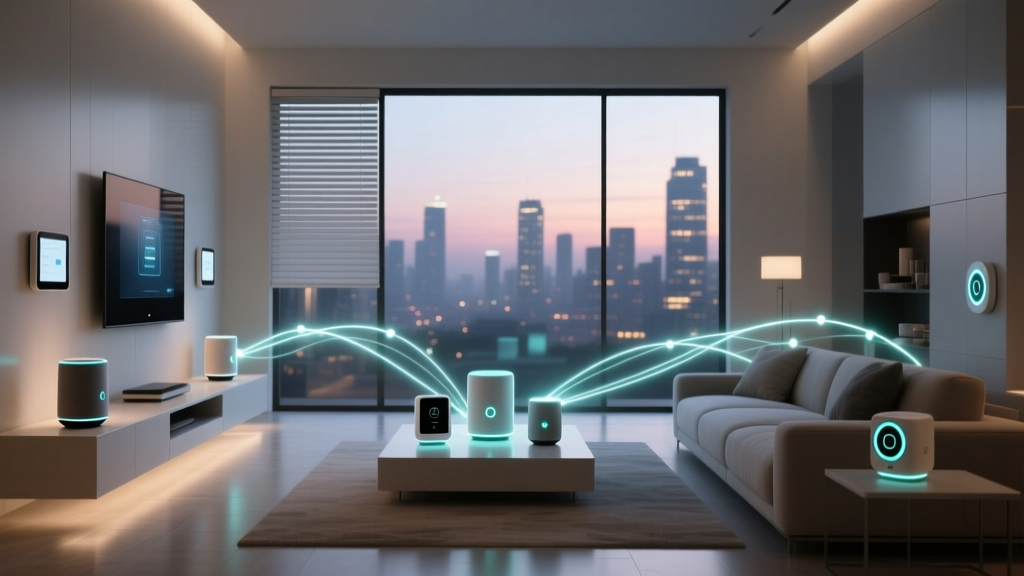
This level of precision transforms the smart home from a reactive environment into a proactive one. Instead of asking a voice assistant to turn on the living room lights, the home already knows you have just walked through the doorway and adjusts the lighting and temperature to your exact preferences. UWB provides the missing contextual layer that bridges the gap between human intent and machine execution.
How UWB Spatial Awareness Works: The Physics of Precision
To understand why UWB is vastly superior to legacy proximity protocols, we must look at the underlying physics of how it measures space. Traditional Bluetooth and Wi-Fi location tracking rely on RSSI (Received Signal Strength Indicator). RSSI attempts to estimate distance by measuring how much a signal has degraded over space. The problem with RSSI is that radio waves bounce off walls, are absorbed by water (including human bodies), and suffer from multipath interference. A Bluetooth signal might look 'weak' simply because a person is standing between the sensor and the target, leading the system to falsely assume the target has moved further away.
UWB completely bypasses the flaws of RSSI by utilizing Time of Flight (ToF). Because UWB pulses are incredibly short (often in the nanosecond range), the system can timestamp the exact moment a pulse is sent and the exact moment it is received. Since radio waves travel at the speed of light, the system can calculate the distance with mathematical certainty. A delay of just one nanosecond equates to roughly 30 centimeters of distance, allowing UWB chips to achieve centimeter-level accuracy regardless of signal strength fluctuations.
Beyond simple distance, modern UWB implementations utilize Angle of Arrival (AoA). By equipping a receiver with an array of multiple antennas, the system can measure the microscopic time difference it takes for a pulse to hit each antenna in the array. This phase difference allows the receiver to calculate the exact direction the signal is coming from. Combined with ToF, AoA provides a complete spatial coordinate (distance and direction), enabling devices to know not just that your smartphone is nearby, but that it is approaching the front door from the left side.
Furthermore, UWB operates with an incredibly low Power Spectral Density (PSD). Because the signal energy is spread across such a wide frequency band (typically between 6.5 GHz and 8.0 GHz for modern smart home applications), the signal actually sits below the noise floor of most narrowband receivers. This means UWB does not interfere with Wi-Fi, Bluetooth, or cellular signals, and conversely, it is highly resistant to interference from those same crowded networks.
Compatibility and Ecosystem Integration
For a protocol to succeed in the smart home, it must be supported by a broad ecosystem of devices. The standardization of UWB is primarily driven by the FiRa (Fine Ranging) Consortium, an industry group dedicated to developing interoperable UWB ecosystems. FiRa ensures that a UWB chip from one manufacturer can accurately range and communicate with a UWB chip from another, which is critical for cross-brand smart home integration.
Apple has been a major pioneer in bringing UWB to the consumer market with its custom U1 and U2 chips, integrated into modern iPhones, Apple Watches, and HomePod smart speakers. This enables features like Precision Finding for AirTags and seamless handoff experiences. Similarly, Samsung has heavily integrated UWB into its Galaxy smartphone lineup and SmartThings ecosystem, allowing users to unlock smart locks and track SmartTags with centimeter-level precision.
On the broader smart home front, UWB is increasingly being viewed as a complementary protocol to the Matter standard and Thread networks. While Matter excels at standardizing device control and state management (e.g., turning a light on or off), it does not natively handle fine-grained spatial awareness. UWB acts as the contextual trigger layer. For example, a Thread network might handle the actual command to unlock a door, but UWB provides the secure, precise proximity verification required to authorize that command without the user ever taking their phone out of their pocket.
As Android natively supports UWB through its Ready to Share and Fast Pair APIs, the cross-platform compatibility of UWB is rapidly expanding. Smart home hubs and access control manufacturers are increasingly embedding FiRa-certified UWB modules into their hardware, ensuring that whether you carry an iOS or Android device, your home will recognize your precise spatial location.
Performance: Precision, Range, and Latency
When evaluating wireless protocols for spatial awareness, three main performance metrics matter: accuracy, range, and power consumption. UWB dominates the accuracy category, offering reliable measurements down to 10 centimeters, and in some optimized environments, even less. This is a massive leap over Bluetooth RSSI, which typically struggles to provide accuracy better than 1 to 3 meters, and Wi-Fi, which can fluctuate by several meters depending on environmental congestion.
In terms of range, UWB is generally optimized for short to medium distances, typically performing flawlessly up to 50 meters in line-of-sight conditions. However, because high-frequency radio waves (like the 6.5 to 8.0 GHz bands used by UWB) do not penetrate solid obstacles like concrete walls or metal doors as easily as lower-frequency signals, its effective range in a multi-room home is naturally segmented. Interestingly, this 'weakness' is actually a massive benefit for room-level automation, as the signal naturally attenuates when passing through walls, preventing the system from accidentally triggering living room automations when you are merely standing in the adjacent kitchen.
Power consumption is another area where UWB shines. Because UWB only draws significant power during the nanosecond pulses it transmits, its duty cycle is incredibly low. A UWB tracker or smart lock module can remain in a 'listening' state for months or even years on a small coin-cell battery. This makes it highly suitable for passive asset tags, battery-operated smart locks, and wireless presence sensors that require zero maintenance.
Security: Defeating Relay Attacks
One of the most compelling reasons to adopt UWB for smart home access control is its inherent resistance to relay attacks. A relay attack is a common hacking technique used against traditional RFID key fobs and Bluetooth-based smart locks. In a relay attack, a hacker stands near your front door with a receiver, while an accomplice stands near your car or bedroom window with an amplifier. They capture the weak Bluetooth or RFID signal from your key fob inside the house, amplify it, and relay it to the front door lock. The lock, relying on RSSI, assumes the key fob is right outside the door and unlocks, granting the hackers access.
UWB makes relay attacks virtually impossible due to the laws of physics. Because UWB relies on Time of Flight (ToF), the system measures the exact nanosecond the signal was sent and received. If a hacker attempts to capture, amplify, and relay a UWB signal, the electronic processing time required to receive the signal, transmit it to the accomplice, and re-transmit it to the lock introduces a delay. Even a delay of a few microseconds is easily detected by the UWB chip, which operates on nanosecond precision. The lock will instantly recognize that the signal took too long to arrive and will deny access.
Furthermore, the FiRa Consortium has implemented Secure Ranging protocols, specifically the Scrambled Timestamp Sequence (STS). STS encrypts the timing markers within the UWB pulses, ensuring that a malicious actor cannot record a previous UWB exchange and replay it later (a replay attack). This combination of cryptographic security and physics-based timing verification makes UWB the most secure wireless protocol available for physical access control, digital car keys, and high-security smart home entryways.
Best Smart Home Devices and Use Cases for UWB
The unique capabilities of UWB open up entirely new categories of smart home automation and device interaction. Here are the most impactful use cases and device types currently leveraging UWB spatial awareness.
1. Hands-Free Smart Locks
The ultimate goal of a smart lock is to eliminate the need to fumble for keys or smartphones. With UWB, your front door can track your approach from the sidewalk. It knows exactly when you cross the threshold of your property, when you step onto the porch, and when you are standing directly in front of the deadbolt. The lock can automatically disengage the moment you reach for the handle, providing a truly magical, hands-free entry experience that is both secure and convenient.
2. Room-Level Presence Detection
Traditional presence detection relies on PIR (Passive Infrared) motion sensors, which fail if you are sitting still on the couch reading a book. UWB-enabled presence sensors or smart speakers can detect the micro-movements of your breathing and the precise location of your UWB-enabled smartphone or wearable. This allows the home to adjust lighting, HVAC, and audio zones on a room-by-room basis, following you seamlessly as you move through the house without ever triggering a false 'away' state.
3. Precision Asset Tracking
While Bluetooth trackers can tell you if your keys are in the house, UWB trackers (like Apple AirTags or Samsung SmartTags) can guide you to their exact location. Using the AoA capabilities of your smartphone, the screen can display an augmented reality-style arrow pointing directly to the couch cushion where your keys are hiding, complete with a precise distance readout.
4. Directional Control and Handoff
UWB enables intuitive 'point-to-control' interfaces. Imagine holding your smartphone or a UWB-enabled smart remote and simply pointing it at your smart TV, your soundbar, or a specific smart bulb. The devices can sense the angle of the remote and automatically bring up the control interface for the exact device you are pointing at. Similarly, audio handoff becomes seamless; walking into a room and pointing your phone at a smart speaker instantly transfers your music playlist to that specific speaker.
5. Pet and Child Tracking Zones
By attaching lightweight, low-power UWB tags to pets or young children, parents can create highly accurate virtual geofences within the home or yard. Unlike GPS, which fails indoors, or Bluetooth, which is too imprecise, UWB can trigger an alert the exact second a pet crosses the threshold into a restricted area, like the kitchen or the front gate.
Frequently Asked Questions (FAQ)
Is UWB safe for human health?
Yes, UWB is exceptionally safe. Because the signal energy is spread across such a wide frequency spectrum, its Power Spectral Density (PSD) is incredibly low. In fact, UWB transmissions often operate below the ambient noise floor of other electronic devices. The total RF energy emitted by a UWB chip is a tiny fraction of what is emitted by a standard smartphone or Wi-Fi router, making it completely safe for continuous use in homes, on children, and on pets.
Does UWB interfere with Wi-Fi or Bluetooth?
No. UWB is designed to coexist peacefully with existing wireless protocols. By utilizing extremely short pulses spread across a wide band (often between 6.5 GHz and 8.0 GHz), UWB avoids the crowded 2.4 GHz and 5 GHz bands used by Wi-Fi, Bluetooth, Zigbee, and Thread. Furthermore, because UWB operates below the noise floor of narrowband receivers, your Wi-Fi router and Bluetooth devices will not even 'notice' the UWB transmissions.
Can UWB penetrate walls?
UWB signals can penetrate standard drywall and glass, but they are heavily attenuated by dense materials like concrete, brick, and metal. While this might seem like a limitation regarding range, it is actually a massive advantage for smart home spatial awareness. The inability to easily penetrate walls allows the system to naturally segment your home into distinct zones, ensuring that an automation triggered in the bedroom does not accidentally affect the lighting in the adjacent hallway.
Do I need a hub for UWB devices?
Currently, UWB requires an 'anchor' network to function optimally for room-level tracking. While your smartphone acts as a mobile anchor for asset tracking, a fully automated smart home will require fixed UWB anchors (such as UWB-enabled smart speakers, dedicated presence sensors, or smart locks) installed in key rooms. As the Matter ecosystem evolves, we expect to see UWB anchors built into a wider variety of standard smart home hubs and lighting fixtures.
How does UWB compare to LiDAR for indoor tracking?
LiDAR uses laser light to map environments and track objects with incredible precision, but it requires strict line-of-sight and fails in dark environments or when objects are obscured (like keys inside a pocket or a bag). UWB uses radio waves, meaning it does not require line-of-sight, works perfectly in total darkness, and can easily detect devices hidden inside clothing or furniture. For smart home spatial awareness and hidden asset tracking, UWB is vastly superior to optical solutions like LiDAR.