The Wild West vs. The Regulated Smart Home
For years, the smart home industry resembled the Wild West. Consumers purchased smart bulbs, plugs, and sensors only to discover that devices from different manufacturers refused to communicate, or worse, dropped off the network entirely. The packaging often boasted vague marketing terms like 'Works with SmartThings' or 'Compatible with Alexa,' but these claims rarely guaranteed a seamless or secure experience. Today, the landscape has shifted dramatically thanks to rigorous protocol certification programs. But what does it actually mean when a device bears the official Matter, Zigbee, or Z-Wave certification logo? Is it just a marketing sticker, or does it represent a fundamental guarantee of interoperability, security, and reliability?
In this comprehensive guide, we will decode the rigorous testing processes behind smart home protocol certification. We will explore the technical requirements for Matter Device Attestation, Z-Wave Plus v2 compliance, and Zigbee 3.0 Base Device Behavior. By understanding these standards, you can make informed purchasing decisions, avoid mesh network failures, and ensure your smart home remains secure against evolving cyber threats.
The Anatomy of Protocol Certification
Protocol certification is not a simple checkbox. It is a multi-layered testing process administered by governing bodies such as the Connectivity Standards Alliance (CSA) for Matter and Zigbee, and the Z-Wave Alliance for Z-Wave products. To earn a certification badge, a device must pass through several distinct phases of laboratory testing:
- RF (Radio Frequency) Compliance: Ensuring the device transmits and receives signals within legal power limits and does not cause interference with other wireless spectrum users.
- Protocol Stack Testing: Verifying that the device's underlying software correctly implements the standard's rules for routing, pairing, and mesh networking.
- Application Layer Interoperability: Testing the device against a matrix of certified hubs and controllers from different brands to ensure that a command sent from an Apple HomePod is correctly interpreted by a third-party smart plug.
- Security Audits: Validating encryption standards, secure boot processes, and over-the-air (OTA) update mechanisms.
Manufacturers pay significant fees to accredited testing labs (such as UL Solutions or TrustCB) to undergo these evaluations. This financial barrier is precisely why cheap, generic, white-label devices often skip certification entirely, relying instead on reverse-engineered or loosely implemented proprietary protocols.
Matter Certification: Device Attestation and the Root of Trust
Matter has taken the smart home industry by storm, promising a unified language for devices across Apple, Google, Amazon, and Samsung ecosystems. However, the true genius of Matter lies not just in its interoperability, but in its strict security compliance, specifically the Device Attestation Certificate (DAC).
Under the Matter specification, every certified device must possess a unique DAC injected into its secure hardware element during manufacturing. This certificate traces back to a Product Attestation Authority (PAA) managed by the manufacturer, which in turn is verified by the CSA's root certificate. When you scan the Matter QR code to pair a new device, your hub (the Commissioner) cryptographically verifies this certificate chain. If the DAC is invalid, expired, or spoofed, the device is categorically rejected from the network.
This compliance requirement effectively eliminates the risk of 'evil twin' attacks, where a malicious actor attempts to introduce a rogue device into your smart home network to intercept traffic or execute unauthorized commands. Furthermore, Matter certification mandates support for Multi-Admin functionality, ensuring that a device can be securely controlled by multiple ecosystems simultaneously without compromising the encryption keys of either platform.
Z-Wave Plus v2: Backward Compatibility and S2 Security
While Matter focuses heavily on IP-based local networking, Z-Wave remains the undisputed king of low-power, sub-GHz mesh reliability. The Z-Wave Plus v2 certification is one of the most stringent in the industry, primarily because it mandates strict backward compatibility. A certified Z-Wave Plus v2 device must be able to join and route messages through a network containing legacy Z-Wave devices dating back over a decade.
A critical component of this certification is the S2 Security framework. Unlike the older S0 framework, which suffered from heavy latency and battery drain due to constant key exchanges, S2 utilizes Elliptic Curve Diffie-Hellman (ECDH) key exchange. Certification labs rigorously test devices to ensure that S2 authentication occurs seamlessly via QR code or PIN, and that the device correctly handles 'Supervision' commands, which provide cryptographic confirmation that a command (like locking a front door) was actually executed, rather than just received.
Additionally, Z-Wave Plus v2 certification enforces strict battery life and range metrics. A certified battery-operated sensor must meet minimum sleep-cycle efficiency standards, ensuring that consumers are not forced to replace CR123A or AA batteries every few months due to poorly optimized firmware.
Zigbee 3.0 and Base Device Behavior (BDB)
Zigbee has been a staple of smart home lighting and sensors for years, but early versions suffered from severe fragmentation. Manufacturers would create custom 'Zigbee profiles' that locked consumers into single-brand ecosystems. The introduction of Zigbee 3.0 and the Base Device Behavior (BDB) specification solved this through rigorous compliance testing.
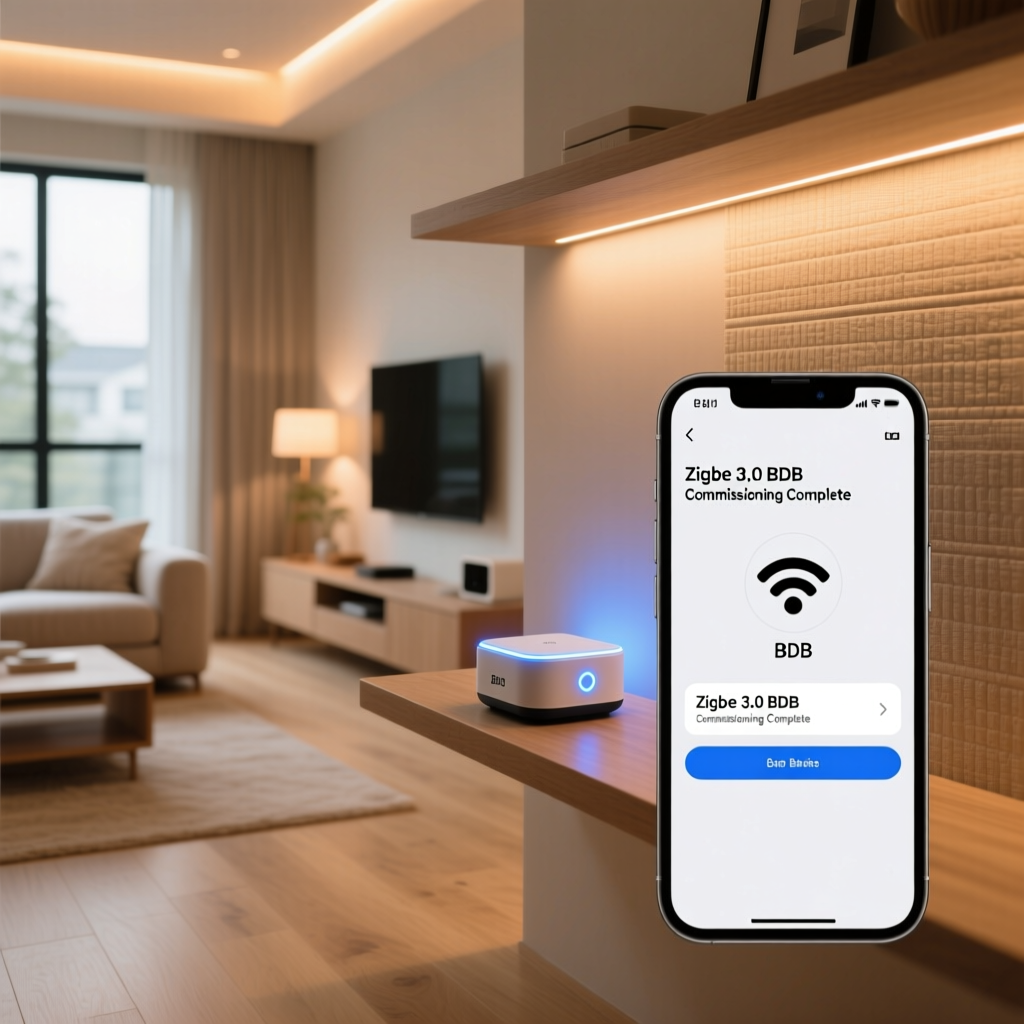
To achieve Zigbee 3.0 certification, a device must comply with BDB, which standardizes how devices join a network, how they form mesh routes, and how they handle touchlink commissioning. Certification labs test 'Green Power' compliance, ensuring that energy-harvesting switches (like battery-less wall switches) can securely proxy their signals through mains-powered Zigbee routers without causing network congestion. If a device fails to properly update its routing tables when a neighboring router is unplugged, it will fail the certification process.
The Hidden Costs of Non-Certified Devices
It can be tempting to save $10 by purchasing a non-certified smart plug or motion sensor from an online marketplace. However, the hidden costs of these uncertified devices often manifest in network instability and security vulnerabilities.
| Feature | Certified Device (e.g., Matter/Z-Wave Plus v2) | Non-Certified / Generic Device |
|---|---|---|
| Mesh Routing | Actively routes traffic, heals network paths, and drops gracefully. | May hoard routing tables, causing 'black holes' where commands are lost. |
| Security | Mandatory AES-128 encryption, secure boot, and OTA update validation. | Often transmits pairing tokens in plain text; vulnerable to replay attacks. |
| Interoperability | Guaranteed to work with all compliant hubs and controllers. | May require proprietary cloud bridges or specific hub firmware versions. |
| RF Interference | Tested to avoid spectrum bleeding into Wi-Fi or Bluetooth channels. | Poor shielding can degrade local Wi-Fi performance and drop connections. |
Uncertified mesh devices are notorious for 'network poisoning.' Because they do not adhere to the strict routing algorithms mandated by certification labs, they may endlessly bounce packets back and forth, creating routing loops that crash the entire smart home hub. In a Z-Wave or Zigbee network, a single uncertified repeater can degrade the performance of 50+ certified devices.
Real-World Impact: Certified Hubs vs. Generic Bridges
The importance of certification extends beyond end-devices to the hubs and border routers that manage them. Consider the difference between an Apple TV 4K (a certified Matter Controller and Thread Border Router) and a generic, uncertified Tuya Wi-Fi hub.
The Apple TV 4K undergoes rigorous CSA testing to ensure its Thread Border Router implementation correctly translates Thread mesh traffic to your home's IP network without introducing latency or dropping packets. It securely stores your Matter fabric credentials in a dedicated Secure Enclave. Conversely, a generic hub may rely on cloud-dependent processing, introducing a 500ms to 2-second delay in automation execution, and storing your encryption keys on an unsecured external server. When building a smart home, investing $100-$150 in a certified hub (like the Aeotec Smart Home Hub for Z-Wave, or the HomePod Mini for Matter/Thread) provides a foundation of reliability that cheap alternatives simply cannot match.
How to Verify Device Compliance Before You Buy
Marketing materials can be deceptive. A box might say 'Matter Ready' or 'Z-Wave Compatible,' which are legally distinct from 'Certified.' Here is how you can verify a device's compliance before handing over your credit card:
- Check the CSA Certified Products Database: The Connectivity Standards Alliance maintains a public, searchable database of every certified Matter and Zigbee product. If the device or its specific model number is not listed, it has not passed official testing.
- Look for the Setup QR Code: Certified Matter devices must feature a specific Matter Setup QR code on the device itself and the packaging. This code contains the cryptographic discriminator and setup payload required for secure commissioning.
- Verify the Z-Wave Plus v2 Badge: Look for the specific 'Z-Wave Plus v2' logo, which features a distinct '2' or 'LR' (for Long Range). Older 'Z-Wave Plus' (v1) devices are still good, but v2 guarantees S2 security and SmartStart compatibility.
- Read the Technical Specifications: Certified devices will explicitly list their security frameworks (e.g., 'Matter 1.2 Compliant,' 'Zigbee 3.0 BDB Certified,' or 'Z-Wave S2 Security'). If the spec sheet only mentions '2.4GHz Wi-Fi' or 'Proprietary RF,' it lacks protocol certification.
Conclusion: Paying the Certification Premium
Protocol certification is the invisible backbone of a reliable, secure, and truly automated smart home. While certified devices from brands like Eve, Philips Hue, Aeotec, and Nanoleaf often carry a slight price premium compared to uncertified alternatives, that cost directly funds the rigorous laboratory testing, security audits, and interoperability guarantees that protect your home. By understanding what the logos truly mean and taking the time to verify compliance, you can build a smart home ecosystem that works seamlessly, securely, and reliably for years to come.