The Smart Home Crossroads: Legacy Reliability vs. The New Standard
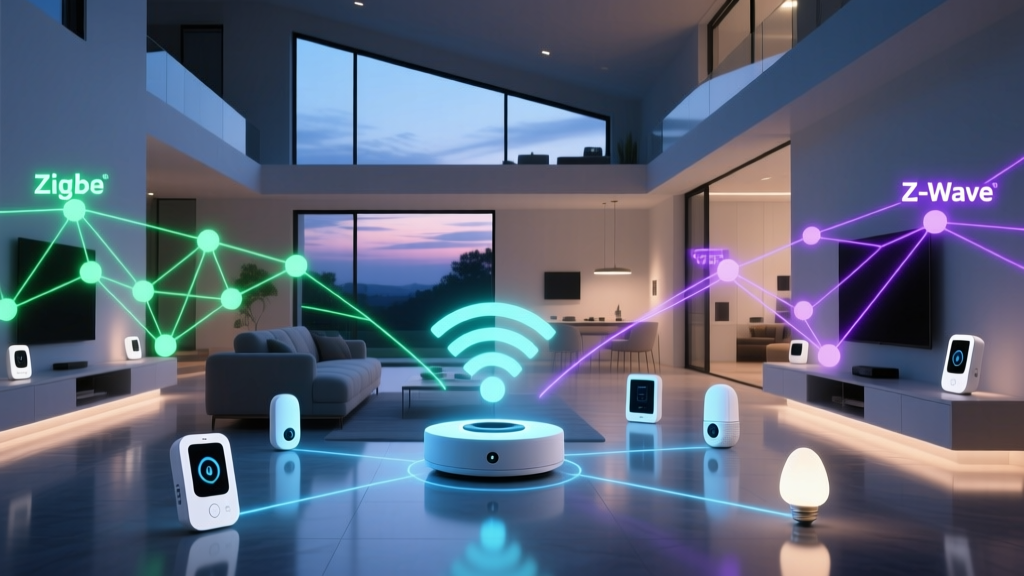
Building a connected home today means navigating a labyrinth of wireless protocols. For years, DIY enthusiasts and professional installers alike relied on a fragmented ecosystem of proprietary hubs and competing standards. Today, the smart home landscape is dominated by a massive transitional shift: the battle between the established, battle-tested reliability of Z-Wave and the highly anticipated, industry-backed promise of Matter. As a smart home architect or an avid DIYer, choosing between Z-Wave and Matter is not just about picking a brand; it is about selecting the foundational nervous system of your home automation. In this comprehensive guide, we will break down the technical specifications, real-world reliability, ecosystem compatibility, and cost considerations of Z-Wave versus Matter to help you decide which protocol deserves a spot in your smart home rack.
Understanding Z-Wave: The Veteran of Smart Home Automation
Z-Wave is a proprietary, low-energy wireless communication protocol designed specifically for home automation. Originally developed in the early 2000s, it has evolved through multiple generations, currently peaking with the 800-series chips. Unlike Wi-Fi or Bluetooth, Z-Wave operates on a sub-GHz frequency—specifically 908.42 MHz in North America and 868.42 MHz in Europe. This lower frequency is the secret to Z-Wave's legendary reliability, as it completely bypasses the notoriously congested 2.4 GHz spectrum that plagues Wi-Fi, Bluetooth, and Zigbee networks.
Z-Wave utilizes a mesh network topology. Every mains-powered Z-Wave device (like a smart plug or a wired light switch) acts as a signal repeater, extending the network's range and creating redundant pathways for data to travel. According to the Z-Wave Alliance Specification, the protocol mandates strict interoperability. If a device carries the Z-Wave certification logo, it is guaranteed to work with any Z-Wave hub, regardless of the manufacturer. This backward compatibility is a hallmark of the protocol, meaning a Z-Wave sensor purchased in 2014 will still seamlessly integrate with a modern 800-series hub today.
Furthermore, Z-Wave's latest iteration introduces Z-Wave Long Range (ZWLR). This enhancement utilizes a star topology alongside the traditional mesh, allowing a single hub to communicate with devices up to a mile away in line-of-sight conditions, while supporting up to 4,000 nodes on a single network. For large estates or properties with detached garages, ZWLR is a game-changer that solidifies Z-Wave's position in the market. You can explore the hardware capabilities driving these features via the Silicon Labs Z-Wave Portfolio.
Understanding Matter: The Industry's Great Unifier
Matter is not a wireless radio frequency in the traditional sense; rather, it is an application-layer protocol that runs on top of existing networking technologies, primarily Thread and Wi-Fi. Launched by the Connectivity Standards Alliance (CSA)—a consortium that includes Apple, Amazon, Google, and Samsung—Matter was created to solve the smart home's biggest pain point: fragmented ecosystems and walled gardens.
Before Matter, an Apple HomeKit user often could not use a device designed exclusively for Amazon Alexa. Matter changes this by providing a unified language. A Matter-certified device can be controlled simultaneously by an Apple HomePod, an Amazon Echo, and a Google Nest Hub. Under the hood, Matter relies heavily on Thread for low-power devices (like sensors and smart locks) and Wi-Fi for high-bandwidth devices (like smart displays and cameras). Thread is an IP-based, low-power mesh networking protocol that operates on the 2.4 GHz spectrum, offering fast local response times and self-healing mesh capabilities similar to Z-Wave, but built on open internet standards (IPv6).
Because Matter is built on IP (Internet Protocol), it integrates natively with modern network infrastructure, making it highly attractive to IT professionals and networking enthusiasts. However, because it relies on the 2.4 GHz band for Thread and Wi-Fi, it must compete for airtime with your home's wireless routers, Bluetooth devices, and even microwave ovens.
Head-to-Head Technical Comparison
| Feature | Z-Wave (800 Series) | Matter (over Thread) | Matter (over Wi-Fi) |
|---|---|---|---|
| Frequency | Sub-GHz (908.42 MHz US) | 2.4 GHz | 2.4 / 5 / 6 GHz |
| Topology | Mesh / Star (ZWLR) | IPv6 Mesh | Star (via Router) |
| Max Range (Indoor) | ~100m (300+ ft) per hop | ~30m (100 ft) per hop | Depends on Wi-Fi AP |
| Max Network Nodes | 232 (Up to 4000 via ZWLR) | 250+ per Thread partition | Depends on Wi-Fi Router |
| Power Consumption | Ultra-Low (Years on coin cell) | Low (Months/Years on battery) | High (Mains power required) |
| Ecosystem Lock-in | None (Hub agnostic) | None (Multi-admin enabled) | None (Multi-admin enabled) |
Range, Reliability, and the 2.4 GHz Congestion Problem
When evaluating smart home protocols, range and reliability are paramount. A smart lock that fails to connect when you are standing on your porch, or a motion sensor that takes three seconds to trigger a hallway light, quickly destroys the "smart" illusion. Here, Z-Wave's sub-GHz frequency provides a distinct physics-based advantage. Lower frequencies penetrate solid objects—like drywall, brick, and metal siding—much more effectively than higher frequencies. In a sprawling, multi-story home with dense building materials, a Z-Wave mesh network will generally require fewer repeaters to maintain a stable connection compared to a Thread network.
Furthermore, Z-Wave operates in a relatively quiet spectrum. The 2.4 GHz band, which Thread and Wi-Fi rely upon, is heavily saturated. Between your neighbors' Wi-Fi networks, wireless earbuds, baby monitors, and Bluetooth peripherals, the 2.4 GHz airwaves are crowded. While Thread utilizes IEEE 802.15.4 (which has different channel spacing than Wi-Fi) to mitigate some interference, it is still fundamentally sharing the same crowded airspace. Z-Wave's dedicated frequency ensures that your security sensors and smart switches are virtually immune to interference from your home theater's Bluetooth speakers or a congested neighborhood Wi-Fi environment.
The Hub Dilemma: Ecosystems and Border Routers
Neither Z-Wave nor Matter operates entirely without a central coordinator, though their approaches differ. Z-Wave requires a dedicated Z-Wave controller (hub). Popular options include the Hubitat Elevation, Samsung SmartThings, and Home Assistant with a Z-Wave USB dongle (like the Zooz ZST39). The hub manages the mesh network, stores device configurations, and executes local automations. The beauty of Z-Wave is that the controller speaks a single, unified language. You buy a Zooz switch and an Aeotec sensor, add them to your Hubitat hub, and they work together instantly.
Matter, on the other hand, requires a "Border Router" if you are using Thread devices, or a standard Wi-Fi router for Wi-Fi devices. The catch with Matter is that the border router is usually embedded inside a smart speaker or display. For example, an Apple HomePod Mini, an Amazon Echo (4th Gen), and a Google Nest Hub Pro all act as Thread border routers. However, cross-platform Thread mesh routing is still maturing. A Thread device connected to an Apple HomePod might not seamlessly use an Amazon Echo as a repeater. This fragmentation at the network layer can occasionally lead to localized mesh weaknesses if you rely on a mixed ecosystem of smart speakers to blanket your home in Thread coverage.
Protocol Performance Metrics Comparison
Top Devices and Cost Considerations
Z-Wave Devices: The Z-Wave market is mature, meaning you have access to thousands of highly specialized, reliable devices. Brands like Zooz, Inovelli, and Aeotec dominate the space. The Zooz ZEN76 S2 On/Off Switch (approx. $14) is a staple for DIYers, offering robust mesh repeating and customizable LED indicators. For advanced lighting control, the Inovelli Blue Series 2-in-1 Switch (approx. $70) supports Z-Wave (and Zigbee variants) with advanced scene control and notification LEDs. Security systems like the Ring Alarm Pro also utilize Z-Wave for all door/window sensors and keypads, capitalizing on the protocol's low latency and high penetration. Z-Wave devices typically carry a slight premium ($15 to $80 per device) due to the licensing and certification costs associated with Silicon Labs' proprietary chips.
Matter Devices: Matter is rapidly expanding, particularly in lighting, smart plugs, and environmental sensors. The Eve Energy Smart Plug (approx. $40) is a premier Matter-over-Thread device that provides real-time energy monitoring and works natively with Apple, Amazon, and Google. Nanoleaf has fully embraced Matter for its smart lighting lines, allowing complex Thread-based lighting arrays to sync across platforms. For hubs and bridges, the Aqara Hub M3 (approx. $100) acts as a powerful Matter controller and Thread border router, bridging older Zigbee sensors into the new Matter ecosystem. Matter devices range widely in price, from $15 smart plugs to $250 smart locks, but early-adopter pricing can sometimes be higher than legacy equivalents.
The Verdict: Which Protocol Wins?
Choosing between Z-Wave and Matter is not necessarily an "either/or" decision; modern hubs like Home Assistant and SmartThings support both simultaneously. However, if you are prioritizing your next wave of device purchases, here is the actionable advice:
Choose Z-Wave if: You live in a large home or a property with dense walls (brick, stucco, concrete). You are building a critical security system (door locks, glass break sensors, garage tilt sensors) where 2.4 GHz interference is unacceptable. You want a mature ecosystem with thousands of specialized, niche devices (like motorized gas valves, water leak shutoffs, and HVAC wire savers) that do not yet have Matter equivalents.
Choose Matter if: You are starting fresh in a smaller, modern home and want the flexibility to switch between Apple, Google, and Amazon ecosystems without replacing your devices. You prioritize IP-based networking, local API integrations, and high-bandwidth devices. You want to future-proof your home with the backing of the world's largest tech conglomerates.
Ultimately, Z-Wave remains the undisputed king of low-interference, long-range reliability for sensors and security. Matter represents the future of cross-platform interoperability and IP-based smart home architecture. By leveraging Z-Wave for your critical infrastructure and Matter for your everyday smart accessories and lighting, you can build a resilient, responsive, and truly unified smart home.