The Elephant in the Smart Home: Matter vs. Zigbee
When the Connectivity Standards Alliance (CSA) introduced Matter, a wave of panic rippled through the smart home community. Enthusiasts and casual users alike wondered if their existing Zigbee devices would become obsolete overnight. The narrative was clear: Thread and Wi-Fi were the chosen network layers for Matter, leaving Zigbee out in the cold. However, as the dust settles and Matter begins its slow, methodical rollout across the consumer market, a different reality has emerged. Zigbee is not dead; in fact, it remains one of the most robust, reliable, and cost-effective protocols in the smart home ecosystem.
To understand why Zigbee remains highly relevant, we must first distinguish between an application layer and a network layer. Matter is an application layer—a universal language that allows devices from different brands to communicate. Thread and Wi-Fi are the transport mechanisms (network layers) that carry this language. Zigbee, on the other hand, is a complete, mature ecosystem with its own application and network layers, built on the IEEE 802.15.4 standard. While native Matter-over-Zigbee does not exist, the concept of 'Matter Bridging' ensures that your Zigbee network can seamlessly integrate into a Matter controller, future-proofing your investment.
Why Zigbee Isn't Going Anywhere
The primary reason Zigbee continues to thrive is its massive installed base and unmatched market penetration in specific device categories. According to the Connectivity Standards Alliance, billions of Zigbee-certified products have shipped over the last decade. This isn't just a legacy statistic; it represents a deeply entrenched supply chain that produces incredibly cheap, highly efficient silicon.
The Power Consumption Advantage
When it comes to battery-powered sensors—such as door/window contacts, motion detectors, and temperature monitors—Zigbee is practically untouchable. While Thread (which also uses the IEEE 802.15.4 radio) boasts similar low-power credentials, the current generation of Thread routers and border routers can be power-hungry, and the Thread mesh routing protocol can sometimes cause battery drain on end devices during network instability. Zigbee's asymmetric mesh architecture, where 'End Devices' sleep for extended periods and rely on 'Routers' (mains-powered devices) to hold messages for them, guarantees multi-year battery life on a single CR2032 coin cell.
Cost and Component Availability
Manufacturing a Zigbee module is significantly cheaper than a Wi-Fi or Thread module. Brands like Sonoff, ThirdReality, and Moes can produce Zigbee temperature sensors and smart plugs that retail for $10 to $15. Comparable Thread or Wi-Fi devices often cost two to three times as much. For users outfitting an entire home with 30+ sensors, this price differential is the deciding factor.
Technical Deep Dive: Mesh, Speed, and Security
Zigbee operates primarily on the 2.4 GHz radio frequency band (with some regional sub-GHz variants like Zigbee Pro Green Power). It offers a maximum data rate of 250 kbps. While this sounds glacial compared to Wi-Fi, smart home commands—like 'turn on the light' or 'motion detected'—require only a few bytes of data. The low bandwidth requirement is exactly what allows Zigbee to minimize power draw and reduce network congestion.
The Mesh Network Architecture
A Zigbee network consists of three types of devices:
- Coordinator: The brain of the network (e.g., your Philips Hue Bridge or Sonoff USB Dongle). There is only one per network, and it handles security keys and network formation.
- Routers: Mains-powered devices like smart plugs and hardwired light bulbs. They repeat signals, extending the mesh range and storing messages for sleeping end devices.
- End Devices: Battery-powered sensors that sleep to conserve energy and communicate only through Routers or the Coordinator.
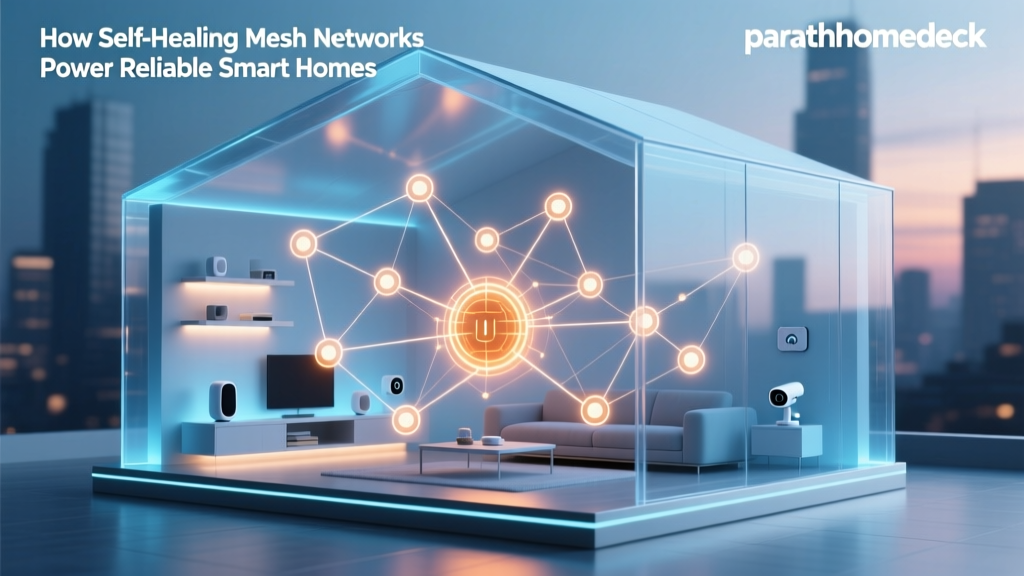
This self-healing mesh means that if one router fails or loses power, the network automatically recalculates the optimal path for data packets, ensuring high reliability.
Security: AES-128 Encryption
Security is often a concern with wireless protocols, but Zigbee 3.0 mandates robust encryption. It utilizes 128-bit Advanced Encryption Standard (AES-128) symmetric key cryptography, the same standard approved by the National Institute of Standards and Technology (NIST) for securing classified government information. Zigbee networks use a combination of a Network Key (shared by all devices to encrypt general traffic) and Link Keys (unique keys shared between the Coordinator and individual devices for secure joining and application-level commands).
Zigbee vs. Thread vs. Wi-Fi: A Feature Comparison
To contextualize where Zigbee fits in the modern landscape, here is a direct comparison of the top smart home wireless protocols.
| Feature | Zigbee 3.0 | Thread (Matter) | Wi-Fi (Matter) |
|---|---|---|---|
| Underlying Standard | IEEE 802.15.4 | IEEE 802.15.4 | IEEE 802.11 |
| Frequency Band | 2.4 GHz | 2.4 GHz | 2.4 / 5 / 6 GHz |
| Topology | Mesh | Mesh | Star (via Router) |
| Data Rate | 250 kbps | 250 kbps | Up to Wi-Fi 7 speeds |
| Power Consumption | Ultra-Low | Low to Ultra-Low | High |
| Battery Sensor Life | 1 - 3+ Years | 1 - 2 Years | Weeks to Months |
| Native Matter Support | No (Requires Bridge) | Yes | Yes |
Bridging the Gap: Integrating Zigbee into Modern Hubs
The lack of native Matter support on Zigbee devices is easily solved by 'Matter Bridges.' A bridge is a hub that translates Zigbee commands into Matter commands, exposing your Zigbee devices to Apple Home, Google Home, and Alexa as if they were native Matter devices.
Philips Hue: Signify has rolled out firmware updates to the Philips Hue Bridge, turning it into a Matter bridge. This means your entire Zigbee lighting network can be controlled natively via Matter controllers, complete with advanced lighting scenes.
Aqara Hubs: The Aqara Hub M2 and M3 act as robust Matter bridges, bringing Aqara's extensive line of Zigbee sensors and switches into the Matter ecosystem.
Home Assistant & Zigbee2MQTT: For the advanced enthusiast, using a platform like Home Assistant with the Zigbee2MQTT add-on provides ultimate control. While Home Assistant's native Matter server integration is still evolving, Zigbee2MQTT supports over 3,000 devices from hundreds of brands, bypassing proprietary hubs entirely and offering local, cloud-free automation with zero latency.
Top Zigbee Devices to Buy Today
If you are building or expanding a smart home today, Zigbee offers incredible value. Here are the top recommendations across various categories:
1. Philips Hue White and Color Ambiance (Lighting)
While expensive ($50 - $65 per bulb), Philips Hue bulbs are the gold standard for Zigbee lighting. They act as phenomenal mesh routers, feature instant physical switch response times via the Hue Dimmer Switch, and offer the best color accuracy in the industry. Cost Range: $25 (White) to $65 (Color Ambiance).
2. Aqara P1 Motion Sensor (Sensors)
The Aqara P1 is a marvel of engineering. It features an adjustable detection interval (a rarity in motion sensors) and a battery life that routinely exceeds 3 years on a single CR2450 battery. It requires an Aqara Hub or a Zigbee2MQTT coordinator. Cost: ~$25.
3. Sonoff SNZB-02D Temperature & Humidity Sensor
Sonoff dominates the budget Zigbee space. The SNZB-02D features a crisp LCD screen, accurate readings, and reliable mesh connectivity. It's perfect for monitoring server closets, greenhouses, or nurseries. Cost: ~$12.
4. ThirdReality Zigbee Smart Plug
Smart plugs are essential for adding dumb appliances to your smart home, and they also serve as vital Zigbee mesh routers. ThirdReality plugs are compact, reliable, and often available in multi-packs for as low as $12 per unit. Cost: ~$15.
Visualizing Protocol Efficiency
When selecting a protocol for battery-powered sensors, longevity is paramount. The chart below illustrates the average expected battery life of a standard door/motion sensor across different wireless protocols, highlighting Zigbee's dominance in low-power scenarios.
Practical Advice for Network Optimization
Zigbee's reliability is legendary, but it is not immune to physics. Because it operates on the 2.4 GHz band, it shares airspace with Wi-Fi, Bluetooth, and even microwave ovens. To ensure a bulletproof Zigbee network, follow these actionable optimization steps:
- Change Your Zigbee Channel: By default, many Zigbee coordinators ship on Channel 11, which directly overlaps with Wi-Fi Channels 1 and 2. Use a Wi-Fi analyzer app to find the least congested Wi-Fi channels in your home, and then set your Zigbee network to Channel 15, 20, or 25, which sit safely between standard Wi-Fi channels.
- Use a USB Extension Cable: If you are using a USB Zigbee coordinator (like the Sonoff Zigbee 3.0 USB Dongle Plus) with a Raspberry Pi or Intel NUC, never plug it directly into the motherboard. USB 3.0 ports generate massive amounts of 2.4 GHz radio frequency interference that can cripple a Zigbee network. Always use a 3-to-6-foot shielded USB extension cable to move the dongle away from the computer and elevate it for better line-of-sight.
- Build a Dense Mesh: Don't rely solely on the coordinator. Distribute Zigbee smart plugs and hardwired light switches evenly throughout your home to create a dense web of routers. This ensures that battery-powered end devices always have a nearby router to connect to, minimizing transmission power and extending battery life.
The Verdict: Should You Still Invest in Zigbee?
The short answer is an emphatic yes. While Matter and Thread represent the future of cross-brand interoperability and high-bandwidth smart home devices, the transition will take years, if not a decade. Thread is still maturing, dealing with border router handoff issues and limited device availability. Wi-Fi remains too power-hungry for the dozens of tiny sensors a modern smart home requires.
Zigbee, backed by the IEEE 802.15.4 standard and over a decade of silicon refinement, offers a proven, ultra-low-power, and highly affordable mesh network. Through the use of Matter Bridges and powerful local hubs like Home Assistant, your Zigbee devices will remain fully functional and integrated into your broader smart home ecosystem for years to come. In the Matter era, Zigbee isn't a relic; it's the reliable workhorse that keeps the smart home running.