Philips Hue Review: The Gold Standard of Smart Lighting
When building a connected home, the first category most people explore is smart lighting. It offers the most immediate visual impact, transforming the ambiance of a room with a simple voice command or automated schedule. At the very top of this market sits the Philips Hue ecosystem. For over a decade, Signify (the parent company of Philips Hue) has iterated on its platform, creating what many consider to be the undisputed king of smart illumination. But with a premium price tag that significantly outpaces budget Wi-Fi alternatives, is the Philips Hue system truly worth the investment?
In this comprehensive Philips Hue review, we will break down everything you need to know. From the intricacies of the Zigbee mesh network and the Hue Bridge to color accuracy, app usability, and deep smart home integrations, we will explore whether this ecosystem deserves a place in your home. For more options and comparisons, be sure to check out our extensive smart lighting guides.
Product Overview: The Hue Ecosystem
Philips Hue is not just a single light bulb; it is a massive, interconnected ecosystem of lighting products. The lineup includes standard A19 and BR30 bulbs, GU10 spotlights, LED lightstrips, portable lamps like the Hue Go, outdoor fixtures, and even specialized entertainment products like the Play HDMI Sync Box. The system is primarily divided into two tiers: White Ambiance (which offers tunable warm-to-cool white light) and White & Color Ambiance (which adds a full spectrum of millions of colors).
Unlike budget-friendly smart bulbs that connect directly to your home Wi-Fi router, the core of the Philips Hue experience relies on the Hue Bridge. This small, puck-shaped hub plugs into your router via Ethernet and communicates with the bulbs using the Zigbee protocol. This architectural choice is the secret sauce behind Hue's legendary reliability, creating a dedicated mesh network that operates independently of your Wi-Fi congestion.
Hardware Ecosystem and Build Quality
One of the most significant advantages of choosing Philips Hue is the sheer breadth of hardware available. While other brands might offer a standard bulb and a lightstrip, Hue provides a solution for nearly every socket and architectural feature in your home. You can find Hue bulbs in various lumen outputs, including standard 800-lumen bulbs, ultra-bright 1100-lumen options, and massive 1600-lumen bulbs designed for large living spaces or high ceilings.
The build quality of Hue products is exceptional. The bulbs feature robust heat sinks that efficiently dissipate warmth, which is crucial for the longevity of LED diodes. The Hue Lightstrip Plus is a standout product in this category, featuring a thick, high-quality adhesive backing and a silicone diffuser that eliminates the "hotspot" effect common in cheaper LED strips, resulting in a smooth, continuous ribbon of light. Furthermore, the Lightstrip can be cut to size and extended, offering unparalleled flexibility for under-cabinet and cove lighting installations.
Beyond bulbs and strips, Hue offers stunning standalone fixtures. The Hue Bloom, Hue Aura, and Ensis pendant lights serve as functional art pieces. The outdoor lineup, including the Lily spotlights and Calla bollards, is built with heavy-duty, weather-resistant materials that withstand harsh elements without degrading in color or performance. When you invest in Hue, you are investing in hardware that feels premium, substantial, and built to last.
Performance, Color Accuracy, and Brightness
Where Philips Hue truly justifies its premium pricing is in raw performance and optical quality. Independent testing consistently shows that Hue bulbs lead the pack in color accuracy and gamut volume. While budget RGB bulbs often struggle to produce deep, saturated greens or rich royal blues, the White & Color Ambiance bulbs render these hues beautifully. The color mixing is seamless, and the transition between colors is buttery smooth, free from the jarring stepping effects seen in lesser hardware.
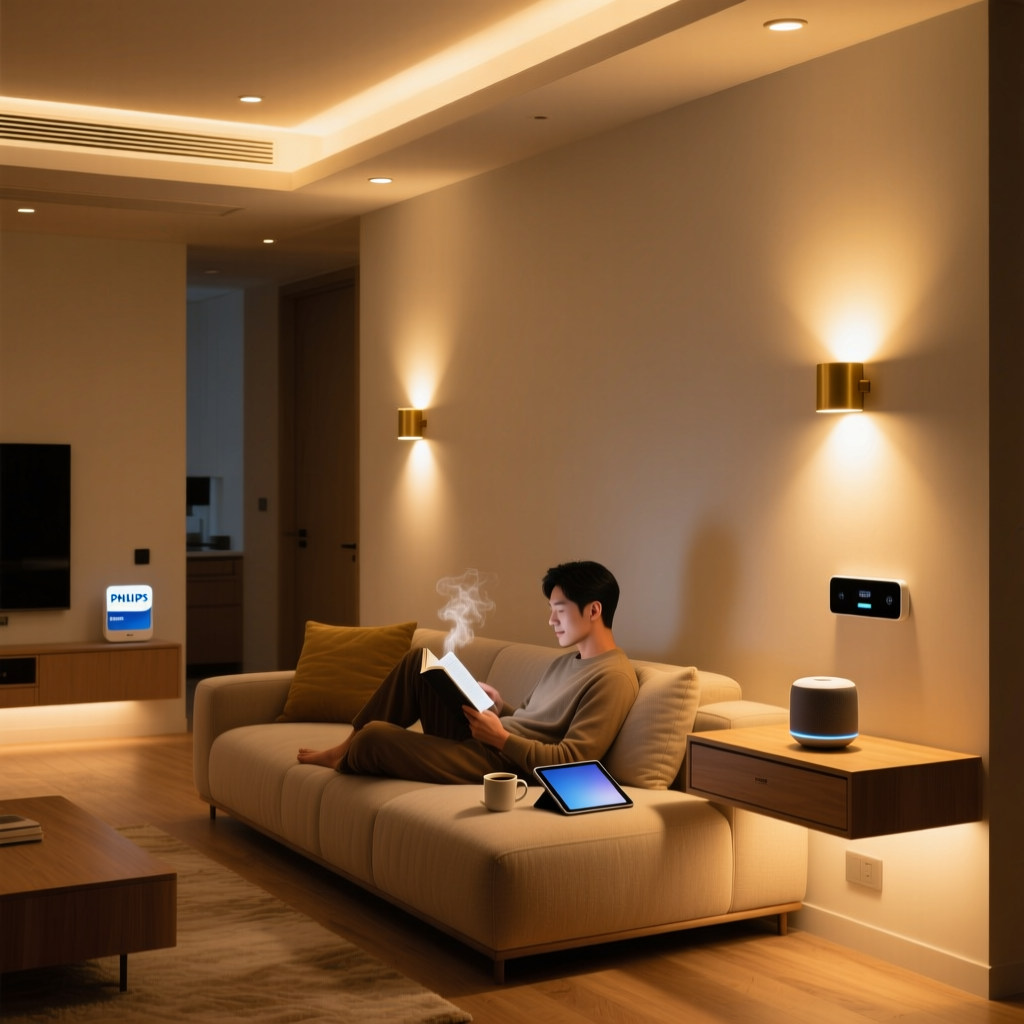
Brightness is another area of dominance. The availability of 1600-lumen bulbs means you can actually use Hue as your primary lighting source, not just as accent lighting. Furthermore, the dimming performance is stellar. Many smart bulbs suffer from Pulse Width Modulation (PWM) flicker when dimmed below 20%, which can cause eye strain and look terrible on camera. Philips Hue utilizes high-frequency dimming that remains completely flicker-free even at the lowest 1% brightness settings, making them ideal for bedroom wind-down routines and home theater environments.
For entertainment, the Hue Play HDMI Sync Box is a game-changer. It intercepts your TV's HDMI signal and analyzes the content in real-time, projecting the colors from your screen onto the walls behind it via Hue lightstrips or Play bars. The latency is virtually non-existent, creating an immersive, cinema-like experience that extends the boundaries of your screen into the room. Whether you are gaming or watching a blockbuster movie, the Sync Box reacts instantly to explosions, scene changes, and dynamic camera movements.
Setup Experience and App Usability
Setting up a Philips Hue system is remarkably straightforward, provided you follow the recommended path. The initial setup involves plugging the Hue Bridge into your router, downloading the Philips Hue app, and pressing the physical link button on the Bridge. The app instantly discovers the hub and guides you through adding your first bulbs. Because Zigbee is a low-power, mesh-networking protocol, adding subsequent bulbs is as simple as screwing them in and letting the Bridge find them. If you have a large home, every bulb you add actually strengthens the network, acting as a repeater to extend the range of the system.
It is worth noting that newer Hue bulbs also include Bluetooth, allowing for direct connection to your phone without the Bridge. However, this Bluetooth mode is severely limited. It restricts you to controlling only a handful of bulbs, limits your range to the same room, and disables advanced automations and out-of-home control. To unlock the true potential of the system, the Hue Bridge is an absolute necessity. If you are exploring central controllers for your broader setup, read our smart home hub reviews to see how the Hue Bridge integrates with larger systems.
The Philips Hue App is widely regarded as the best smart lighting interface on the market. It is visually appealing, intuitive, and packed with features. You can create "Rooms" and "Zones" to group lights logically. The automation engine is robust, allowing for complex routines based on time of day, sunrise/sunset, and geofencing (turning lights on when you arrive home and off when you leave). The app also features a "Natural Light" mode that subtly shifts the color temperature of your White Ambiance bulbs throughout the day to match the sun, promoting better circadian rhythms.
For power users, the open nature of the Hue Bridge API means there is a thriving community of third-party apps. Applications like iConnectHue (for iOS) and Hue Essentials offer even deeper customization, advanced scene creation, and widget support that surpasses the official app in certain niche scenarios.
Smart Home Ecosystem and Compatibility
A smart light is only as good as the ecosystem that controls it, and Philips Hue plays nicely with virtually everyone. The system offers native, first-class integrations with Amazon Alexa, Google Home, and Apple HomeKit. For Apple users, the Hue Bridge is a HomeKit powerhouse. It exposes all your Zigbee bulbs to HomeKit securely and reliably, and it even supports HomeKit Secure Video when paired with compatible Hue outdoor cameras, a rare feature in the lighting space.
Crucially, Philips Hue has fully embraced the Matter smart home standard. Through a firmware update, the Hue Bridge acts as a Matter bridge, securely exposing your entire Zigbee lighting network to Matter-compatible controllers like Apple TV, HomePod, and modern SmartThings hubs. This ensures that your investment is future-proofed. You no longer have to worry about proprietary walled gardens; your Hue lights can be seamlessly integrated into any Matter-based automation alongside devices from other brands. Learn more about the new standard in our Matter compatibility guide.
Beyond the major voice assistants, Hue integrates with Samsung SmartThings, IFTTT, and specialized systems like the Logitech Harmony remote ecosystem. The sheer volume of third-party software and hardware that supports the Hue API is unmatched, ensuring that no matter what smart home platform you migrate to in the future, your lights will be supported.
Pros and Cons
To summarize our findings, here is a quick breakdown of the strengths and weaknesses of the Philips Hue ecosystem.
Pros
- Unmatched Reliability: The Zigbee mesh network ensures lights respond instantly, even if your Wi-Fi goes down.
- Superior Light Quality: Excellent color accuracy, deep saturation, and flicker-free dimming down to 1%.
- Massive Hardware Lineup: From standard bulbs to outdoor spotlights and HDMI sync boxes, there is a product for every need.
- Broad Compatibility: Native support for HomeKit, Alexa, Google, and Matter ensures future-proofing.
- Best-in-Class App: The official app, alongside third-party alternatives, offers unparalleled control and automation.
Cons
- Premium Pricing: Hue products are significantly more expensive than Wi-Fi alternatives like Govee or Wyze.
- Bridge Requirement: To get the full experience, you must purchase and find ethernet space for the Hue Bridge.
- Ecosystem Lock-in: While Matter helps, some advanced Hue-specific features (like Entertainment Sync) only work within the proprietary Hue ecosystem.
Deck Score and Final Verdict
At Smart Home Deck, we evaluate products across five core dimensions to provide a balanced, objective score. Here is how Philips Hue stacks up against the competition.
Final Verdict: Philips Hue remains the gold standard for smart lighting. While the initial buy-in is steep, the unparalleled reliability, stunning light quality, and deep ecosystem integrations make it a worthwhile investment for anyone serious about home automation. It is a "buy once, cry once" system that will serve you flawlessly for years to come.
Frequently Asked Questions
Do I need the Philips Hue Bridge?
Technically, no, but practically, yes. Modern Hue bulbs feature Bluetooth, allowing you to control them directly from your phone without a hub. However, Bluetooth is limited to about 10 bulbs, requires you to be in the same room, and disables out-of-home control and advanced automations. To unlock the full power of the Zigbee mesh network, remote access, and smart home integrations, the Hue Bridge is an absolute necessity.
Are Philips Hue bulbs worth the high price?
If you value reliability and light quality, yes. Budget Wi-Fi bulbs often suffer from network congestion, delayed response times, poor color accuracy, and visible flickering when dimmed. Philips Hue bulbs are engineered to last for tens of thousands of hours, maintain perfect color consistency across multiple bulbs, and operate on a dedicated network that won't slow down your home Wi-Fi. The premium price buys you a premium, frustration-free experience.
Does Philips Hue work with Matter?
Yes. Signify has rolled out firmware updates for the Hue Bridge that enable it to act as a Matter bridge. This means your Zigbee-based Hue lights can be securely exposed to any Matter-compatible smart home platform, including Apple Home, Google Home, Amazon Alexa, and Samsung SmartThings, ensuring your system is fully future-proofed.
Can I use Philips Hue outdoors?
Absolutely. Philips Hue offers a dedicated line of outdoor smart lighting, including path lights, wall lanterns, and spotlights. These fixtures are rated for wet and damp locations (IP65 and IP67 ratings) and are built with heavy-duty materials to withstand rain, snow, and extreme temperatures. They integrate seamlessly into your indoor Hue app, allowing you to create unified indoor-outdoor lighting scenes.