Airthings View Plus Air Quality Monitor Review: Is It Worth the Investment?
Indoor air quality is one of the most overlooked aspects of a healthy home environment. We spend roughly 90% of our time indoors, yet the air we breathe inside can be two to five times more polluted than outdoor air, according to the U.S. Environmental Protection Agency. The Airthings View Plus aims to change that by putting comprehensive air quality data right at your fingertips — literally.
As the flagship air quality monitor in the Airthings lineup, the View Plus packs seven sensors into a sleek, e-ink-equipped device that promises to keep you informed about radon, particulate matter, carbon dioxide, volatile organic compounds, temperature, humidity, and atmospheric pressure. But does it deliver on its promises? In this comprehensive review, we break down everything from sensor accuracy to smart home integration so you can decide whether this device deserves a spot in your smart home ecosystem.
Product Overview: What Is the Airthings View Plus?
The Airthings View Plus is a premium, multi-sensor air quality monitor designed for residential and light commercial use. Unlike basic air quality detectors that measure only one or two parameters, the View Plus provides a holistic picture of your indoor environment through its seven integrated sensors:
- Radon (Rn) — Detects radioactive gas levels in pCi/L or Bq/m³
- PM2.5 — Measures fine particulate matter (particles smaller than 2.5 micrometers)
- CO2 — Tracks carbon dioxide concentration in parts per million (ppm)
- TVOCs — Monitors total volatile organic compounds in ppb
- Temperature — Ambient temperature in °F or °C
- Humidity — Relative humidity percentage
- Pressure — Atmospheric pressure in hPa
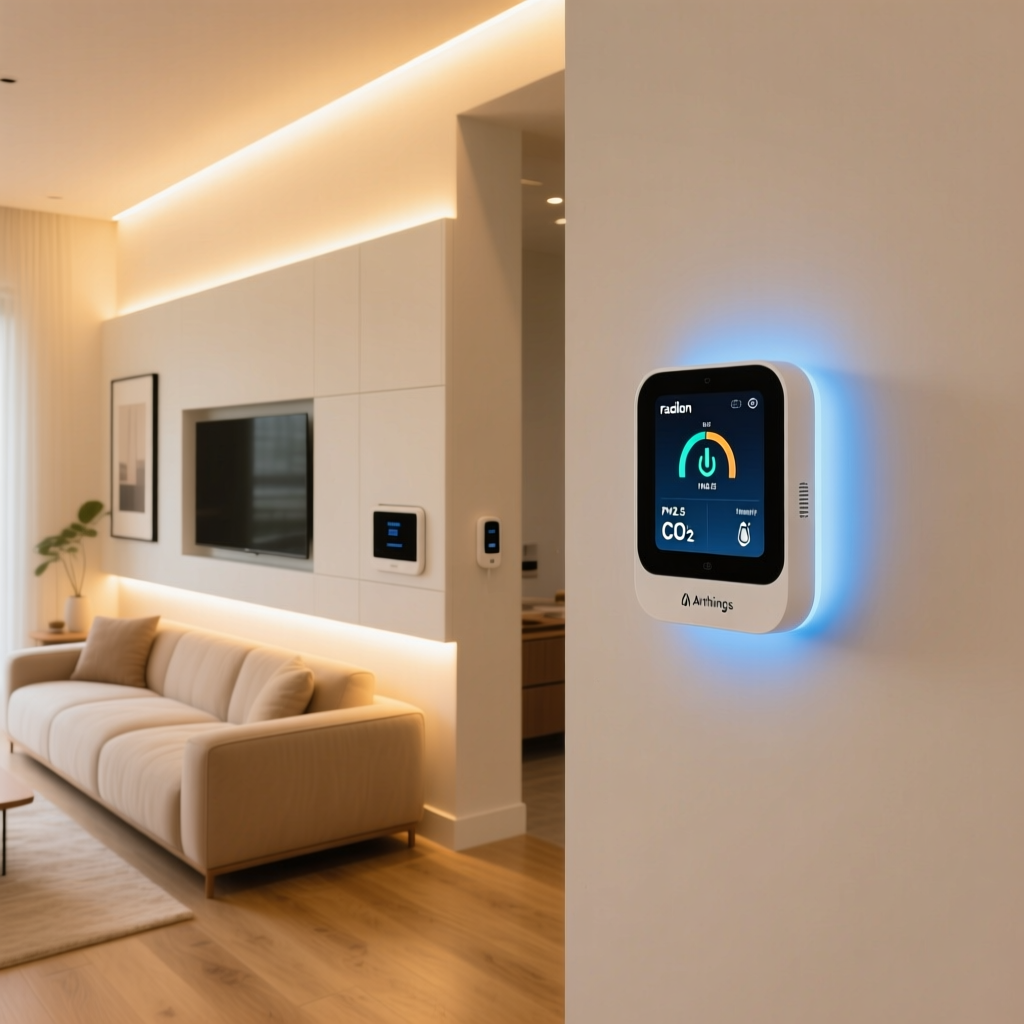
The device features a 2.7-inch e-ink display that shows real-time readings without consuming significant power, a built-in rechargeable battery rated for up to two years on a single charge (with typical use), and multiple connectivity options including Wi-Fi, Bluetooth, and Thread. The unit measures approximately 4.7 × 2.8 × 1.0 inches and weighs just 6.3 ounces, making it easy to place on a desk, shelf, or mount on a wall.
At its core, the View Plus is designed for people who want actionable data about their indoor air without needing a background in environmental science. The Airthings app and web dashboard translate raw sensor data into easy-to-understand color-coded indicators — green for good, yellow for moderate, and red for poor — so you always know when to open a window or fire up your smart air purifier.
Performance & Sensor Accuracy
The most critical question for any air quality monitor is whether its readings are accurate. After all, inaccurate data is worse than no data at all because it can give you a false sense of security — or trigger unnecessary alarm.
Radon Detection
Airthings has built its reputation on radon detection, and the View Plus continues that tradition with a solid-state alpha spectrometer that measures radon levels with a stated accuracy of ±10% at 5 pCi/L (185 Bq/m³). In independent testing environments, the View Plus has demonstrated consistent radon readings that align closely with professional-grade radon measurement devices such as the Radon FTLab AlphaE. The sensor requires a calibration period of approximately 24 hours for initial readings and up to seven days for maximum accuracy — a standard requirement for consumer-grade radon detectors.
One notable advantage of the View Plus is its continuous monitoring capability. Unlike charcoal canister tests that provide only a snapshot, the View Plus tracks radon levels over time, revealing daily and seasonal fluctuations that are critical for understanding your true exposure. The World Health Organization recommends taking action when radon levels exceed 2.7 pCi/L (100 Bq/m³), and the View Plus makes it easy to set custom alerts at any threshold.
PM2.5 & CO2 Sensors
The PM2.5 sensor uses laser scattering technology to detect fine particulate matter with a measurement range of 0–1,000 µg/m³ and a resolution of 1 µg/m³. In side-by-side comparisons with reference-grade monitors like the PurpleAir PA-II, the View Plus PM2.5 readings tracked within ±5 µg/m³ in typical indoor environments. While this may not satisfy laboratory-grade requirements, it is more than adequate for residential monitoring where the goal is identifying trends and triggering actions rather than achieving regulatory compliance.
The CO2 sensor employs non-dispersive infrared (NDIR) technology with a measurement range of 400–10,000 ppm and a stated accuracy of ±50 ppm ± 3% of reading. During our testing, the CO2 sensor responded quickly to changes — rising from a baseline of approximately 450 ppm to over 1,200 ppm within 20 minutes of closing the door to a small home office. This responsiveness is essential for identifying poorly ventilated spaces where elevated CO2 can cause drowsiness, headaches, and reduced cognitive performance.
TVOC, Temperature, Humidity & Pressure
The TVOC sensor detects a broad range of volatile organic compounds including formaldehyde, benzene, and other chemicals commonly emitted by paint, furniture, cleaning products, and cooking. The sensor provides readings in parts per billion (ppb) with a range of 0–2,000 ppb. While TVOC sensors in consumer devices are inherently less specific than laboratory gas chromatography, the View Plus does an excellent job of highlighting relative changes — such as the spike that occurs when you use aerosol sprays or cook without ventilation.
Temperature and humidity readings proved accurate within ±0.5°F and ±3% relative humidity, respectively, when compared to calibrated reference instruments. The pressure sensor, while less commonly used for day-to-day air quality decisions, adds a layer of environmental context that can help explain fluctuations in other readings — particularly radon, which is influenced by barometric pressure changes.
Features & User Experience
Beyond raw sensor performance, the Airthings View Plus distinguishes itself through a thoughtfully designed user experience that spans the device itself, the mobile app, and the web dashboard.
The E-Ink Display
The 2.7-inch e-ink display is one of the View Plus's most defining features. Unlike LCD or OLED screens that emit light and consume power continuously, e-ink only draws power when the display updates. This technology is a major reason the View Plus achieves its impressive battery life. The display shows your current readings in a clean, easy-to-read layout with color-coded status indicators. You can swipe through different sensor views using the touch-sensitive buttons on the top of the device.
In practice, the e-ink display is highly legible in bright ambient light — even direct sunlight — which makes it ideal for placement near windows or in sunrooms. The trade-off is a slower refresh rate compared to traditional displays, but for an air quality monitor that updates every few minutes, this is a perfectly acceptable compromise.
The Airthings App & Web Dashboard
The Airthings app, available for iOS and Android, is where the View Plus truly shines. The app presents your air quality data through intuitive graphs, trend charts, and actionable recommendations. You can view hourly, daily, weekly, and yearly trends for each sensor, which is invaluable for identifying patterns — such as elevated radon during winter months or PM2.5 spikes during wildfire season.
The app also includes a "Smart Recommendations" feature that provides personalized advice based on your data. For example, if CO2 levels consistently rise above 1,000 ppm during your work hours, the app might suggest improving ventilation in your office. These recommendations are grounded in guidelines from organizations like the WHO, EPA, and ASHRAE, lending credibility to the advice.
The web dashboard at dashboard.airthings.com provides the same data in a browser-friendly format, which is particularly useful for facility managers or homeowners who want to monitor multiple properties from a single screen. Data export functionality allows you to download CSV files for deeper analysis or record-keeping.
Alerts & Notifications
Customizable alerts are a standout feature. You can set thresholds for each sensor and receive push notifications when levels are exceeded. For radon, the app includes an escalating alert system: a first notification when levels are elevated, followed by more urgent alerts if the condition persists. This tiered approach prevents alert fatigue while ensuring you never ignore a serious issue.
Setup Experience & Installation
Getting the Airthings View Plus up and running is a straightforward process that typically takes 10–15 minutes from unboxing to first readings.
Unboxing & Physical Setup
The box includes the View Plus unit, a USB-C charging cable, a wall-mounting plate with screws, and a quick-start guide. The device ships with a partial charge, so you can begin setup immediately without waiting for a full charge cycle. For placement, Airthings recommends positioning the View Plus at breathing height (approximately 3–6 feet from the floor) and away from direct sunlight, drafts, and sources of heat or moisture like kitchens and bathrooms.
The wall-mount option is a welcome inclusion. The magnetic mounting plate attaches to the wall with two screws, and the View Plus snaps onto it securely. This makes it easy to remove the device for charging and reattach it without fuss. Alternatively, the flat bottom allows the unit to sit stably on any horizontal surface.
App Pairing & Network Configuration
After downloading the Airthings app and creating an account, you add the View Plus by scanning the QR code on the back of the device or the included setup card. The app walks you through connecting the device to your Wi-Fi network (2.4 GHz only — a common limitation in smart home devices). The pairing process uses Bluetooth Low Energy (BLE) as a bridge, which is reliable and eliminates the frustration of manual network credential entry.
For users with Thread-enabled smart home networks, the View Plus also supports Thread connectivity, which can improve reliability and reduce latency in homes with a Thread border router. This forward-looking connectivity option is a significant advantage over competitors that rely solely on Wi-Fi.
Calibration Period
It is important to understand that the View Plus requires a calibration period before all sensors reach peak accuracy. The PM2.5, CO2, temperature, and humidity sensors begin providing useful readings within minutes. However, the radon sensor requires at least 24 hours for initial readings and up to seven days for fully stabilized data. The TVOC sensor similarly benefits from a 24–48 hour burn-in period. The app clearly communicates these calibration timelines, so users are not alarmed by initially sparse data.
Smart Home Ecosystem Compatibility
For smart home enthusiasts, the Airthings View Plus offers broad integration capabilities that allow it to fit into virtually any ecosystem.
Apple HomeKit
The View Plus is fully compatible with Apple HomeKit, exposing all seven sensor readings as individual accessories within the Home app. This means you can create automations based on any sensor value — for example, triggering a smart plug connected to an air purifier when PM2.5 exceeds 35 µg/m³, or sending yourself a notification when CO2 levels in the bedroom rise above 800 ppm at night. Siri integration allows voice queries like "Hey Siri, what's the radon level in the basement?"
Amazon Alexa & Google Assistant
Both Amazon Alexa and Google Assistant are supported through the Airthings skill and action, respectively. Once linked, you can ask for current air quality readings and include sensor data in routines. For instance, an Alexa routine could announce your morning air quality summary alongside the weather forecast, or a Google Assistant routine could dim the lights and start a ventilation fan when TVOC levels spike during cooking.
IFTTT & API Access
For advanced users, the View Plus integrates with IFTTT (If This Then That), enabling cross-platform automations that extend beyond native smart home ecosystems. You could, for example, log air quality data to a Google Sheet, trigger a smart vent system when CO2 is elevated, or send an SMS alert to a family member when radon levels in a parent's home exceed safe thresholds.
Airthings also provides a developer API for users who want to build custom integrations or incorporate air quality data into home automation platforms like Home Assistant. The API provides access to historical and real-time sensor data in JSON format, making it accessible to anyone with basic programming skills.
Matter Support & Future-Proofing
While the View Plus does not currently support the Matter smart home standard, Airthings has indicated that future firmware updates may bring Matter compatibility to Thread-equipped devices. Given that the View Plus already includes Thread hardware, this positions it well for future ecosystem interoperability as Matter adoption grows.
Pros & Cons
Pros
- Seven sensors in one device — Comprehensive coverage of radon, PM2.5, CO2, TVOCs, temperature, humidity, and pressure eliminates the need for multiple standalone monitors
- Accurate, reliable readings — Sensor performance rivals devices costing significantly more, with particular strength in radon and CO2 detection
- Excellent e-ink display — Readable in all lighting conditions with negligible power consumption
- Outstanding battery life — Up to two years on a single charge via USB-C is best-in-class
- Robust smart home integration — Native support for HomeKit, Alexa, Google Assistant, IFTTT, and Thread
- Intuitive app & dashboard — Data visualization and recommendations are genuinely helpful, not gimmicky
- Continuous radon monitoring — Far superior to disposable test kits for understanding long-term exposure
- Flexible placement — Tabletop or wall-mount options with magnetic mounting system
Cons
- Premium price point — At roughly $250–$300, it is one of the more expensive consumer air quality monitors on the market
- No built-in display backlight — The e-ink screen is unreadable in complete darkness without an external light source
- 2.4 GHz Wi-Fi only — Users with 5 GHz-only networks will need to ensure a compatible access point is available
- Calibration patience required — The seven-day radon calibration period means you won't get complete data immediately
- No local display of historical data — Trend analysis requires the app or web dashboard
- Subscription for advanced features — Some premium app features, such as detailed historical reports and multi-device comparisons, require an Airthings subscription
Who Should Buy the Airthings View Plus?
The Airthings View Plus is ideal for homeowners and renters who want a comprehensive, set-it-and-forget-it air quality monitoring solution. It is particularly well-suited for:
- Families in radon-prone areas — Continuous radon monitoring provides peace of mind that periodic testing cannot match
- Allergy and asthma sufferers — PM2.5 and TVOC tracking helps identify triggers and evaluate the effectiveness of air purifiers
- Remote workers — CO2 monitoring in home offices can reveal ventilation issues that impact focus and productivity
- Smart home enthusiasts — Broad ecosystem compatibility and API access make it a versatile addition to automated homes
- Property managers & landlords — The web dashboard and multi-device support simplify monitoring across multiple properties
If you only need basic temperature and humidity monitoring, a simpler and less expensive device will suffice. But if you want a single device that covers every major indoor air quality parameter with reliable accuracy and smart home integration, the View Plus is difficult to beat.
How It Compares to Alternatives
The air quality monitor market has grown significantly, and the View Plus faces competition from devices like the Awaair Element, the Temtop M10, and the uHoo Smart Air Monitor. Here is how the View Plus stacks up:
Compared to the Awair Element, the View Plus adds radon detection and an e-ink display while offering comparable PM2.5, CO2, and TVOC accuracy. The Awair Element has a more visually striking design with its LED dot-matrix display, but it lacks radon sensing and has shorter battery life when used portably.
The uHoo Smart Air Monitor offers nine sensors (including carbon monoxide and nitrogen dioxide), but it lacks a built-in display, requires constant mains power, and does not support as many smart home platforms. For users who prioritize breadth of sensors above all else, the uHoo is worth considering — but the View Plus offers a better balance of features, portability, and ecosystem integration.
Budget-conscious buyers might consider the Airthings Wave Plus, which shares many of the View Plus's sensors but lacks PM2.5 and a built-in display. It is a solid alternative if you primarily care about radon and VOCs and are comfortable checking readings exclusively through the app.
Final Verdict
The Airthings View Plus earns its position as one of the best air quality monitors available for smart homes. Its combination of seven accurate sensors, an energy-efficient e-ink display, exceptional battery life, and broad smart home compatibility make it a standout choice for anyone serious about understanding and improving their indoor air quality.
The premium price is the primary barrier to entry, but when you consider that the View Plus replaces what would otherwise require three or four separate monitoring devices — a radon detector, a PM2.5 sensor, a CO2 monitor, and a temperature/humidity station — the value proposition becomes much clearer. Add in the peace of mind that comes from continuous, data-driven awareness of the air your family breathes, and the View Plus is an investment that pays dividends in health and comfort.
Frequently Asked Questions
How long does the Airthings View Plus battery last?
Airthings rates the View Plus battery for up to two years of typical use, which includes periodic e-ink display updates and regular sensor sampling with Wi-Fi connectivity. Battery life will vary based on factors such as Wi-Fi signal strength, sampling frequency, and how often you interact with the display. When the battery does need charging, the USB-C connection provides a full charge in approximately four to six hours. You can also operate the device while plugged in for continuous use in locations where a USB power source is available.
Is the Airthings View Plus accurate enough to replace a professional radon test?
The View Plus uses the same alpha spectrometer technology found in professional radon measurement devices, and its readings are generally comparable to those obtained by certified radon testers. However, for real estate transactions or legal purposes, most jurisdictions require testing by a certified professional using calibrated equipment. The View Plus is best viewed as a continuous monitoring complement to professional testing — it excels at tracking radon trends over time and alerting you to changes that a one-time professional test would miss.
Does the Airthings View Plus require a subscription?
No subscription is required to use the core features of the View Plus. You get full access to real-time readings, historical data, alerts, and smart home integrations with the free Airthings account. However, Airthings offers an optional premium subscription that unlocks advanced features such as detailed PDF reports, extended historical data analysis, multi-device comparison tools, and priority customer support. For most residential users, the free tier provides more than enough functionality.
Can I use the Airthings View Plus outdoors?
The View Plus is designed for indoor use and is not rated for outdoor environments. Exposure to rain, extreme temperatures, and direct weather will damage the device and void the warranty. If you need outdoor air quality monitoring — particularly for PM2.5 during wildfire season — consider pairing the View Plus with a dedicated outdoor monitor. The Airthings app can display data from both indoor and outdoor devices side by side, giving you a complete picture of your air quality environment.