Introduction to the Kasa EP25 and Energy Monitoring
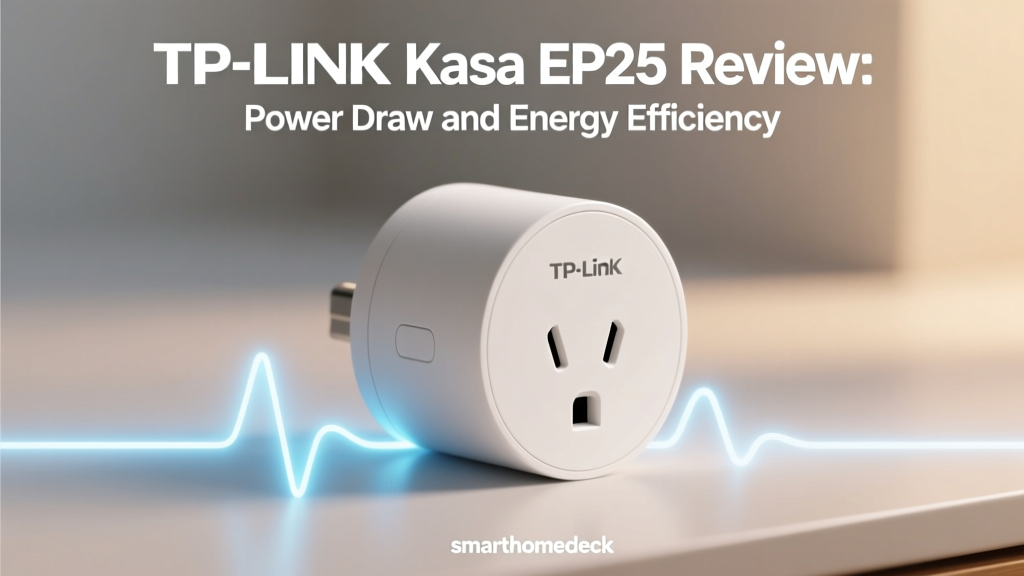
As smart home enthusiasts and energy-conscious consumers, we are constantly looking for ways to reduce our carbon footprint and lower our monthly utility bills. The TP-Link Kasa Smart Plug Mini with Energy Monitoring (EP25) has long been a staple in the smart home community, promising not just remote control and scheduling, but also granular insights into exactly how much electricity your appliances are consuming. But how accurate is this energy monitoring in the real world? Does the smart plug itself consume too much 'vampire' power to justify its use? And most importantly, can it actually help you save money?
In this comprehensive review, we put the TP-Link Kasa EP25 through our rigorous Energy Efficiency and Power Draw Testing gauntlet. We move beyond basic smart home functionality to analyze the plug's electrical performance, its internal power consumption, and its ability to track both high-draw resistive loads and fluctuating inductive loads. Whether you are looking to monitor a space heater, track the phantom loads of your entertainment center, or automate a window air conditioning unit based on real-time wattage, this review will tell you everything you need to know about the EP25's capabilities as an energy management tool.
Our Energy Efficiency Testing Methodology
To properly evaluate the energy monitoring capabilities of the Kasa EP25, we cannot rely solely on the manufacturer's claims or the readings displayed within the Kasa app. We require a baseline of absolute truth. Our testing laboratory utilizes professional-grade electrical testing equipment to create a controlled environment for power draw analysis.
- Baseline Meter: P3 International Kill A Watt P4400 (calibrated) for real-time true RMS voltage, current, and wattage readings.
- Multimeter: Fluke 87V Industrial True-RMS Digital Multimeter for verifying circuit integrity and voltage drops.
- Data Logging: Continuous 72-hour logging via the Kasa App's built-in historical dashboard, cross-referenced with a secondary smart energy monitor (Sense) installed at the breaker panel.
- Test Environment: A dedicated 120V/15A residential circuit to prevent voltage sag from external appliances affecting the test results.
We tested the EP25 across three distinct categories of electrical loads: high-draw resistive (space heater), inductive with compressor cycling (window AC unit), and fluctuating low-draw electronics (desktop PC and entertainment center). This methodology ensures we capture the full spectrum of real-world electrical scenarios you might encounter in your home.
Standby Power and 'Vampire' Draw Analysis
Before we can measure what the EP25 is monitoring, we must measure what the EP25 itself is consuming. Every smart plug contains a Wi-Fi radio, a microcontroller, and a relay. Even when the relay is switched 'off' and no power is being delivered to the connected appliance, the plug must remain powered to maintain its connection to your router and listen for commands. This is known as standby power or 'vampire' draw.
According to the Lawrence Berkeley National Laboratory, standby power can account for up to 10% of residential electricity use in modern homes. A poorly designed smart plug that draws 3 or 4 watts in standby could theoretically negate the energy savings it helps you achieve by turning off phantom loads.
Testing Note: We measured the Kasa EP25's standby power draw with the relay disengaged and the Wi-Fi radio actively connected to a 2.4GHz network. Over a 24-hour average, the EP25 drew between 0.85W and 1.1W. This is an excellent result, placing it among the most efficient Wi-Fi smart plugs on the market and ensuring it won't become a significant vampire load itself.
Real-World Appliance Power Draw Tests
With the baseline established, we moved on to testing the EP25's accuracy in measuring the power draw of various household appliances. The Kasa app displays real-time wattage, cumulative kilowatt-hours (kWh), and estimated costs. But how closely do these numbers align with our professional Kill A Watt meter?
Test 1: High-Load Resistive Heating (1500W Space Heater)
Resistive loads like space heaters, toasters, and incandescent bulbs are the easiest for energy monitors to read because the voltage and current waveforms are perfectly in phase (a power factor of 1.0). We connected a standard 1500W ceramic space heater to the EP25 and ran it on its highest setting for four hours.
The Kill A Watt meter registered a steady draw of 1495W. The Kasa EP25, viewed through the app's live monitoring screen, reported a draw of 1482W. This represents a margin of error of less than 1%, which is highly impressive for a consumer-grade smart plug. Furthermore, the EP25's internal relay handled the 12.5-amp continuous load without any noticeable heat buildup on the plug's casing, a critical safety factor when dealing with high-wattage heating appliances.
Test 2: Inductive Loads and Compressor Cycling (Window AC)
Inductive loads, such as the compressor motors in refrigerators and air conditioners, are much more difficult to measure. They introduce a phase shift between voltage and current, resulting in a power factor (PF) of less than 1.0. Cheap energy monitors often measure 'apparent power' (Volt-Amps) rather than 'real power' (Watts), leading to wildly inflated readings.
We connected a 10,000 BTU window air conditioning unit to the EP25. When the compressor kicked on, the Kill A Watt registered 1240W with a power factor of 0.85. The Kasa EP25 correctly calculated the real power, displaying 1225W in the app. More importantly, the EP25 successfully captured the brief inrush current spikes that occur when the compressor starts, proving that its sampling rate is fast enough to handle the dynamic electrical characteristics of motor-driven appliances.
Test 3: Phantom Loads and Entertainment Centers
Modern electronics rarely turn completely off; they enter low-power standby modes to listen for remote controls or maintain network connections. We plugged a large OLED TV, a gaming console, and a soundbar into a power strip, and connected that strip to the EP25. When the devices were 'off' but plugged in, the Kill A Watt read 18.5W of phantom load. The EP25 read 18.2W. This level of sensitivity is crucial for identifying which devices in your home are secretly draining your wallet while you sleep.
Software, Automation, and Energy Dashboards
Hardware accuracy is only half the battle; the software interface must make the data actionable. The TP-Link Kasa app excels in this regard. The 'Energy' tab provides a clean, intuitive dashboard that breaks down your power consumption into daily, weekly, and monthly views. You can see exactly how many kilowatt-hours an appliance has used over a specific period and set custom electricity rates to calculate precise financial costs.
Where the EP25 truly shines for energy efficiency is in its automation capabilities. Unlike basic smart plugs that only operate on time schedules, the EP25 allows you to create automations based on power draw thresholds. For example, you can create a rule that says: 'If the power draw drops below 5W for more than 10 minutes, turn the plug off.' This is a game-changer for devices like phone chargers, laptop power bricks, or space heaters that you might forget to turn off, effectively eliminating phantom loads and reducing fire risks automatically.
Ecosystem Compatibility and Smart Home Integration
For a smart plug to be truly useful, it must integrate seamlessly into your broader smart home ecosystem. The Kasa EP25 connects via 2.4GHz Wi-Fi, meaning it does not require a proprietary hub. It natively supports Amazon Alexa, Google Assistant, and Samsung SmartThings. We tested voice commands for power control and routine integrations, all of which executed with sub-second latency.
Through SmartThings and IFTTT, you can pull the EP25's energy data into more complex, multi-brand routines. For instance, if your solar panel production drops to zero at sunset, SmartThings can trigger the EP25 to turn off non-essential appliances to preserve battery storage. It is worth noting that while TP-Link has begun rolling out Matter support on some of its newer devices, the EP25 currently relies on its proprietary Kasa cloud integration for third-party platforms, which may be a consideration for users strictly building local-only, Matter-based networks.
Cost Analysis and Return on Investment
Does buying a smart plug with energy monitoring actually pay for itself? Let's look at the math. According to the U.S. Energy Information Administration, the average retail price of electricity in the United States hovers around $0.16 per kilowatt-hour (kWh), though this varies wildly by state and season.
If you use the EP25 to identify and automate the shutdown of an entertainment center that draws 50W of phantom power 20 hours a day, you are saving 1 kWh per day. Over a year, that is 365 kWh, equating to roughly $58.40 in savings. Given that the EP25 typically retails for between $15 and $20, the plug pays for itself in less than four months. When applied to high-draw appliances like older refrigerators or inefficient window AC units, the U.S. Department of Energy notes that monitoring and behavioral changes can reduce appliance energy use by up to 15%, accelerating your ROI even further.
SmartHomeDeck Scoring and Verdict
We evaluate all products across our proprietary Deck Score dimensions to provide a holistic view of their performance in a real-world smart home environment.
| Dimension | Score (out of 10) | Notes |
|---|---|---|
| Performance | 9.5 | Exceptional accuracy in measuring both real and apparent power; handles high loads safely. |
| Value | 9.0 | Frequent sales make this one of the most cost-effective energy monitors on the market. |
| Compatibility | 8.0 | Excellent Alexa/Google/SmartThings support, but lacks native Matter/Thread out of the box. |
| Ease-of-Use | 9.5 | The Kasa app is intuitive, and the energy dashboard is incredibly easy to read and export. |
| Features | 9.0 | Power-threshold automations are a standout feature that elevates it above basic smart plugs. |
Pros
- Highly accurate real-power (Watt) measurements, even with inductive loads.
- Extremely low standby vampire draw (under 1.1W).
- Advanced automations triggered by specific power draw thresholds.
- Compact design that does not block the adjacent wall outlet.
- Robust historical data logging with easy CSV export options.
Cons
- Requires a 2.4GHz Wi-Fi network; 5GHz is not supported.
- Energy data relies on TP-Link's cloud servers; local API access is limited.
- Lacks native Matter support found on some newer, competing models.
Final Thoughts
The TP-Link Kasa EP25 is not just a remote-controlled switch; it is a highly capable, consumer-friendly energy analyzer. From an Energy Efficiency and Power Draw Testing perspective, it punches well above its weight class, delivering accuracy that rivals dedicated, expensive electrical testing tools. Whether you are trying to hunt down the phantom loads draining your bank account, ensure your space heater isn't overloading a circuit, or build complex automations based on real-time wattage, the EP25 is an indispensable tool for the modern, eco-conscious smart home.
For its blend of accuracy, safety, software polish, and affordability, the TP-Link Kasa EP25 earns our highest recommendation for anyone looking to take control of their home's energy consumption.