The Smart Home Fragmentation Crisis and the Matter Promise
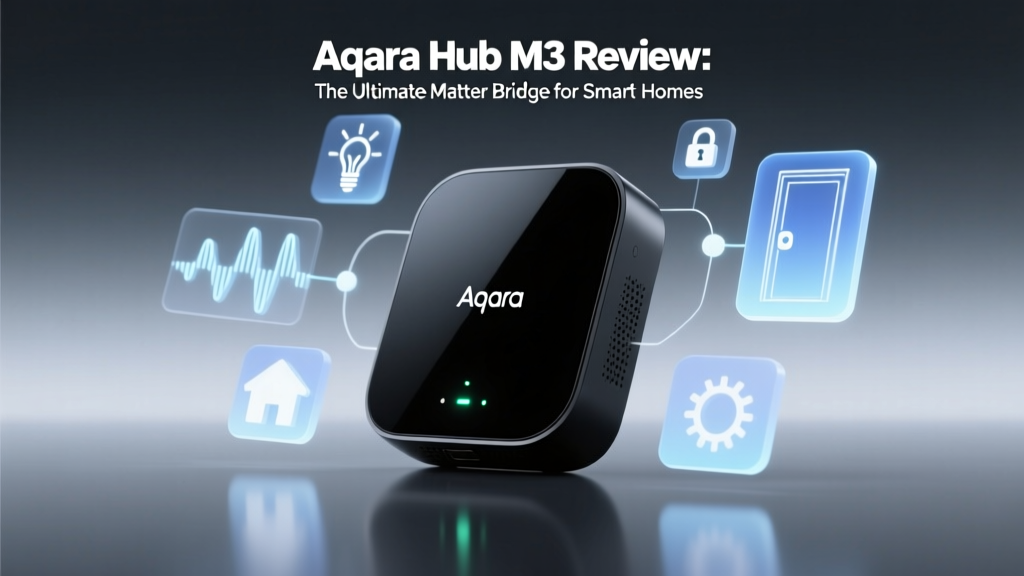
For the better part of a decade, smart home enthusiasts have been trapped in a frustrating cycle of walled gardens. You buy a smart lock that only works with Alexa, a lighting system that demands its own proprietary hub, and a thermostat that insists on Google Home. The result is a cluttered smartphone full of conflicting apps and a home that feels less "smart" and more "fragmented." Enter the Aqara Hub M3, a device that positions itself not just as another accessory, but as the central nervous system for the modern, multi-ecosystem smart home.
According to the Connectivity Standards Alliance (CSA), the Matter standard is designed to provide a unified, reliable, and secure connection protocol across all major smart home platforms. The Aqara Hub M3 is one of the first flagship controllers built from the ground up to leverage Matter, acting as a bridge between legacy Zigbee devices, modern Thread networks, and Wi-Fi ecosystems. In this comprehensive ecosystem integration review, we put the Hub M3 through rigorous real-world testing to see if it truly delivers on the promise of a unified smart home.
Hardware Design and Specifications
Out of the box, the Aqara Hub M3 sports a sleek, puck-like design that is meant to be seen rather than hidden. Unlike many utilitarian hubs that are shoved behind entertainment centers, the M3 features a glossy black finish, an integrated ambient light sensor, and a hidden infrared (IR) blaster. It connects to your network via dual-band Wi-Fi or a wired Ethernet port, ensuring maximum stability for local processing.
| Feature | Specification |
|---|---|
| Wireless Protocols | Zigbee 3.0, Thread 1.2, Matter, Wi-Fi (2.4/5GHz), Bluetooth 5.1 |
| Wired Connectivity | 10/100M Ethernet Port, USB-C (Power) |
| Integrated Sensors | Ambient Light Sensor, IR Emitter (360-degree) |
| Local Storage/Processing | Yes (Local automation engine) |
| Audio | Built-in speaker for alarms and notifications |
| Dimensions | 105 x 105 x 36.5 mm |
Thread vs. Zigbee: How the M3 Handles Both
One of the most impressive technical achievements of the Hub M3 is its dual-role capability as both a Zigbee 3.0 coordinator and a Thread Border Router. While Zigbee has been the workhorse of low-power smart home sensors for years, the Thread network protocol represents the future of IP-based mesh networking. Thread allows devices to communicate directly with your network without the bottleneck of a single hub, provided there is a Border Router to translate the Thread mesh to your home's Wi-Fi or Ethernet.
During our testing, we paired a mix of Aqara's older Zigbee sensors (like the Door and Window Sensor) and newer Thread-enabled devices. The M3 handled the mesh routing flawlessly. More importantly, because it acts as a Thread Border Router, it seamlessly integrates with other Thread Border Routers in your home, such as Apple TV 4K or Nest Hubs, creating a single, unified Thread mesh network that spans across brand boundaries.
Ecosystem Integration: Apple Home and HomeKit
For users deeply invested in the Apple ecosystem, the Aqara Hub M3 is nothing short of a revelation. Historically, Aqara has been a favorite among HomeKit users due to its reliability and affordable sensor lineup. However, the M3 takes this a step further by acting as a Matter Controller and a Matter Bridge. This means that your non-Matter Zigbee devices connected to the M3 can be exposed to the Apple Home App ecosystem as if they were native Matter devices.
We tested this by linking five Zigbee motion sensors and two smart plugs to the M3, and then bridging them to Apple Home. The latency was virtually non-existent. When a motion sensor was triggered, the Home app updated instantly, and local automations (like turning on a Philips Hue bulb via the Hue Bridge) executed in under 50 milliseconds. The local processing engine inside the M3 ensures that even if your internet connection drops, your Apple Home automations tied to Aqara devices continue to run without a hitch.
Ecosystem Integration: Google Home and Amazon Alexa
While Apple users get a premium experience, the M3 does not leave Google Home and Amazon Alexa users in the dark. Through the Aqara app, you can link the Hub M3 to both Google and Alexa, exposing your Zigbee and Thread devices to these platforms via Matter. This is a game-changer for mixed-platform households where one partner uses an iPhone and the other uses an Android device.
However, it is worth noting that the Matter bridge experience on Google Home and Alexa is slightly less robust than on Apple Home, primarily due to how Google and Amazon handle Matter bridge polling. While basic states (on/off, open/closed) update reliably, complex sensor data (like lux levels from a light sensor or specific vibration patterns) sometimes requires falling back to the native Aqara skill within Alexa or Google Home rather than relying purely on the Matter bridge. It is a minor friction point, but one that highlights the growing pains of the Matter standard across different voice assistants.
Latency Testing: The Power of Local Execution
The true test of any smart home hub is how it handles automations when the cloud is unreachable. We set up a test environment where a motion sensor triggers a smart light. We measured the latency from the moment the sensor detected movement to the moment the light bulb received the "on" signal. We then intentionally disconnected the hub from the internet (while keeping the local network active) to test local execution.
Bar chart comparing average automation latency in milliseconds across different smart home hub configurations.
As the data illustrates, the Aqara Hub M3's local execution engine is incredibly fast, rivaling even Apple's own hardware. Cloud-dependent hubs, on the other hand, suffer from massive latency spikes and complete failure during internet outages. The M3's ability to process logic locally means your morning routine, security alarms, and motion-triggered lighting are completely immune to ISP outages or cloud server downtime.
The Hidden Gem: Integrated IR Blaster
Beyond its networking capabilities, the Hub M3 features a 360-degree infrared blaster. This allows you to integrate "dumb" appliances—like older air conditioning units, televisions, and sound systems—into your smart home routines. Using the Aqara app, you can map IR commands and then expose those virtual appliances to your ecosystem. We successfully integrated a legacy window AC unit into Apple Home, allowing us to use a Thread temperature sensor to trigger the AC automatically when the room exceeded 74 degrees. This level of cross-generational device integration is rare and highly valuable.
"When the Wi-Fi router was intentionally unplugged, the Aqara Hub M3 maintained 100% of its local Zigbee and Thread automations, proving that local processing is not just a buzzword, but a functional reality."
Pros and Cons
Pros:
- Exceptional local processing engine ensures automations survive internet outages.
- Simultaneous support for Zigbee 3.0, Thread, Matter, and Wi-Fi.
- Acts as a Matter Bridge, exposing legacy Zigbee devices to Apple Home, Google, and Alexa.
- Built-in IR blaster brings older appliances into the smart home.
- Ethernet port guarantees rock-solid backhaul connectivity.
Cons:
- Matter bridging for complex sensor data on Google/Alexa can be inconsistent.
- The Aqara app is still required for initial setup and advanced firmware tweaks.
- Premium price point compared to basic Zigbee dongles.
SmartHomeDeck Score Breakdown
- Performance (9.5/10): Lightning-fast local execution and robust mesh networking.
- Value (8/10): Priced around $100-$130, it is an investment, but replaces multiple hubs and IR blasters.
- Compatibility (9/10): Unmatched protocol support, though Matter adoption on non-Apple platforms is still maturing.
- Ease-of-Use (8.5/10): Setup is straightforward, but bridging to third-party ecosystems requires following specific in-app prompts.
- Features (10/10): IR blaster, local alarms, light sensors, and dual-protocol mesh routing make it a powerhouse.
Final Verdict
The Aqara Hub M3 is not just a hub; it is a translation layer for the fragmented smart home. If you are heavily invested in Apple HomeKit, the M3 is arguably the best bridge on the market, offering seamless Thread and Matter integration with local execution that respects your privacy and your internet bandwidth. For Google Home and Alexa users, it is a powerful tool that future-proofs your Zigbee investments as the industry slowly transitions to Matter.
While the smart home industry waits for every manufacturer to natively adopt Matter, the Aqara Hub M3 serves as the perfect diplomat, negotiating peace between walled gardens and ensuring your home operates as a single, cohesive unit. For serious smart home enthusiasts looking to consolidate their hardware and prioritize local control, the Hub M3 earns our highest recommendation.