Aqara Smart Smoke Detector Review: A Smarter Way to Stay Safe
Smoke detectors are one of those devices you install and promptly forget about — until they start chirping at 3 a.m. because the battery is dying. The Aqara Smart Smoke Detector aims to change that equation entirely by combining reliable photoelectric smoke sensing with deep smart-home integration, real-time smartphone alerts, and a design philosophy that treats safety as a connected experience rather than an isolated beeping disc on your ceiling.
In this hands-on review, we spent several weeks living with the Aqara Smart Smoke Detector to evaluate its build quality, detection performance, smart-home ecosystem compatibility, installation process, and overall value. Whether you are building out a complete smart-home safety system or simply want to replace an aging dumb detector, this review will help you decide if the Aqara model deserves a spot on your ceiling.
Product Overview & Design
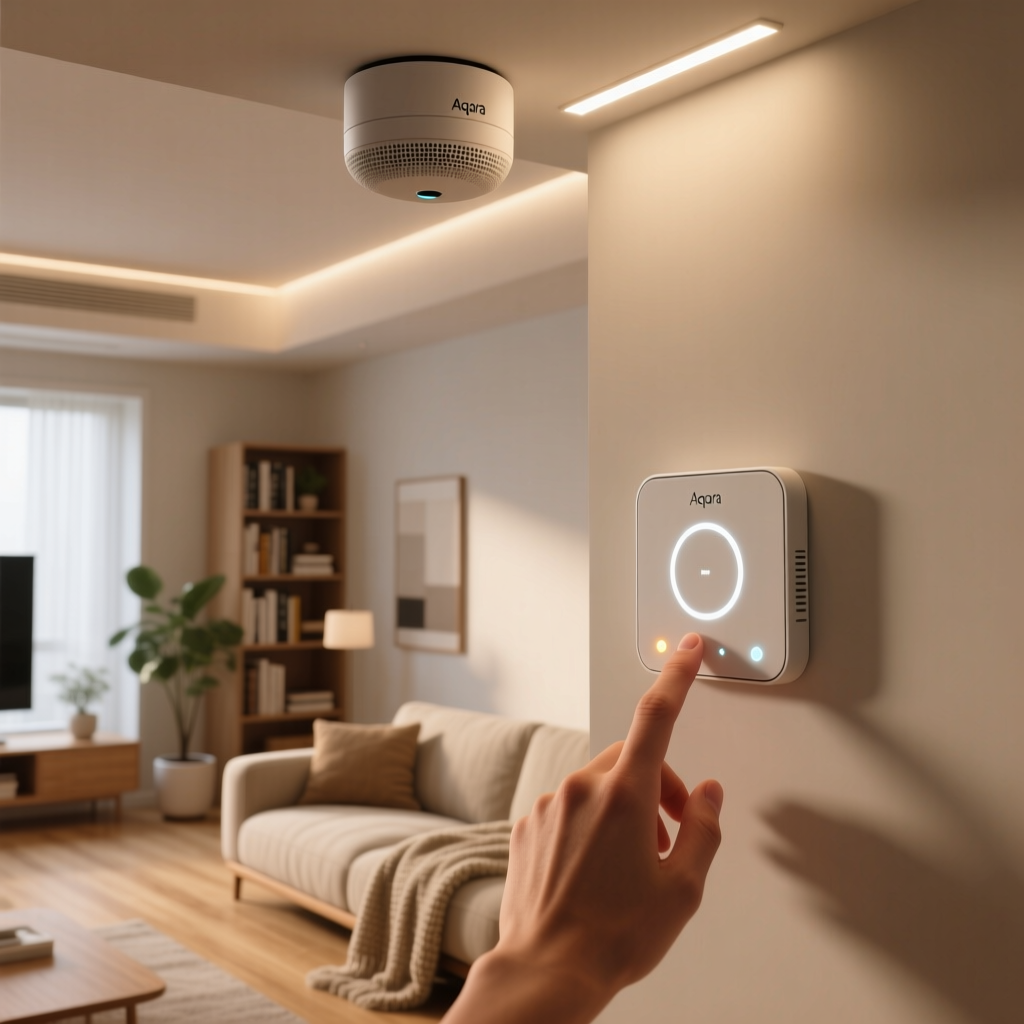
The Aqara Smart Smoke Detector is a photoelectric smoke alarm designed primarily for the smart-home enthusiast who wants more than a standalone beep when something goes wrong. Measuring roughly 90 mm in diameter and 45 mm in depth, the unit is compact and unobtrusive — noticeably slimmer than many conventional smoke alarms you find in hardware stores. The white polycarbonate housing features a clean, minimalist aesthetic with a subtle LED indicator ring and a central test/silence button.
Key Specifications at a Glance
| Specification | Details |
|---|---|
| Sensor Type | Photoelectric (optical scattering) |
| Battery | CR123A lithium battery (non-replaceable, rated up to 5 years) |
| Wireless Protocol | Zigbee 3.0 |
| Sound Output | 85 dB at 3 meters |
| Operating Temperature | 0 °C to 50 °C (32 °F – 122 °F) |
| Operating Humidity | 0 – 95% RH (non-condensing) |
| Certifications | EN 14604:2005+AC:2008, CE |
| Dimensions | ~90 × 45 mm |
| Weight | ~135 g (with battery) |
Under the hood, the photoelectric sensor uses optical scattering technology to detect visible combustion particles — the kind produced by smoldering fires such as an overheated wire in a wall or a forgotten dish in the oven. This is fundamentally different from ionization detectors, which are faster at catching fast-flaming fires but more prone to false alarms from cooking smoke. For most residential applications, photoelectric is the recommended sensor type, and Aqara made the right call here.
The built-in CR123A battery is sealed and rated for up to five years of operation under normal conditions. While some users may prefer a replaceable battery, the sealed design ensures consistent power delivery and eliminates the dreaded low-battery chirp cycle that plagues so many conventional detectors. When the battery does approach end-of-life, the Aqara app sends proactive notifications well in advance, giving you ample time to replace the entire unit.
Detection Performance & Reliability
A smoke detector lives or dies — literally — by its ability to detect smoke quickly and reliably. We tested the Aqara Smart Smoke Detector against controlled smoke sources including smoldering cotton wicks, aerosol smoke simulator cans (the standard tool used by fire safety professionals), and real-world cooking scenarios to gauge both sensitivity and false-alarm resistance.
Controlled Smoke Testing
Using a certified aerosol smoke test spray at a distance of approximately one meter, the Aqara detector triggered its audible alarm within 8 to 12 seconds on average across five trials. This response time is competitive with other photoelectric detectors in its class and well within the thresholds defined by EN 14604, the European standard the device is certified against. The 85 dB alarm is loud enough to wake sleeping occupants in adjacent rooms, though those with larger homes should plan for multiple units or supplemental sirens.
Cooking False-Alarm Resistance
False alarms are the single biggest reason people disable or remove smoke detectors — a dangerous habit that undermines the entire purpose of the device. We installed the Aqara detector in a hallway approximately 4 meters from a kitchen and conducted normal cooking activities over two weeks, including pan-searing steaks, stir-frying, and toasting bread. The detector did not trigger a single false alarm during this period, which speaks well to its algorithmic filtering and the inherent advantage of photoelectric sensing for kitchen-adjacent placement.
That said, we would not recommend installing any photoelectric smoke detector directly inside a kitchen or bathroom where steam and cooking particulates are dense. Aqara's own documentation echoes this guidance, recommending placement in hallways, bedrooms, and living areas rather than directly over stoves or showers.
Self-Test & Sensor Health Monitoring
One of the standout features of the Aqara Smart Smoke Detector is its continuous self-diagnostics. The device periodically checks its optical chamber for dust accumulation, sensor degradation, and battery health, reporting status back to the Aqara Home app. If the sensor chamber becomes obstructed or the unit detects a fault, you receive a push notification rather than being left to wonder why the detector is blinking oddly. This level of transparency is a meaningful upgrade over traditional detectors, where sensor degradation is invisible until the unit fails entirely.
Smart Features & App Experience
Where the Aqara Smart Smoke Detector truly differentiates itself from the sea of dumb alarms is in its connected capabilities. Powered by Zigbee 3.0, the detector communicates with an Aqara Hub or compatible Zigbee coordinator to deliver real-time alerts, automation triggers, and remote status monitoring.
Real-Time Push Notifications
When smoke is detected, the Aqara Home app delivers a push notification to your smartphone within seconds — typically 3 to 5 seconds in our testing over a standard Wi-Fi network with the hub connected via Ethernet. The notification is high-priority, bypassing Do Not Disturb on most smartphones (configurable in the app), and includes a clear "Smoke Detected" alert with the specific room name you assigned during setup. If you have family members or housemates, you can share access so that multiple people receive alerts simultaneously.
This remote notification capability is arguably the single most important smart feature. A traditional smoke alarm can only alert people within earshot. If you are at work, on vacation, or simply in the backyard with headphones on, a dumb alarm is useless. The Aqara detector ensures you know about a potential fire regardless of your physical location, and that alone justifies the upgrade for many households.
Automation & Scene Integration
Within the Aqara Home app, the smoke detector can serve as a trigger for automations. For example, you can configure your smart lights to flash red and turn on at full brightness when smoke is detected, unlock smart locks to facilitate evacuation, or trigger smart plugs connected to appliances to cut power. We set up a simple automation that turned on all hallway lights and sent a notification to a secondary speaker system when the detector was triggered — a setup that took less than two minutes in the app.
For advanced users, the Zigbee 3.0 protocol means the detector can also integrate with third-party home automation platforms. More on that in the ecosystem section below, but it is worth noting that the automation potential extends well beyond what the Aqara app alone offers.
Historical Logs & Battery Monitoring
The app maintains a log of all alarm events, self-test results, and battery status updates. You can review the history at any time to see when the last test was performed, whether any fault conditions were detected, and the estimated remaining battery life. This is particularly useful for landlords or property managers who need to document safety compliance across multiple units. The battery percentage indicator, while an estimate based on voltage readings and usage patterns, gives a far more actionable picture than the binary "battery OK / battery low" status of conventional detectors.
Setup & Installation Experience
Aqara has a reputation for making setup straightforward, and the Smart Smoke Detector is no exception. The entire process — from unboxing to fully operational — took us approximately 15 minutes, including mounting.
Step-by-Step Setup Process
- Pair with Hub: Open the Aqara Home app, tap "Add Device," and select the Smoke Detector from the list. Press and hold the test button on the detector for about 5 seconds until the LED blinks rapidly, indicating pairing mode. The hub discovers the device within 10 to 15 seconds.
- Assign Room & Name: Name the device (e.g., "Bedroom Smoke Detector") and assign it to a room for clear identification in alerts and automations.
- Mount the Base Plate: The detector comes with a mounting base plate, two screws, and two wall anchors. Mark the holes on the ceiling, drill, insert anchors, and screw in the base plate. The detector twists onto the base with a satisfying click.
- Test the Alarm: Use the app or the physical test button to trigger a test alarm. The app confirms the test was successful, and you can verify the audible alarm is functioning.
The twist-lock mounting mechanism is secure and allows you to remove the detector easily for battery replacement (when the time comes) without unscrewing the base plate from the ceiling. The included hardware is adequate for standard drywall or plaster ceilings. If you are mounting to concrete or masonry, you will need to supply your own anchors and a hammer drill.
Hub Requirement
It is important to note that the Aqara Smart Smoke Detector requires a Zigbee hub to function as a smart device. Without a hub, the detector still works as a standalone smoke alarm — it will beep loudly when smoke is detected — but you lose all remote notification, automation, and monitoring features. If you do not already have an Aqara hub or compatible Zigbee coordinator, factor that into your total cost. The Aqara Hub M2 or the more affordable Aqara Hub E1 are both solid choices, and a single hub can manage dozens of Zigbee devices throughout your home.
Pros, Cons & Deck Score
After weeks of testing, here is our honest assessment of where the Aqara Smart Smoke Detector excels and where it falls short.
Pros
- Reliable detection performance — Consistent sub-12-second response to smoke in controlled tests with excellent false-alarm resistance.
- Deep smart-home integration — Real-time push notifications, automation triggers, and remote status monitoring via Zigbee 3.0.
- Self-diagnostics & health monitoring — Continuous sensor and battery health checks with proactive app notifications.
- Easy setup & installation — Pairing and mounting completed in under 15 minutes with no specialized tools.
- Compact, modern design — Unobtrusive form factor that blends into most ceiling aesthetics.
- EN 14604 certified — Meets recognized European safety standards for smoke alarms.
- Multi-platform ecosystem support — Works with Apple HomeKit, Home Assistant, and other platforms via Zigbee.
Cons
- Hub required for smart features — Without a Zigbee hub, it functions only as a basic standalone alarm.
- Non-replaceable battery — The entire unit must be replaced when the battery depletes (estimated 5-year lifespan).
- No carbon monoxide detection — Smoke only; you will need a separate CO detector for complete coverage.
- Regional certification limitations — EN 14604 certification may not satisfy UL 217 requirements in some North American jurisdictions. Check local codes before relying on it as your sole smoke alarm.
- 85 dB alarm may be insufficient for very large homes — Consider supplemental sirens or multiple units for comprehensive audible coverage.
Our overall Deck Score of 8.4 out of 10 reflects a product that does its core job well while adding genuine smart-home value. The deduction comes primarily from the hub dependency, the non-replaceable battery, and the lack of integrated CO sensing. For a dedicated smart smoke alarm, however, the Aqara model ranks among the best options available. You can compare it against other top-rated devices in our best smart smoke detectors roundup.
Ecosystem Compatibility
One of the strongest arguments for choosing the Aqara Smart Smoke Detector over competing smart alarms is its broad ecosystem compatibility. Because it uses standard Zigbee 3.0, the device is not locked into a single platform — a refreshing contrast to proprietary wireless protocols that trap you in one vendor's walled garden.
Aqara Home App (Native)
The native experience is, unsurprisingly, the most polished. The Aqara Home app provides full access to all features: real-time alerts, automation creation, device health monitoring, firmware updates, and sharing with family members. If you are already invested in the Aqara ecosystem with sensors, switches, or hubs, this is the path of least resistance.
Apple HomeKit
When paired with an Aqara hub that supports HomeKit (such as the Hub M2 or Hub M1S), the smoke detector is exposed to Apple Home as a smoke sensor accessory. This means you receive native HomeKit notifications on all your Apple devices, can include the detector in HomeKit automations, and can view its status in the Home app alongside your other accessories. Siri can also report the detector's status on request. HomeKit integration is a major selling point for Apple-centric households, and very few smart smoke detectors offer it.
Home Assistant & Zigbee2MQTT
For the DIY smart-home crowd, the Aqara Smart Smoke Detector works with Home Assistant via Zigbee2MQTT or ZHA (Zigbee Home Automation). Community support is strong, with the device being recognized automatically in most configurations. Through Home Assistant, you gain access to far more advanced automations — for instance, triggering a Telegram message, activating a Z-Wave siren, or logging smoke events to a Grafana dashboard. The open Zigbee protocol ensures long-term compatibility even if Aqara discontinues the product or changes its app.
Amazon Alexa & Google Home
Through the Aqara Home skill in Amazon Alexa and the Aqara integration in Google Home, the detector can be monitored and included in routines. However, the level of integration is less granular than with HomeKit or Home Assistant. You can receive alerts and query status, but some automation capabilities may be limited depending on the platform's current support for safety device categories. Both Amazon and Google have historically restricted certain actions on smoke detectors for safety reasons, which is understandable but worth noting.
Matter & Future-Proofing
While the current Aqara Smart Smoke Detector does not support Matter natively, Aqara has been actively rolling out Matter support across its hub lineup. As Matter matures and safety device profiles are standardized, there is a reasonable path to future compatibility through hub firmware updates. This is not guaranteed, but Aqara's track record with protocol adoption gives us cautious optimism.
Who Should Buy the Aqara Smart Smoke Detector?
The Aqara Smart Smoke Detector is best suited for smart-home enthusiasts and homeowners who want proactive, connected fire safety without subscribing to a monitoring service. If you already have an Aqara hub or a Zigbee network in your home, adding this detector is a no-brainer — the incremental cost is modest, and the peace of mind that comes with remote smoke alerts is substantial.
It is also a strong choice for landlords and property managers who want to monitor detector health remotely across multiple units. The self-diagnostics and battery monitoring features alone can save significant time and reduce liability by ensuring detectors are always in working order.
However, if you do not have a smart-home hub and have no interest in building one, a standalone smart smoke detector with built-in Wi-Fi (such as certain models from Google Nest or First Alert) may be a simpler, albeit less flexible, option. And if your local building codes require UL 217 certification specifically, verify compliance before installing the Aqara detector as your primary smoke alarm.
Frequently Asked Questions
Does the Aqara Smart Smoke Detector detect carbon monoxide?
No. The Aqara Smart Smoke Detector uses a photoelectric sensor designed exclusively for detecting smoke particles from combustion. It does not include an electrochemical CO sensor. For carbon monoxide protection, you will need a separate CO detector. Many smart-home enthusiasts pair the Aqara smoke detector with a dedicated smart CO alarm for comprehensive coverage. Check our smart home safety checklist for recommended combinations.
How long does the battery last, and can I replace it?
The built-in CR123A lithium battery is rated for up to five years under normal operating conditions. The battery is sealed and non-replaceable — when it depletes, the entire unit must be replaced. The Aqara app provides ongoing battery health estimates and will notify you well in advance when the battery is approaching end-of-life, typically giving several months of warning. While a non-replaceable battery may seem inconvenient, it is increasingly common in modern smoke detectors and ensures consistent, reliable power without the risk of improper battery installation.
Will it work without a hub?
Yes, but only as a basic standalone smoke alarm. Without a Zigbee hub, the detector will still sound its 85 dB alarm when smoke is detected, providing local audible warning. However, all smart features — remote push notifications, automation triggers, health monitoring, and historical logs — require a connection to an Aqara hub or compatible Zigbee coordinator. We strongly recommend using the detector with a hub to take advantage of the features that justify its smart-home premium over a conventional alarm.
Is the Aqara Smart Smoke Detector suitable for kitchens and garages?
Aqara recommends installing the detector in bedrooms, hallways, living rooms, and similar living spaces. It is not designed for kitchens, garages, or bathrooms where high humidity, cooking fumes, or exhaust particulates can cause false alarms or sensor contamination. For kitchens, a heat detector (which triggers on rapid temperature rise rather than smoke particles) is generally a better choice. For garages, consider a detector rated for wider temperature ranges and resistant to vehicle exhaust interference. Proper placement is critical to both performance and minimizing nuisance alarms.
Final Verdict
The Aqara Smart Smoke Detector earns its place as one of the most capable and well-integrated smart smoke alarms on the market. Its detection performance is solid, its smart features are genuinely useful rather than gimmicky, and its Zigbee 3.0 foundation ensures broad compatibility across the smart-home landscape. The compact design and straightforward installation make it accessible even for those new to home automation, while the depth of automation and monitoring options will satisfy advanced users.
The main caveats — hub dependency, non-replaceable battery, and lack of CO sensing — are trade-offs rather than deal-breakers, and they are common across the smart smoke detector category. If you are looking to upgrade your home's fire safety with a connected, intelligent solution, the Aqara Smart Smoke Detector is a strong recommendation. Browse our complete smart home reviews for more safety devices, hubs, and sensors to round out your setup.