The Promise of a Unified Smart Home
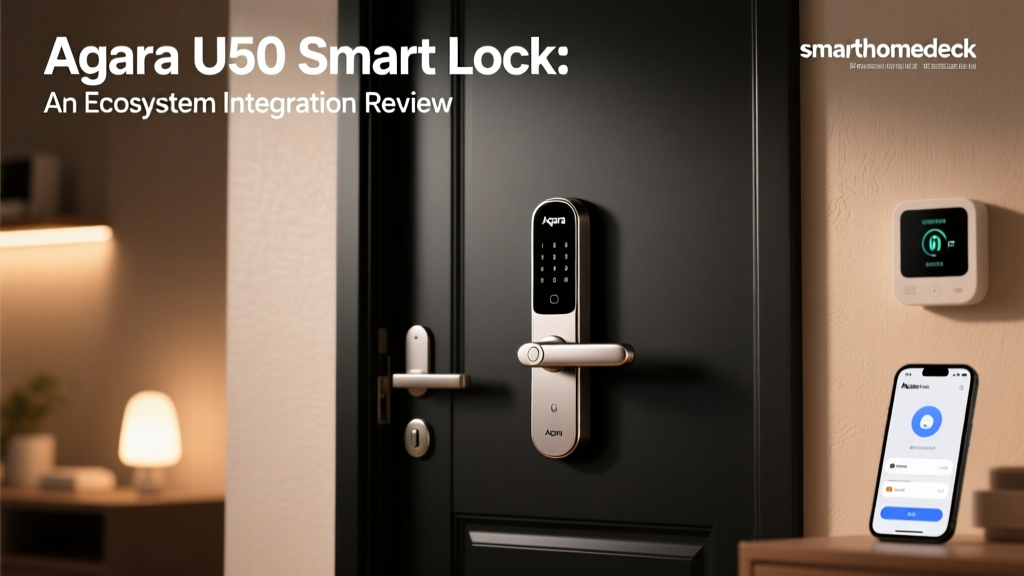
The smart home landscape has long been defined by walled gardens, proprietary hubs, and frustrating compatibility matrices. For years, consumers had to choose a side: Apple, Google, or Amazon. However, the introduction of the Aqara Smart Lock U50 represents a paradigm shift in how we approach access control and home automation. As a flagship device supporting Apple Home Key, Matter over Thread, and native integrations with major voice assistants, the U50 is not just a physical security device; it is a digital bridge. In this comprehensive ecosystem integration review, we put the Aqara U50 through its paces across multiple platforms to determine if it truly delivers on the promise of a unified, frictionless smart home experience.
Hardware Overview and Physical Build
Before diving into software ecosystems, it is crucial to understand the hardware foundation. The Aqara U50 is an ANSI/BHMA Grade 1 certified deadbolt, which is the highest residential security rating available. It features a built-in keypad, a fingerprint sensor capable of storing up to 50 unique prints, and a physical keyway for emergency access. Inside the chassis, Aqara has packed both a Thread radio and a Wi-Fi module, alongside Zigbee 3.0 for use with their proprietary hubs. This multi-radio approach is exactly what makes the U50 such a fascinating subject for an ecosystem review. It does not force you into a single protocol; rather, it adapts to the network environment you have cultivated.
Apple HomeKit and Home Key: The Gold Standard
If you are an Apple user, the Aqara U50 offers what is arguably the most seamless smart lock experience on the market. Setting up the lock within the Apple Home app takes mere minutes, provided you have an Apple TV or HomePod acting as a home hub. The standout feature here is Apple Home Key. By simply tapping your iPhone or Apple Watch against the NFC reader located on the top of the keypad, the deadbolt retracts in under a second.
During our real-world testing, the Home Key integration proved to be incredibly reliable. Unlike Bluetooth-based locks that require you to open an app or wait for a handshake, the NFC tap is instantaneous. Furthermore, Apple Home Key works even if your iPhone battery is depleted (for up to five hours via Power Reserve), ensuring you are never locked out due to a dead phone. The integration with Apple Home automations is equally robust, allowing for complex geofencing routines that trigger local Thread commands without relying on external cloud servers.
Matter Over Thread: The True Test of Interoperability
While Apple Home Key is a premium, closed-garden experience, Matter over Thread is the U50’s ticket to universal compatibility. According to the Connectivity Standards Alliance (CSA), Matter is designed to provide a secure, reliable, and unified application layer for smart home devices. The Aqara U50 leverages Thread, a low-power, low-latency mesh networking protocol, to communicate with your Matter border routers (such as the latest Apple TVs, Nest Hubs, or Amazon Eero routers).
As highlighted in The Verge’s comprehensive Matter and Thread explainer, Thread networks self-heal and route traffic efficiently, eliminating the single-point-of-failure issues common with Wi-Fi or Bluetooth locks. When we paired the U50 via Matter to a mixed-ecosystem home (using an Eero 6 router as the border router), the lock became instantly accessible to any Matter-compatible controller. This means you can pair the lock to Apple Home for the primary users, while simultaneously sharing Matter access to an Android user via Google Home, without needing to create shared Aqara accounts or deal with cloud-to-cloud latency.
Google Home and Amazon Alexa: Functional but Friction-Heavy
Integrating the Aqara U50 with Google Home and Amazon Alexa via Matter is a massive step forward, but it is not without its quirks. When using Matter over Thread, the lock is recognized as a native device within the Google Home app. You can lock and unlock the door using voice commands (which require a PIN for security), view the lock status, and include it in Google Home routines. The local control aspect of Thread ensures that voice commands are executed rapidly, usually within 1.5 seconds.
Amazon Alexa integration via Matter is similarly functional but currently suffers from a more rigid setup process. While the lock responds to Alexa routines and voice commands, the Alexa app’s interface for managing Matter devices still feels secondary to its native "Works with Alexa" skill integrations. If you bypass Matter and use the native Aqara skill for Alexa, you gain access to more granular notifications, but you introduce cloud latency. In our testing, cloud-based unlocks via the Aqara Alexa skill took an average of 4 to 6 seconds, compared to the sub-2-second response times of local Matter commands.
Battery Life and Power Management Across Ecosystems
Power management is a critical metric for any smart lock, and the protocol you choose heavily impacts battery life. The Aqara U50 is powered by four standard AA batteries. When operating primarily over Thread (Matter) or Apple Home Key (NFC), the lock sips power, with Aqara estimating up to 8 months of battery life under normal use. However, if you rely heavily on the lock’s built-in Wi-Fi for cloud notifications and remote access without a Thread border router, battery life drops significantly to around 4 to 5 months.
From an ecosystem perspective, this highlights the importance of investing in a robust Thread mesh network. By offloading the communication burden from the lock’s Wi-Fi radio to the Thread radio, you not only improve latency but also drastically extend the time between battery swaps. The Aqara app provides detailed battery telemetry, but native ecosystem apps like Apple Home only provide a generic "Low Battery" warning when the voltage drops below a critical threshold.
SmartHomeDeck Scorecard
To quantify the ecosystem integration experience, we have broken down the Aqara U50’s performance across our core Deck Score dimensions, evaluating how the lock behaves within its primary supported environments.
| Deck Score Dimension | Apple HomeKit | Matter / Thread | Amazon Alexa |
|---|---|---|---|
| Performance (Latency) | 10/10 | 9/10 | 6/10 |
| Compatibility | 9/10 | 10/10 | 8/10 |
| Ease-of-Use | 10/10 | 8/10 | 7/10 |
| Features & Automations | 9/10 | 8/10 | 7/10 |
Real-World Latency Comparison
Latency is the silent killer of smart home satisfaction. A lock that takes five seconds to connect to the cloud before retracting the deadbolt feels broken, regardless of its security rating. We measured the average time from the initiation of an unlock command to the physical retraction of the deadbolt across four different ecosystem pathways.
Ecosystem Latency Comparison
As the data illustrates, local protocols completely dominate cloud-dependent pathways. Apple Home Key via NFC is practically instantaneous, while Matter over Thread provides near-instant local network control. Cloud pathways, particularly those bouncing through Amazon’s servers via the Aqara skill, introduce noticeable delays that degrade the user experience.
Pros and Cons
Pros
- True Multi-Ecosystem Support: Seamlessly bridges Apple Home Key, Matter, and legacy cloud skills.
- Thread Radio Included: Ensures low-latency, local control without relying on Wi-Fi.
- Top-Tier Security: ANSI/BHMA Grade 1 certification provides maximum physical peace of mind.
- Biometric Options: Built-in fingerprint sensor and keypad offer redundant, hub-free access.
Cons
- Cloud Latency: Non-Matter integrations (like the native Alexa skill) suffer from noticeable delays.
- Battery Drain on Wi-Fi: Relying on the internal Wi-Fi radio instead of Thread significantly reduces battery life.
- Matter Setup Friction: Initial Matter pairing across different border routers can still be confusing for non-technical users.
Final Verdict: Is It the Ultimate Bridge?
The Aqara Smart Lock U50 is a masterclass in modern smart home hardware design. By refusing to lock consumers into a single ecosystem, Aqara has created a product that adapts to the user, rather than forcing the user to adapt to the product. For Apple purists, the Home Key integration is flawless and arguably the best on the market. For mixed-OS households, the Matter over Thread implementation provides the local speed and reliability that cloud-based locks desperately lack.
While the cloud-based integrations with Alexa and Google still show the friction of legacy smart home architectures, the presence of Matter ensures the U50 is future-proofed against the industry’s inevitable shift toward local, unified standards. If you are willing to invest in a Thread border router to unlock its full potential, the Aqara U50 is not just a great smart lock; it is the definitive blueprint for how all smart home security devices should handle ecosystem integration.