Introduction: Beyond the Sticker Price
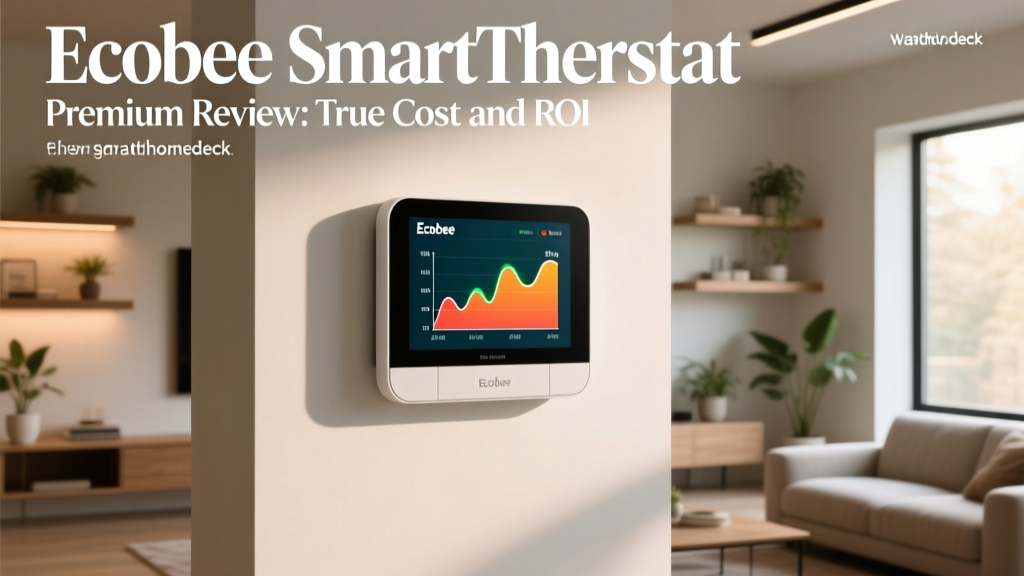
When evaluating smart home upgrades, the climate control hub is often the first device homeowners consider. It sits at the intersection of daily comfort and significant utility expenses. However, the smart thermostat market is saturated with options ranging from budget-friendly $50 models to premium $250+ flagship devices. For the discerning buyer, the initial MSRP is only a fraction of the story. To truly understand the value-for-money proposition of a high-end device, we must conduct a rigorous Total Cost of Ownership (TCO) and Return on Investment (ROI) assessment.
In this in-depth review, we are putting the Ecobee SmartThermostat Premium under the microscope. Priced at an MSRP of $249, it represents a significant upfront investment compared to basic programmable models. But does the hardware justify the premium? By analyzing installation realities, hidden subscription fees, ecosystem compatibility, and long-term energy savings, we will determine whether the Ecobee Premium is a frivolous luxury or a mathematically sound investment for your home.
Unpacking the Hardware: What Are You Actually Paying For?
At $249, the Ecobee SmartThermostat Premium is positioned as a flagship device. To assess its value, we must first look at what is included in the box. Unlike competitors that strip down the package to upsell accessories later, Ecobee includes a comprehensive suite of hardware right out of the gate.
The Main Unit and Built-In Alexa
The primary thermostat unit features a stunning edge-to-edge glass touchscreen, a premium metal dial, and dual-band Wi-Fi connectivity. More importantly, it features far-field microphones and a high-fidelity speaker, effectively functioning as a full Amazon Echo smart speaker. Considering a standalone Echo Dot costs around $50, the integration of Alexa directly into the thermostat provides immediate secondary value, allowing you to use voice commands, set intercoms, and stream Spotify Connect audio directly from your hallway wall.
The Included SmartSensor
Perhaps the most critical inclusion for value-seekers is the SmartSensor. Many competing thermostats require you to purchase remote room sensors separately for $40 to $50 per pack. The Ecobee Premium includes one SmartSensor in the box. This battery-operated puck uses a Passive Infrared (PIR) sensor to detect occupancy and a highly accurate thermistor to read ambient room temperature. By placing this sensor in a bedroom or a notoriously hot upstairs room, the Ecobee can prioritize occupied spaces, effectively solving multi-story temperature imbalances without the need for a multi-thousand-dollar zoned HVAC system.
The Hidden Value of Built-In Air Quality Monitoring
One of the most overlooked value propositions of the Ecobee Premium is its integrated air quality monitor. Modern homes are increasingly well-insulated, which traps indoor pollutants. The Premium model continuously monitors Volatile Organic Compounds (VOCs) and carbon dioxide (CO2) levels in parts per billion (ppb) and parts per million (ppm), respectively.
If you were to purchase a standalone, high-quality VOC and CO2 monitor—such as the Aranet4 or the Awair Element—you would easily spend between $150 and $250. By baking this sensor directly into the thermostat, Ecobee allows the device to take automated action. If VOC levels spike due to cooking fumes or off-gassing, the Ecobee can automatically trigger your HVAC system's fan to circulate and filter the air, or alert you to open a window. When you factor in the $200+ cost of standalone air quality monitors, the $249 price tag of the Ecobee Premium suddenly looks like a bargain.
Installation Costs: DIY vs. Professional
The next variable in our TCO equation is installation. Smart thermostats require a constant power source, typically provided by a 24V C-wire (Common wire). Older homes often lack this wire, leading many consumers to believe they must hire a professional HVAC technician.
The Power Extender Kit (PEK)
Ecobee addresses this brilliantly by including a Power Extender Kit (PEK) in the box. The PEK wires directly into your HVAC control board at the furnace or air handler, utilizing existing wires to deliver constant power to the thermostat. Because this kit is included, DIY installation is viable for approximately 95% of homes, saving you the $100 to $150 labor cost a professional electrician or HVAC tech would charge. For the average homeowner comfortable with turning off the breaker and following color-coded wiring diagrams, the installation cost is effectively $0.
Subscription Costs: Are There Hidden Fees?
A growing trend in the smart home industry is the hardware-as-a-loss-leader model, where companies lock essential features behind monthly paywalls. Does Ecobee engage in this practice?
Ecobee offers an optional subscription called the Smart Home & Comfort plan, priced at $5 per month or $50 per year. This plan includes advanced HVAC health monitoring (alerting you if your compressor is failing or if a sensor goes offline), monthly air filter deliveries, and advanced historical energy reports. However, it is entirely optional.
Unlike some security ecosystems that restrict local control or historical data without a subscription, the Ecobee Premium functions flawlessly as a standalone device. You retain full access to scheduling, geofencing, remote app control, SmartSensor logic, and basic energy reports without paying a dime extra. The absence of mandatory subscription fees is a massive win for long-term value-for-money.
Energy Savings, Utility Rebates, and ROI Timeline
The core financial justification for any smart thermostat is energy conservation. According to the U.S. Department of Energy, heating and cooling account for nearly half of the average home's energy expenses. The DOE notes that properly utilizing a programmable or smart thermostat can significantly reduce this burden by eliminating wasted HVAC cycles when the home is unoccupied.
But what does the empirical data say? A comprehensive field study conducted by the National Renewable Energy Laboratory (NREL) evaluated the real-world savings of smart thermostats across diverse climates. The study found that smart thermostats yielded average heating savings of roughly 10% to 12%, and cooling savings of up to 15%, depending on user behavior and regional climate extremes.
The ROI Calculation
Let us apply this data to a practical scenario. Assume a 2,000-square-foot home in a mixed-humid climate spends $1,800 annually on heating and cooling. A conservative 12% blended savings rate equates to $216 saved per year.
- Upfront Hardware Cost: $249
- Installation Cost: $0 (DIY via PEK)
- Mandatory Subscriptions: $0
- Year 1 Energy Savings: $216
Under these conditions, the Ecobee Premium pays for itself in approximately 14 months. Over a standard 5-year hardware lifecycle, the net energy savings would total $1,080, resulting in a net positive ROI of $831 after subtracting the initial hardware cost.
The Utility Rebate Factor
Pro Tip: Before purchasing, check the DSIRE (Database of State Incentives for Renewables & Efficiency) or your local utility provider's marketplace. Many utility companies offer instant rebates ranging from $50 to $125 for ENERGY STAR-certified smart thermostats, which can reduce your initial out-of-pocket cost to under $150.
Ecosystem Compatibility and Future-Proofing
Value is also defined by longevity and interoperability. A device that locks you into a single, proprietary ecosystem loses value if you decide to switch smartphone platforms or voice assistants later. The Ecobee Premium is a masterclass in agnostic compatibility.
It natively supports Apple HomeKit, Amazon Alexa, Google Assistant, and Samsung SmartThings. Furthermore, Ecobee has been a pioneer in adopting Matter and Thread networking protocols. This means the thermostat can communicate locally with other Thread-enabled devices, reducing Wi-Fi network congestion and ensuring that your automations continue to run even if your internet connection drops. This future-proofing ensures the device will remain relevant and functional for years to come, protecting your initial investment.
Deck Score Dimensions
At SmartHomeDeck, we evaluate products across five core dimensions to provide a holistic view of their market position. Here is how the Ecobee SmartThermostat Premium scores from a strict value-for-money perspective:
| Dimension | Score (out of 10) | Assessment Notes |
|---|---|---|
| Performance | 9.5 | Flawless temperature regulation, fast PIR occupancy detection, and highly accurate VOC/CO2 sensing. |
| Value | 9.0 | High MSRP is heavily offset by included SmartSensor, PEK kit, and built-in air quality/speaker hardware. |
| Compatibility | 10.0 | Native HomeKit, Alexa, Google, Matter, and Thread support. Unmatched ecosystem agnosticism. |
| Ease-of-Use | 8.5 | App interface is intuitive, though the PEK installation requires moderate DIY confidence. |
| Features | 9.5 | Air quality monitoring and HVAC health tracking elevate it beyond basic climate control. |
Pros and Cons
Pros
- Includes a SmartSensor and Power Extender Kit (PEK) in the box, eliminating hidden accessory costs.
- Integrated VOC and CO2 air quality monitoring replaces the need for $150+ standalone sensors.
- No mandatory subscription fees to access core smart features or historical data.
- Built-in Alexa with far-field microphones acts as a fully functional smart speaker.
- Exceptional cross-platform compatibility including Apple HomeKit, Matter, and Thread.
Cons
- $249 MSRP is a steep barrier to entry for budget-conscious buyers.
- The physical design, while premium, is slightly bulkier than some ultra-minimalist competitors.
- Lacks a built-in camera for presence detection (relies entirely on PIR sensors and geofencing).
Final Verdict: A Masterclass in Long-Term Value
When viewed in isolation, a $249 wall dial seems difficult to justify. However, the Ecobee SmartThermostat Premium is not just a thermostat; it is a consolidated smart home hub, an air quality monitor, a remote room sensor, and a high-fidelity smart speaker. When you itemize the cost of purchasing these functionalities separately, the Ecobee Premium emerges as a phenomenal value-for-money proposition.
From a Total Cost of Ownership perspective, the lack of mandatory subscriptions, the inclusion of DIY-enabling installation hardware, and the empirically proven energy savings result in an ROI timeline of just over one year for the average household. When you factor in potential utility rebates, the financial argument becomes undeniable. For homeowners who view their smart home not as a series of disposable gadgets, but as a long-term infrastructure investment, the Ecobee SmartThermostat Premium stands as the undisputed champion of the climate control category.