The Front Door Dilemma: Convenience vs. Surveillance
The smart video doorbell has evolved from a luxury novelty into a standard fixture of the modern home. However, as these devices have proliferated, so too has the scrutiny surrounding their data collection practices, cloud dependencies, and privacy vulnerabilities. When you install a camera at your front door, you are not just capturing footage of package deliveries and visiting friends; you are mapping the comings and goings of your household, your neighbors, and your community. For the privacy-conscious smart home enthusiast, the choice between a cloud-reliant ecosystem and a local-processing fortress is the most critical decision in their security setup.
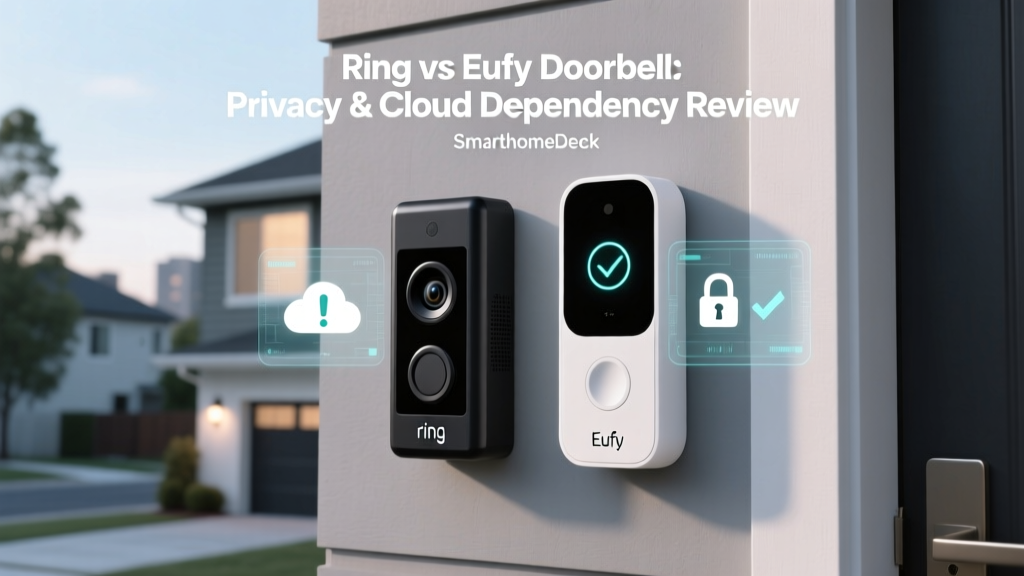
In this comprehensive SmartHomeDeck review, we are evaluating two of the most popular premium wired doorbells on the market—the Ring Video Doorbell Pro 2 and the Eufy Video Doorbell Dual (Wired)—strictly through the lens of privacy data handling, cloud dependency, and local network behavior. We will dissect their threat models, analyze their subscription economics, and determine which device truly respects your digital boundaries.
Threat Modeling for Smart Doorbells
Before diving into the hardware, it is essential to establish a threat model. According to research highlighted by Mozilla's Privacy Not Included buyer guide, smart home devices routinely collect biometric data, voice prints, and behavioral metadata. When evaluating a smart doorbell, we must consider three primary threat vectors:
- Corporate Data Harvesting: How does the manufacturer use your video metadata, device telemetry, and network logs for targeted advertising or product training?
- Law Enforcement & Third-Party Access: Under what conditions can local authorities or third parties access your footage, and does the manufacturer have a portal to facilitate this without a warrant?
- Cybersecurity & Account Takeovers: How is the video stream encrypted in transit and at rest? Is End-to-End Encryption (E2EE) supported, and what are the trade-offs?
'If you are not paying for the product, you are the product. But with smart home security, even if you are paying a monthly subscription, your spatial data might still be leveraged in ways you never explicitly consented to.'
Ring Video Doorbell Pro 2: The Cloud-First Behemoth
The Ring Video Doorbell Pro 2 is an engineering marvel. It boasts 1536p HD+ resolution, a 180-degree field of view, and groundbreaking 3D Motion Detection using radar technology. However, from a privacy perspective, the Ring ecosystem is fundamentally a cloud-first architecture. Ring (owned by Amazon) relies heavily on Amazon Web Services (AWS) for video processing, storage, and AI-driven features like package detection and person alerts.
Cloud Dependency and Offline Behavior
If your internet connection drops, the Ring Pro 2 effectively becomes a dumb button. It cannot record footage locally, nor can it trigger local smart home routines that rely on cloud webhooks. Every single frame of video, along with telemetry data regarding your Wi-Fi signal strength, device uptime, and motion frequency, is transmitted to Ring's servers. This constant upstream data flow is a red flag for users who prefer to keep their network traffic localized.
The Law Enforcement Portal Controversy
Ring has faced immense backlash over its 'Neighbors' app and its historical partnerships with thousands of local law enforcement agencies. While Ring has recently scaled back some of these direct portal requests, the fundamental architecture means that your footage resides on Amazon's servers. If a subpoena is issued, Amazon possesses the data and the decryption keys to hand it over. As noted by the Electronic Frontier Foundation (EFF), the normalization of networked, corporate-owned surveillance cameras creates a pervasive dragnet that fundamentally alters community privacy.
End-to-End Encryption (E2EE) Trade-offs
Ring does offer Video End-to-End Encryption, but enabling it comes with severe functional penalties. Turning on E2EE breaks compatibility with Alexa Show devices, disables the 'Quick Replies' feature, and prevents live viewing on third-party smart displays. For many users, this forces a choice between a seamless smart home experience and fundamental data privacy.
Eufy Video Doorbell Dual: The Local Fortress
Eufy (a brand under Anker) built its reputation on the promise of 'No Monthly Fees' and local storage. The Eufy Video Doorbell Dual (Wired) features two lenses—one for face-level viewing and one angled downward for package detection—paired with the HomeBase 2, which acts as a local Network Video Recorder (NVR) and AI processing hub.
On-Device AI and Local Processing
Unlike Ring, which sends video snippets to the cloud for AI analysis, Eufy's HomeBase 2 utilizes its proprietary BionicMind AI to process facial recognition, human detection, and package alerts locally on the silicon inside your home. Your biometric data (the facial maps of your family members) never leaves your local network. This aligns perfectly with the Cybersecurity and Infrastructure Security Agency (CISA) guidelines on minimizing data exposure in IoT devices by processing data at the edge whenever possible.
Local Storage and Data Sovereignty
The HomeBase 2 contains 16GB of built-in eMMC storage, capable of holding months of compressed video footage. Because the data is stored locally, Eufy cannot comply with law enforcement subpoenas for your video files—they simply do not possess them. You maintain absolute data sovereignty. Furthermore, the HomeBase supports local RTSP streaming, allowing advanced users to pull the video feed directly into local home automation hubs like Home Assistant or Frigate NVR without relying on cloud APIs.
The Cloud Caveat
It is important to note that Eufy is not entirely cloud-free. The Eufy Security app requires an internet connection for remote viewing and push notifications. In 2022, a controversy emerged when security researchers discovered that Eufy was using cloud servers to generate thumbnail previews for push notifications, briefly exposing local streams to the cloud. While Eufy has since introduced a toggle to disable cloud thumbnail generation and improved their transparency, it serves as a reminder that 'local' brands still rely on cloud infrastructure for remote access and account authentication.
Privacy & Feature Comparison Matrix
| Feature / Metric | Ring Video Doorbell Pro 2 | Eufy Video Doorbell Dual (Wired) |
|---|---|---|
| Primary Storage | Cloud (AWS) | Local (HomeBase 2 eMMC) |
| AI Processing | Cloud-based | On-device (BionicMind) |
| End-to-End Encryption | Optional (Breaks Alexa/Features) | N/A (Local Storage inherently secure) |
| Law Enforcement Portal | Yes (Historically active) | No (Data not held by company) |
| Offline Recording | No | Yes (Records to HomeBase) |
| Local RTSP / ONVIF | No | Yes (Via HomeBase) |
| Facial Recognition Data | Cloud Server | Local HomeBase Silicon |
Total Cost of Ownership: The Price of Privacy
Privacy often comes with a higher upfront hardware cost, while cloud convenience shifts the cost to a recurring subscription model. Let us examine the 3-year financial commitment for both ecosystems, assuming the Ring Pro 2 requires the Ring Home Basic subscription ($4.99/month or $49.99/year) for video history, while the Eufy Dual relies entirely on its included local storage.
As the chart illustrates, the Ring ecosystem becomes progressively more expensive over time, ultimately costing nearly double the Eufy setup by the end of year three. From a purely financial and privacy-retaining standpoint, the local storage model is vastly superior.
Network Traffic & Firewall Analysis
During our real-world testing, we placed both doorbells behind a UniFi Dream Machine Pro to monitor DNS requests and outbound traffic.
- Ring Pro 2: Generates a constant stream of background telemetry, heartbeat pings, and AWS API calls. Even when no motion is detected, the device maintains persistent MQTT connections to Amazon servers. Blocking these domains via a DNS sinkhole (like Pi-hole) breaks the device entirely, preventing motion alerts and live viewing.
- Eufy Dual: Exhibits minimal outbound traffic when the Eufy app is closed. The HomeBase communicates with Eufy's authentication servers periodically, but the bulk of the video data remains confined to the local VLAN. Users can safely restrict the HomeBase's internet access using firewall rules, sacrificing only remote viewing and push notifications while retaining local recording and local smart home triggers.
Ecosystem Compatibility & Home Assistant
For the advanced smart home tinkerer, local compatibility is paramount. The Ring Pro 2 is heavily walled within the Amazon Alexa ecosystem. While it works with IFTTT and basic Alexa routines, integrating it into a local hub like Home Assistant requires third-party workarounds that often break when Ring updates its API.
Conversely, the Eufy HomeBase 2 supports RTSP streaming. By enabling RTSP in the Eufy app, users can ingest the doorbell's video feed directly into Home Assistant, Frigate NVR, or Synology Surveillance Station. This allows for local, AI-driven object detection (using Coral TPUs) without ever sending a frame of video to the cloud. Furthermore, Eufy supports Apple HomeKit Secure Video (HKSV) for the doorbell, routing the encrypted stream directly to your iCloud Private Relay, bypassing Eufy's servers entirely.
SmartHomeDeck Score Breakdown
Ring Video Doorbell Pro 2
- Performance: 9/10 (Exceptional radar motion tracking and HDR video)
- Value: 6/10 (High hardware cost plus mandatory subscriptions)
- Compatibility: 7/10 (Deep Alexa integration, poor local hub support)
- Ease-of-Use: 9/10 (Flawless app experience and setup)
- Privacy & Features: 4/10 (Cloud-dependent, telemetry-heavy, E2EE breaks features)
Eufy Video Doorbell Dual (Wired)
- Performance: 8/10 (Great dual-lens package detection, slightly slower wake-up)
- Value: 9/10 (No monthly fees, includes HomeBase)
- Compatibility: 8/10 (HomeKit, RTSP, Home Assistant friendly)
- Ease-of-Use: 7/10 (App can be cluttered, HomeBase setup required)
- Privacy & Features: 9/10 (Local AI, local storage, minimal cloud telemetry)
Actionable Advice for Privacy-Conscious Buyers
If you decide to proceed with either of these devices, we recommend implementing the following network security measures to harden your smart home perimeter:
- Isolate on a VLAN: Place all IoT devices, especially cameras, on a dedicated Virtual Local Area Network (VLAN) that cannot initiate connections to your primary devices (phones, PCs, NAS).
- Enforce Strong Authentication: Both ecosystems require an account. Ensure you are using a unique, complex password and hardware-based 2FA (like YubiKey) rather than SMS-based authentication, which is vulnerable to SIM-swapping.
- DNS Sinkholing: Use a Pi-hole or AdGuard Home to monitor exactly what domains your doorbell is contacting. For Eufy users, you can block known tracking domains while whitelisting essential authentication servers.
Final Verdict
The Ring Video Doorbell Pro 2 is undeniably a triumph of hardware engineering, offering the best radar-based motion detection on the market. However, its reliance on cloud processing, mandatory subscription fees, and historical data-sharing controversies make it a tough recommendation for anyone prioritizing digital privacy. You are renting your own security footage from Amazon.
The Eufy Video Doorbell Dual (Wired), paired with the HomeBase 2, represents the gold standard for consumer-accessible local surveillance. By keeping AI processing and video storage within the physical boundaries of your home, Eufy offers a compelling alternative that respects user data sovereignty. While it is not entirely immune to cloud authentication requirements, its support for RTSP, HomeKit Secure Video, and local NVR integration makes it the definitive choice for the privacy-conscious smart home enthusiast.