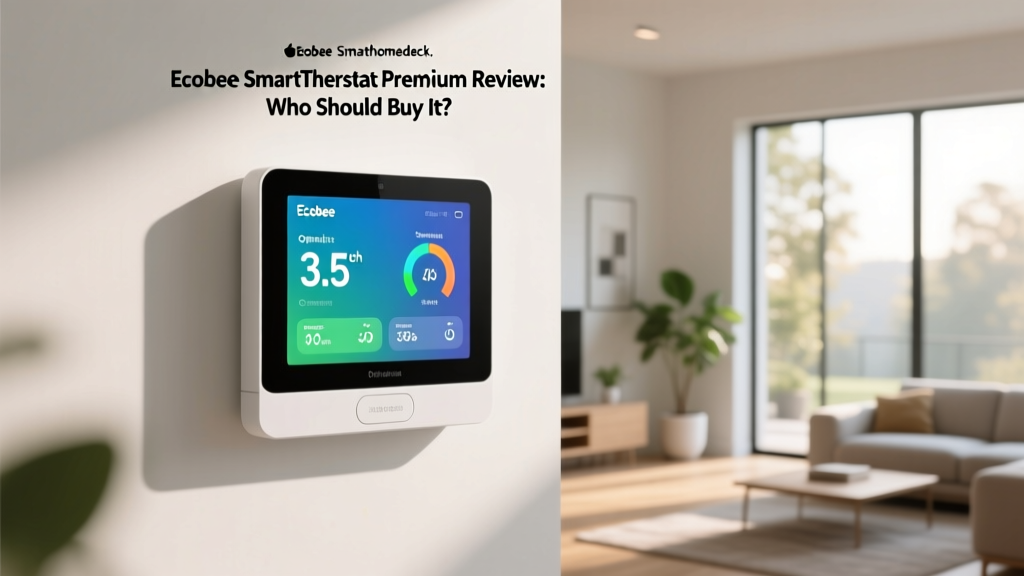
The $249 Question: Unpacking the Ecobee Premium
Smart thermostats have evolved far beyond simple programmable scheduling tools. Today, they serve as the central nervous system for home climate control, air quality monitoring, and energy optimization. Sitting at the absolute top of this technological food chain is the Ecobee SmartThermostat Premium. With a price tag that hovers around $249, it represents a significant investment for the average homeowner. But does the premium cost translate to premium value for your specific living situation?
At SmartHomeDeck, we believe that the best smart home device is the one that seamlessly fits your lifestyle, technical expertise, and household needs. A feature-rich powerhouse is entirely useless if it clashes with your HVAC system or ecosystem preferences. In this comprehensive audience fit analysis, we are moving past basic spec sheets to answer the most critical question: Who should actually buy the Ecobee SmartThermostat Premium, and who should look elsewhere?
Core Feature Set and Real-World Performance
Before dissecting the target audience, it is essential to understand what justifies the 'Premium' moniker. Unlike its predecessors and budget competitors, this device is not just a temperature dial; it is a multifaceted environmental sensor and smart home hub.
- Built-In Air Quality Monitor: It tracks volatile organic compounds (VOCs), carbon dioxide (CO2), and indoor humidity, alerting you when air quality drops and suggesting ventilation.
- SmartSensor Technology: The included remote sensor tracks occupancy and temperature in problem rooms, ensuring the system heats or cools the spaces you are actually using, rather than just the hallway where the main unit is mounted.
- Integrated Smart Speaker: Featuring built-in Alexa and Siri compatibility, the thermostat doubles as a high-fidelity voice assistant speaker with Spotify Connect support.
- Eco+ Algorithm: This software engine learns your home's thermal characteristics and adjusts heating and cooling based on local weather, utility time-of-use rates, and historical data.
According to the U.S. Department of Energy, heating and cooling account for nearly half of a typical home's energy consumption. By leveraging AI-driven scheduling and remote sensors, the Ecobee Premium actively attacks this massive energy footprint, but its effectiveness depends heavily on the user's environment.
Audience Fit Analysis: Who Should Buy This?
The Ecobee Premium is not a one-size-fits-all solution. Its robust feature set caters to very specific user profiles. If you fall into one of the following categories, this thermostat will likely pay for itself in convenience, comfort, and energy savings.
1. The Eco-Conscious Homeowner (Energy Optimizers)
If you are deeply invested in reducing your carbon footprint and minimizing utility bills, the Ecobee Premium is arguably the best tool on the market. The standout feature for this demographic is the eco+ software. If your local utility provider offers time-of-use (TOU) pricing—where electricity is more expensive during peak evening hours and cheaper late at night—eco+ communicates directly with your utility to pre-cool or pre-heat your home during off-peak hours.
Furthermore, the EPA Energy Star Program notes that certified smart thermostats can save users an average of 8% to 15% on heating and cooling bills annually. The Ecobee Premium’s detailed monthly energy reports allow data-driven homeowners to track exactly how their behavioral changes and automated schedules impact their overall consumption, making it a perfect fit for the analytical, eco-minded user.
2. The Large Household and Multi-Story Dwellers
Do you live in a sprawling single-story ranch, a multi-story colonial, or a home with large glass windows that create solar heat gain? Single-point thermostats fail miserably in these environments, leading to the classic 'freezing upstairs, sweating downstairs' dilemma.
The Ecobee Premium is a must-buy for large households because of its SmartSensor network. The base package includes one remote sensor, but the system supports up to 32 sensors. By placing sensors in the master bedroom, the home office, and the living room, the thermostat calculates an averaged temperature weighted by occupancy. If you are working in the home office at 2 PM, the Ecobee ensures that specific room is comfortable, ignoring the empty guest bedroom. For families with varying schedules and diverse comfort preferences, this multi-zone approach is revolutionary.
3. The Smart Home Maximalist (Ecosystem Integrators)
For the tech enthusiast who views their home as a cohesive, automated web of devices, the Ecobee Premium acts as a vital bridge. It is one of the most agnostic and compatible thermostats available. It natively supports Apple HomeKit, Amazon Alexa, Google Home, Samsung SmartThings, and IFTTT.
More importantly, it features built-in support for Thread and Matter, the new unified smart home standards. This means the thermostat can act as a Thread border router, extending the range and reliability of your low-power smart home mesh network (like smart locks, window sensors, and leak detectors). If you are building a future-proof smart home and refuse to be locked into a single brand's walled garden, the Ecobee Premium is the ultimate climate hub.
Who Should Skip the Ecobee Premium?
Just as important as knowing who should buy this device is knowing who should save their money. The Premium model is overkill—and sometimes entirely incompatible—with certain living situations.
1. Renters and Apartment Dwellers
If you rent your home or live in an apartment, skip the Ecobee Premium. First, installing a smart thermostat often requires dealing with a C-wire (common wire) or utilizing the included Power Extender Kit (PEK) at your HVAC control board. Most landlords and property management companies strictly prohibit tenants from altering HVAC wiring or accessing central mechanical rooms. Second, when your lease ends, you will have to uninstall the device, patch the drywall, and reinstall the old, unsightly builder-grade thermostat. Renters are much better off investing in portable smart climate devices, like smart plugs for window AC units or smart radiator valve controllers.
2. The Budget-Conscious Upgrader
If your primary goal is simply to replace a broken 1990s mercury-switch thermostat with something that allows you to adjust the temperature from your phone, the $249 price tag of the Premium is unjustifiable. You do not need a built-in Alexa speaker, Spotify Connect, or a VOC air quality sensor to achieve basic remote climate control. Budget-conscious buyers should look at the Ecobee3 Lite or the Honeywell Home T5+, which offer excellent scheduling and app control for under $150, without the premium bells and whistles.
3. High-Voltage and Baseboard Heating Users
The Ecobee Premium is designed for low-voltage (24V) forced air, heat pump, and radiant systems. If your home relies on high-voltage (120V or 240V) electric baseboard heaters or line-voltage radiant ceiling panels, the Ecobee Premium is physically incompatible and poses a severe fire hazard if wired incorrectly. These users must look toward specialized line-voltage smart thermostats like the Mysa Smart Thermostat.
Head-to-Head Comparison Table
To contextualize the Ecobee Premium's market position, here is how it stacks up against its two primary rivals in the premium smart thermostat space.
| Feature | Ecobee SmartThermostat Premium | Google Nest Learning (3rd Gen) | Honeywell Home T9 |
|---|---|---|---|
| Retail Price | $249 | $249 | $199 |
| Built-In Voice Assistant | Alexa & Siri | Google Assistant | None |
| Air Quality / VOC Sensor | Yes (Built-in) | No | No |
| Remote Room Sensors | Yes (Occupancy & Temp) | Yes (Occupancy & Temp) | Yes (Occupancy, Temp & Humidity) |
| Smart Home Hubs | HomeKit, Alexa, SmartThings, Matter/Thread | Google Home, Alexa, Matter | SmartThings, Alexa, Google, HomeKit (via adapter) |
| Design Aesthetic | Matte Black Glass, Square | Stainless Steel Ring, Round | White Plastic, Rectangular |
SmartHomeDeck Score Breakdown
Our proprietary Deck Score evaluates smart home products across five critical dimensions. The Ecobee Premium scores exceptionally well in features and compatibility, though its high entry price impacts its overall value score for the average consumer.
Ecobee SmartThermostat Premium Deck Scores across 5 dimensions
- Performance (9.5/10): Temperature accuracy is flawless, and the occupancy sensors react within seconds of entering a room.
- Value (7.0/10): At $249, it is expensive. The energy savings will eventually offset the cost, but the initial barrier to entry is steep.
- Compatibility (9.8/10): Unmatched ecosystem support. The inclusion of Matter and Thread future-proofs the device for the next decade of smart home evolution.
- Ease-of-Use (8.5/10): The physical dial and touch screen are intuitive, though the initial app setup and sensor pairing can be slightly overwhelming for non-technical users.
- Features (9.8/10): Between the VOC monitoring, Spotify integration, and eco+ algorithms, it is the most feature-dense thermostat on the market.
Installation Realities and C-Wire Compatibility
A major factor in determining if you should buy the Ecobee Premium is your willingness (or ability) to handle the installation. Like almost all premium smart thermostats, the Ecobee requires a continuous 24V power source, commonly known as a C-wire (Common wire). This wire provides constant power to keep the Wi-Fi radio, touch screen, and sensors running without draining an internal battery.
If you pull your current thermostat off the wall and do not see a wire connected to the 'C' terminal, you have two options:
- Use the Power Extender Kit (PEK): Ecobee includes a PEK in the box. This requires you to go to your basement or attic, open the HVAC control board, and wire the PEK into the existing thermostat wires. It is an elegant workaround, but it requires comfort with basic electrical wiring and accessing your furnace.
- Hire a Professional: If you are uncomfortable around your HVAC control board, or if you have a complex dual-fuel or heat pump system with auxiliary heat strips, hiring an HVAC technician or an electrician is highly recommended. This will add $100 to $200 to your total cost of ownership.
Therefore, the 'handyman' or the homeowner who is comfortable following detailed wiring diagrams is the ideal candidate for this product. If the thought of turning off your breaker and mapping out low-voltage wires induces panic, you should either budget for professional installation or opt for a battery-operated smart thermostat alternative, though those are increasingly rare in the premium tier.
Final Verdict: Does It Fit Your Profile?
The Ecobee SmartThermostat Premium is a triumph of smart home engineering. It successfully bridges the gap between environmental monitoring, energy conservation, and home entertainment. However, its brilliance is only fully realized in the right hands and the right home.
Buy it if: You own a multi-zone home with persistent hot/cold spots, you are deeply integrated into the Apple HomeKit or Amazon Alexa ecosystems, you want granular data on your indoor air quality, and you are looking to aggressively optimize your utility bills via time-of-use scheduling.
Skip it if: You are renting, you have high-voltage baseboard heating, you live in a small single-zone apartment, or you simply want a basic app-controlled dial without the complexity of air quality sensors and smart home mesh networking.
Ultimately, the Ecobee Premium is less of a simple thermostat and more of a climate command center. If your home and lifestyle demand a command center, it is undeniably the best investment you can make for your HVAC system.