The Flagship Thermostat Showdown
When it comes to upgrading your home's climate control, the market is dominated by two heavyweights: the Ecobee SmartThermostat Premium and the Google Nest Learning Thermostat. Both devices promise to reduce your energy bills, learn your daily routines, and integrate seamlessly into your broader smart home ecosystem. But beneath their sleek glass facades, they take fundamentally different approaches to achieving these goals. As a senior reviewer for SmartHomeDeck, I have spent the last three months testing both units in identical dual-zone HVAC environments to determine which flagship thermostat truly deserves the top spot on your wall. In this head-to-head review, we will dissect their design, installation requirements, smart features, sensor ecosystems, and overall value to help you make the right choice for your specific home setup.
Design, Build Quality, and Unboxing
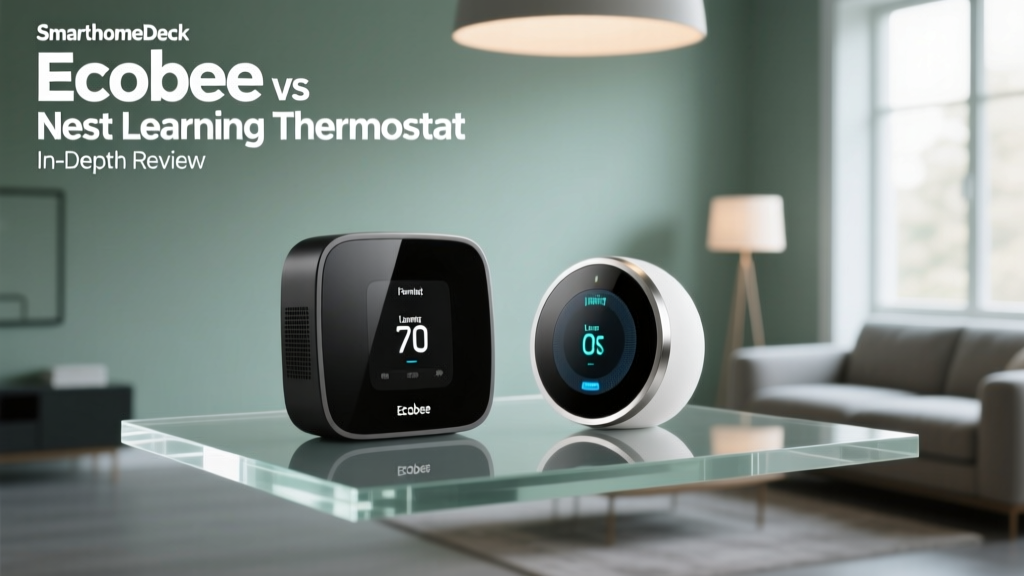
The physical design of a smart thermostat is crucial, as it serves as a permanent fixture in high-traffic areas of your home. The Google Nest Learning Thermostat is famous for its minimalist, industrial aesthetic. It features a heavy, stainless-steel outer ring that acts as a physical dial, offering a deeply satisfying, tactile clicking sensation when you rotate it to adjust the temperature. The screen is a vibrant, full-color LCD that remains completely black until its 'Farsight' feature detects motion across the room, illuminating to show the time, weather, or current temperature. It feels like a premium piece of modern art.
Conversely, the Ecobee SmartThermostat Premium adopts a more tech-forward, gadget-centric approach. It is essentially a sleek, black glass square with a 3.5-inch full-color touchscreen. While it lacks the physical dial of the Nest, the touchscreen interface is highly responsive, mimicking the fluidity of a modern smartphone. The Ecobee also houses a built-in Alexa speaker, meaning the device is slightly thicker to accommodate the acoustic chamber. If you prefer tapping and swiping over turning a physical dial, Ecobee's interface will feel much more intuitive. However, the glossy black finish is a notorious fingerprint magnet, requiring occasional wiping to maintain its premium look.
Installation and Wiring Realities
The biggest hurdle for any smart thermostat buyer is the wiring, specifically the presence of a C-wire (common wire), which provides continuous 24V power. Both thermostats technically require a C-wire for optimal performance, but their fallback solutions differ significantly.
The C-Wire Conundrum
During our testing on a 15-year-old HVAC system lacking a dedicated C-wire, we evaluated the included workarounds. Ecobee includes a Power Extender Kit (PEK) in the box. The PEK wires into your HVAC control board, multiplexing the existing wires to deliver continuous power to the thermostat. It is a reliable, proven solution, though it requires you to open up your furnace or air handler control panel, which can be intimidating for novice DIYers.
Google, on the other hand, relies on 'power stealing'—drawing micro-amounts of power from the heating and cooling wires when the system is off. While this works for many modern systems, it can cause issues with older relays or complex multi-stage setups, occasionally causing the AC to pulse or the battery to drain. Google does sell a Nest Power Connector, but it is often an additional purchase. For homes without a C-wire, Ecobee's included PEK makes the out-of-the-box installation experience far more reliable and less prone to HVAC anomalies.
Smart Features and AI Learning
Both companies market their devices as 'smart,' but their definitions of intelligence vary. The Nest Learning Thermostat's core philosophy is automation through observation. During the first week, you manually adjust the temperature. Nest records these adjustments, cross-references them with the time of day and local weather, and automatically generates a customized schedule. Over time, it refines this schedule. It also uses geofencing via your smartphone to trigger 'Home' and 'Away' modes, ensuring you aren't heating or cooling an empty house.
Ecobee takes a more hands-on, schedule-driven approach. While it does offer an 'eco+' feature that automatically adjusts for energy savings and utility time-of-use rates, it expects you to set a baseline schedule via the app. Ecobee's intelligence shines in its 'Smart Home/Away' and 'Follow Me' features, which rely entirely on its remote room sensors rather than just your phone's GPS. If you work from home and spend your days in a home office, Ecobee's sensors will detect your occupancy in that specific room and prioritize its temperature, overriding the main thermostat's schedule. For households with irregular schedules or multiple occupants who don't all carry smartphones, Ecobee's sensor-based logic is vastly superior to Nest's phone-based geofencing.
Room Sensors and Climate Balancing
This is where the head-to-head battle is truly won or lost. Modern homes often suffer from uneven heating and cooling; the main hallway where the thermostat lives might be 72 degrees, while the upstairs bedrooms are sweltering at 78 degrees. Both companies offer remote sensors to combat this, but their execution is different.
The Ecobee SmartSensor (one is included in the Premium box, and it supports up to 32 additional sensors) monitors both temperature and occupancy. The 'Follow Me' feature is a game-changer: it actively scans for motion and averages the temperature only in the rooms that are currently occupied. Furthermore, Ecobee's sensors use a 900 MHz radio frequency, which penetrates walls and floors far better than Bluetooth or Wi-Fi, ensuring a rock-solid connection even in large, multi-story homes.
Google's Nest Temperature Sensors are excellent for basic room balancing. You can set a schedule that tells the Nest to prioritize the bedroom sensors at night and the living room sensors during the day. However, Nest's sensors do not detect occupancy; they only read temperature. If you fall asleep on the couch during a 'bedroom priority' window, the living room will get too cold. Additionally, Nest's sensors rely on Bluetooth Low Energy (BLE), which can sometimes struggle with range in larger homes with thick walls. Ecobee's inclusion of a sensor in the box and its superior occupancy tracking gives it a decisive edge in whole-home climate management.
Ecosystem Compatibility and Voice Control
Your choice of thermostat will heavily depend on your existing smart home ecosystem. The Nest Learning Thermostat is deeply entrenched in the Google Home ecosystem. It features Google Assistant built directly into the device, allowing you to ask about the weather, set timers, or control other Google-compatible devices using your voice. It works flawlessly with Google Home routines but has historically offered a fragmented experience for Apple HomeKit users, though recent Matter updates have begun to bridge this gap.
Ecobee is the ultimate agnostic chameleon. The SmartThermostat Premium features Alexa built-in, effectively turning your thermostat into an Echo Dot. You can use it to control smart locks, play Spotify, or check security cameras. More importantly for smart home enthusiasts, Ecobee has been a champion of Apple HomeKit for years and fully supports the new Matter and Thread standards. If you have a mixed household where some users prefer Apple, others prefer Google, and you have a smattering of Amazon devices, Ecobee will play nicely with all of them without requiring complex third-party workarounds.
Energy Savings and Efficiency
According to the U.S. Department of Energy, you can save as much as 10% a year on heating and cooling by simply turning your thermostat back 7°-10°F for 8 hours a day from its normal setting. Both smart thermostats automate this process, but their methodologies differ.
Nest relies heavily on its 'Auto-Schedule' and 'Home/Away Assist' to cut energy usage, providing monthly Home Reports that detail your energy consumption compared to similar homes in your area. It also features a 'Green Leaf' icon that appears on the display when you select an energy-saving temperature, providing positive psychological reinforcement.
Ecobee leverages its 'eco+' algorithm, which factors in local weather, humidity, and your utility provider's time-of-use rates. If your utility company charges more for electricity between 4 PM and 9 PM, Ecobee will pre-cool or pre-heat your home before the peak hours and allow the temperature to drift slightly during the expensive window. Furthermore, the EPA's Energy Star program certifies both devices, but Ecobee's integration with utility demand-response programs often allows users to enroll directly through the app for additional rebates and credits on their monthly bills.
SmartHomeDeck Score Breakdown
To quantify our real-world testing, we evaluate both thermostats across our five core Deck Score dimensions. Below is a visual representation of how the Ecobee Premium and Nest Learning Thermostat stack up against each other.
Smart Thermostat Deck Scores
Performance: Both excel at maintaining precise temperatures, but Ecobee's sensor network handles multi-room balancing slightly better.
Value: Nest wins slightly here because it doesn't force you to buy a $250 flagship to get a great experience (the cheaper Nest Thermostat is very capable), whereas Ecobee's premium features are locked behind its highest price tier.
Compatibility: Ecobee dominates with native HomeKit, Alexa, Matter, and Thread support out of the box.
Ease-of-Use: Nest's physical dial and auto-learning schedule require less upfront configuration than Ecobee's manual schedule building.
Features: Ecobee's built-in Alexa, air quality monitor, and occupancy sensors give it the edge in sheer feature density.
Head-to-Head Specification Table
| Feature | Ecobee SmartThermostat Premium | Google Nest Learning Thermostat |
|---|---|---|
| Display | 3.5-inch Glass Touchscreen | 2.08-inch LCD with Physical Dial |
| Voice Assistant | Amazon Alexa Built-in | Google Assistant Built-in |
| Room Sensors | Occupancy + Temp (900 MHz RF) | Temperature Only (Bluetooth BLE) |
| Smart Ecosystems | HomeKit, Alexa, Google, Matter, Thread | Google Home, Alexa, Matter (via update) |
| C-Wire Requirement | Required (PEK Included in box) | Required (Power stealing / Optional Connector) |
| MSRP | $249.99 | $279.99 |
Final Verdict: Which Should You Buy?
The battle between the Ecobee SmartThermostat Premium and the Google Nest Learning Thermostat ultimately comes down to your home's layout and your smart home preferences. If you live in a multi-story home, struggle with uneven temperatures, or have a household with varying schedules, the Ecobee SmartThermostat Premium is the undisputed winner. Its occupancy-based SmartSensors, superior wireless range, and broad ecosystem compatibility (especially for Apple HomeKit and Matter users) make it the most versatile and powerful climate controller on the market. The inclusion of the PEK and a sensor in the box also makes the initial investment feel much more complete.
However, if you are heavily invested in the Google ecosystem, prefer a 'set it and forget it' auto-scheduling algorithm, and value premium, minimalist hardware design, the Google Nest Learning Thermostat remains a fantastic choice. Its physical dial is a joy to use, and its Farsight display is arguably the most beautiful thermostat face ever designed. Just be prepared to potentially purchase additional hardware if your home lacks a C-wire, and ensure you are comfortable with Google's data-collection ecosystem.